 PEPI NIKOLOPOULOU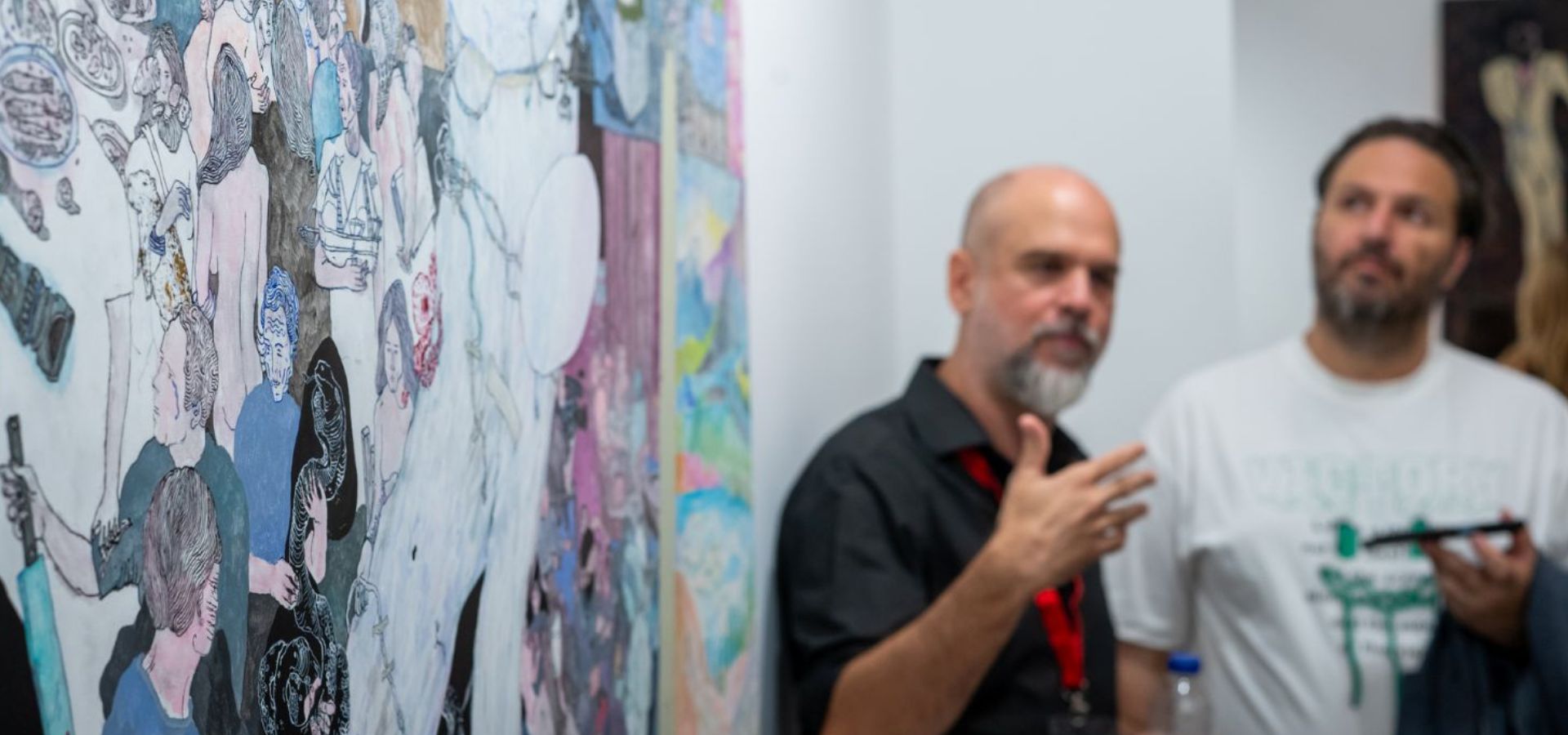
The works Anatropi I and II: Precious Moments of Inspiration and Peace are the two new paintings at the very heart of the 66th Thessaloniki International Film Festival, unveiled this year a little earlier here in Athens
Painting and cinema. Two ways of creating stories out of images, of generating atmospheres, of unraveling the thread of memory, of giving current to the imagination.
At booth R1 of Zouboulaki Gallery, amidst the vibrant atmosphere of Art Athina, we came face to face with two works by Stefanos Rokos. Works colorful, filled with fragments of images, like the credits rolling at the end of a film, a thank-you speech for all the unseen heroes behind the cameras. Just as the closing titles list hundreds of names, the Anatropees resemble a tribute to cinema’s invisible contributors: all those who work behind the scenes, holding the light, the sound, the atmosphere. Rokos incorporates them into his own visual language, composing an ode to the collectivity required by every cinematic work.
The works Anatropi I and II: Precious Moments of Inspiration and Peace are the two new paintings at the very heart of the 66th Thessaloniki International Film Festival, unveiled this year a little earlier here in Athens. Two canvases of particularly dense writing, where countless visual stimuli, microcosms, and emotions coexist-just as in a grand cinematic adventure.
Rokos’s works enclose hidden worlds that require time to be discovered. Like watching a film frame by frame: meals and gatherings around a table, cats wandering, faces burning in ecstasy, knives cutting or slaughtering. Hell and paradise, roles and stories unfolding in parallel. And then, a door bisecting the image in two: on the one side, truth and reality; on the other, the staged set, as behind the cameras or in front of the boom mics in a film studio. It is there, where the false and the real intertwine, that the flame of inspiration is born in ambiguity.
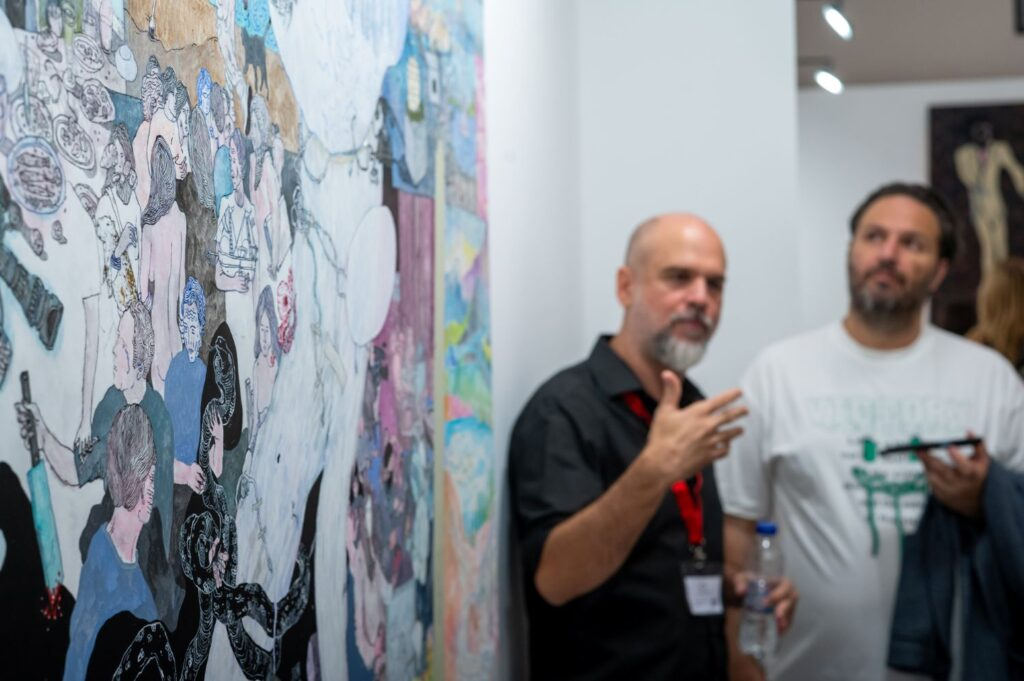
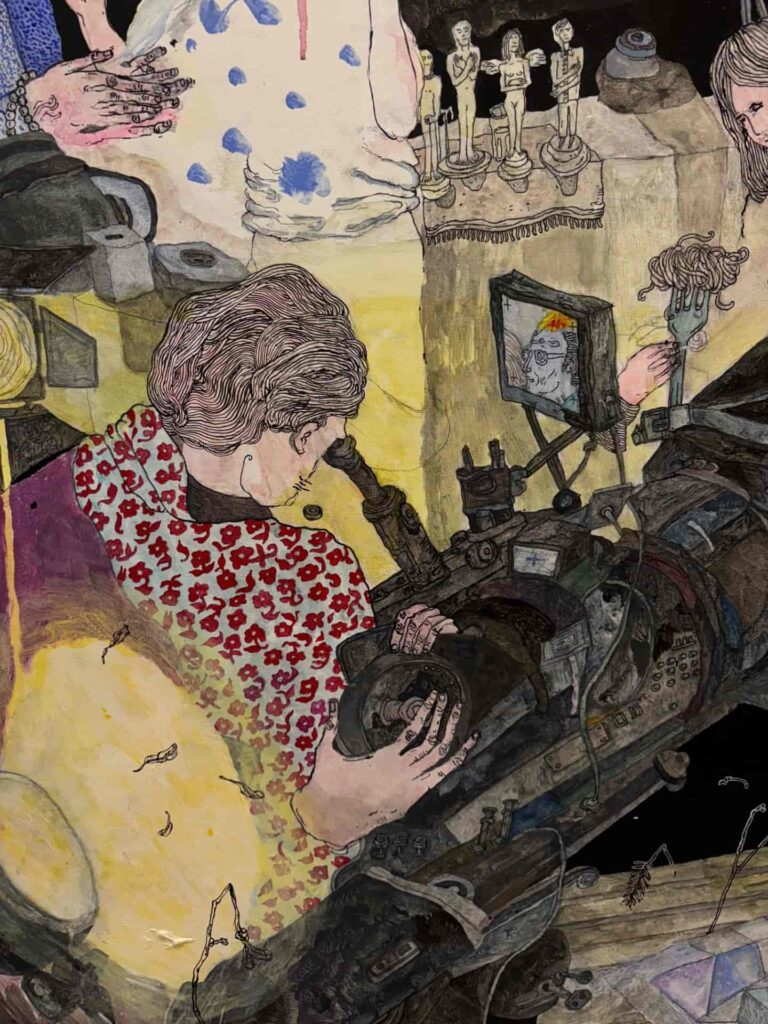
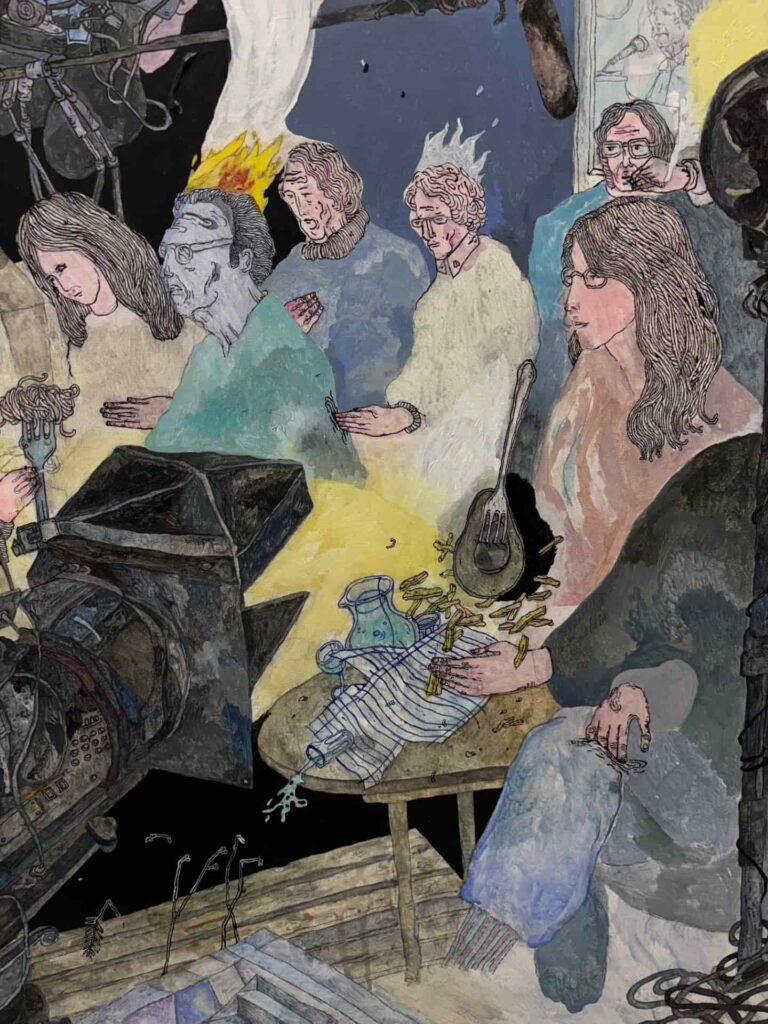
In the Anatropees, figures emerge as if they had escaped from the dark movie theaters. Heroes of David Lynch-like the mysterious man from Lost Highway played by Robert Blake-stand beside small sketches of Ozzy Osbourne and Brian Wilson of the Beach Boys, who recently passed away, leaving behind songs that accompanied the magic of the screen. Rokos does not simply build a visual universe; he creates a cinematic palimpsest where music, pop culture, and cinema converse with equal intensity on canvas.
Somewhere in between, one can trace Stefanos’s inspiration-that sweet, warm flame. It is the subtle force that connects seemingly disparate elements: the cats and the shared meals, the faces consumed by ecstasy and the scenes of violence, paradise and hell. A spark that unites the real with the staged, like behind the cameras on a film set.
It is the confession of an artist who, for more than fifteen years, has faithfully attended the festival, always dreaming of one day giving form to a piece of it. And now, like a hidden script that had been quietly ripening, it finds its way onto canvas.
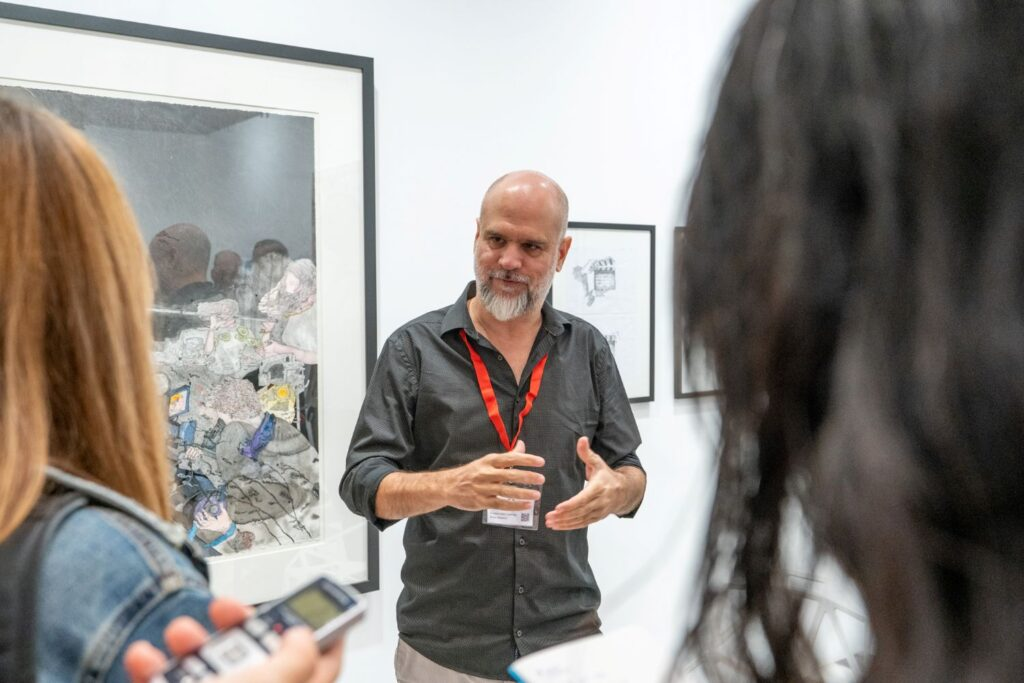
As he admits: “I imagine a story, turn it into a script, create characters, place them in the light, in the shadow, or somewhere in between… In my works nothing moves, yet there is movement.” This love for cinema has filled him with ready-made scenes, like miniature screenplays waiting to take shape. And when a few months ago the Thessaloniki International Film Festival and its artistic director, Orestis Andreadakis, gave him the green light, the moment had come. Stefanos Rokos was already prepared.
It is a tradition of the Thessaloniki International Film Festival to periodically commission its visual identity from distinguished artists, cultivating a continuous dialogue between image and cinematic storytelling. Each time, the baton is passed to artists who leave their own mark: from Dimitris Anastasiou and Dimitris Papaioannou, to Stella Kapezanou and Vassilis Selimas.
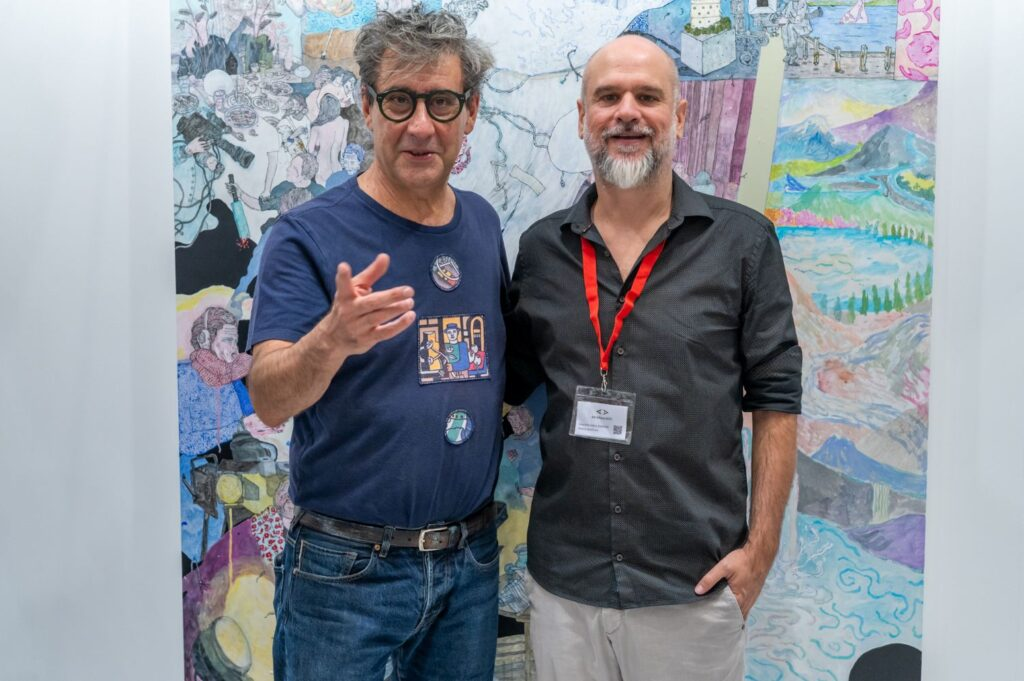
Rokos, a beloved visual artist for our generation, speaks of the way he feels part of cinema: “I imagine a story, turn it into a script, create characters, place them in the light, in the shadow, or somewhere in between…” And indeed, in his works there is an imperceptible movement, as if an invisible camera were gliding over the forms and colors.
As I looked at the Anatropees, I recalled his phrase: “In my paintings nothing moves, yet there is movement.” And truly, you felt that movement and musicality seized your gaze and led you deeper, into a narrative beyond the canvas.
There is always a twist in Rokos’s works, a reversal hidden inside everyday objects. Here it is the telephone and the avocado-two small props that act as comments, as enigmatic protagonists, as tiny destabilizers, almost as codes in a film for the viewer to decipher.
Yet my mind drifts. The telephone, a means of communication, is like the cable that transfers energy from the set to the viewer, from the idea to the image. The avocado, with its exotic beauty and its primal, soft taste that unfolds in layers, feels like a metaphor for the stories unraveling in a cinema hall. A symbol, perhaps, of art itself: something familiar and foreign at once, that beckons you to taste it again. Rokos keeps the mystery intact; he will not utter a word about these two choices.
These works became the starting point for two short animation films, the official spots of the Festival, created by Rokos himself together with Fokion Xenos, and set to music by Jim Sclavunos—the legendary musician who has played with Nick Cave and the Bad Seeds since 1994. A collaboration that connects the Greek visual arts with the global music scene, bringing an unexpected dynamic to Thessaloniki’s great cinematic celebration.
This seems to be one of Rokos’s strongest qualities: his ability to bridge the arts, to make you forget whether you are looking at a painting, a film, or a dream. And there, among viewers, collectors, art people, and the city itself, Art Athina for a moment resembled a screening room. Only this time, the film was playing inside us.