 KATERINA PARRI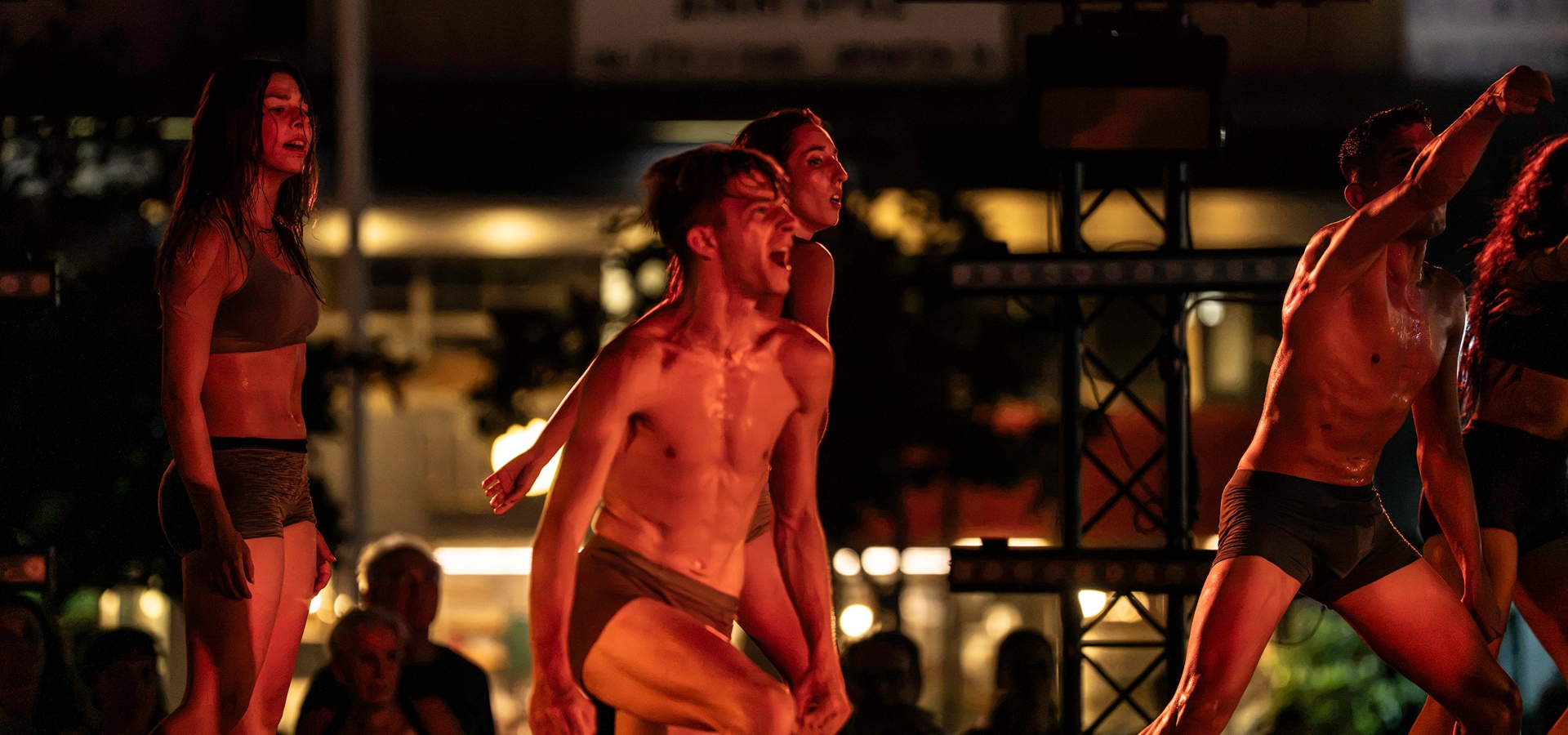
The opening days of the 32nd Kalamata International Dance Festival (KIDF) captured the unique magic of dance-its transcendent language as well as its deeply human truth, expressed through the body. As Artistic Director Jenny Argyriou wrote in her statement about the core of KIDF 32, the festival celebrates “bodies that, no matter how deeply they have been wounded, never stopped fighting their battles.”
The Kalamata International Dance Festival is one of those rare festivals you leave feeling that something inside you has shifted. There is something about dance -its sheer physicality- that seems to work directly on the mind and the senses. Watching bodies move across the stage, bodies that bear the imprint of years of rigorous discipline and relentless practice, is a profoundly moving experience. They rise, curl, stretch, connect; tendons and muscles seem to reach beyond anatomy towards something almost transcendent. Something that exists beyond the body itself. Even while you remain seated, what unfolds before you somehow lifts you up and draws you into a shared emotional space.
That is the singular magic of dance. And perhaps nothing could express that magic better than the first words I encountered upon entering the Kalamata Dance Megaron. This year’s 32nd Kalamata International Dance Festival (KIDF) is dedicated to the theme of the “magic” of dance, and visitors are welcomed by a quote from the legendary Greek choreographer Zouzou Nikoloudi:
“I truly believe that if everyone on Earth danced, our world would be a better place.”
Her words appear above a planter overflowing with blooming lavender, at the entrance to the foyer where the exhibition Zouzou Nikoloudi: Methodology as Practice begins to unfold.
The scent and colour of lavender are no coincidence. As the choreographer’s family recalls, Nikoloudi’s studio was always filled with its fragrance, while “very interesting music” could already be heard from the corridor before one entered the room. Curated with exceptional museographic sensitivity by Erato Koutsoudaki-Gerolympou, the exhibition celebrates the remarkable choreographic methodology -and, ultimately, the artistic philosophy- of one of Greece’s most influential choreographers, Zouzou Nikoloudi (1917–2004).

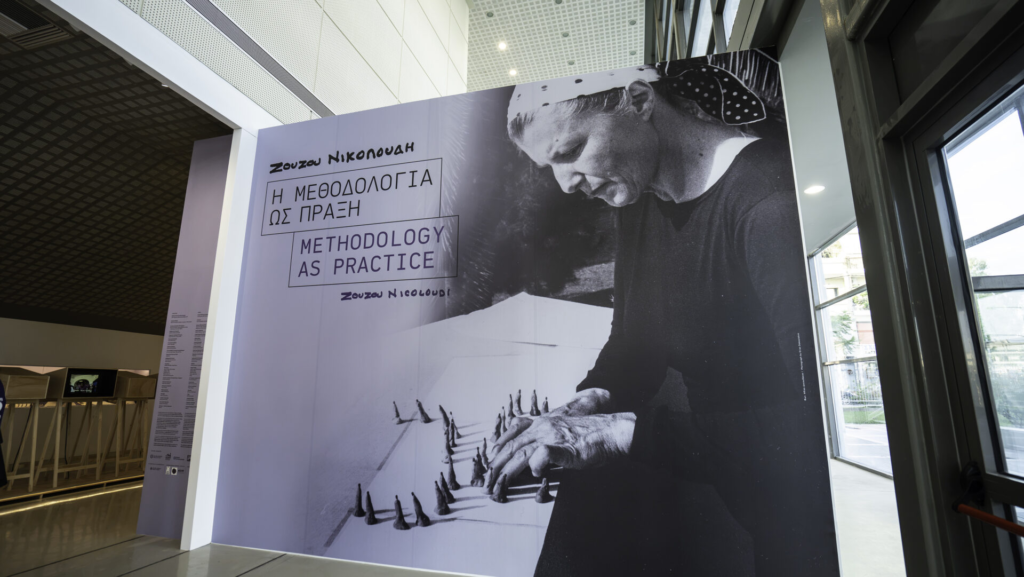
Despite its intimate scale, the exhibition feels remarkably expansive. Through choreographic scores, notebooks, photographs and video material, every corner of the foyer is thoughtfully activated, allowing the story to unfold almost choreographically as visitors move through the space. Once again, the word that comes to mind is magic.
Yet the exhibition succeeds above all in fulfilling the promise of its title. Even visitors unfamiliar with Nikoloudi can follow the chronology of her life and career, but more importantly, they come away with a clear understanding of the methodology that defined her artistic practice. Supported by carefully selected archival material and documentation, curated under the scientific guidance of Steriani Tzintziloni, the exhibition reveals not only what Nikoloudi created, but how she thought, observed and transformed movement into a lifelong artistic language.
How is movement recorded? The question appears on a mirrored surface where, as visitors read the text, they also see their own reflections. It is one of the exhibition’s most compelling moments. Here, in a clear and accessible way, we are introduced to the distinctive choreographic method developed by Zouzou Nikoloudi.
The exhibition reveals how her celebrated Chorika -independent dance works based on choral passages from ancient Greek drama, which also gave their name to her dance company- came into being. While most choreographers rely on video recordings, photographs or written notes, dance anthropologist Rena Loutzaki explains that Nikoloudi followed a radically different path. She first “painted” her ideas until they gradually transformed into choreography. Using moving human figures, colours, arcs, geometric forms, musical notes, words and numbers arranged inside hand-drawn grids -each square corresponding to a single musical measure- she mapped every dancer’s movements, their spatial relationships and the formations they would create on stage.
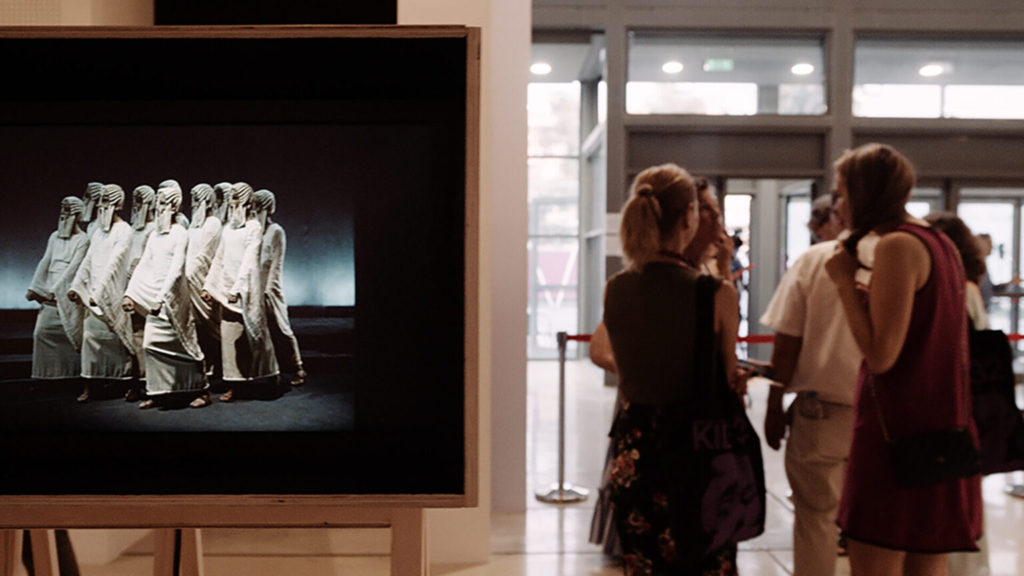
As the exhibition explains, these choreographic “scores” were drawn before rehearsals even began. They were never simple notes but creative tools in their own right. As the choreography evolved, Nikoloudi continuously redrew and refined them, gradually building a rich visual archive of her artistic thinking and compositional process.
Suddenly, everything else displayed throughout the exhibition begins to make sense. Her sketchbooks filled with tiny figures in motion, alongside the miniature clay sculptures she modelled from colourful human forms, emerge as essential components of her choreographic language rather than simply artworks. Her musical education is equally evident, with drawn figures often intertwined with musical notation, revealing choreography and music as inseparable elements of the same creative process.
Large translucent rice-paper banners descend from the ceiling to the floor, visually unfolding the entire journey from the first conceptual sketches to the final choreographic act. Together they recreate Nikoloudi’s creative “studio”, presenting material from her six Chorika productions through photographs, archival documents, handwritten notes and original working material.
The exhibition also traces her artistic journey through collaborations with some of the most influential figures of twentieth-century Greek culture, including Koula Pratsika, Yannis Tsarouchis, Karolos Koun, Nikiforos Vrettakos and Giorgos Kouroupos. It also reminds visitors of her special connection to the Kalamata International Dance Festival itself: when the festival was inaugurated in 1995, its first edition was dedicated in her honour.
A newspaper clipping from Typos tis Messinias, dated 5 July 1995, preserves the words of the festival’s founding Artistic Director Vicky Maragopoulou, whose vision continues to resonate today. She described the festival as exploring “three historical moments in the evolution of artistic dance: Ancient Greece, Russian Ballet and contemporary dance,” while enriching the programme with concerts, folk dance, song, performance and visual arts. It was, she wrote, an affirmation that dance is not only a universal language but also “a timeless and multifaceted art form that uniquely brings together all the arts.”
Back to 2026. The exhibition officially opens the 32nd Kalamata International Dance Festival, with Artistic Director Jenny Argyriou welcoming audiences and introducing Zouzou Nikoloudi: Methodology as Practice. As curator Erato Koutsoudaki-Gerolympou explained, the exhibition was conceived by Argyriou herself. Its ambition was never simply to pay tribute to an important choreographer, but to reveal the creative process hidden behind what audiences ultimately experience on stage.
Speaking at the opening, Koutsoudaki-Gerolympou described Nikoloudi as a singular figure in Greek dance history:
“Zouzou Nikoloudi’s case is unique because, over the years, she developed an entirely personal and remarkably sophisticated system of choreographic notation a choreography score—that survives today through her archives, most of which are preserved at the Benaki Museum. The greatest legacy she left us is the Chorika. They were both the name of her company and the artistic works that emerged when she decided to establish herself as an independent choreographer. She selected choral passages from ancient Greek tragedies, as well as The Birds and Ichneutae, and transformed them into autonomous choreographic works by combining speech, music and movement. Upon this trilogy she built her artistic practice with extraordinary care, choosing outstanding literary translations, collaborating with distinguished contemporary composers such as Nikiforos Rotas, Giorgos Kouroupos and Thodoros Antoniou, and bringing actors and dancers together in a shared training process—an approach that was genuinely groundbreaking when she first introduced it in 1968.”

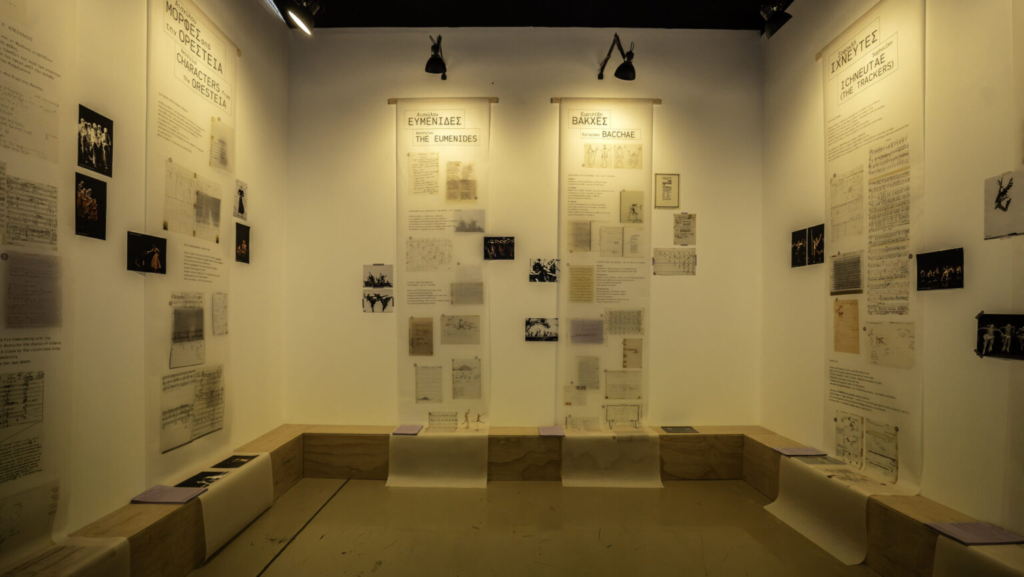

Watching the archival footage from the legendary Greek television series Paraskinio, I found myself captivated not only by Nikoloudi’s work but by her presence- how she spoke, how she moved, and how she explained her own choreographic notation. She reflected on her life, recalling how her parents had opposed her decision to become a dancer, until the influential German expressionist choreographer Mary Wigman encouraged her with the words: “You have wings. Go and fly.” Nikoloudi began her artistic journey after becoming a mother, while her years at Koula Pratsika’s School of Dance would prove decisive, leading to a lifelong collaboration that lasted until Pratsika’s death.
Throughout the exhibition, excerpts from her choreographies play on small screens: a compelling fusion of contemporary movement with themes drawn from ancient Greek drama, featuring masks, ritual gestures and classical costumes. As I watched, the voices of her daughters, granddaughters and great-granddaughters –Eliza Prokopiou, Marina Prokopiou, Ioanna Prokopiou, Angeliki Dekoulakou, Margarita Chrysaki and Athina Chrysaki– filled the space, sketching a portrait not only of the artist but of the woman behind the work.
They remember her as deeply spiritual, someone driven by a lifelong search for her true self. She believed, they say, that “we are not our bodies, but something far deeper that we must discover.” She lived exactly as she wished, and they are convinced she was profoundly happy because she devoted her life to what she truly loved.
Above all, they remember her as a luminous presence -someone who embodied what the French call la joie de vivre. She delighted in life, loved nature and cherished the countryside. Every summer she would tell her children, and later her grandchildren, “Take off your shoes now, you won’t need them in the garden.” She embraced ageing with grace and dignity, believing that human beings are inseparable from nature, a lesson she passed on to every generation of her family.
“Children need light,” she would often say. “Above all, they need light.”
One memory remains especially vivid: playing in the garden while their grandmother dyed costumes for performances such as The Birds, using an ordinary ironing board as her worktable.
“It was magical,” they recall.
And perhaps that is the word that lingers long after leaving the exhibition and, indeed, the festival itself. Not spectacle. Not nostalgia. Simply magic.

Leaving behind the six Chorika of Zouzou Nikoloudi, I found myself facing another six bodies this time in Yoann Bourgeois’ opening performance for KIDF 32, He Who Falls. Six performers. Six individuals. Three pairs standing on a suspended wooden platform.
The creaking of the timber dominates the Main Stage of the Kalamata Dance Megaron, becoming almost another performer in the piece. From the very beginning, the bodies are engaged in a relentless struggle for balance. Among the soundtrack, I Did It My Way briefly appears -played in reverse- before giving way to the soaring intensity of opera.
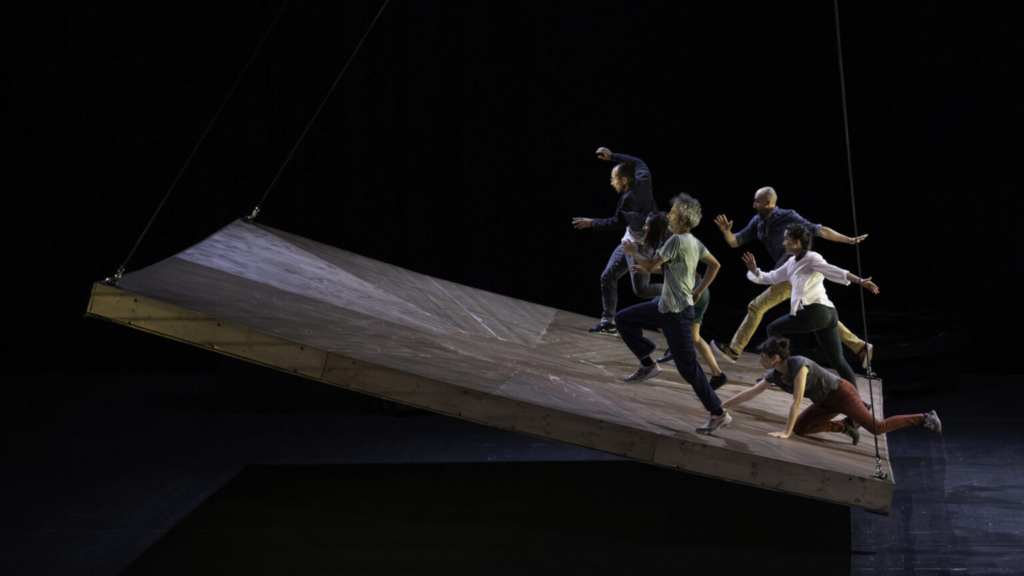
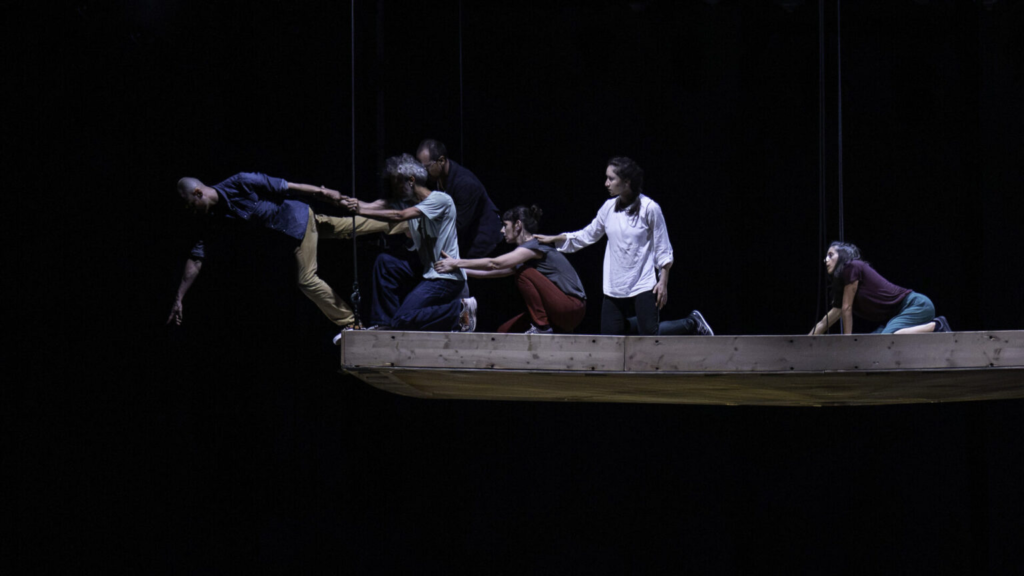
At first, the performers move in a frantic circular dance. Then the wooden platform begins to tilt, transforming into an enormous seesaw, a giant scale constantly shifting its weight from one side to the other. The people upon it are simply trying to survive. At times they lose the ground beneath their feet; at others they disappear beneath the platform, cling to its underside high above the stage, or surrender to its movement, carried back and forth while narrowly avoiding being crushed by the very structure that sustains them. Their bodies skim dangerously close to the swinging platform, escaping collision by mere centimetres.
Within this relentless vortex, one performer eventually falls. The others continue running, stepping over the motionless body whenever they encounter it. Then a second falls. The remaining performers keep moving as the obstacles multiply -two bodies, then three, then five- until, one after another, every performer lies motionless on the wooden floor.
Technically, He Who Falls is astonishing. At several moments it quite literally takes your breath away, particularly during its most daring acrobatic sequences. Every possibility of the platform’s ingenious mechanism is explored, suggesting not only extraordinary physical mastery from the performers but also immense technical complexity in the construction of the stage itself.
For sixty-five mesmerising minutes, the platform’s endless rotation and oscillation become impossible to look away from. Yet beyond the spectacle, the metaphor is unmistakable. Bourgeois transforms imbalance into the condition of being human. We spend our lives trying to find our footing, to move forward, to survive, to succeed, to fall, to stand up again and each of us learns, in our own imperfect way, how to keep moving despite the ground constantly shifting beneath our feet.
Of the performances I have seen so far at this year’s KIDF, however, it was the second that stayed with me the most. It was the one I truly connected with. The one during which, at certain moments, I could no longer hold the performers’ gaze. The one that reached somewhere much deeper within me.
That performance was Mercury Rising, presented on the Alternative Stage.
Created by Swedish-German choreographer Jefta van Dinther together with performers Dawn Jani Birley, Rita Mazza and Lukas Malkowski, the work descends into the deepest cave of the human unconscious. I entered that cave from its very first second, witnessing how the human body alone can narrate the evolution of language and communication from the dawn of humanity to a future we have yet to experience.
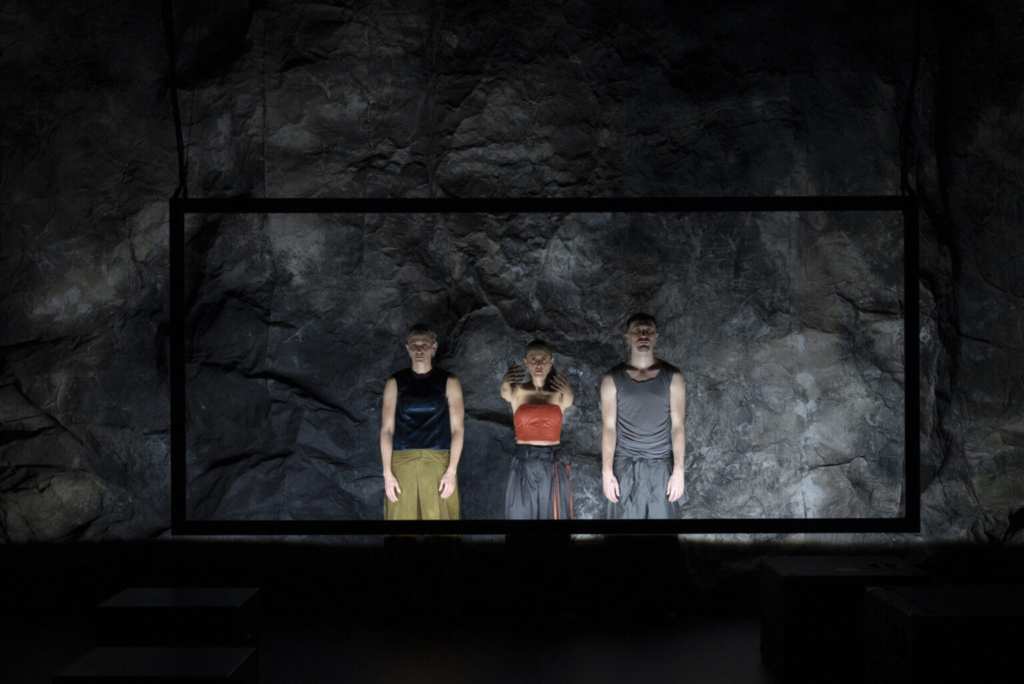
Signs, gestures, rhythm, gaze, astonishing interpretative precision and every visible impulse of the nervous system become part of an archaeological excavation not of history, but of ourselves. It is profoundly abstract and, at the same time, inexplicably intimate. The performances by Birley, Mazza and Malkowski are extraordinary, possessing a rare intensity that is both unsettling and deeply moving.
Reading more about the work afterwards, I learned that Mercury Rising incorporates multiple sign languages, making it accessible to both Deaf and hearing audiences alike. It felt only natural, then, that a large part of the audience applauded in sign language at the end, following the performers themselves as they took their bows. It was one of those quiet moments when inclusion ceased to be a concept and became a shared experience.
After this choreographic excavation, I stepped back into the daylight -quite literally- and made my way to Kalamata’s Central Square for my favourite section of the festival: Dance in the City.
I have always loved this programme because it brings the festival to everyone. Even if someone living in or visiting Kalamata has not booked a single performance, this is the moment when the festival finds them instead. There is something deeply meaningful about that.
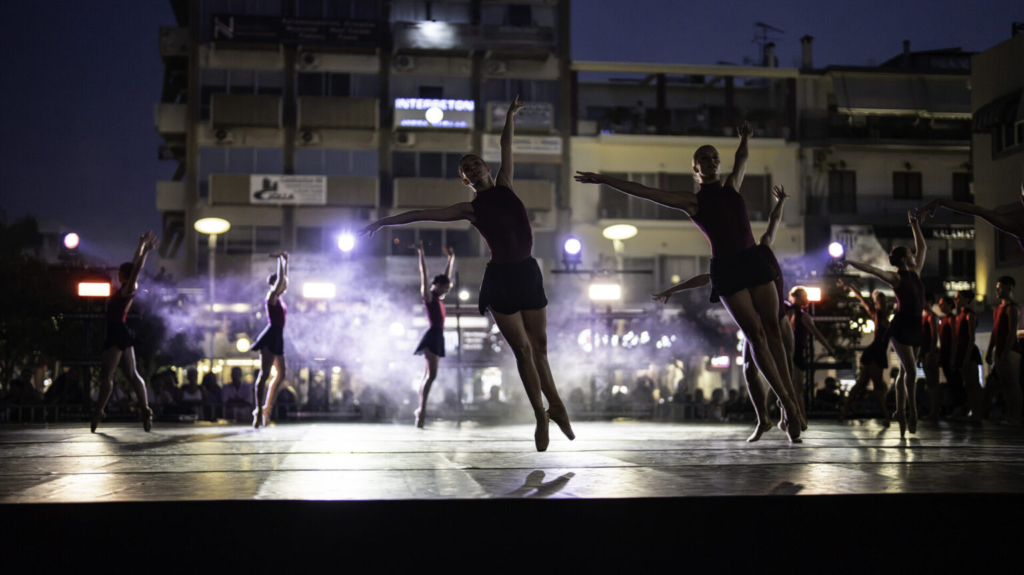
I still remember last year’s spectacular Future Cargo by the Greek National Opera Ballet, when a full-size articulated truck occupied the square and crowds gathered around it. I remember thinking this year would be hard to surpass. After all, it is difficult to compete with a truck transformed into a stage.
But dance, once again, proved that it never depends on scale. Human expression alone is enough.
This year, the spotlight belonged to the Greek National Opera Professional Dance School, whose students presented Metamorphosis, under the direction of Giorgos Matskaris. The programme featured a contemporary dance diptych with choreography by Cyril Baldy and Jesús Rubio Gamo, offering the young dancers an opportunity to test both their technical precision and expressive range.
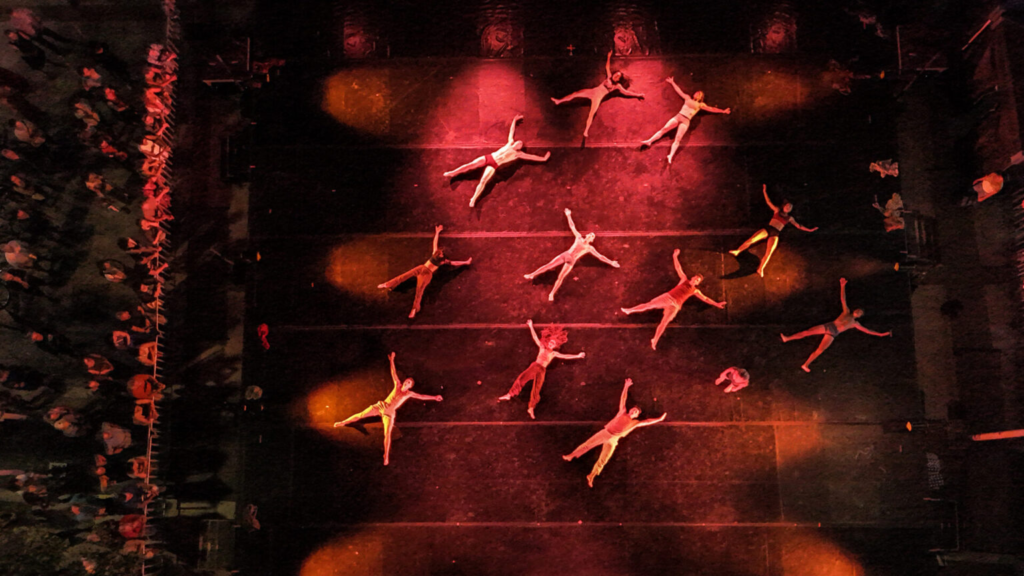
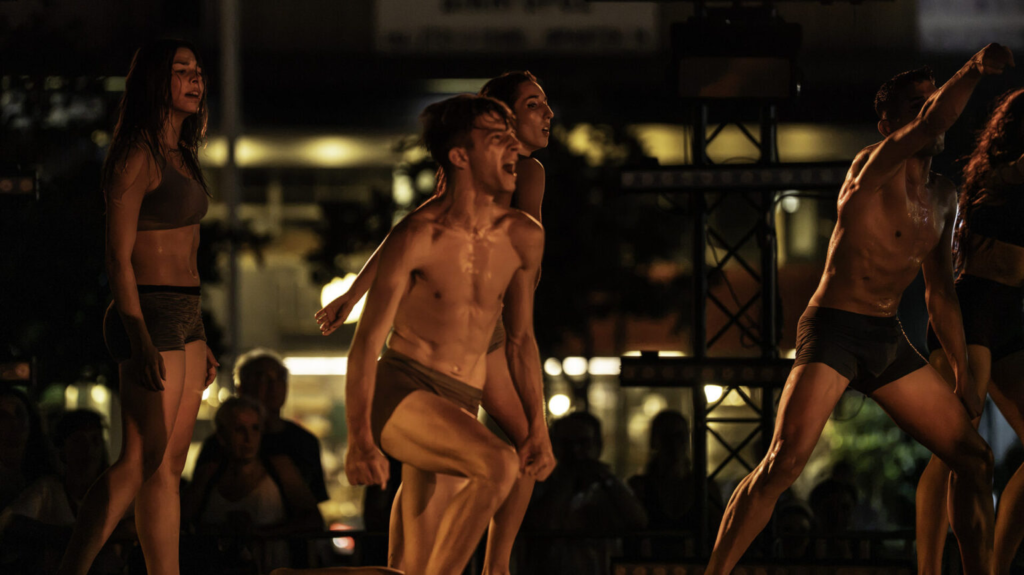
The square was once again filled with people, but one excerpt stood out above all: Gran Bolero.
The eleven performers, Konstantinos Kreouzis, Isidora Lantzi, Kleio Skiada, Angelos Tsanis, Nikolas Charkas, Lambros Bintakos, Georgia Dimou, Lydia Kapouni, Alexandra Spanou, Georgios Tsigos and Patra Christodoulou gave themselves completely to the choreography. They danced, shouted, breathed, exhausted themselves, expressing every emotion with remarkable commitment and generosity.
Watching dance students perform with such conviction brings a particular kind of joy. They represent not only talent but possibility the future of the art form unfolding before your eyes.
Yet the moment I will remember most happened almost accidentally.
Throughout the performance, a group of young children standing below the stage could not stop dancing to Ravel’s music. They copied the movements they saw, trying with complete seriousness to imitate the performers. Then, once the dancers had taken their bows and the stage had emptied, the children climbed up onto it themselves. They continued dancing, recreating what they had just witnessed before inventing movements of their own, letting imagination take over where memory ended.
It was, perhaps, the most beautiful image of the festival.
A simple yet powerful reminder of why international festivals matter especially when they take place outside major cultural capitals. They allow art to become something close rather than distant, something encountered naturally rather than sought out deliberately. They give children the chance to experience dance not as an abstract cultural institution but as a living language they are free to imitate, inhabit and make their own.
Some encounters with art last for an evening. Others quietly shape a lifetime.
The 32nd Kalamata International Dance Festival also extends beyond the theatre through Dance on Screen, and during my stay in Kalamata I had the chance to experience two video installations: All She Likes Is Popping Bubble Wrap by choreographer Ioanna Paraskevopoulou and BARE under by choreographer Vittoria Kotsalou.
The first is an ingenious dialogue between image and sound. The screen is divided in two: on one side unfolds a cinematic sequence, while on the other Paraskevopoulou recreates its entire soundscape live through movement and everyday objects. Every gesture is precisely synchronised with the projected image, transforming the body into an instrument and the performance into an irresistibly playful exploration of how sound and image can be reimagined.
BARE under, by contrast, is a complete immersion beneath the surface.
The room is washed in deep blue light spilling from the screen. Settling into a beanbag, I let Jeph Vanger’s atmospheric score take over. A solitary body drifts, floats and dances underwater, and before long your own body begins to breathe with it. The entire space seems submerged. The movement follows the rhythm of respiration the air we need to survive, the breath we sometimes feel we have lost, and at other moments inhale more deeply than ever before.
Air and water. Breath and life. And so, arriving almost at the end of an exhalation, this is what the opening days of the 32nd Kalamata International Dance Festival have left me with: the magic of dance-its ability to speak in a language beyond words, yet remain profoundly rooted in the body and in human experience.
Perhaps that is why Jenny Argyriou’s words about the heart of this year’s festival continue to echo long after the performances have ended. KIDF 32 is, above all, about “bodies that, no matter how deeply they have been wounded, never stopped fighting their battles.”
After these first days in Kalamata, it is hard to imagine a more fitting description of what dance -and perhaps life itself- can be.