 PEPI NIKOLOPOULOU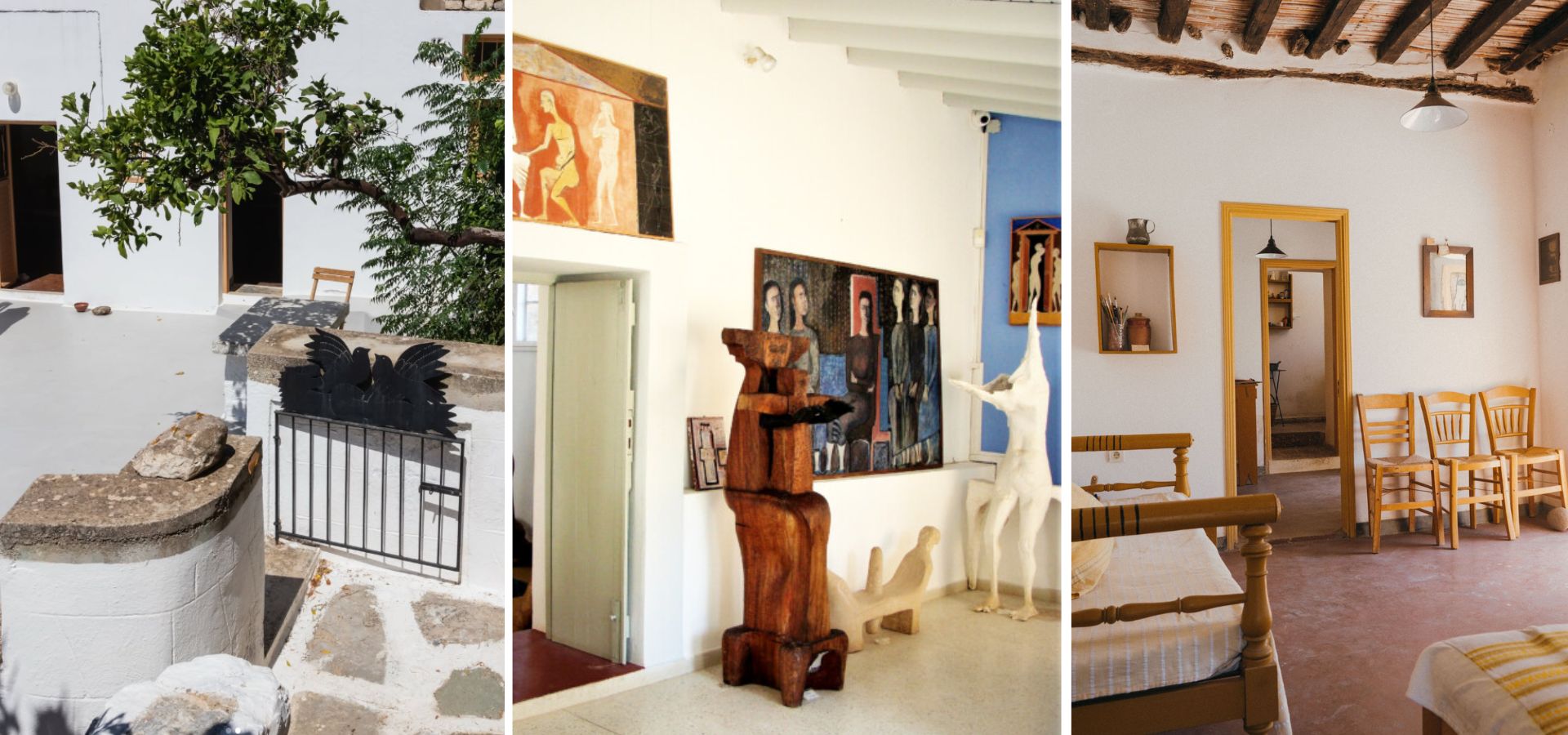
From Alekos Fassianos’ Cycladic retreat on Kea and Nikos Hadjikyriakos-Ghika’s intellectual hub in Athens to Yannis Tsarouchis’ atmospheric studio in Maroussi and Christos Kapralos’ seaside home on Aegina, these remarkable spaces reveal modern Greek art through the places where it was created
To step inside an artist’s home is to see beyond the finished masterpiece. The light entering the studio, the books on the shelves, the objects collected over a lifetime and the landscape beyond the window often reveal as much about an artist’s vision as the paintings themselves. Across Greece, a handful of artists’ homes have been carefully preserved, inviting visitors to experience the intimate environments where some of the country’s most celebrated painters and sculptors lived and worked. From Alekos Fassianos‘ Cycladic retreat on Kea and Nikos Hadjikyriakos-Ghika’s house of ideas in central Athens to Yannis Tsarouchis‘ atmospheric studio in Maroussi and Christos Kapralos‘ seaside museum on Aegina, these remarkable places offer a unique way to experience modern Greek art through the homes and studios that shaped some of its greatest masters.
[1]
Alekos Fassianos’ Studio House on Kea
Where the Aegean found its way onto the canvas
Nestled in the hilltop village of Ioulida on the island of Kea, Alekos Fassianos’ studio house is a simple Cycladic home where whitewashed walls meet ochre tones and local stone, overlooking the endless blue of the Aegean. The house perfectly reflects the aesthetic that defined the artist’s work: simplicity, clean forms and an enduring dialogue with the distinctive light of Greece.
Fassianos’ relationship with Kea began almost by chance in the spring of 1967, when he accompanied a family friend to the island to fulfil a religious vow. What started as a brief visit soon became a lifelong bond. Hidden beaches, fertile valleys, ancient wells, the preserved architecture of Ioulida and the island’s self-sufficient way of life captivated him, leading him to establish his summer studio here–a place where he could live and create away from the pace of Athens.
Before long, the house evolved into a meeting place for artists and intellectuals. Among its guests were Louis Aragon, Yannis Tsarouchis, Niki de Saint Phalle, Jean Tinguely, Nikos Stefanou and many other friends and collaborators, transforming the residence into a vibrant hub of artistic exchange.
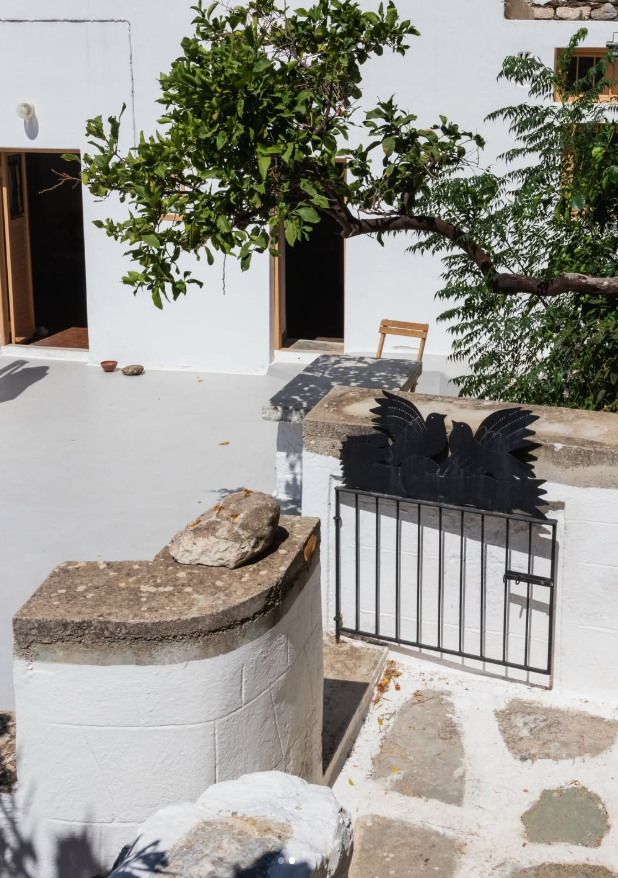

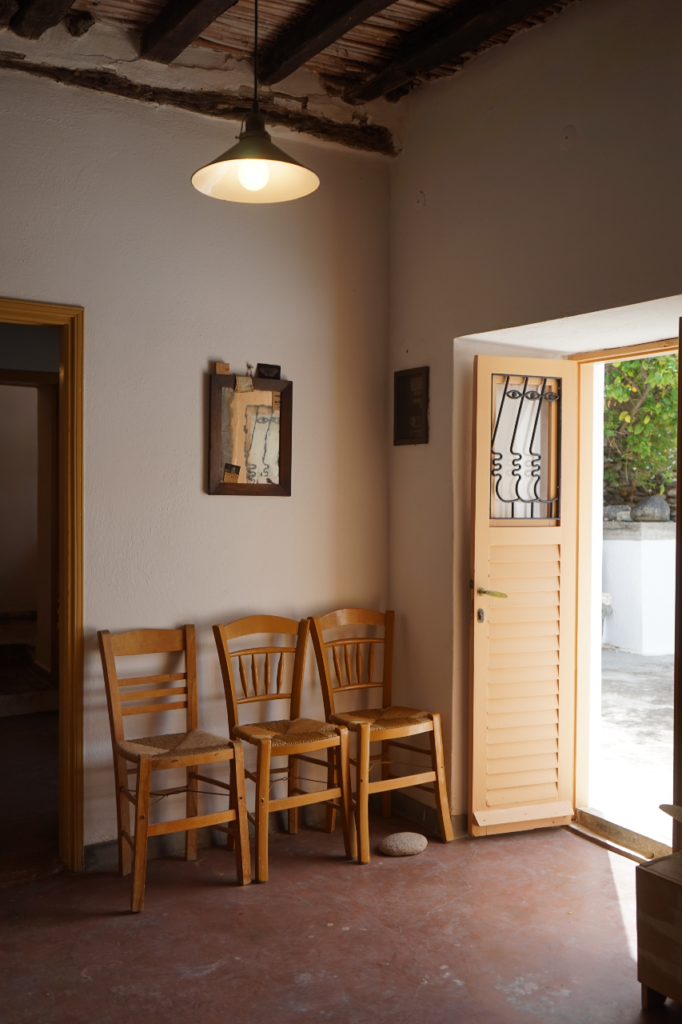
Today, the studio remains remarkably intact, as though the artist has simply stepped outside for a walk. Alongside his works, visitors encounter an abundance of personal belongings, toys, ceramics and small sculptures, as well as the artist’s own interventions throughout the house. Custom-made metal railings, door handles, hand-painted furniture and countless handcrafted details reveal a creator who never separated art from everyday life. For Fassianos, aesthetics extended far beyond the canvas, permeating every object and every corner of the home he inhabited.
Address
Alekos Fassianos Street, Ioulida, Kea
Opening Hours
Thursday–Sunday
10:00–13:00 & 18:00–21:00
Admission
General admission: €3
Free admission for visitors under 18, people with disabilities and one accompanying person, as well as accredited journalists.
[2]
The Nikos Hadjikyriakos-Ghika Gallery
A house where ideas were born
Few houses in Athens tell the story of 20th-century Greek intellectual life as vividly as the building at 3 Kriezotou Street. More than the home and studio of painter Nikos Hadjikyriakos-Ghika, it is a place where painting met literature, architecture, music and philosophical thought.
Built in the early 1930s for the Hadjikyriakos family, the building is a fine example of interwar Athenian architecture. In the mid-1950s, Ghika decided to make it his permanent home, adding an extra floor of his own design and transforming the rooftop into a spacious, light-filled studio. It was here that he lived and worked for almost four decades, until his death in 1994.

Today, the upper two floors have been preserved much as the artist left them. Visitors can wander through the striking living room with its pioneering architectural design, the sitting room, the dining room dominated by the monumental painting Kifissia, and finally the studio itself, where easels, brushes, books and objects collected during his travels recreate the atmosphere of a working artist’s space. It is one of the rare places where not only the aesthetics of a home have been preserved, but also the rhythm of an artist’s everyday life.
The lower floors house a permanent exhibition that expands far beyond Ghika’s own work. Through paintings, sculptures, manuscripts, photographs, books and personal belongings of more than 200 artists, writers and intellectuals, the exhibition traces the evolution of Greek artistic and intellectual life from the end of the First World War to the eve of the military dictatorship in 1967. It reveals the dialogue between Greece and modern Europe while placing Ghika and the celebrated Generation of the ’30s within the broader cultural landscape that shaped modern Greek identity.
Address
3 Kriezotou Street, Athens
Opening Hours
Wednesday, Friday, Saturday & Sunday: 10:00–18:00
Thursday: 10:00–00:00
Monday & Tuesday: Closed
Admission
Entry is available with the Benaki Museum unified ticket or with an individual ticket for the Nikos Hadjikyriakos-Ghika Gallery, according to the museum’s current ticket policy.
[3]
Yannis Tsarouchis Foundation
The house where light became painting
If there is one place where visitors can truly step into the world of Yannis Tsarouchis, it is his house and studio in Maroussi. More than a museum, it preserves not only his work but also the atmosphere in which it was created.
Built in 1965 at 28 Ploutarchou Street, the house served for nearly twenty-five years as Tsarouchis’ home, studio and personal museum. The ground floor housed his private living quarters, while the first floor and rooftop studio became his creative sanctuary, where some of the defining works of modern Greek painting came to life.
The house itself was made possible by the success Tsarouchis enjoyed in Paris in the early 1960s. Using the proceeds from the sale of his paintings, he purchased the property and designed a space that reflected both his artistic vision and his way of life. In 1981, he established the Yannis Tsarouchis Foundation, transforming part of the house into a museum where he personally curated exhibitions of his work.
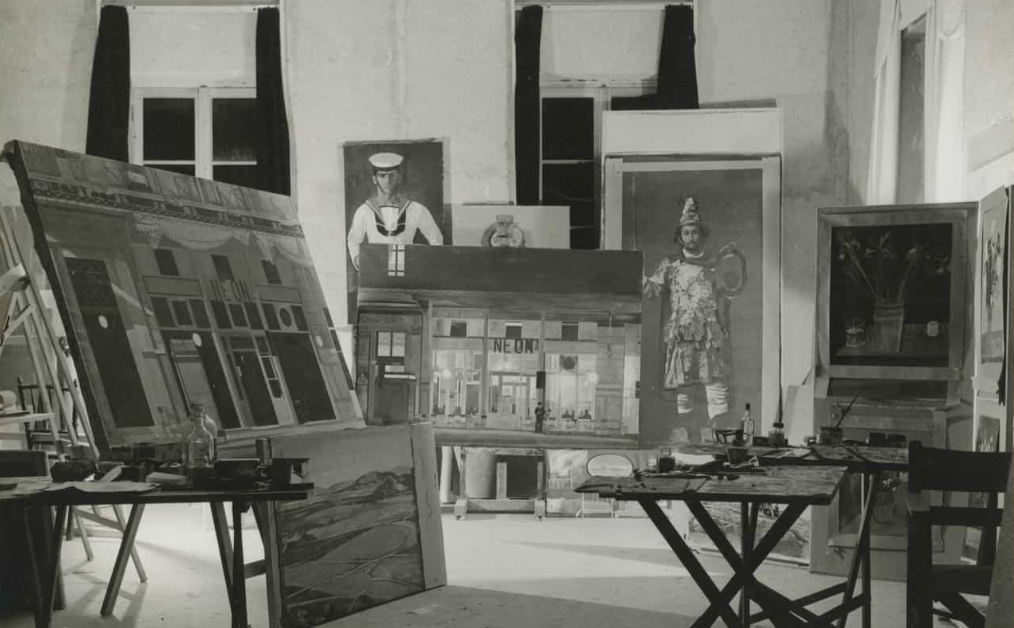
Today, a visit to the Foundation offers an experience unlike that of a conventional museum. Drawing on the artist’s extensive photographic archive, the studio has been meticulously recreated to reflect not only its original layout but also Tsarouchis’ unique working methods. Faithful reproductions of his paintings are displayed exactly as they once were–pinned to the fabric-covered walls or leaning casually against them–capturing the atmosphere of the studio while safeguarding the original works, which are now housed at the Benaki Museum.
Personal belongings, photographs, books and painting tools complete the picture of a space that feels as though the artist has only just stepped away. It is a rare opportunity to understand not only what Tsarouchis painted, but also how he thought about light, composition and the theatrical staging of an image. Following extensive restoration works, the house reopened to the public in 2018 and continues to stand as one of the most important places dedicated to the legacy of modern Greek art.
Address
28 Ploutarchou Street, Maroussi, Attica
Opening Hours
Monday–Friday: 09:00–14:00
Saturday–Sunday: Closed
The Foundation remains closed throughout August.
Admission
General admission: €5
[4]
Christos Kapralos Museum
Where stone meets the sea
For Christos Kapralos, Aegina was far more than a place to live-it became an integral part of his artistic identity. In his seaside home and studio at Plakakia, he lived, worked and created most of his mature oeuvre, with the light and waters of the Saronic Gulf as his constant companions. It is no coincidence that he chose to bequeath his home so that it could continue to serve as a place dedicated to art and creativity.
The house has operated as a museum since 1995 and, since 2006, has functioned as an annex of the National Gallery – Alexandros Soutsos Museum. The six rooms of Kapralos’ home and studio have been preserved according to the artist’s wishes, allowing visitors to experience the very environment in which many of his most important works were conceived.
The museum displays sculptures in wood, porous stone and marble, alongside terracottas, ceramics, prints and paintings, all created during Kapralos’ years on Aegina. Highlights include the plaster cast of his monumental 40-metre-long frieze The Pindus Battle Memorial (1952–1956), as well as the striking installation Parody of the Pediment of Olympia (1971–1972), composed of eucalyptus trunks–two works that reveal the monumental scale and expressive power of his sculpture.

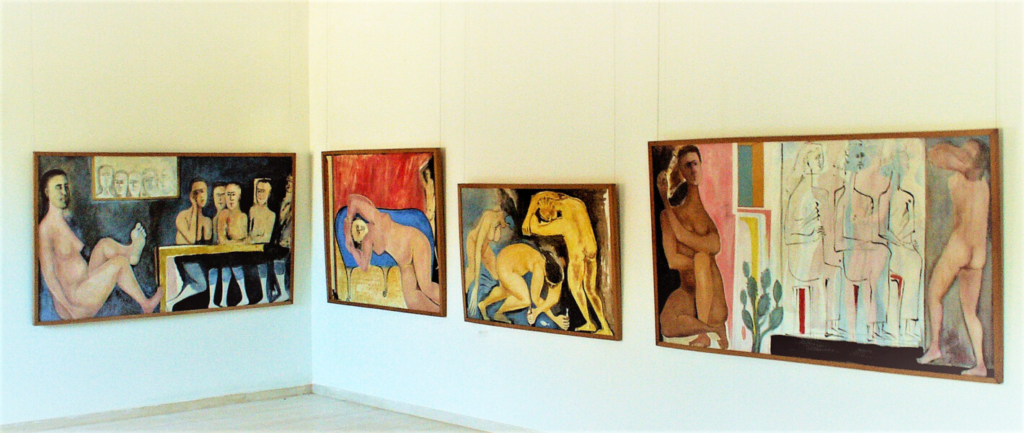
Equally compelling is the section devoted to his paintings, which he turned to in the later years of his life when age made carving wood and stone increasingly difficult. His seascapes, self-portraits and robust human figures retain the same sense of volume and sculptural presence that defines his three-dimensional work, revealing that even with a paintbrush in hand, Kapralos continued to think like a sculptor.
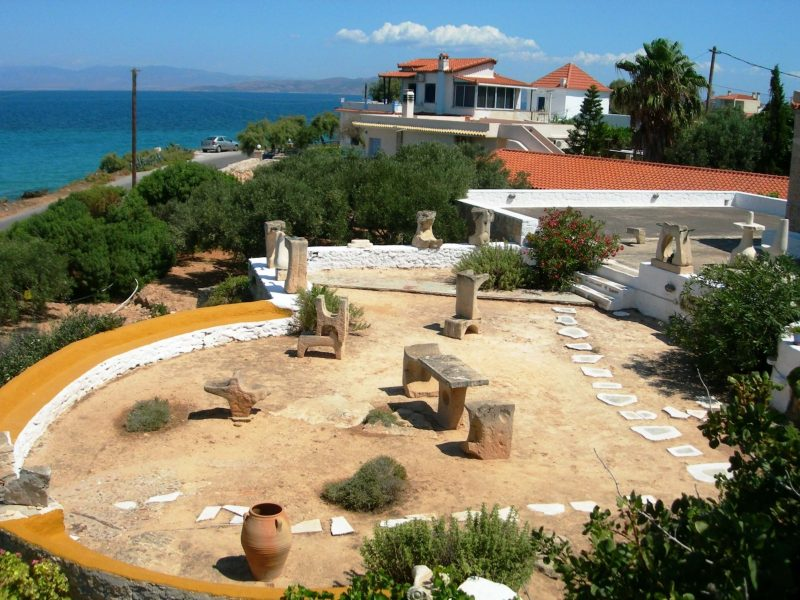
The visit concludes in the museum’s garden, where monumental sculptures and colourful mosaics created by the artist overlook the sea. Here, visitors quickly understand that Aegina was not simply Kapralos’ home, but the landscape that shaped the very language of his art.
Address
73 Nikou Kazantzaki Street, Aegina 180 10
Opening Hours
Monday–Tuesday: Closed
Wednesday–Friday: 08:30–15:30
Saturday–Sunday: 09:30–16:30
Admission
Free admission