 KATERINA PARRI
By Sofia Triantou
The journey from the ancient Eiresione to today’s tree is a beautiful path of knowledge revealing the way Greeks perceive celebration, family, and time
Christmas is approaching, and every time I think of it, a childhood image comes to mind: multicoloured lights flashing wildly, a house filled with warmth and anticipation.
In Greece, we have grown accustomed to seeing the Christmas tree as a central part of the celebration, as if it had always stood in the heart of the home covered in lights, ornaments, and memories. Yet if we look back into history and tradition, we realise that this familiar, nostalgic image is relatively recent. Beneath it lies an older cultural layer of symbolism: from the ancient Eiresione to the seafaring traditions of decorated boats, and finally to the fir tree that Greece embraced in the 19th century.
In ancient Greece, the Eiresione was a branch of olive or wild olive (kotinos), decorated with woollen ribbons (from ἔριον = wool), fruits, figs, walnuts, almonds, chestnuts, and grains; sometimes small vessels of oil or honey were added as well.
Children whose parents were both alive walked from house to house singing agermoi, early forms of today’s Christmas carols and at the end, the branch was hung on the household door, as a gesture of gratitude for the year’s harvest and a wish for abundance and protection in the year to come.
The Eiresione, then, was not merely decoration it was a traditional object rich in symbolic meaning. Hanging at the threshold of the home, it signified participation in the community, a collective wish for the household, the harvest, and the future. If we look today at our modern Christmas tree, laden with symbols, lights, and memories, the distance is not so great after all. It is possible that the tree—with its ornaments and twinkling lights still serves the same fundamental needs: the need for light, for hope, for protection, for continuity.
The Christmas tree, as we know it today, is not an old Greek tradition. It originated in Central and Northern Europe and was introduced to Greece in the 19th century, with King Otto acting as its cultural “carrier.” In 1833, a Christmas fir was decorated for the first time at the palace in Nafplio, and the following year the custom reached Athens.

The first documented Christmas tree in a private home dates to 1843 in Plaka. Yet despite its prestigious beginnings, within palaces, diplomatic circles, and upper-middle-class households, the tree was not easily adopted across Greek society. For decades it remained a symbol of privilege, of cities and the well-to-do. Its widespread presence in Greek homes came only after World War II; it was mainly during the 1950s that the fir finally entered most households, in cities but also in villages, becoming an almost self-evident part of Christmas. In coastal regions and the islands, however, the tradition of the decorated ship endured for many more years: a wooden, often handmade boat illuminated and adorned, symbol of the sea, of longing, of the sailors’ return to harbour, and of the hope of reunion with home and family. For those with ties to the sea, the boat was often considered more authentic than the “foreign” tree, a celebration of seafaring, dwelling, and return.
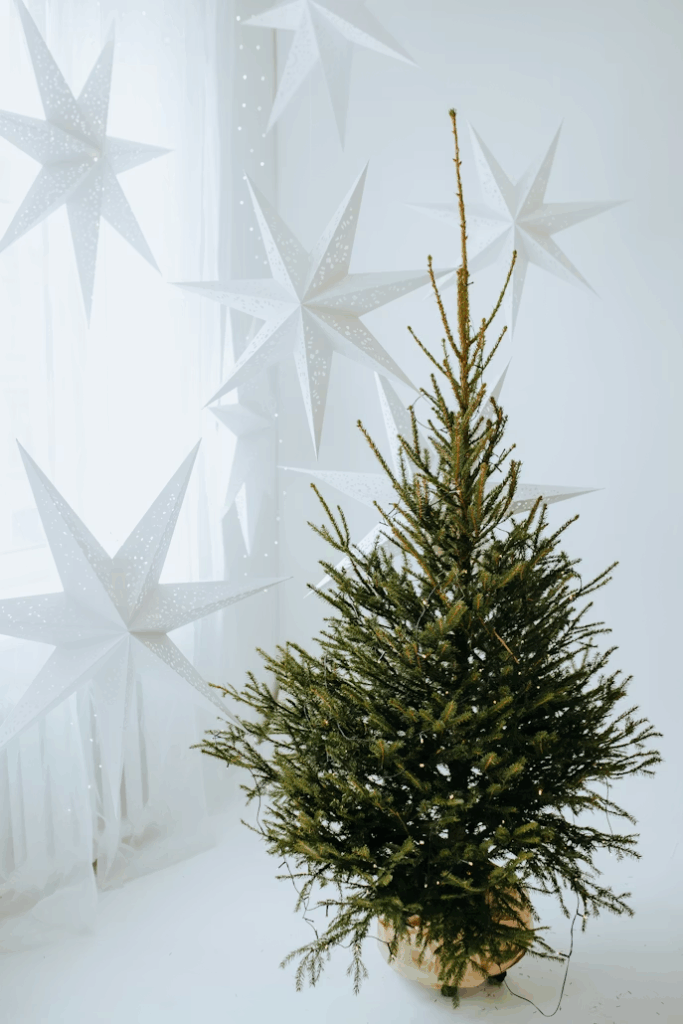
Today, the Christmas tree dominates almost everywhere, though the tradition of the ship has not vanished. On islands and coastal areas especially, boats are still decorated sometimes alongside the tree. In these homes and communities, the two coexist: the fir in the living room, the ship in the window or courtyard a reminder of Greece’s layered Christmas identity.
The modern Greek home its tree sometimes real, sometimes artificial, sometimes small, sometimes towering resembles a fairy tale. Every ornament, every light, every detail carries a personal story filled with childhood crafts and family moments.
This journey, from the ancient Eiresione to today’s Christmas tree, is a beautiful passage through history, revealing how Greeks understand celebration, family, and the presence of time.