 PEPI NIKOLOPOULOU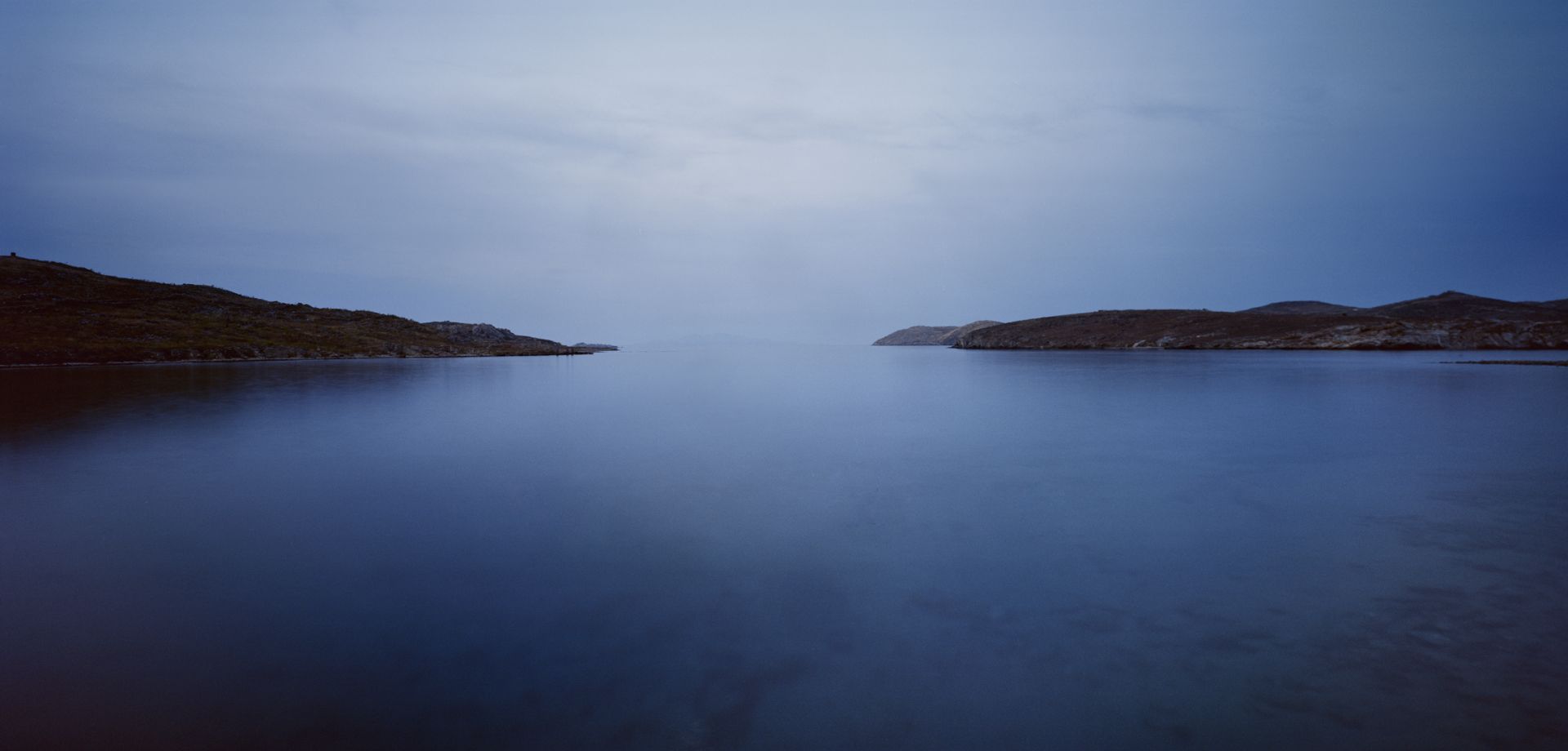
Delos, the island of the gods, the center of the ancient world, emerges through the lens of Erieta Attali in a way that is hard to describe with words. In her photography exhibition Delos: Land adrift, which opens on June 25 at the Benaki Museum, a new, lyrical dimension of the island is revealed – that of silence, light, and desolation.
Erieta Attali is one of the most prominent landscape and architectural photographers of our time. She began her career in archaeological sites, and today she captures the mythical island of Delos, the birthplace of Apollo and Artemis. For Erieta Attali, the artistic representation of an archaeological site transcends the mere literal act of recording. Simply put, she primarily focuses on the spirit of the place – the spirit of the people who inhabited the Cyclades and the Aegean islands.
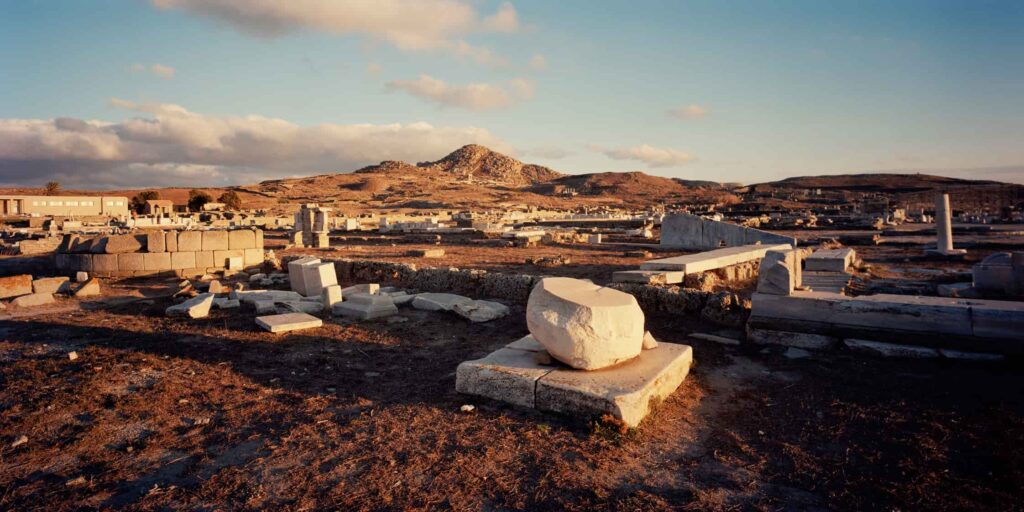
“Delos is the center of the world,” she tells me, and she is not referring only to its historical significance, but also to its spiritual position on the map of the Aegean. Her engagement with archaeology began early when photography became her first professional tool for recording and capturing archaeological sites. “From the age of 26, I worked in excavations, photographing the finds and the ancient buildings, and this shaped me as both a photographer and a person. But for me, photography was never just a tool of documentation. It has always had an artistic dimension, a way to express the essence of the place and its history with a different perspective. The 12 years I spent working on archaeological sites, such as the Macedonian tombs and ancient Greek archaeology, gave me the opportunity to understand the deep connection between light and space with human history.”
Thus, photography evolved within her into something more than a mere recording. She began to see photography as a language that could tell stories, revealing the hidden truths of each place.
So, when the time came to work in Delos, this project was a natural continuation of her path. “The island, which was the center of the world for ancient Greece, captivated me again with the same power I had felt all these years in archaeology. Photography here, in this landscape, became the bridge to connect the archaeological history with my artistic approach, giving new meaning to the place and time.”
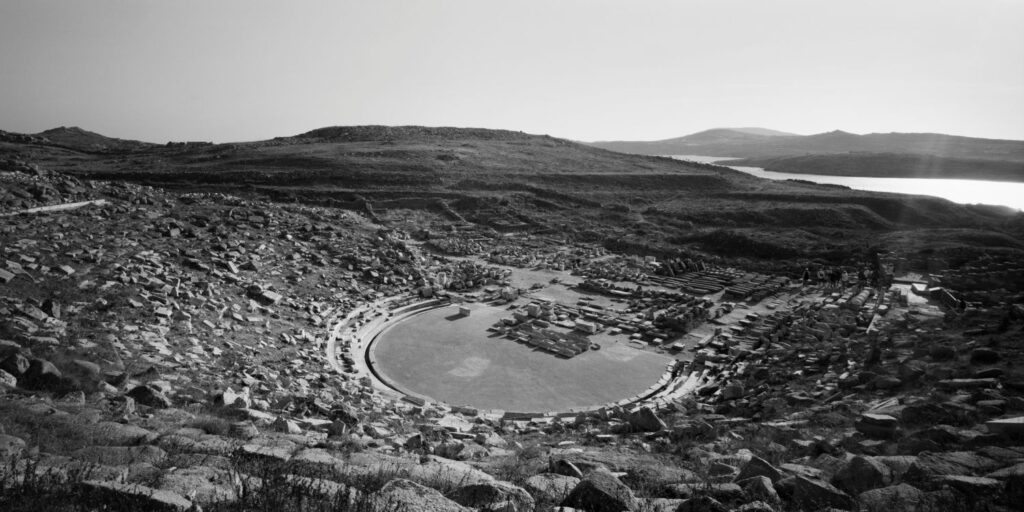
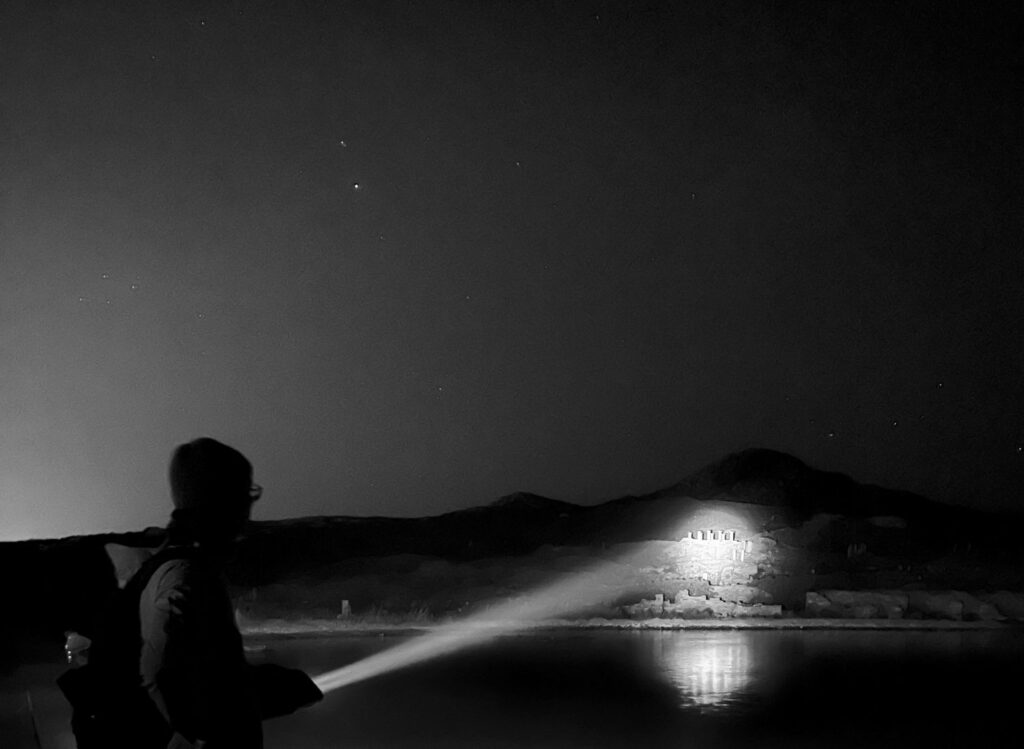
When Erieta Attali travelled from Paris to photograph Delos, the weather conditions would not only alter her plans, but also reshape her artistic approach. “When I arrived from Paris, we encountered fierce winds which actually forced the authorities to stop flights and boats. I had just made it to Mykonos. Flights were cancelled, ferries stopped, and I was forced to stay in Mykonos,” she says. “From there, I started seeing Delos. Just 20 minutes from the island, and I couldn’t go! I watched Delos from Mykonos appear and disappear, depending on the light and the waves caused by the strong winds, the sunset. This specific moment and experience shaped my concept around the entire photography project.“
This unique experience in Mykonos became the starting point for her work on Delos. She made the decision to photograph the island from surrounding Cycladic islands, such as Paros, Syros, Mykonos, Sifnos, Naxos and Tinos, capturing the transformations that occurred with the rising and setting of the sun, as well as the singular moment of the full moon.
A photographic reflection on the ancient island of Delos, the mythical birthplace of Apollo and Artemis.
Attali’s photography of Delos is a reflection of the spirit of the place, the light, and the absence of human presence. “I don’t need to try to depict the desolation. My camera captures the silence of the place“.
I wonder what it was that accompanied her through the endless hours of silence with her large-format camera, with which she photographs with great care and precision. Exposure times can range from 30 minutes to two hours, and it is interesting to imagine how many thoughts, emotions, and observations may arise during this time. What connects the photographer with the landscape and the light for such a long period, in complete stillness and silence, waiting for the right moment to capture the image she so vividly envisioned? “I wait for hours, on the mountain or at a spot from where I can see Delos,” says the photographer herself. “Time may pass and nothing happens – but it’s the moment when the light changes, when the place reveals itself.”
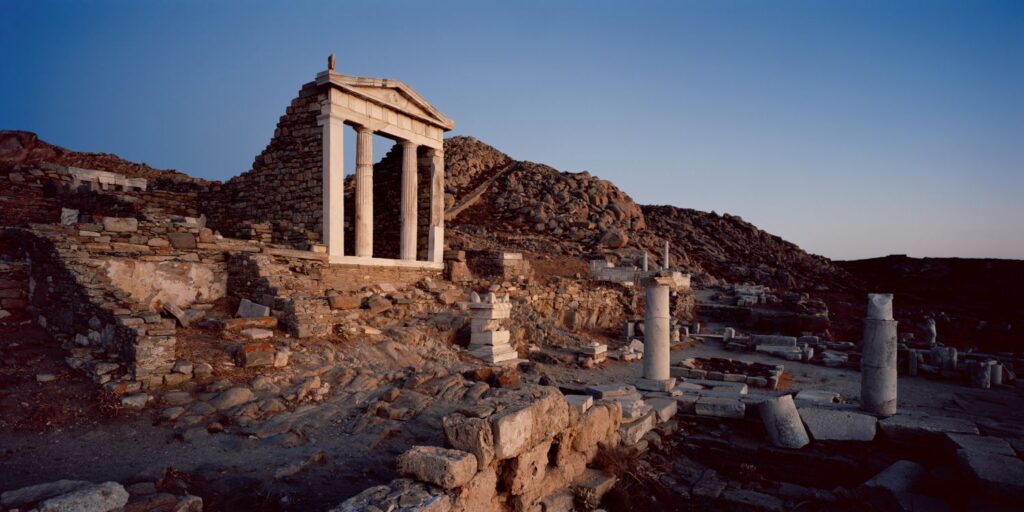
With the generous support of the French School of Athens, the Benaki Museum, and the Department of Prehistoric and Classical Antiquities of the Cyclades Antiquities Ephorate, Erieta Attali’s exhibition is presented for the first time in Greece and incorporates the unique elements of the island. A revelation of Delos as a living composition of light and shadow, of the past and the eternal, offering a unique visual narrative that bridges history with myth, landscape with the soul of the place.
Curated by Erieta Attali and Lambros Papanikolatos, the exhibition features 25 large scale prints by Erieta Attali, a 7-minute film by Elizabeth Tsouctidi, and a cartographic mapping designed by architect Aris Kafantaris. Exhibition design by Tasos Roidis.
Info
Erieta Attali. DELOS | LAND ADRIFT
Benaki Museum, Museum of Greek Culture,
Koumbari 1 & Vas. Sofias, 106 74 Athens
Duration: From June 25, 2025, to September 21, 2025