 elc team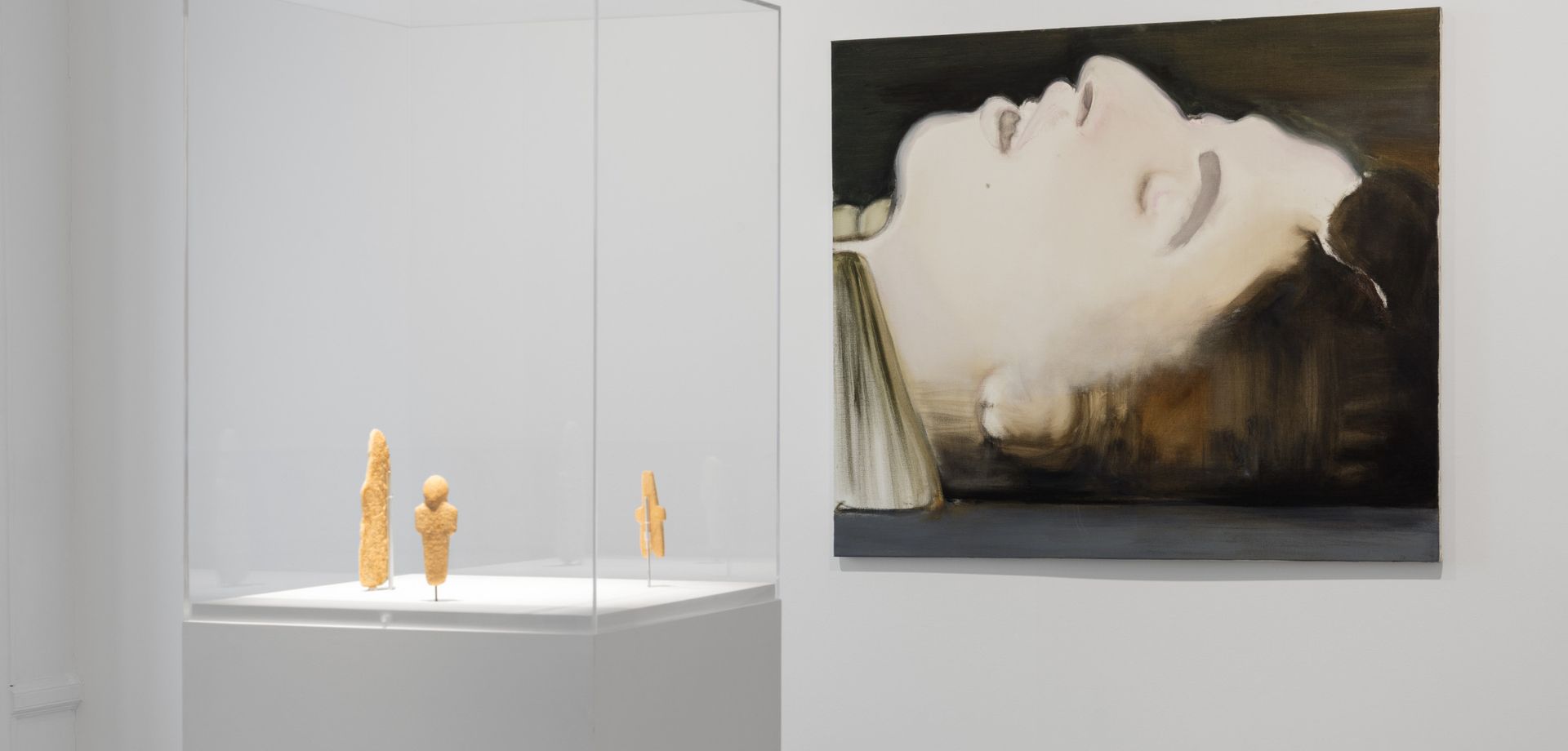
Marlene Dumas: Cycladic Blues brings together more than forty paintings and works on paper spanning over three decades
The Museum of Cycladic Art is pleased to present Marlene Dumas: Cycladic Blues, the first solo museum exhibition in Greece by renowned artist Marlene Dumas, one of the most distinctive voices in contemporary art. The exhibition will be on view from June 5 to November 2, 2025. Curated by independent curator Douglas Fogle in close collaboration with the artist, the exhibition emerges as a direct response to the histories of figuration that Dumas explored within the archaeological collections of the Museum of Cycladic Art. For this exhibition, Dumas has personally selected works from across her oeuvre, while, in a rare gesture, she has also hand-picked a group of fourteen archaeological artefacts from the Museum’s collection to be presented alongside her own works.
Born in South Africa in 1953 during the years of Apartheid, but having lived and worked in Amsterdam for nearly five decades, Marlene Dumas has spent her career using the practice of painting to explore deeply human states of being, ranging from violence, mourning, and melancholy to joy and tenderness. She has repeatedly done this by taking the human body as her subject in exhibitions at museums across the world such as Palazzo Grassi in Venice (2022), the Musée d’Orsay in Paris (2021), Tate Modern in London (2015), the Stedelijk Museum in Amsterdam (2014), and the Museum of Modern Art in New York (2008).
Marlene Dumas: Cycladic Blues brings together more than forty paintings and works on paper spanning over three decades, offering a representative view of Dumas’s strangely beautiful and provocative representations of the human form. Among them are two new monumental paintings: Old (2025) and Phantom Age (2025), created especially for this exhibition at the Museum of Cycladic Art.
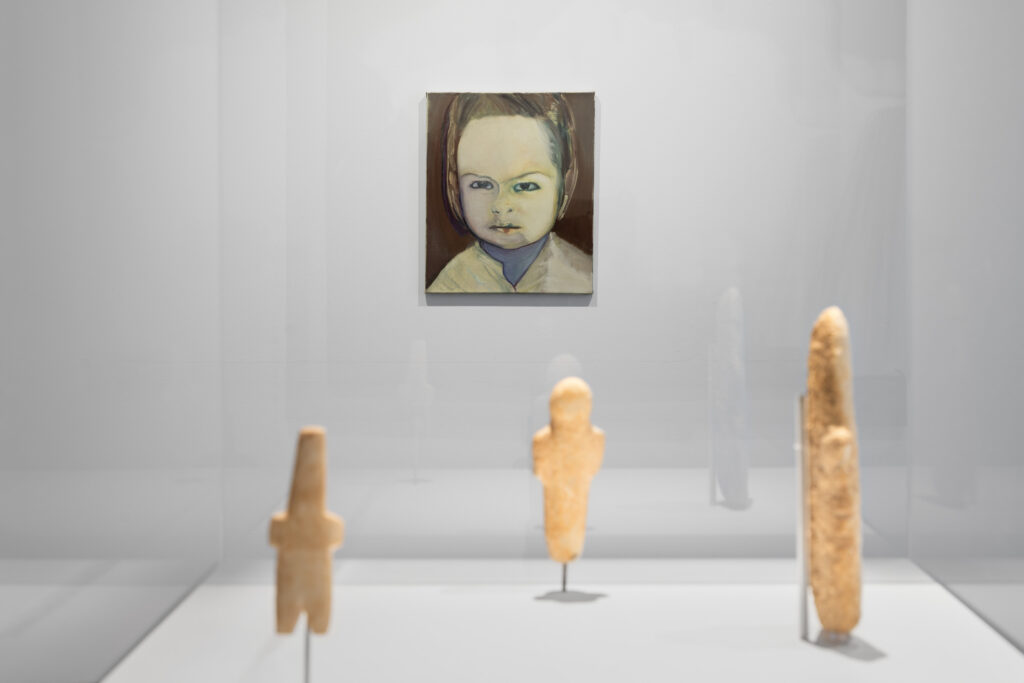
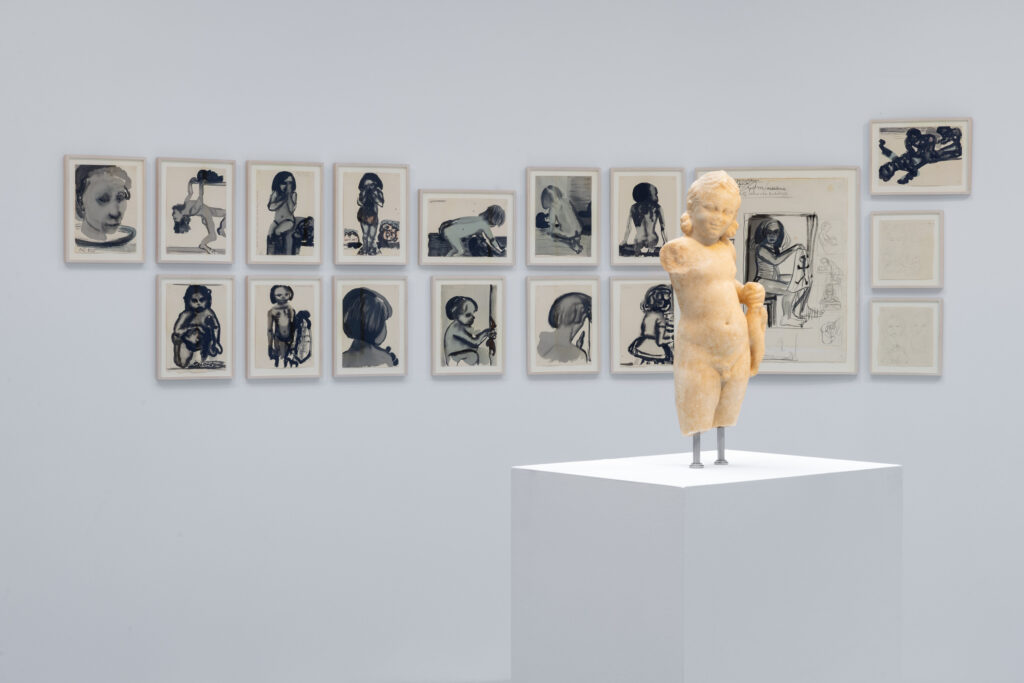
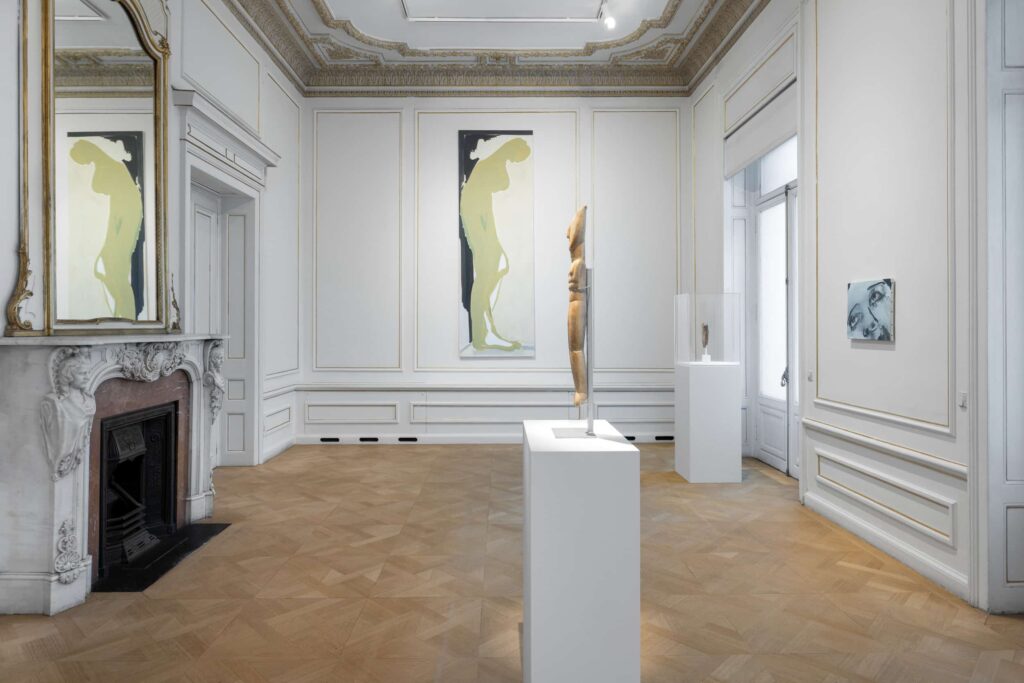
Dumas’s paintings are shown in conversation with fourteen antiquities from the Museum’s collections, ranging from schematic figurines of the Late Neolithic period and stylized marble figurines of the Cycladic Bronze Age to sculptural works from the Classical period, spanning regions from the Aegean to Cyprus. These artefacts have either directly inspired or resonate with Dumas’s works on view, highlighting enduring and universal themes such as life, love, motherhood, gender, and mortality. This rare pairing invites visitors to reflect on both the timelessness and immediacy created by the coexistence of Dumas’s works with creations from the past.
As Marlene Dumas states: “What a privilege it is to exhibit at the Museum of Cycladic Art in Athens with its exquisite collection of antiquities. These works have a timeless quality, as if freed from our human prejudices.“
As curator Douglas Fogle has stated: “Both mute and loquacious, the bodies that haunt Dumas’s canvases engage in an anachronistic pas de deux with the abstracted human forms of the Cycladic figurines created by unknown artists some five thousand years ago”.
Whether looking at Dumas’s intimate ink, crayon and pencil drawings on paper or her monumentally scaled vertical canvases, we become spectators in a theatre of human experience that the artist is able to conjure with the touch of her hand and the slight movements of her brush. Indeed, as she has suggested, “Painting is about the trace of the human touch.” In the wide variety of faces, torsos, full length bodies and isolated body parts that Dumas materializes with her hand from the nothingness of tubes of oil paints, we come to see what she means.
In new monumentally scaled vertical works such as Old (2025) and Phantom Age (2025), for example, Dumas continues her investigation of the passage of life over time while also furthering her exploration of different modes of painting. Based on a sculpture from the second century B.C. titled The Old Market Woman, depicting a woman dressed for a Dionysian feast, both paintings exhibit different perspectives on their shared source image as well as diverse means of production.
In 50+ (2010-2018), another work premiering in this exhibition, Dumas offers a fresh take on aging in the form of the head of a mature woman whose head is thrown back in an indeterminate expression of agony or joy. This explosive, if small-scale, work was inspired by a close-up postcard image of a Roman copy of a notable Hellenistic sculpture, depicting an old woman on her way to a Dionysian festival, carrying a wine jug and dressed in her best clothes.
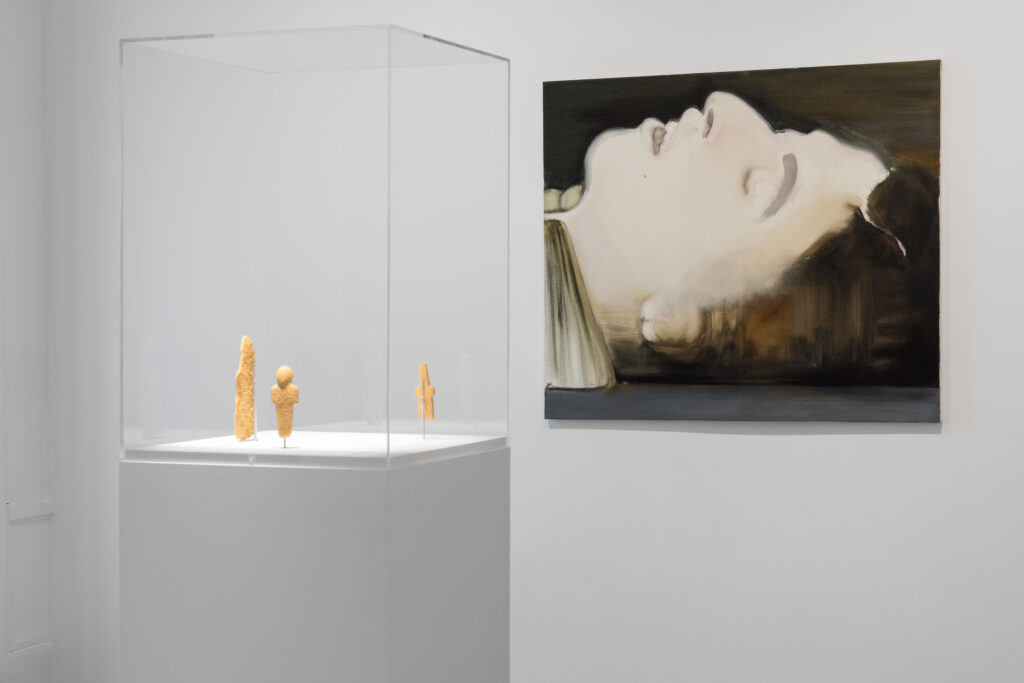

The theme of death haunts many of Dumas’s paintings, manifesting in her representations of the human face. In Alfa (2004), the artist’s gauzy, atmospheric handling of her oil paints gives an emptied out, mask-like character to the face of a dead woman seen in profile and lying in final repose. The source material for this painting was a newspaper clipping of a young dead Chechnyan woman who was part of the Moscow theatre hostage tragedy in 2002, while its title is derived from the first letter of the Greek alphabet.
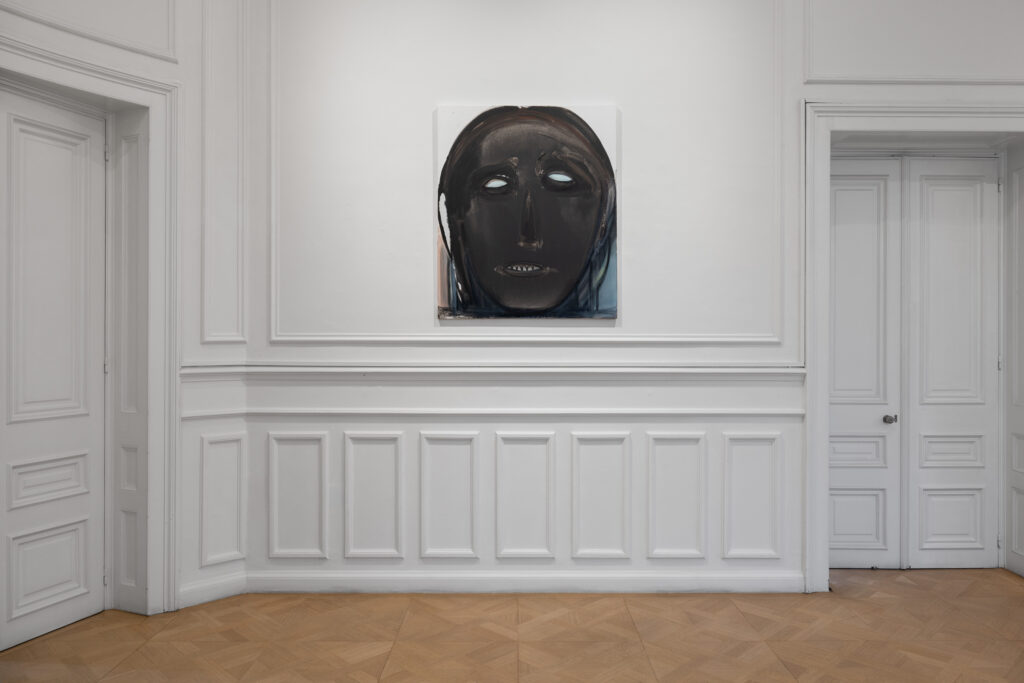
The much later work, Persona (2020), is a pathos-filled portrait of a face taken from a photograph of one of Auguste Rodin’s plaster casts created for his monumental Gates of Hell (1880-1917). As Dumas has pointed out, the word persona derives from the Latin word for mask, and was used to describe the devices donned by actors in ancient theatre in order to embody their characters. In death, the face becomes a death mask, or rather, a stand-in for the presence that once inhabited a body. This can be seen in other works such as Skull (as a house) (2007) which is one part Renaissance memento mori—a reminder that death comes to all—and another part haunted house, or even in her painting Cycladic Blues (2020) which transforms the expressionless and stylized totemic head of an Early Cycladic figurine (which may have possibly been a funerary sculpture) into a face with three subtle movements of the artist’s hand.
The artist’s own family has been a recurring theme throughout her work which can be seen in Helena (1992), an early and particularly powerful portrait of the artist’s daughter as a child. Other works demonstrate a similar proactive embrace of life. Whether it is in the intimate and lovingly rendered portraits of her pregnant daughter in Helena Michel (2020), her son-in-law and grandson in Shèrkènt and Eden (2020), or her daughter and grandson in Helena and Eden (2020), Dumas often takes life (and particularly her own life) into a heartfelt embrace as she creates her work. The entire complexity of life—sex, birth, aging and death—plays an equally important role in Marlene Dumas’s unique form of painterly practice. Various erotic bodies populate many of her paintings, such as the luminous, back-lit crouching figure of Leather Boots (2000), the kneeling chiaroscuro protagonist of High Heeled Shoes (2000), or the contorted and dream-like phantom of her watercolor Dorothy D-Lite (1998), based on Polaroid photographs that the artist took of erotic dancers in Amsterdam.
Drawing has always played a central role in Dumas’s life and career, and this exhibition includes over twenty examples of her works on paper. This group of work spans two decades, and ranges from the tragic to the comic, evoking troubled states of being, or alluding to dramatic biblical scenes such as in Give me the Head of John the Baptist (1992), the artist’s seventeen-part installation of drawings loosely based on the biblical story of Salome and John the Baptist.
Marlene Dumas: Cycladic Blues is accompanied by a full-color publication co-published by Roma, Amsterdam and the Museum of Cycladic Art in Athens, with essays by the artist and Douglas Fogle.
Info
Marlene Dumas: Cycladic Blues
5 June – 2 November 2025
Stathatos Mansion
Ticket Prices*: €16 & €12 reduced *Includes entrance to the Permanent Exhibitions. Link: https://cycladic.gr/en/ektheseis/marlene-dumas-cycladic-blues/
Public Guided Tours
Ticket prices for guided tours: 20€ & 16€ reduced
The guided tour ticket is available only online.
Greek (from 12/6/2025): Thursday 18:00, Sunday 13:00
English (from 21/6/2025): Every other Saturday 11:00 Link: https://cycladic.gr/en/ektheseis/marlene-dumas-cycladic-blues/
Museum of Cycladic Art, Vasilissis Sofias Ave. & 1 Irodotou St. 106 74, Athens
Tel.: (+30) 210 7228321-3
W: www.cycladic.gr
Instagram: @cycladic_museum
Facebook: @CycladicArtMuseum
LinkedIn: The Museum of Cycladic Art
Opening hours:
Monday, Wednesday, Friday, Saturday: 10:00-17:00
Thursday: 10:00-20:00
Sunday: 11:00-17:00
Tuesday: Closed