 KATERINA PARRI
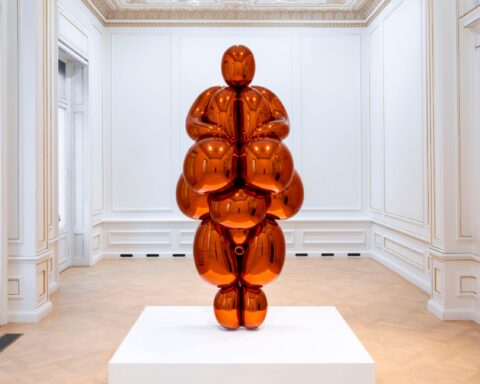
The Museum of Cycladic Art will present to the public for the first time Jeff Koons’ work Balloon Venus Lespugue (Orange) (2013–2019), by the internationally acclaimed American artist. Exploring the significance of the Venus figure from the Paleolithic period to the present, the work will be on view from 19 March to 31 August 2026 at the Stathatos Mansion, alongside ten replicas of Upper Paleolithic “Venus” figurines. Together, they pose the question of how the universal archetype of fertility transcends both time and space.
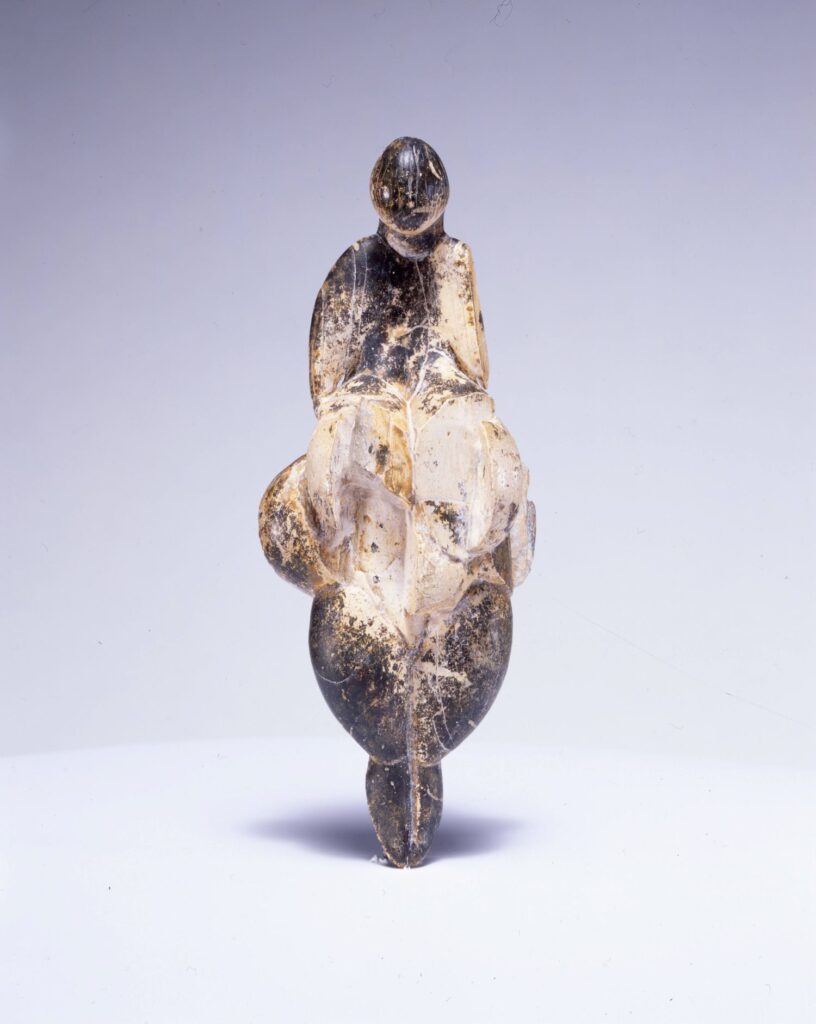
For this work, Koons draws inspiration from the Paleolithic “Venus of Lespugue,” a mammoth-ivory figurine dating to approximately 28,000 years ago. Referring to the form of Venus-goddess of love and fertility-its image has been a recurring influence in his work since the late 1970s. Koons’ interpretation of the Lespugue Venus, part of the Antiquity series begun in 2008, incorporates a wide range of art-historical references-from Botticelli and Titian to Duchamp and Brancusi-alongside enduring concepts of beauty and form. Through a meticulous, years-long process, Koons transformed the fetishised original, known for its exaggerated curves, into a monumental sculpture that appears to be made of balloons, evoking the proportions of Giacometti’s figures.
The Museum will frame Koons’ work with ten replicas of Upper Paleolithic “Venus” figurines-loans from institutions housing the immovable originals. Among them is the replica of the Venus of Lespugue from the Muséum National d’Histoire Naturelle in Paris, which served as the direct source of inspiration for Koons’ stainless-steel sculpture with its polished, reflective surface. These “Venus” figurines embody one of the earliest aesthetic codes of humankind: a deeply abstracted representation of fertility, survival, and continuity in compact, portable forms. Koons’ version re-examines this prehistoric visual language through a radically different medium and context—the industrial, hyper-material world of the 21st century.

Koons’ work investigates how ancient sacred depictions resonate within contemporary attraction to form, surface, desire, and ingenuity. Through the reflective surface of Balloon Venus Lespugue (Orange), visitors are invited to consider how material transformation alters or sustains symbolic meaning, and how contemporary art may reconnect us with ancient aspects of human existence.
Balloon Venus Lespugue (Orange) (2013–2019) comes from the Homem Sonnabend Collection (property of Antonio Homem Sonnabend and Phokion Potamianos Homem) and will be exhibited at the Museum of Cycladic Art for the first time. The presentation will be accompanied by a new publication featuring essays by Jeff Koons and leading scholars, outlining new research on the Paleolithic period in Greece and abroad.
About Jeff Koons
Internationally recognized artist Jeff Koons (b. 1955, York, Pennsylvania) is widely known for his iconic sculptures Rabbit and Balloon Dog, as well as his monumental floral works Puppy and Split-Rocker. Using everyday objects as a point of departure, Koons’ practice revolves around themes of self-acceptance and transcendence.

Since his first solo exhibition in 1980, his work has been presented in major museums and galleries worldwide. He was the subject of a landmark retrospective at the Whitney Museum of American Art in 2014, which later traveled to the Centre Pompidou and the Guggenheim Bilbao.
Koons has received numerous awards and distinctions in recognition of his cultural contributions. President Jacques Chirac appointed him Officer of the National Order of the Legion of Honour. He has also received the U.S. State Department Medal of Arts and was the first artist-in-residence at Columbia University’s Mortimer B. Zuckerman Mind Brain Behavior Institute. He serves on the board of the International Centre for Missing and Exploited Children (ICMEC) and co-founded the Koons Family Institute, dedicated to combating child abduction and exploitation worldwide.
Jeff Koons lives and works in New York.
The Homem Sonnabend Collection
The Homem Sonnabend Collection is the private collection of Antonio Homem Sonnabend and Phokion Potamianos Homem. The collection brings Renaissance works into dialogue with representative examples of African and Oceanic art, as well as early 20th-century decorative arts. It also highlights key figures of post-war and contemporary art, from Pop Art to Arte Povera, alongside works from the 1980s and 1990s. Encompassing photography, sculpture, and painting, the collection includes works by Andy Warhol, Cy Twombly, Roy Lichtenstein, Jasper Johns, Robert Rauschenberg, Claes Oldenburg, Michelangelo Pistoletto, Mario Schifano, Lucio Fontana, Jannis Kounellis, Bernd and Hilla Becher, Hiroshi Sugimoto, Jeff Koons and others.