 KATERINA PARRI
By Stelios Parris
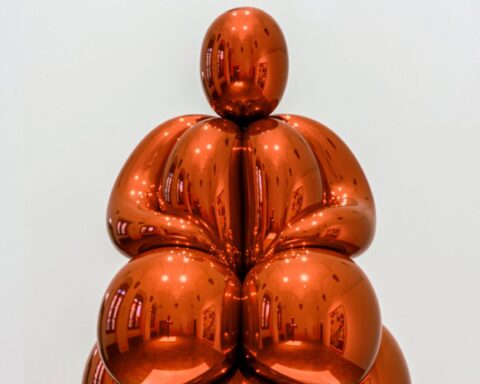
You enter the “cave,” observe the Paleolithic “Venuses,” and then step into the light to see your own reflection on Jeff Koons’ Balloon “Venus” Lespugue.
At the Museum of Cycladic Art, at the Stathatos Mansion, the exhibition Jeff Koons: “Venus” of Lespugue opened its doors. As the Museum’s President, Sandra Marinopoulou, said:
“A small exhibition in scale, yet significant in its scholarly content and interpretation. We welcome Jeff Koons to our Museum. His iconic work is directly influenced by the Paleolithic ‘Venus’ of Lespugue, the celebrated mammoth ivory figurine dating to approximately 28,000 years before our era and housed at the Muséum National d’Histoire Naturelle in Paris.
Jeff’s striking, gleaming orange ‘lady’ is what prompted us to imagine yet another dialogue between antiquity and the present. Ten Paleolithic ‘Venuses’, certified replicas from museums abroad that house the immovable originals, and which until now have never been exhibited and studied together in a single museum exhibition, are gathered for the first time opposite Jeff Koons’ contemporary ‘Venus’. Because the human form does not belong to only one era. It is transformed through time, expressed through different materials, scales, and symbols, while remaining recognisable. Balloon ‘Venus’ Lespugue invites us to reflect on timeless values of beauty and form and becomes the occasion for a unique encounter.”

Jeff Koons, born in 1955, is one of the most successful artists in contemporary art. Influential and commercially acclaimed, he became globally known for his sculptural works resembling enormous balloons twisted into animal shapes. His best-known work is Balloon Dog, a sculpture made of भारी, stainless steel with a mirrored surface. Reflection, in my view, is also the secret of this exhibition’s success. The reflection of light and of our own image on a work of art, the balloon Venus Lespugue, but only after we have emerged from a “cave” that houses ten “Venuses.”
Aphrodite Gonou, advisor to the Museum of Cycladic Art’s Contemporary Art Programme, explained how the exhibition came about:
“At first, it seemed to us that this alone was enough. It is such an extraordinary work that we felt it could stand on its own at the Stathatos Mansion, and I think even that would have been sufficient. But through discussion it emerged that it would be wonderful to also bring the objects that had inspired Jeff Koons. These ‘Venuses’, let’s call them Venuses, from 30,000 years ago, and to ‘see’ them together. So, in these two rooms, it is as if we suddenly travel through time in an almost ‘Big Bang’ way, from thirty thousand years ago to the present. I think that is particularly fascinating, and one can think of so many things. It is interesting for archaeologists, for us, and for people in contemporary art. We always love it when dialogues are created between these two worlds.”

Photo: Paris Tavitian © Museum of Cycladic Art
The Museum’s Scientific Director, Dr. Panagiotis Iossif, who also spoke on behalf of co-curator Dr. Ioannis Fappas, noted:
“As Aphrodite mentioned, the idea for this exhibition began with a single work. It was then enriched with unique replicas that we borrowed, in an effort to guide the visitor on a journey through time-not just through time, but into the very origins of human creation. Into the first representations of the human form by what we now properly refer to as anatomically modern humans, who are, in fact, our shared ancestors. It was at this point that these ancestors began to represent the human form using different materials and in different ways. With abstraction, with distortion of form, and in all these cases, they chose to depict the female figure.
In the exhibition, we sought to create a strong scenographic experience of immersion and descent into the origins of humanity. The majority of these objects-the Paleolithic ‘Venuses’, as they are conventionally called-originate from caves. We wanted to explore how the people who created, used, and lived with these objects experienced life within those caves. For this reason, the experience we aim to offer visitors in the space of the Paleolithic ‘Venuses’ is one that is calm and gentle, allowing them to hear the sounds that might be formed within a cave. We want this experience to be fully immersive.”
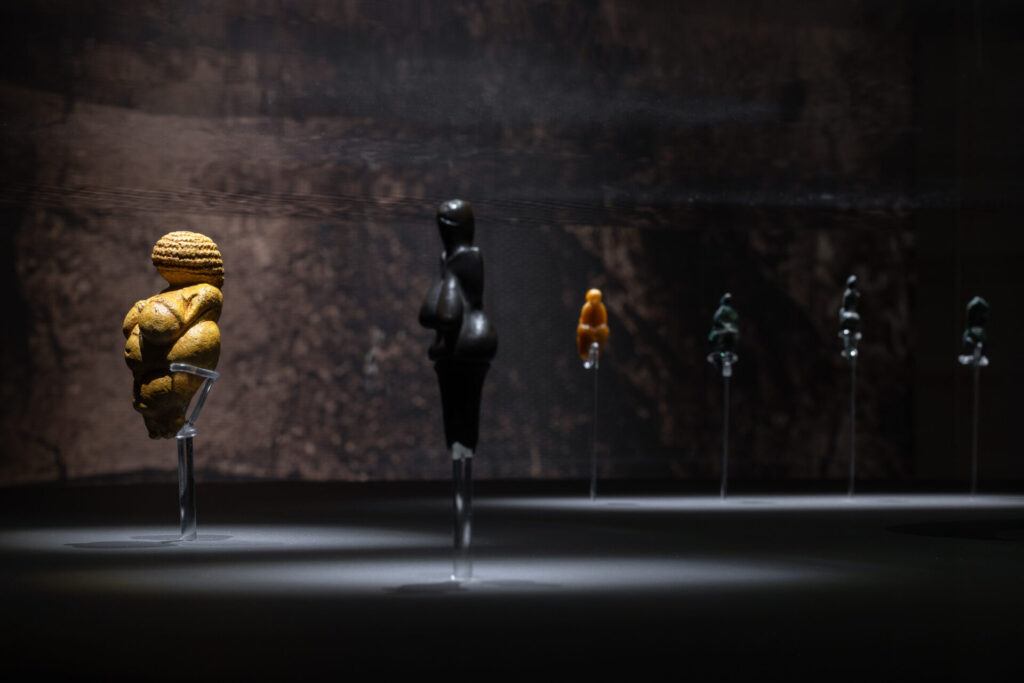
Photo: Paris Tavitian
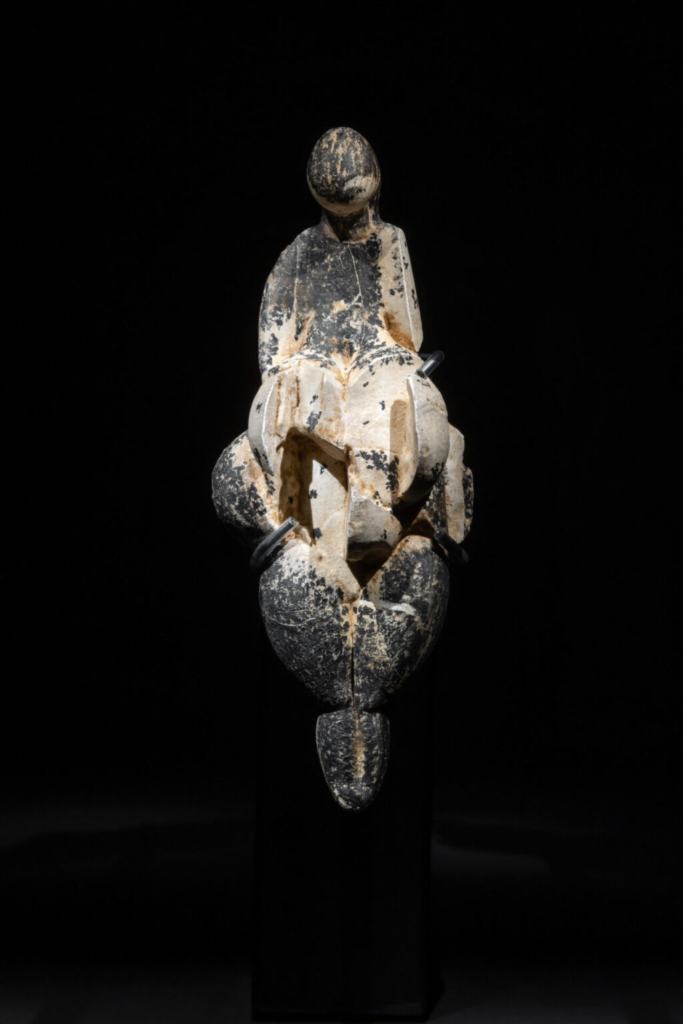
Muséum national d’histoire naturelle, Musée de l’Homme, Paris, HA–19030
© Museum of Cycladic Art
Photo: Paris Tavitian
“The space is very dark because we wanted to create a strong contrast with Jeff Koons’ work, which is luminous, colorful, and playful. Of course, the Paleolithic Venuses can also be seen as playful, depending on how you look at them. So we wanted to play between these two seemingly opposite ends, which, however, are so similar that they ultimately converge at the same point.
Koons’ work makes extensive use of technology-indeed, highly advanced technology. One must imagine that, in relative terms, people of that era were also using the most advanced technology available to them. Working mammoth ivory requires highly specialized knowledge and tools that only a few possessed. We should try to place ourselves in their position and understand that, ultimately, they are not so different from the way Jeff Koons works today.”
For me, this transition-from the darkness of one room, observing the works created by the ancestors of the human species, which we have named “Venuses,” with their abundant, curved, and as symmetrical as possible forms-was particularly powerful. And just as my eyes had adjusted to the dark, I stepped into the light, only to be dazzled by Koons’ gleaming orange “Venus,” placed at the center of a bright room.
Aphrodite Gonou described it perfectly:
“Koons’ Balloon Venus today creates a sense of awe. As you enter the room and encounter this extraordinary sculpture, you experience something akin to what that Paleolithic human might have felt. It is something you look at and instinctively say, ‘Wow-how did someone manage to do that?’ To create something that appears so light and airy, yet is made of steel, shining so brilliantly.”
But most importantly, it becomes a point where we can gather and feel that we belong. Jeff Koons has often said that what matters most to him is that, upon entering this room, we all feel a sense of connection. There is a childlike quality to it, due to the element of the balloon. Perhaps it evokes childhood memories. Perhaps it is its beauty, perhaps its color. What matters is that we can already see it: it is one of those works where anyone who enters, whether they know about art or not, somehow feels good.
I have noticed that visitors spend more time with this work than in exhibitions with multiple objects, where people tend to move quickly, glance, pass by, and leave. Here, they stay. They take photos. They look, and they look at themselves reflected in it.
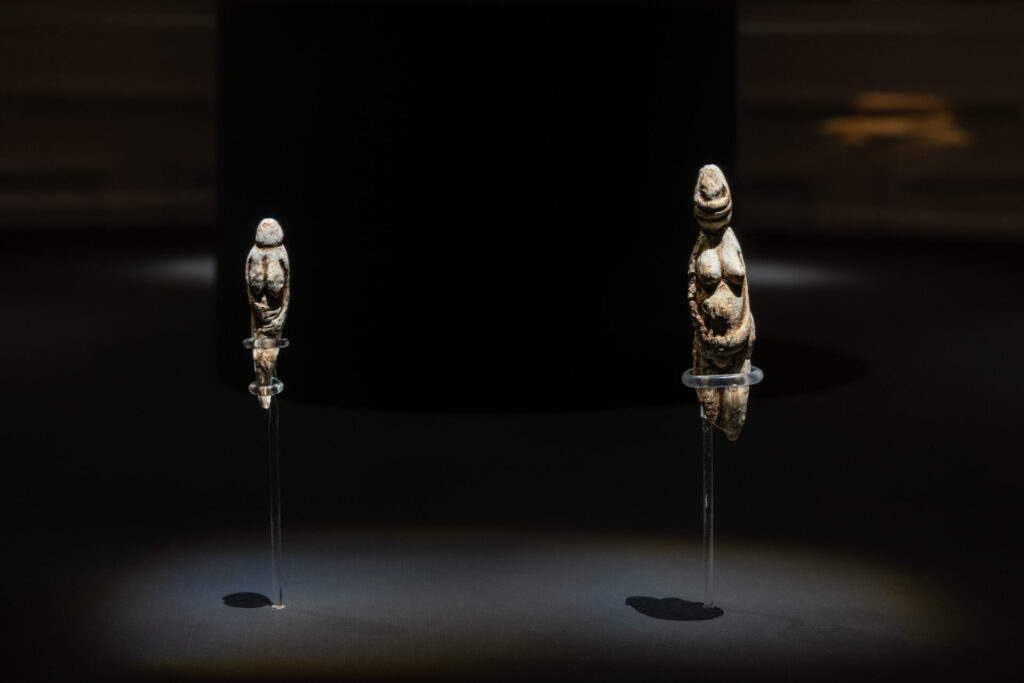
National Archaeological Museum of Taranto (MArTA), 139802, 139803
© Museum of Cycladic Art
Photo: Paris Tavitian
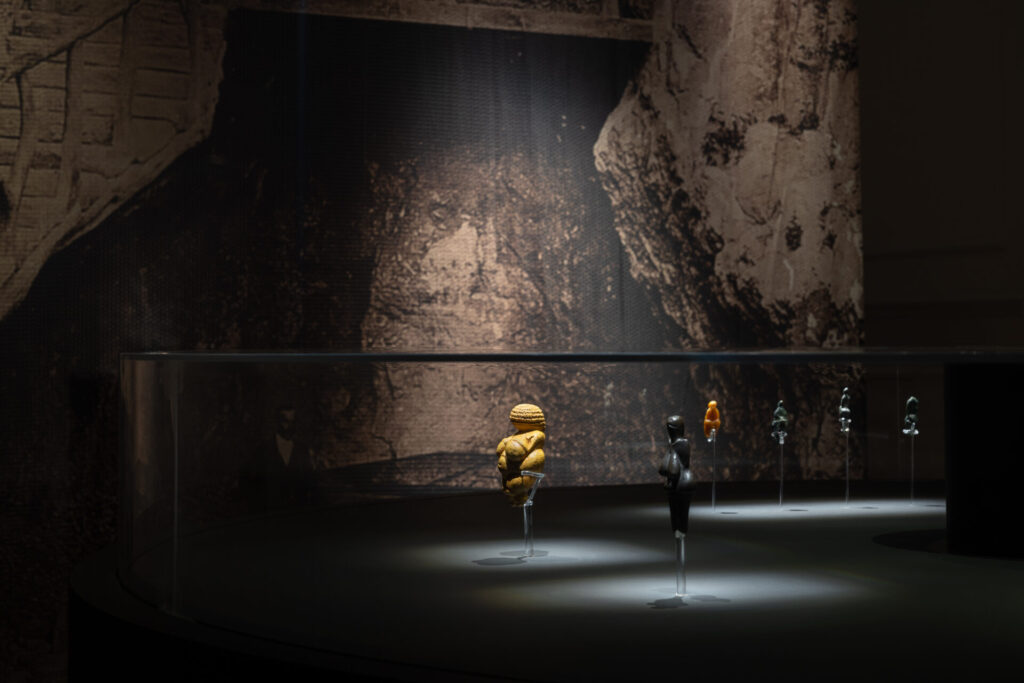
Photo: Paris Tavitian
As for what it may mean to each person… so much has been written. That it reflects our contemporary era, consumerism, advertising, the abundance of objects, overproduction. But someone may simply see themselves. Perhaps for the first time, someone may feel: ‘I had a really good time at the museum today… I liked this.’ Often, people may enter a museum and feel they didn’t understand, that someone needs to explain things to them. Here, I think the connection happens instantly, and it gives us the space to think about many things.”
It is a highly engaging exhibition with a strong narrative axis that can resonate equally with a child and a seasoned art lover. You become both observer and viewer and, as you approach the work, you see your own reflection. From observing the Paleolithic figurine, you now observe your own image and find yourself lost in thought, with all your senses activated.
I saved for last some of the most compelling remarks by Jeff Koons himself:
“I believe this exhibition is very relevant to the moment we are living in. We spoke about bringing together these Venus figurines, these Paleolithic objects. And it is wonderful. It is remarkable that, across time, people continue to engage with them. I think what matters most is what we all share here together in this room. It is our union, what we share as a universal vocabulary. Some of this relates to biological memory, to the importance of language, to storytelling, to how we express emotions and feelings, to what it means to be human, to how we describe this moment in time. And we see this in people who lived 40,000 to 45,000 years ago, and how that connects to us today.
What is important is this shared language we have, which gives us a reason to face each day with optimism, believing that we can continue to evolve, that we can create a better life for ourselves and share it with the community. These people embedded knowledge-whatever knowledge they had about life, about reproduction, even about how to form a community-and they shared it with one another. And I think what this exhibition is truly about is this sharing of information. I could not be more satisfied or happier to be part of such an exhibition at this moment.
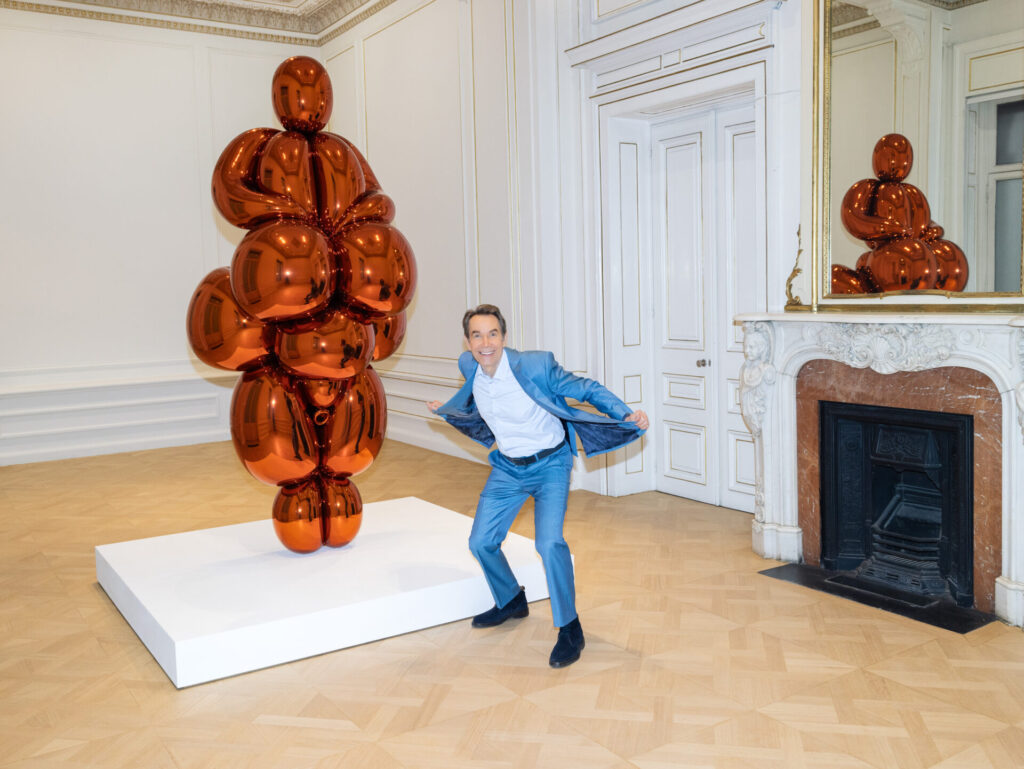
Photo: Paris Tavitian © Museum of Cycladic Art
Art changed my life completely. When it entered my life, it gave me a way to ‘be’, to interact with the world. It allowed me to connect with others. And it enabled me to participate fully in becoming as complete a person as possible. And this applies to all aspects of life: as a spouse, as a parent, as an artist, in every way within my community. To be here and to be in dialogue, not only with the Venuses that are part of the exhibition, but with all of history-through poets who refer to a Venus, or by looking at the paintings of Titian, creating this sensual quality of light, emotion, and feeling, and all the different connections that tie into a universal vocabulary… this deep vocabulary that you can experience through this dialogue within the exhibition. I would truly like to thank the team here who organized this and had the vision for such an exhibition. Thank you.”
Regarding his own work and the Venus of Lespugue, Jeff Koons said:
“I looked at the various Paleolithic Venuses, but what I loved was its modernist quality. And, you know, it makes me think of this kind of profile it has, this very linear quality, combined with the fullness of its form, yet with a distinctly modernist sensibility. If I think about the sculpture, just by looking at its surface, it is highly reflective. And I became engaged with reflections, with reflective surfaces, through philosophy. When I was studying philosophy, the word I encountered most often was ‘to reflect’ and ‘reflection’. And the whole process is about managing reflection-about contemplating things, thinking about yourself in relation to things, and reflecting on them in general.
But there are so many things in life that almost tell us not to engage with ourselves. Narcissus-this myth, in a way, is quite destructive-because people feel they cannot look at themselves. They feel they shouldn’t really engage with themselves, or examine their own issues, when in fact the opposite should happen: we should open ourselves up and truly look at ourselves, so that we can accept ourselves. And from that point, we can move outward, open up to the world, and engage in these interactions and with works of art. We can have Pop Art that seems to deal with everything in our external world, but ultimately what it really leads us to is acceptance-where we accept other people. So first we accept ourselves, and then we accept others.”

Natural History Museum of Vienna, PRAE-44.686
© Museum of Cycladic Art
Photo: Paris Tavitian
“In Greek art, the foundation of philosophy lies there. And as for the spherical form, balloons naturally want to become round. That is their natural shape. So, when I thought about creating these ‘Balloon Venus’ works, looking at these Paleolithic pieces, I wanted to make them out of membrane. We have an inner life, and we interact with the external world. So there is this constant inside–outside interaction. I thought that the membrane, functioning almost like a kind of skin, with this membrane surface, could become a dialogue about our internal processing of things and then our interaction with the external world.
Thinking about the Paleolithic era, perhaps a hunter might have looked at his prey and noticed how the intestines expanded, how the organs swelled, how internal membranes grew, and thought: ‘I could make something from this,’ and thus form an object like the ‘Balloon Venus.’ It came from a very deep internal place within an organism. So when we look at these Venus figurines, we can reflect on our own existence; we can feel the depth within them. Embedded within them is the biological memory of what it means to be human and what is relevant and important to us. So my intention this time was to engage with this sense of significance, of meaning, of what is truly relevant, and to approach, in a philosophical way, our relationship with ourselves in the world today and our interaction within it.

National Archaeological Museum of Taranto (MArTA), 139802, 139803
© Museum of Cycladic Art
Photo: Paris Tavitian
For each ‘Balloon Venus’ I created, I chose different colors. It could be yellow, orange, magenta. I made five different colors. But personally, I enjoy the orange because it relates to the earth. It is the most ‘earth-like’ of the colors I work with. So I think it resonates; it carries a color that resembles clay.”
In closing, Jeff Koons also reflected on how his use of reflective stainless steel began:
“The first time I ever worked with stainless steel was when I was walking along Fifth Avenue in New York and saw in a shop window a train made by Jim Beam. It was made of cars for drinking and contained bourbon. I looked at it, and it was made of porcelain and plastic. I thought this would be a really interesting readymade. But then I thought: ‘Oh, I could make this out of stainless steel.’ I could create this kind of artificial luxury. I would polish it, make it completely reflective, and return it to the manufacturer, Jim Beam, replacing the ‘spirit’ with the object-because the spirit was the alcohol. And then they would place the tax stamp back on it, which is like the ‘skin’ of the stamp.
So my intention was ‘optical intoxication’: to create something that was not truly made of a luxurious material, but was based on something proletarian. It was based on serving people-this is the kind of stainless steel used to make spoons, forks, plates. And what happened next? That is the beauty of art, its connectivity, its intuitive response. What preserves alcohol is type 304 stainless steel; that is what they use in distillery piping. That is the magical side, the metaphysical side of art-its ability to connect with things. That was my first use of the material.

Mirror-polished stainless steel with transparent color coating, 266.9 × 124.1 × 104.7 cm
Edition of 5 unique versions
Homem Sonnabend Collection
Photo: Paris Tavitian © Museum of Cycladic Art
I hope the work is visually intoxicating, that it engages interest and affirms the viewer. It affirms you-that all of this is about you. It is entirely about your own experience as you interact with the work, and about the fact that the work accepts everything. It reflects everything in its environment. It never excludes anything. It never says, ‘I will not reflect this.’ It is open to everything.”
The exhibition is accompanied by a detailed catalogue, which includes an image that reveals the quality of Jeff Koons as an artist, as Dr. Panagiotis Iossif explained:
“I will conclude by saying one thing that I truly take away with me, because it impressed me more than anything else. When you hold the catalogue in your hands, you will see an X-ray image, a CT scan that reveals the interior of the Venus created by Jeff Koons. And within it, you can see all the folds that are formed when we tie a balloon. These are parts of Koons’ work that are not visible, that cannot be seen. And yet, he insisted and made a great effort to render them. When I asked him about it, he replied: ‘I do this because I must be honest and sincere towards the person who uses the object itself. I would never create something hollow or cheap when I need to make it in a way that honors them.’
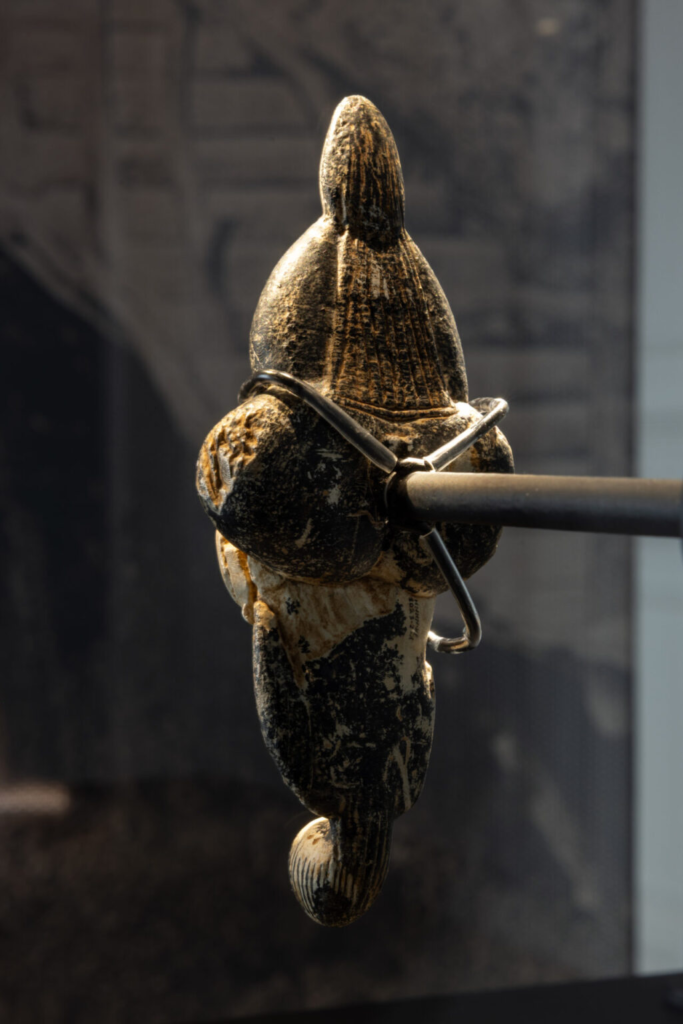
Muséum national d’histoire naturelle, Musée de l’Homme, Paris, HA–19030
© Museum of Cycladic Art
Photo: Paris Tavitian
I think it is incredibly important to realize that the artist considers the person-the viewer, or even the “consumer,” if you will-who will encounter the work. Usually, artists do not work on the parts that are not visible; this relates to the notion of non finito, as Michelangelo described it in many instances. Here, however, I believe we are witnessing a reversal, or even an “anomaly,” in the course of art history. And I would truly like to thank Jeff Koons for sharing this perspective with us, among the many facets of his work.”
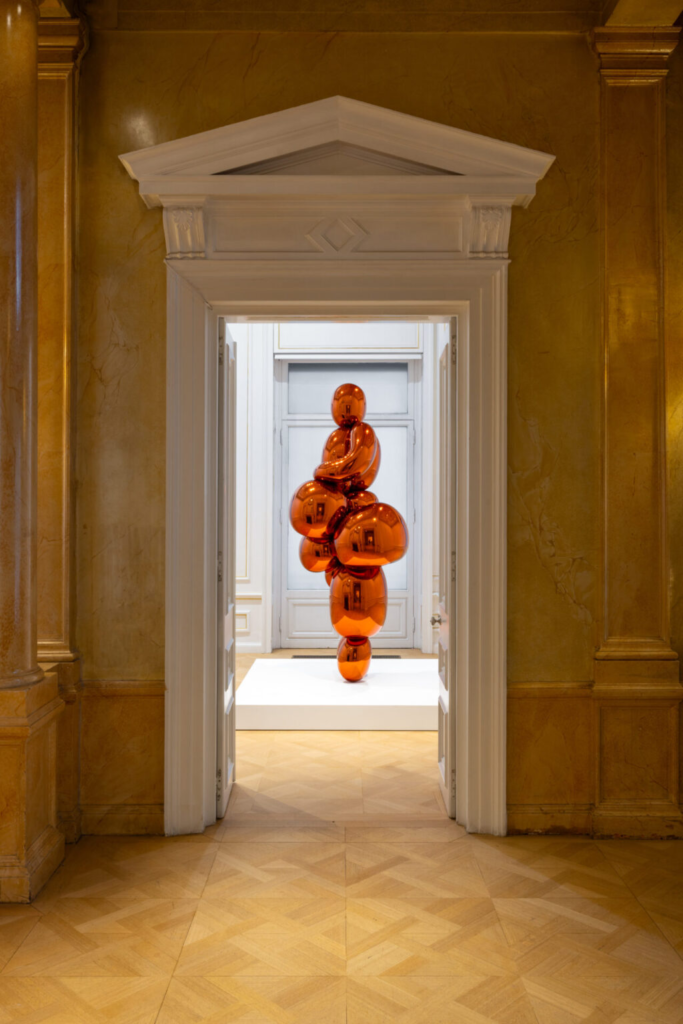
Mirror-polished stainless steel with transparent color coating, 266.9 × 124.1 × 104.7 cm
Edition of 5 unique versions
Homem Sonnabend Collection
Photo: Paris Tavitian © Museum of Cycladic Art
Info
Jeff Koons: “Venus” of Lespugue | Museum of Cycladic Art
UNTIL AUGUST 31, 2026