 Pepi Nikolopoulou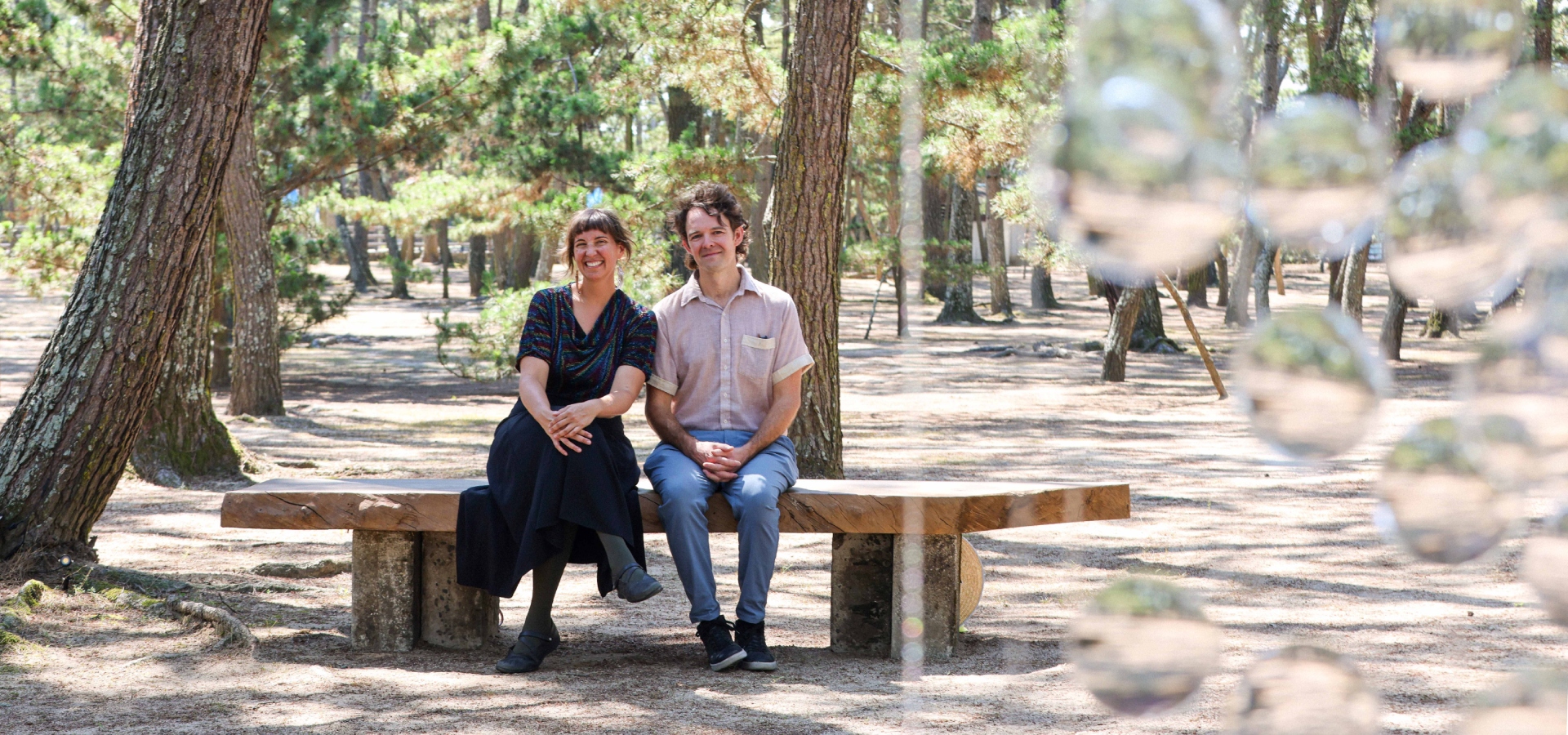
By Sibylla Lymberopoulou
The Canadian artistic duo Caitlind r.c. Brown and Wayne Garrett speak to elc: “With Chronotopia*, we invite visitors to look through thousands of lenses in order to understand how they fragment the world around them into a series of ‘moments’.”*
The 2026 Art Prize of the G. & A. Mamidakis Foundation has been awarded to Canadian artistic duo Caitlind r.c. Brown and Wayne Garrett for their project Chronotopia. Now in its sixth year, the Art Prize offers contemporary artists the opportunity to create unique sculptural installations. The winning works are permanently exhibited in Agios Nikolaos, Crete, becoming integral parts of the Foundation’s collection. Artists from around the world are invited to participate, creating site-specific artworks especially for the competition.
Among 410 submissions, Caitlind r.c. Brown and Wayne Garrett secured the award thanks to the strength of their conceptual approach, the clarity of their artistic language, their technical mastery, and the sustainability of the project. In this interview, they discuss the artwork, its significance, the influence of Crete on its creation, and the Art Prize itself.
What does winning the G. & A. Mamidakis Foundation Art Prize mean to you?
It is an unexpected honour to be selected as the winners of the G. & A. Mamidakis Foundation Art Prize, especially knowing the large number of artists who applied. Above all, it brings us indescribable joy to create a site-specific artwork in Agios Nikolaos, Crete, in a place surrounded by the Mediterranean Sea, birds, lizards, a beautiful garden, and a beach filled with holidaymakers enjoying the sun.
How would you describe Chronotopia to someone who has never experienced it?
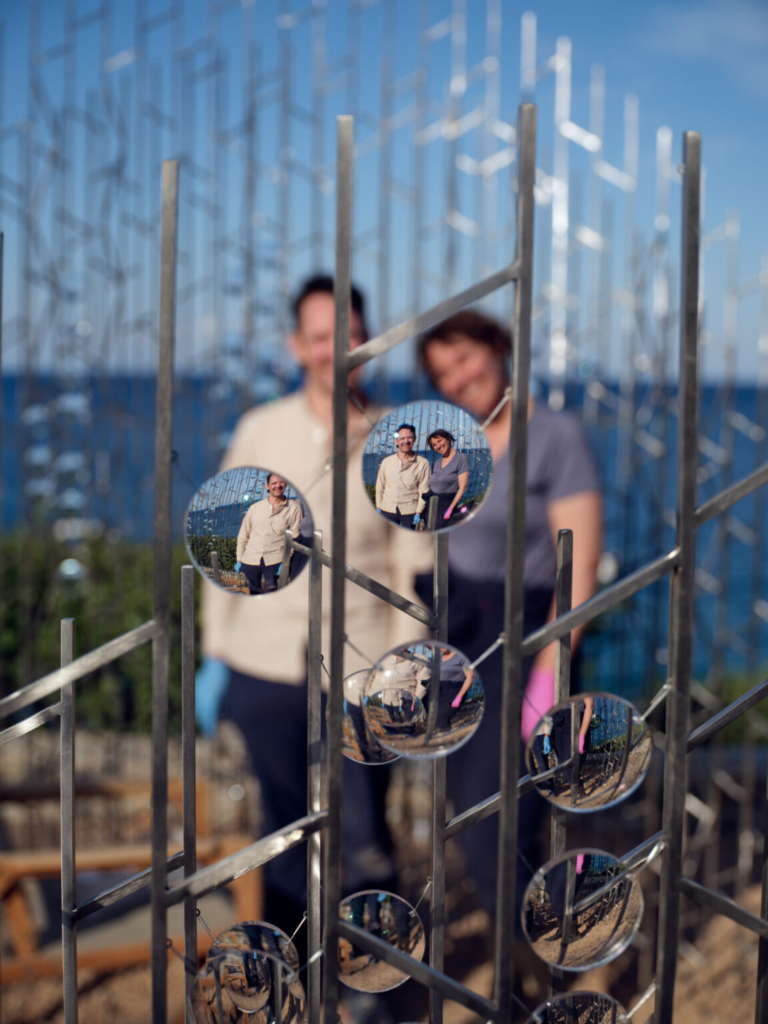
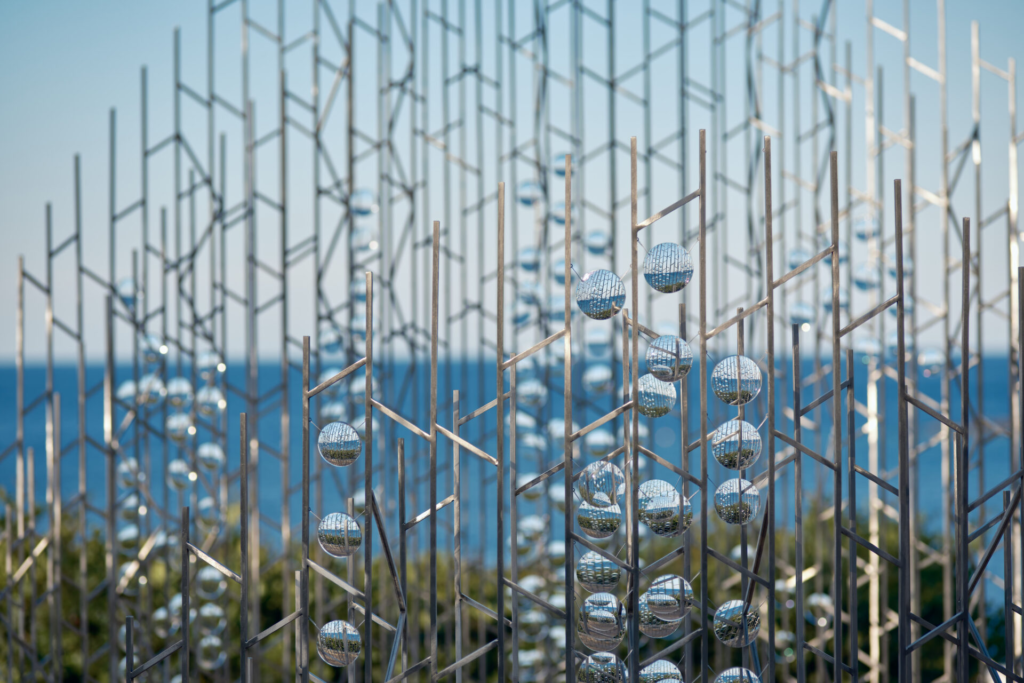
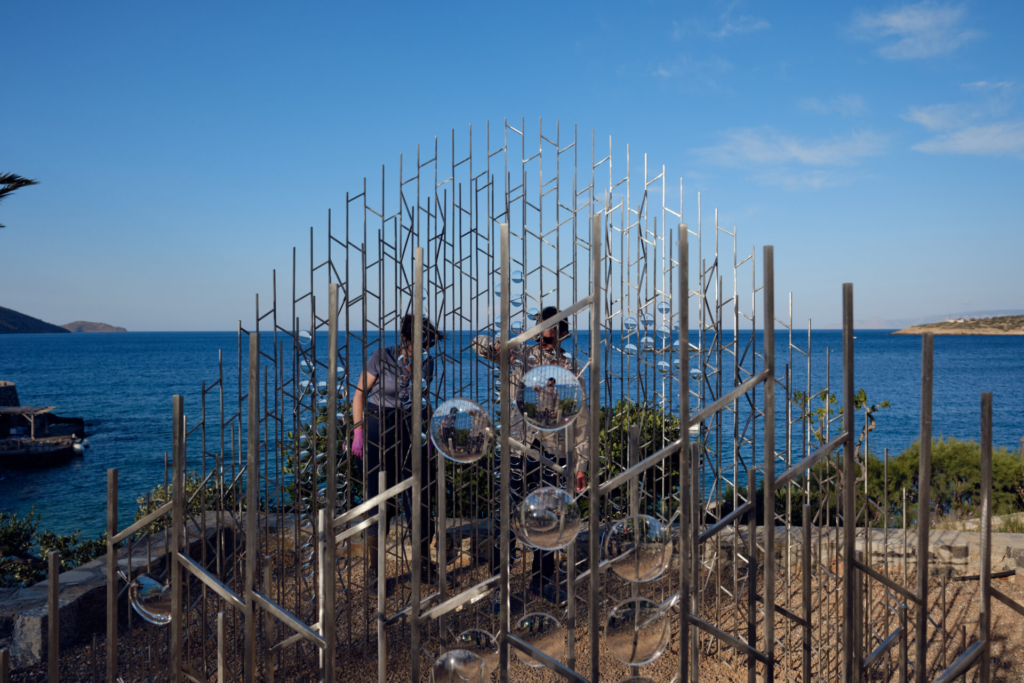
Chronotopia is a shimmering beacon glowing from a platform overlooking the Mediterranean. From a distance, the artwork appears mysterious and ephemeral as it trembles in the wind. As you approach, its materiality gradually reveals itself. Visitors can literally step inside the work, immersing themselves in a world surrounded by optical lenses.
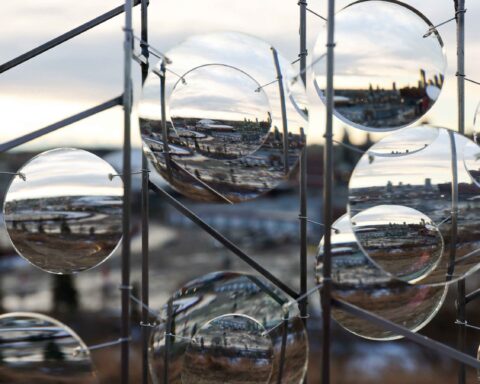
The lenses reveal the surrounding world in constantly shifting ways, much like the land, sea, and sky themselves. Through them, viewers encounter different aspects of the landscape, distorted and displaced through the eyes of countless distinct “optical prescriptions.” The experience is akin to being underwater or wrapped in light.
At night, the work transforms into a galaxy of starlight, offering an entirely different experience from its daytime appearance.
What do you hope to express through Chronotopia?
Chronotopia seeks to illustrate the experience of the “chronotope” – the complex way in which a particular place alters time and time, in turn, alters place. In an ancient and mythologically significant location such as Crete, it is easy to perceive the latter. The way place alters time, however, is often more invisible and harder to grasp.
With Chronotopia, we invite visitors to look through thousands of lenses in order to understand how they fragment the world around them into a series of “moments,” each unfolding simultaneously and eternally, each a galaxy of its own.
This is an experience of place that we rarely contemplate, confined as we are by the singular perspective of our human bodies. Yet the land, the sea, and the sky experience time very differently through their more-than-human localities. Perhaps time unfolds as one continuous reality, everywhere, all at once. We attempt to make the metaphysical tangible and share it through a human perspective.
How does the use of optical lenses contribute to the meaning of the work?
The lenses we use are raw polycarbonate vision lenses. These optical objects are traditionally used to correct eyesight. They are designed to help people see more clearly at a distance, striving toward a shared perception of reality.
For us, these lenses embody a powerful desire shared by many people: to expand our perception beyond the limits of our own singular point of view and move toward a collective understanding of the spaces we inhabit together.
How did Crete influence the conception and realization of the artwork?
When designing Chronotopia, we drew inspiration from Crete’s striking visual character, combined with a more subtle mythological relationship to time. Particularly important to this work is its visual connection to the surrounding environment, especially the blue horizon line of the Mediterranean.
Where would you ideally place the work, and why?
The work was designed specifically to overlook the Mediterranean’s remarkable blue horizon. It interacts with the convergence of water, sky, and land, allowing visitors to observe them through the lenses in ever-changing combinations.
Most importantly, we selected a location at Minos Palace that offers long views and is surrounded by as much vegetation as possible. Visitors approach the artwork from afar, wandering through the gardens before discovering Chronotopia. This small journey becomes part of the experience itself.
What brings the two of you together in this shared artistic practice?
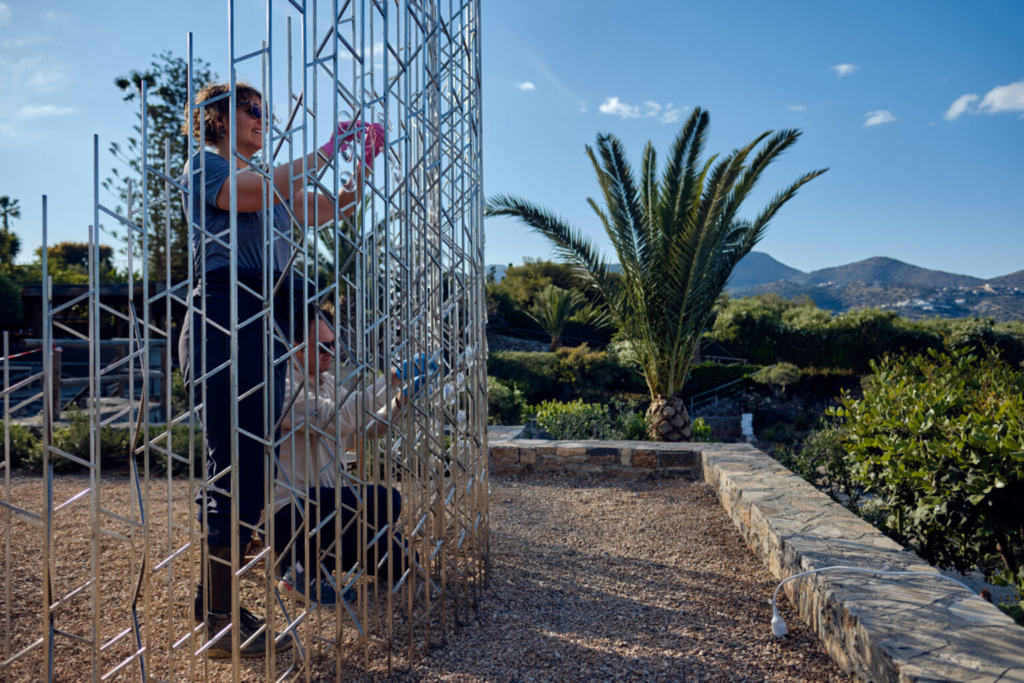
We have been collaborating for more than fifteen years and are often told that we bring together a unique combination of skills. Our backgrounds span conceptual, technical, and administrative expertise, all of which are essential to sustaining a full-time visual arts practice capable of operating across many different contexts and countries.
What unites us is a love of exploring new places, solving problems, and meeting people. For this reason, our work is often people-centred and site-specific. We strive to integrate our projects into every place we visit.
We are always aware that we, and by extension our work, are guests on the land. It is an extraordinary privilege to be invited to work in breathtaking locations such as Crete, and we hope our work reflects the generosity of the places we occupy, allowing visitors to see familiar aspects of their own environment through new eyes.
Caitlind r.c. Brown and Wayne Garrett have collaborated since 2010, focusing on site-specific installations and public art. Together they have exhibited work in countries including Japan, China, and Turkey. Brown’s background in cultural production and Garrett’s training as a machinist and jazz musician bring a distinctive dimension to their artistic practice. Chronotopia embodies precisely this interdisciplinary approach through its phototopic qualities, which challenge and expand human perception.