 elc team
By Stelios Parris | Photos: Ypatia Kornarou
“In a way, we don’t choose the play—I believe the play chooses us. At some point, it feels like a command… I think this first part we brought to Athens is one of those we felt was inevitable. Especially when you consider what is happening in our world.”
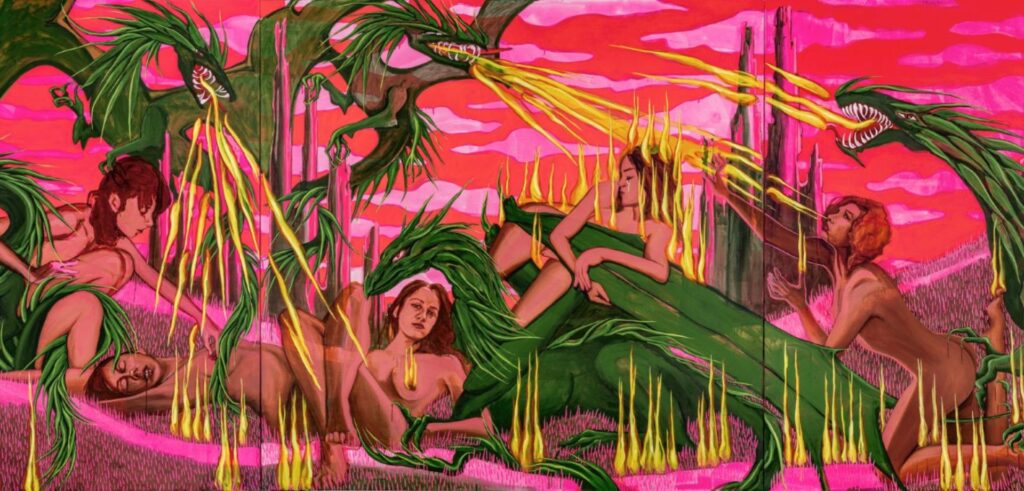
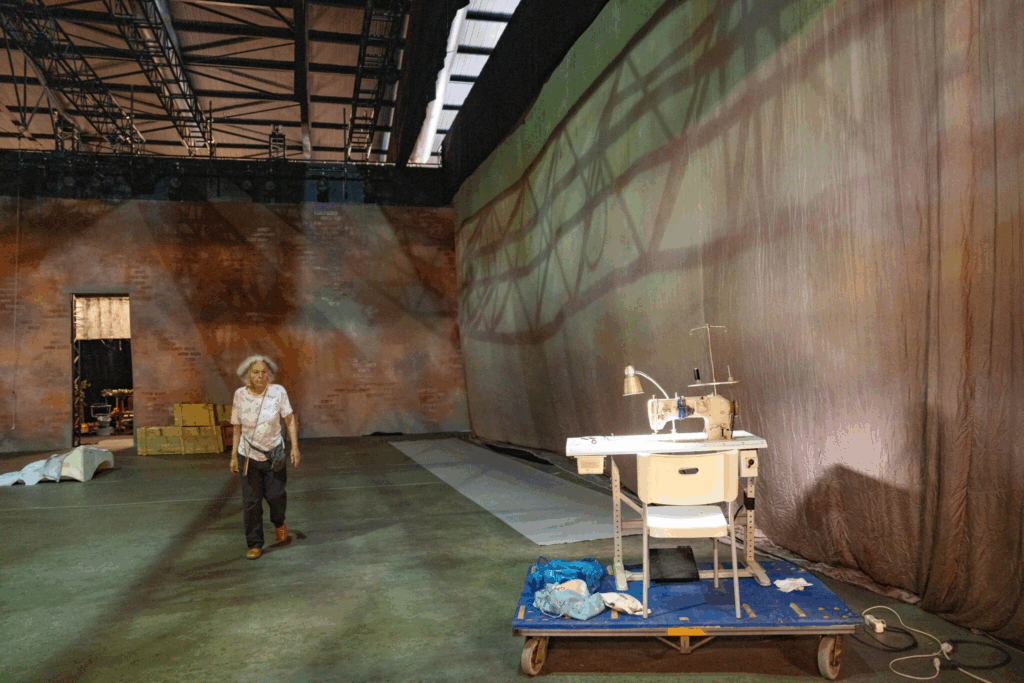
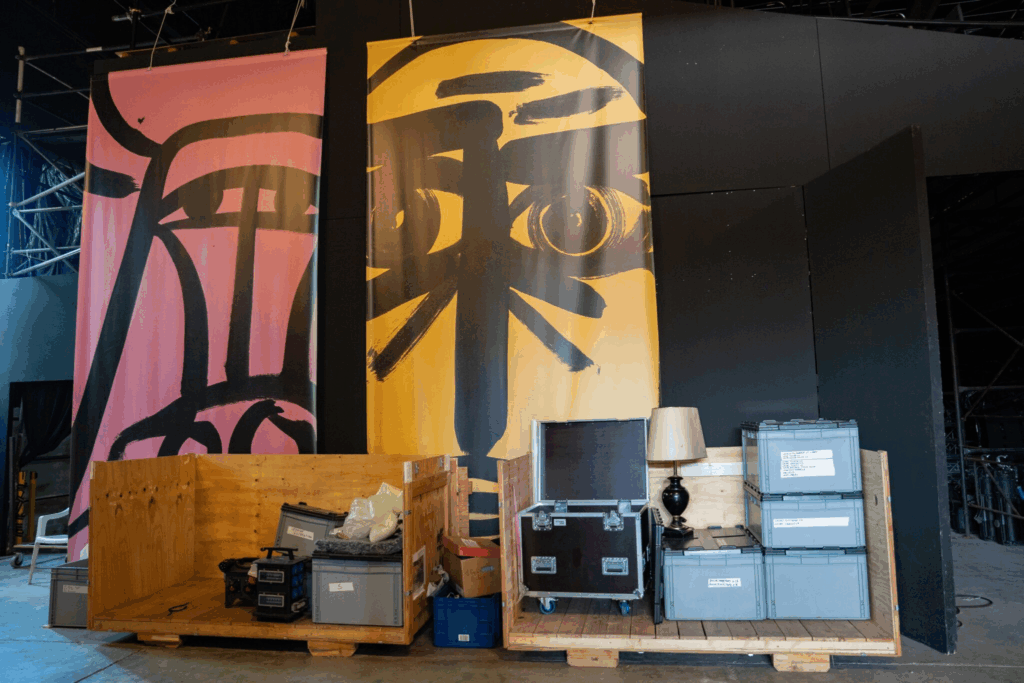
I was walking through the garage of Piraeus 260, absentmindedly observing the wooden crates lined up in rows, each one carefully numbered. On the side, stenciled in black spray paint, were the words Théâtre du Soleil. “The Theatre of the Sun has returned to the land of light,” I thought, and began searching for the dragons. But there were no dragons—just people heading toward Hall D, where the set for Here Be Dragons / Hic sunt Dracones by Ariane Mnouchkine was being assembled.
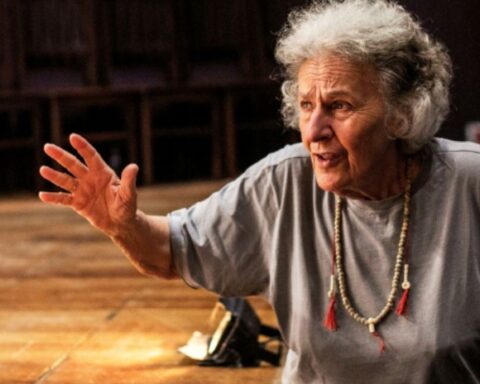
I spotted her sitting at the large table in the dressing room area next to Hall D, dominated by that bold red metal staircase. She was deep in conversation with her team, phone in hand and surrounded by notes. Her gray hair unruly, her gaze arresting. “You’re fishing for compliments,” she said when I asked if she felt there was anything different about our festival, compared to the many others she’s attended throughout her career. She didn’t have much time—I didn’t want to disturb her—but I managed to ask a few questions.
“Like all festivals, this one is a celebration, a party. And we like parties,” she said, smiling warmly—so much like her Théâtre du Soleil, which she founded 61 years ago.
“When you come to Greece, you come to your roots—your cultural roots. So, yes, it’s emotionally significant. When you go to Tokyo, you go to an extraordinary culture, to otherness, which is also very important to me. So these are two different kinds of feelings. Japan has become a kind of path for me too. But when you’re in Greece, everything feels like a path: the word, the letters, mega, micro. So it’s a spiritual journey. And of course, it’s also an artistic journey—even if it weren’t a theater festival. It has to do with our inner evolution.”
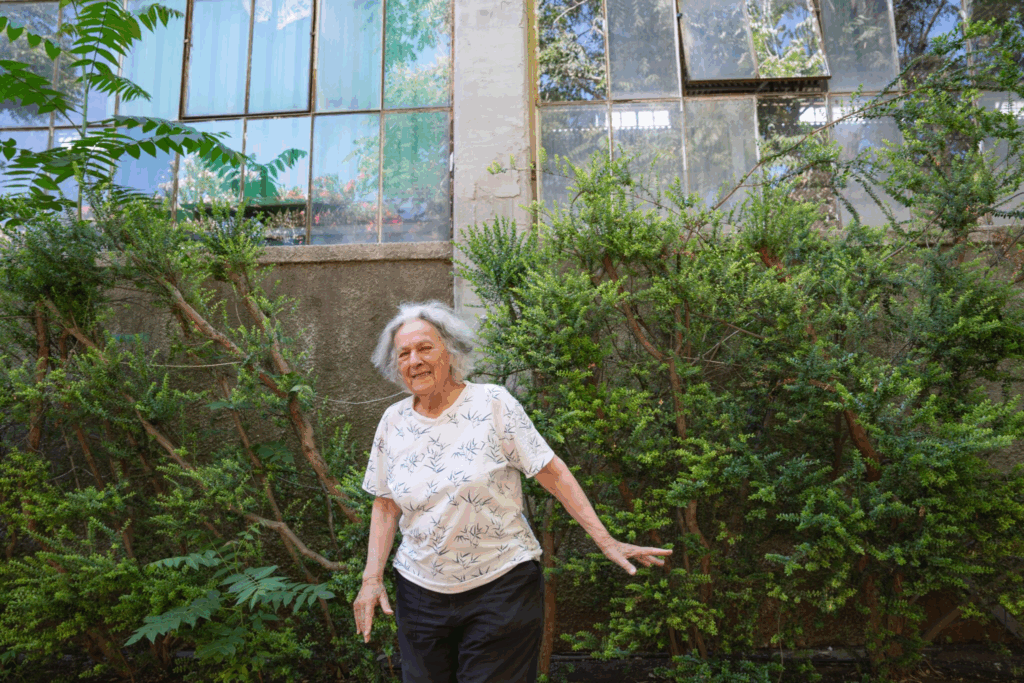
You founded Théâtre du Soleil 61 years ago—almost like a commune. Do you believe that communities like our Athens and Epidaurus Festival could be seen as a kind of cultural commune?
“I think that’s already happening—at least here, in this place. I can’t speak for the entire festival because it’s so vast, so immense. But here, where we are now, with the people around us, the ones who take care of us, yes—it feels like a little village. It’s very intimate here. What’s happening today between my team and the Greek team, even with the language barrier, feels familiar. We understand each other quickly, almost like we’ve been working together for years. And that’s wonderful.”
She couldn’t recall exactly how she felt during her first visit in 2006 to the Athens and Epidaurus Festival—and who could blame her? She’s been to so many festivals, in so many countries. She may not have stored those memories, but she remembered to say thank you.
“I want to thank Giorgos Loukos, who invited us when he was the artistic director. And thank you to Katerina Evangelatos as well. We are very, very grateful and very happy to be here. There’s a good feeling here—a sense of peace, which is rare and therefore precious.”
Immediately, I recalled an image of her in 2011, standing in Syntagma Square during the protests and social unrest in Greece.
“That was a deeply moving moment, when we joined the demonstration with the giant puppet, the big statue. That’s something we will all remember—it was beautiful and very emotional.”
I realized she has met the Greek audience both in the theater and in protest. I asked her how she feels about Greek audiences when she brings her work here.
“It’s funny—everyone asks this question. Brazilians ask me if their audience is warmer than others. The truth is, there are of course differences, but the audience is the audience—and the play is the play. There’s something universal. For example, we went to Taiwan with Les Éphémeres—a very French play—and I was worried. I thought, how will they connect with something so unfamiliar? But to my surprise, people cried at exactly the same moment as they did in France. Things I thought were purely local turned out to be global. Hopefully, the same will happen with our latest work. Because I truly believe that a theater audience, wherever it is—in France, Germany, Greece, Taiwan, or Korea—is made up of human beings. The same emotions, the same understanding, the same humanity arise. And that’s what will happen here too.”
How do you think the Greek audience will respond to Here Be Dragons?
“I honestly don’t know. The play deals with a very specific period—it speaks about the Russian Revolution. In France, for instance, sometimes we don’t have a clear understanding of what really happened—who Lenin, Stalin, or Gusin were, beyond the communist mythology. I don’t know how this is viewed here in Greece, what the prevailing mythology is around Bolshevism. So we’ll find out during the performance.”
I told her that we, too, are in a period of unrest—teetering between the tragic and the dramatic. She nodded, knowingly, as if she had already studied our political situation. We are all boiling European societies, I told her, and asked how she chooses her themes—what inner need drives her creative choices.
“You know, I don’t really know—because, in a way, I feel like we don’t choose the work. The work chooses us. At some point, it feels like a command, as if we simply can’t do anything else. It becomes important. It becomes necessary. It becomes inevitable. I think this first part of the trilogy we brought to Athens is one of those inevitable works. Especially given what’s happening in the world right now. We began this trilogy—yes, it will be a trilogy—because we want to understand the tragedy of our Time. So for us, it was inevitable. Sometimes it becomes inevitable for the audience as well, but that’s not for us to decide. The gods of theater decide that.”
I couldn’t help but ask about the link between ancient tragedies and today’s tragedies.
“Of course there is one—otherwise ancient Greek tragedies wouldn’t still be so famous. So yes, there is a connection to the present. Greek tragedies—and many other works—are universal, both geographically and temporally.”
Would you like to see one of your works performed in Ancient Theater of Epidaurus? Would that feel like a milestone for you? Do you believe that space holds a certain energy?
“Well, if I said no, I’d be the first person ever to say no. So yes, of course—there’s something miraculous about it. When you go there, when you sit and hear the acoustics, you think: how is this even possible? If you close your eyes, you can imagine the people, the noise, the scent, the joy. And the fear. It would be incredible to stage a play there. But I don’t think in terms of conquest. Everything that comes is a blessing. And in a way, that place is too sacred to be conquered. If we ever perform there, it won’t be about conquering it—it will be about being conquered by the history of theater.”
This is only the first part of your trilogy. So we’ll be waiting for the next two parts, I told her.
“I hope so,” she replied. She didn’t want to share too much about Here Be Dragons, saying she prefers not to give directions to the audience. I said goodbye with a final wish: “I hope one day we’ll see a work of yours made specifically for the Ancient Theatre of Epidaurus.” She smiled and said, “I’ll think of something.”
As I left the space at Piraeus 260, I saw the Greek Festival team at work—craftsmen moving scenery, art workers opening the wooden crates that contained the dreams of Théâtre du Soleil. I managed one last glance inside one of them and saw a blue suitcase nestled among layers of fabric. I hadn’t seen any dragons that day, but I had met the woman who gave birth to them. No flames came from her mouth—only gentle, wise words.

In the end, the greatest artists—those as rare as dragons—are the most grounded of all. The Greek audience loves Ariane Mnouchkine. Every one of her productions is sold out. And as for me, I can only hope that one day, when the trilogy is complete, I will see her in Epidaurus—with a creation as rare and unique as the dragons she conjures.