 elc team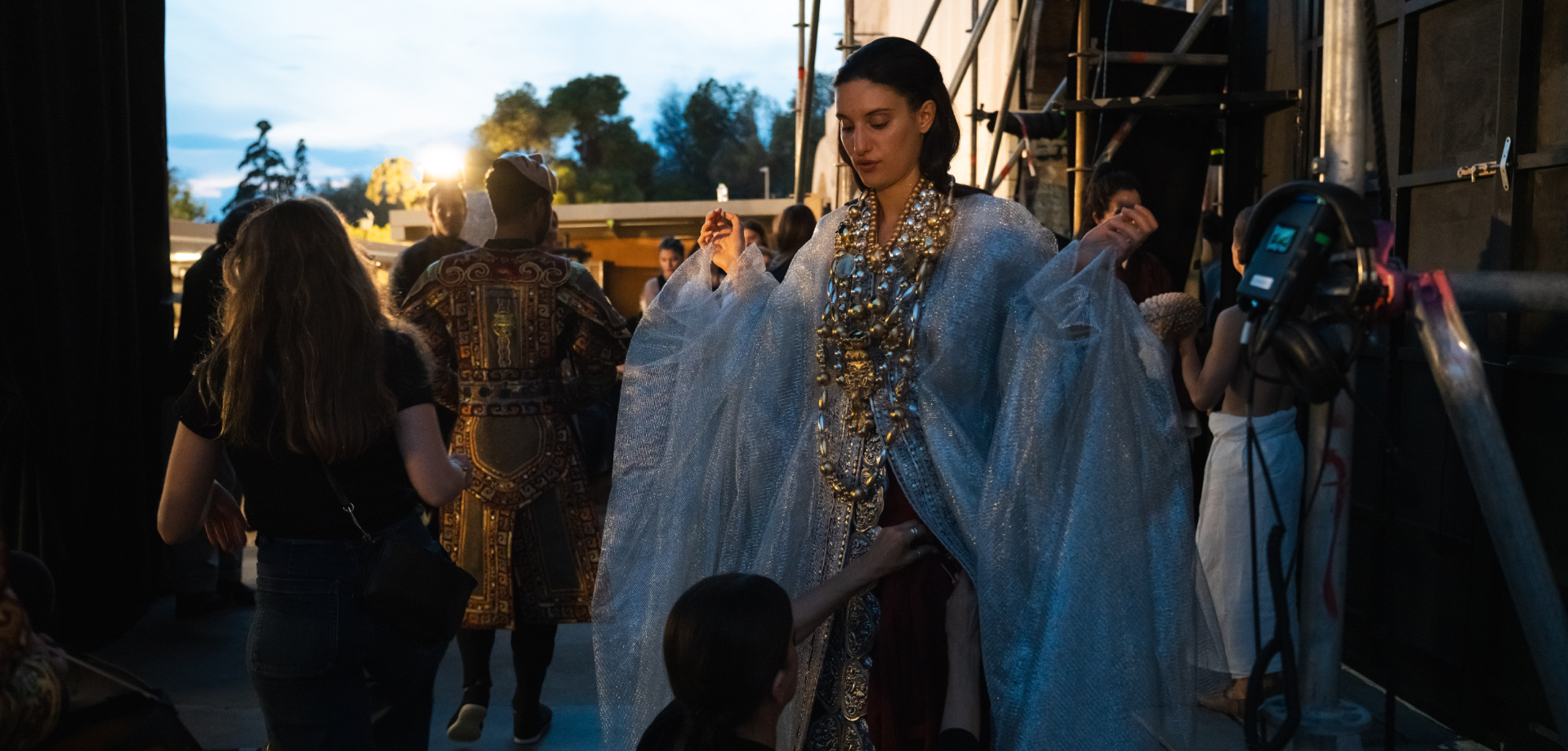
By Stelios Parris
We attended the chilling Turandot under the musical direction of Pier Giorgio Morandi, stage direction by Andrei Șerban, and set & costume design by Chloé Obolensky — and spoke with soprano Maria Kosovitsa and choreographer Georgia Tegou.
Everything begins in silence. You hear only the footsteps of the characters on the wooden floor that covers part of the orchestra at the Odeon of Herodes Atticus. A red banner is hanging, and many bamboo poles. A girl is being chased—four men tear her clothes and five sickles fall. Three riddles must be solved. Two choirs merge with the voice of the people. A performance using masks, imaginative costumes, and unexpected choreography. A lyrical, experimental experience full of visual surprises—and at one moment, even fragrant.
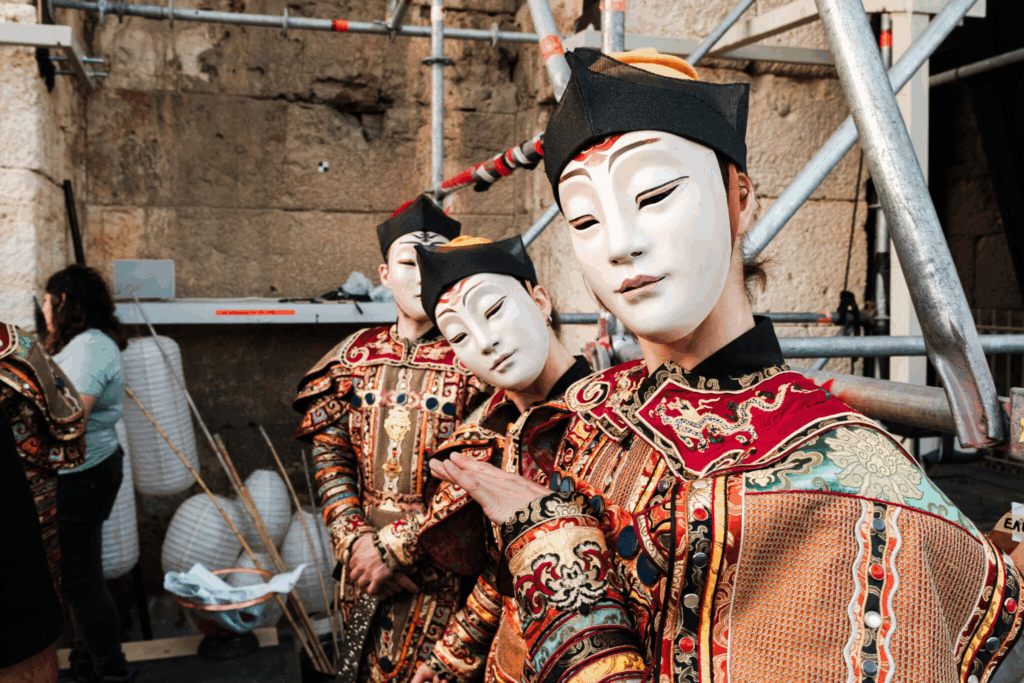
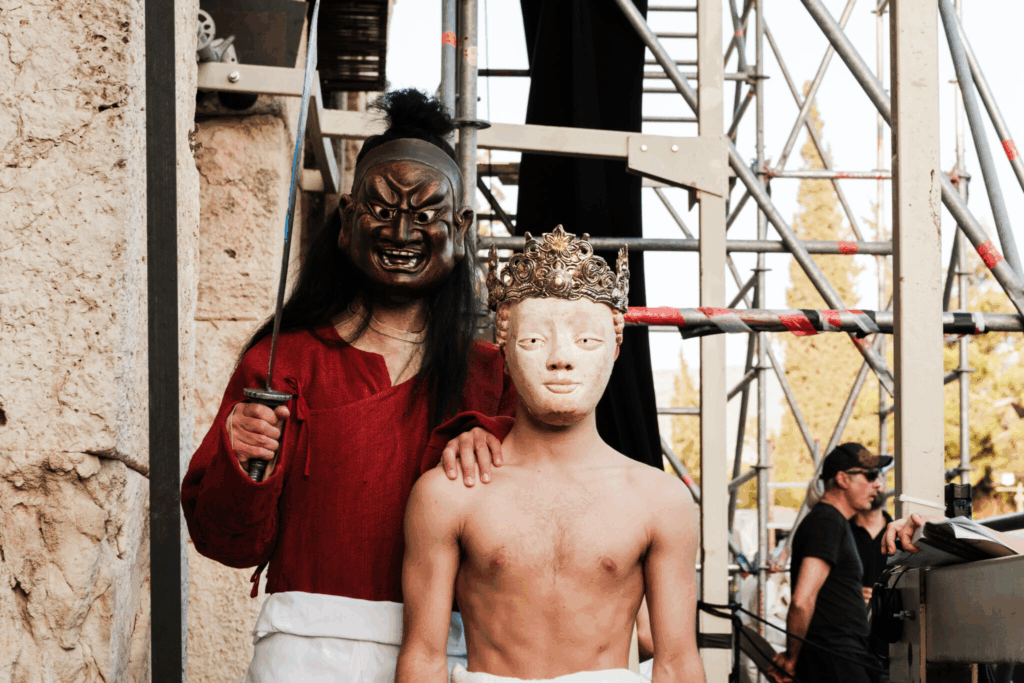
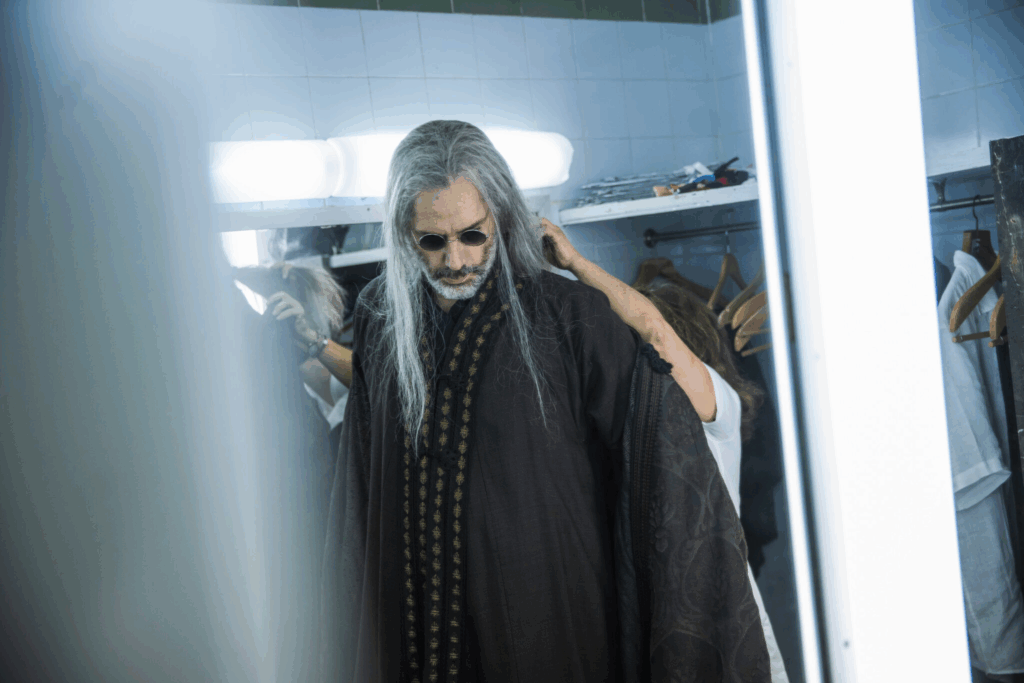
Let me not spoil the rest of the production prepared for us by the Greek National Opera. Instead, I’d rather share with you two conversations I had just before the General Rehearsal of “Turandot” at the Herodion, under the musical direction of Pier Giorgio Morandi, stage direction by Andrei Șerban, and set and costume design by Chloé Obolensky. Costumes were hung, opera singers warming up their voices, and dancers preparing. People in a creative frenzy, and me, watching from backstage with a smile like a gleeful child—this production had already won me over. In my ear, I held onto the question of what I might ask soprano Maria Kosovitsa and choreographer-dancer Georgia Tegou. But whatever I had initially planned to ask, I set aside, won over by their warmth and their smiles. Some call it stage fright—the artist’s tension before revealing their labor to an audience—but I call it a creative climax.

How are you involved in Turandot?
In this production, I was invited by Ms. Kate Flatt, who is the choreographer of the show, and I’m her collaborator. We’re working together on the choreography of this piece—and to explain it better, let’s go one step back.
Wait, before you choreograph me step by step—if Kate herself invited you, that means you’re a great choreographer and movement director too.
I hope so! I met Kate Flatt in London almost ten years ago. I live and work there. I saw her speak at a choreography conference and was deeply inspired. The way she spoke about choreography really spoke to me.
What do you remember from what she said at the conference? Anything specific?
What stuck with me was how she spoke about strategy, about structuring a language. Choreography as a language through which you communicate, conveying deeper meaning. I don’t recall her exact words, but seeing her there inspired me so much. At the time, I had a fellowship where young choreographers could observe the rehearsals of more established ones. So I asked to observe Kate’s rehearsals—and that’s how we met.
Which show was she working on then?
Les Misérables.
The musical?
Yes, yes—Kate did the original choreography.

And a Greek woman found herself learning beside her.
She allowed me to sit in on her rehearsals, mentored me, and was incredibly welcoming. We’ve maintained a great relationship ever since. She’s attended my shows, given me feedback, and then one day she called to invite me to work on this production of Turandot. It’s a revival of Andrei Șerban’s legendary production from 1984, where he first worked with Kate 40 years ago. But here it’s a completely new adaptation—with new set design and costumes by Chloé Obolensky—so everything’s different. And Andrei is someone who loves to experiment and innovate constantly.
Will we, the audience, experience this experimentation?
Yes—very much so. It’s beautiful.
Based on what you said earlier—that choreography is a language—does it apply the same whether it’s Broadway, a musical, contemporary dance, or the Herodion?
Yes, absolutely. It communicates. And Andrei wanted to bring in his longtime collaborator Kate, to present a work that has had huge success at the Royal Opera House for 40 years. But here, everything is new—new space, new approach. The Herodion is such a unique venue, and this is essentially a new work. Different set design, a different directorial vision. Still, they wanted to preserve some elements from the old production. So Kate invited me to help carry over some of that material while imagining the new together.
And did you succeed?
Yes, we had a wonderful collaboration.
Give us a little hint—what moment gave you chills personally?
There are many intense, powerful moments. The whole show is in motion. Andrei loves movement. It’s a living, breathing human landscape throughout. For me, this invitation was special—I worked with amazing people like Kate, Andrei, and Ms. Chloé, and learned so much from them.
ou’re working with Chloé Obolensky on sets and costumes—she’s a school in herself, I assume.
Yes, even from our first creative meetings, I could feel their energy and inspiration. It felt like there was a real flow—of creativity, of exchange, of experience. It’s like I went back to school for two months. This invitation from Kate was incredibly generous—and the fact that she brought me on as her collaborator rather than an assistant was huge.
So essentially, it was on equal terms.
Well, I’m still her collaborator, but yes, I was invited as part of the creative team—which is a tremendous honor for me.

Did you already love Puccini’s Turandot before this?
I’ve always loved classical music—I’m also a classical pianist, in addition to being a dancer. So it was like the puzzle pieces of my life came together: my love for music and my love for dance.
Then can I ask something that always intrigued me about Turandot? It’s Puccini’s final opera—why is it considered so special?
Yes, it’s extraordinary. The last section Puccini wrote was Liu’s funeral, and that part is haunting—it’s like he knew it would be his final work, his swan song. It feels like his personal requiem. I think it’s the most powerful moment in the whole score.
Have you ever played that piece on the piano?
I’ve tried playing the overture—after watching the pianist during rehearsals in London, which was an incredible experience. I got the score and started exploring, just to see—can I?
These collaborations seem deeply rewarding.
Yes, very much so. Collaboration is something I really care about. I’ve never belonged to one single “language”—there’s music, there’s dance, I love design and architecture. I mix all of them in my work. I use costume as a performative object—it’s a partner to me. As is any object: the sword, the skull, the mask. So all the elements Ms. Obolensky brought to this production inspired me in how I choreographed movement—for both dancers and actors.
There’s also a children’s choir on stage. Did you get them to move too?
No, the choirs don’t move.
They’re not supposed to?
I won’t reveal that secret.
Do you think Greek audiences have embraced opera? The Herodion hosts operas every year through the Athens Epidaurus Festival and other productions.
I think Greeks are quite familiar with theatre—it’s part of our lives from an early age. Even if we don’t think of ourselves as “theatre lovers” like abroad, people still say Greeks are theatre-goers. I believe some things are in our DNA, somehow part of our tradition.
Did you face any choreographic challenges in this production?
One of the key things Kate and I had to pay attention to was that the piece already had an existing choreographic language. And by language, I mean a code of movement. You can’t just invent new things on a whim. You need to stay true to the existing material and build something new on top of it. You have to work with that same movement code—it’s not a limitation, but a kind of guiding framework. Otherwise, one act might feel like it belongs to a different opera altogether. You have to be consistent.
Did you ever propose something that you thought might be “too much”—a kind of sacrilege to Turandot?
Yes, I dared! Kate and I have a very good relationship—sometimes she laughs at my overenthusiasm…
Did she also take bold steps, even if not necessarily modern ones?
She did. This whole team is so inspiring because they’re all open to experimentation and innovation. It’s beautiful to see that. They’re still fresh.
Fresh, despite their years of experience.
Exactly. They haven’t become complacent—they want to keep exploring.
So, the conclusion: great artists never settle. They take risks.
That’s true. I don’t think any big name became big by accident.
Do you have any artistic dreams—maybe something bold you’d like to do in opera?
I want to create my own. I have an idea for a contemporary opera—but I won’t reveal everything just yet.
You’ll tell me when rehearsals begin for your own opera.
If I make it happen…
You will.
Conversation with Maria Kosovitsa
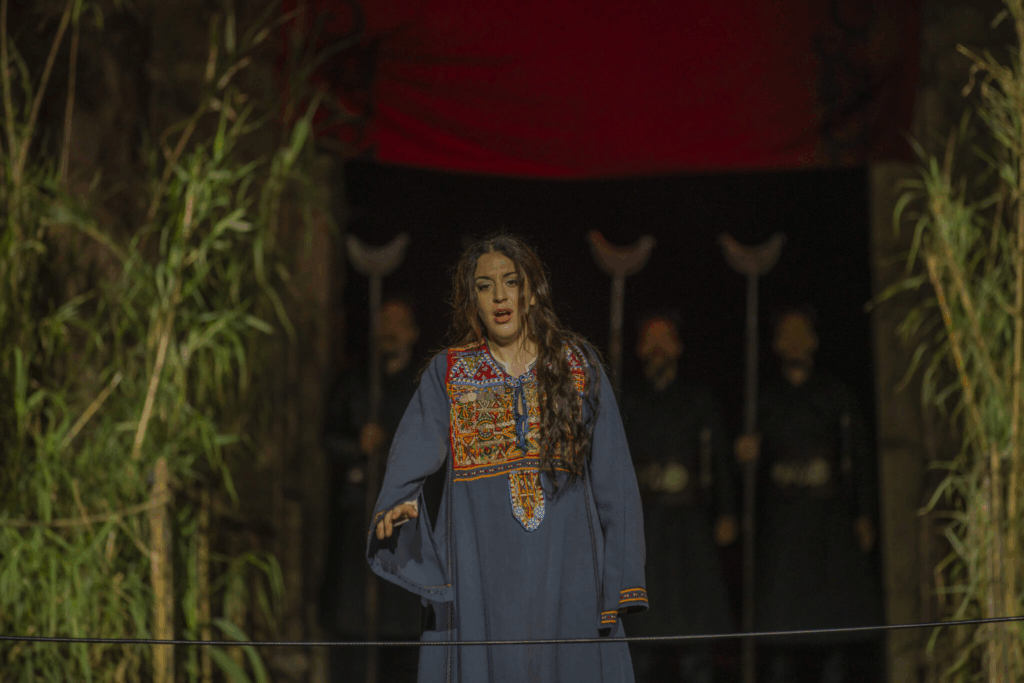
Have you done your warm-ups?
Yes—my warm-ups, my hair, my costumes—everything’s ready for the performance.
How long does the warm-up take?
A good warm-up takes about half an hour.
What you do is basically athleticism.
Yes, it’s definitely high-performance sport. An artist’s routine shares a lot with that of an athlete. You need good sleep, healthy food, daily voice and body training—it’s a full package that keeps you in shape.
Was this always your dream since childhood?
Honestly, I didn’t realize how demanding it would be. The job is taxing—on the voice, the body, the soul. But each part of it has its own value, its own joy.
Is this your first time performing at the Herodion?
Yes—it’s my first time. Can you tell how nervous I am?
Describe this nervousness—consider me your stress reliever, pass it on to me.
I feel deeply nervous, but also deeply moved. Being here, in such an iconic venue, among so many extraordinary artists—from the director and conductor to all the cast—is overwhelming. These are people who’ve left their mark on this art. Andrei Șerban, Chloé Obolensky, Kate Flatt, our maestro Pier Giorgio Morandi—they’re legends.
Do you feel like they embraced you as their “little soprano” just before you spread your wings?
Absolutely. The atmosphere is so warm and full of love. Also, Ms. Cellia Costea, who plays Liu in the first cast, is not only a phenomenal soprano but also an exceptional person. She has protected and supported me like few others I’ve met in this field.
So one day you’ll say: my first time at the Herodion was playing the slave girl.
A slave girl from the Kingdom of the Tatars, where Timur and his son Calaf come from before they reach Beijing.
And what’s it like having two “mistresses,” since you perform in both casts? How do the two Turandots differ?
It’s an incredible experience, because each artist brings something unique to the role. Working with two different Turandots challenges me to find new aspects of myself within the character—it enriches the role constantly.
Tell me something you’ve learned from each of your Turandots.
Ms. Lise Lindstrom, with whom we’ve done most of the rehearsals, is incredibly sweet. Despite her fame and success, she’s humble and creates such a joyful working environment. She’s taught me that above all, this work should be about joy. Then, Ms. Catherine Foster is a powerhouse in this role. Her discipline and seriousness in approaching the character is a lesson in itself.
Does the role of Liu have something tragic about it?
Definitely. Liu is platonically in love with Calaf, though he doesn’t know it—perhaps chooses not to know it. She doesn’t sing much in terms of quantity, but her presence is vital. Her actions are pivotal to the plot. What she does changes the entire course of the opera. It’s a tragic moment, but also one that reveals the power of sacrificial love—how it can transform people.
What is it about love in Turandot that requires solving three riddles before you can enjoy it?
From Calaf’s side, love certainly has its challenges—as we’ve all experienced. But love is also such a powerful force that it disregards danger completely.
Have you ever sacrificed love for your career or that athlete-like discipline we spoke about?
Yes.
So sacrifices are real.
They are. Perhaps it’s also because at that time, I hadn’t fully figured out what I wanted. But I believe that if you find someone who truly connects with you, who loves and supports you—even with a demanding schedule—then love can actually strengthen your art. It’s definitely possible.
So you’re a “slave” to both Love and the Herodion—because this is just the beginning of your journey.
Exactly—it’s my artistic debut with the Greek National Opera and in this role.
What do you feel about this venue—its energy?
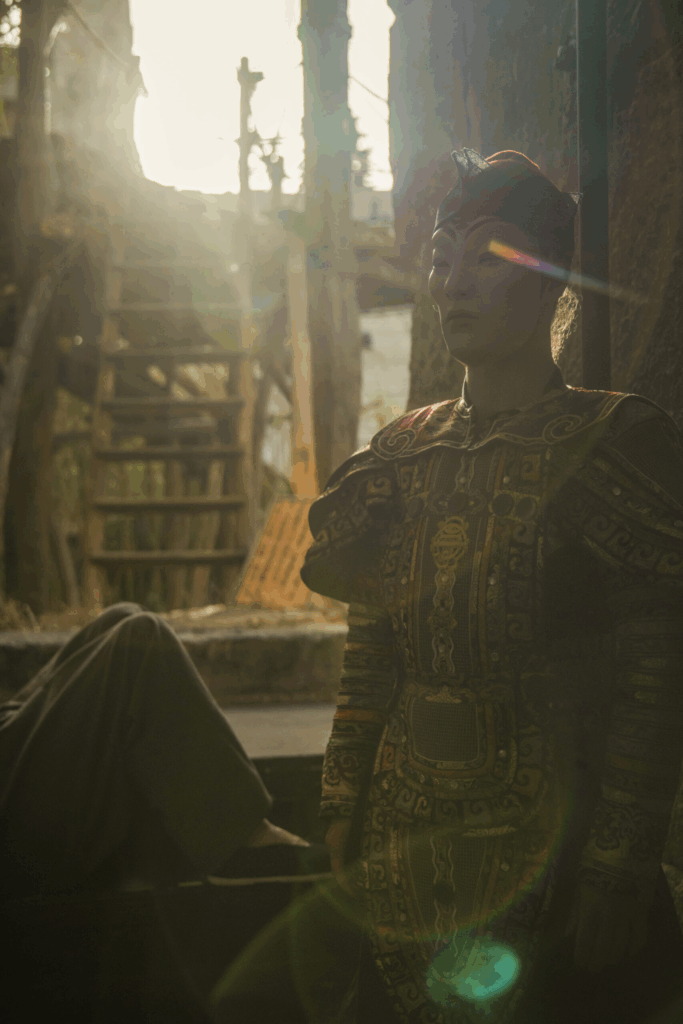
It’s incredible. The space itself adds energy to the performance. It becomes part of the set. And because of the gravitas of the place, it makes our interpretations even deeper.
Earlier, you mentioned you were nervous.
Very much so.
But you don’t seem it while we’re talking—so you must be a good actress too.
No—I think you’re just being very kind. You don’t make me feel afraid.
And right at the moment when our conversation was about to end, something happened—one of those magical coincidences life sometimes gifts us. A knock at the door, and a man poked his head in.
MK: Hello!
Everything alright?
MK: All good.
Are we going to crush it out there?
MK: We’re trying.
Are we going to crush it?
MK: Yes!
That’s the spirit! Break a leg!
MK: Thank you so much for everything.
You’ll be amazing. And remember—when there’s an audience, you won’t hear your own voice. Tonight, you’ll hear a bit more because the central seating area will be more empty, but during the real performance, it’ll be full. Just sing like you always do. Don’t push. Just sing beautifully, as always.
MK: Thank you. Truly, thank you.
Who was that?
That was Mr. Panagis Pagoulatos—our casting director at the Greek National Opera.
He came to give her strength, to wish her luck, to offer a few final, human words to ease any lingering fear. Isn’t that magical?
You see? I wish art continues to unite us all.
And I wish to see you many more times on stage at the Herodion.
Amen.
And I hope I have the honor one day to interview you again—for your first lead role. Close your eyes and tell me: which role would that be?
Can I say something that may not be possible now… maybe in the future?
Your dreams are yours. We don’t ask for permission to dream.
Madama Butterfly by Puccini.
And so I wished her well, kissed her hand, and let her return to her preparation—ten minutes before the curtain would rise. I made my way to the audience, and as I climbed the steps, Chloé Obolensky darted past me like a panther. I sat and stared at the Odeon, which is now entering its most minimalist phase yet—it will take a rest after this summer season. The monument needs it. We’ll find other stages. We won’t lose our festival summers.
I must admit, my eyes delighted in the sight of the Herodion’s arches, stripped of the metallic rigging that usually holds up the lights. I dare hope that, when it welcomes us again, it will favor minimalist infrastructure. I love simplicity—even though the Turandot I watched was bursting with imagery, surprises, and motion. But the simplicity I long for did exist—because the staging and movement had a clear purpose. They were never excessive.
I won’t describe the performance further—or the shivers I felt watching Maria Kosovitsa. I had already bonded with her—I was holding my breath along with her—and yes, she stood proudly next to her fellow artists, all of whom gave their souls to the stage. At one point, a breeze sent the scent of incense into the air, as if the gods of art had blessed the scene—making the sets and costumes come alive even more.
As I left, a lone woman was quietly humming Nessun Dorma—the same aria that once haunted me, back when I was a teenager pretending to be Pavarotti with my friends, not knowing a word of Italian:
“Dilegua, o notte! Tramontate, stelle! Tramontate, stelle! All’alba vincerò! Vincerò! Vincerò!” “Fade away, o night! Set, you stars! At dawn, I will win! I will win! I will win!”
And we will all win.
You too, Georgia Tegou, when you create your own contemporary opera.
And you, Maria Kosovitsa, who will become a great soprano.
I’ll always remember that night in 2025 when I went to the Herodion and watched a Turandot that gave me chills—the first one that made me cry. Because I had already connected with two women who are the future.
Info
Dates:
June 1, 3, 5, 6 & 8, 2025
Start time: 21:00 (9:00 PM)
Ticket prices:
From €15 to €130
Odeon of Herodes Atticus
Dionysiou Areopagitou St., Athens, Greece
Tel: +30 210 3232771