 elc team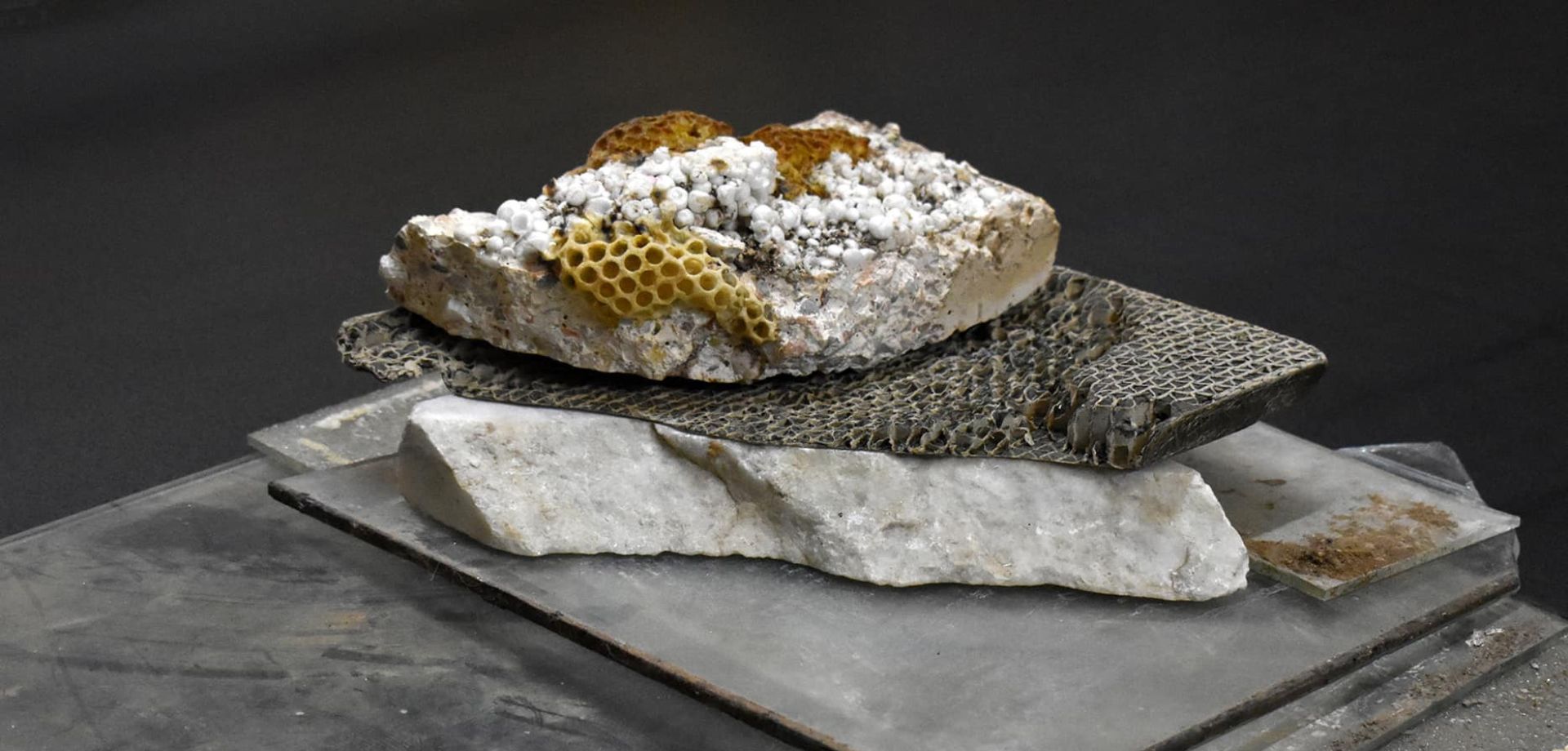
What does it signify if we have reached the end of the natural landscape as we knew it?
Are we entering a post-territorial reality, where digital, virtual, or algorithmic landscapes surpass the natural? Does Google Maps constitute a new form of geological stratum? How does one excavate a mode of mediation or other remnants that seemingly lack physical substance? What does this mean for archaeological stratigraphy?
The exhibition This way the traces never die is the outcome of an artistic exploration focused on the landscape as both a concept and a material object of memory, transformation, and absence. Through a series of works that act as witnesses or hybrid remnants, Athina Koumparouli constructs a narrative with open-ended questions around the landscape and its loss during an era of climate crisis.
Matter emerges as a vessel of memory — a container of stories, a time capsule that can offer insights into past uses of the landscape that led to its disappearance.
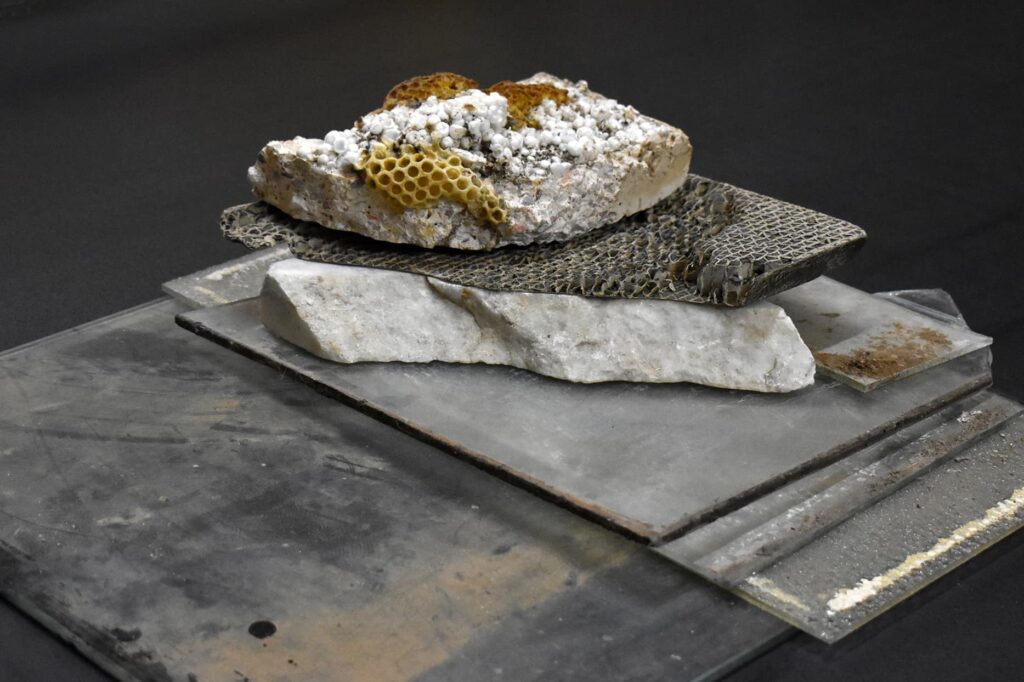

The works in the exhibition depict gestures that do not aim to preserve what remains, but rather turn toward the excavation of what has vanished. The artist’s experience as a conservator of antiquities — and specifically the restoration of an object made of vegetal tar — serves as the starting point for the exhibition. A chronological coincidence with the surge of wildfires during 2021–2024 redirected the research process, with devastated landscapes serving as case studies.
Adopting archaeological methodology and transforming it into an artistic tool, the artist presents a new form of excavation that includes fragments of the landscapes under investigation. Among them, casts of charred tree roots function as natural archives and imprints of destruction. In parallel, three-dimensional model-fragments of now-lost trees are digitally reconstructed using photogrammetry and Google Street View data.
Seeking presence through absence, the exhibition maps a landscape that is both imaginary and deeply real.
The exhibition also includes archival and photographic material from the artistic research, intrinsically linked to the artist’s practice.

The notion of absence serves as the central axis of the exhibition — not as something static, nor through the grief of loss, but as a field of exploration: how we might encounter the landscape again, even when it is no longer visible. Ultimately, it is a quest for a new relationship with the irreversibly transformed landscape.
The exhibition text is written by Kyveli Mavrokordopoulou. The exhibition is accompanied by a printed publication and a video, both of which include textual and visual interventions by other artists and researchers. They operate as a constellation of conversations among friends, where personal reflections compose a collective commentary on the work.
(Contributors to the publication: Peggy Zali and Panagiotis Lianos, Katerina Stamou, Alexandros Psychoulis, Vasilis Galanis. Documentation photography by Romane Bourgeois. Video by Konstandza Kapsali.)
Info
This way the traces never die | A.Antonopoulou Art
Exhibition Opening: Thursday, June 12, 2025, 7 – 10 p.m.