
 PEPI NIKOLOPOULOU
Elpida Kourtzi and a Six-Generation Ceramic Tradition
In Agiasos, on the island of Lesvos, the Kourtzi family has been working with clay for six generations. According to documented records preserved in the family archive, its story begins in 1820, at a time when ceramics were an integral part of everyday life. The kala, as clay vessels were known in Agiasos, could be found in every household, in kitchens, storerooms and on dining tables across the island.
Over nearly two centuries of continuous creation, the Kourtzi family developed a distinctive ceramic identity, recognised through its techniques, forms and characteristic decorative motifs.
Today, Elpida Kourtzi, the sixth-generation representative of the family, grew up listening to stories about clay, kiln fires and the people who devoted their lives to ceramics. Her grandfather, Nikos Kourtzis, was one of the most influential figures in the history of the workshop.
Each generation added its own element to the craft. From the primitive and purely functional forms of the early years, the family’s ceramics gradually evolved to include decoration, colour and motifs. “Each generation added something of its own,” she explains. The major turning point came with her grandfather, Nikos Kourtzis. “He was completely devoted,” she says. “Even shortly before he passed away, he was still sitting at the wheel, shaping clay with his hands.”
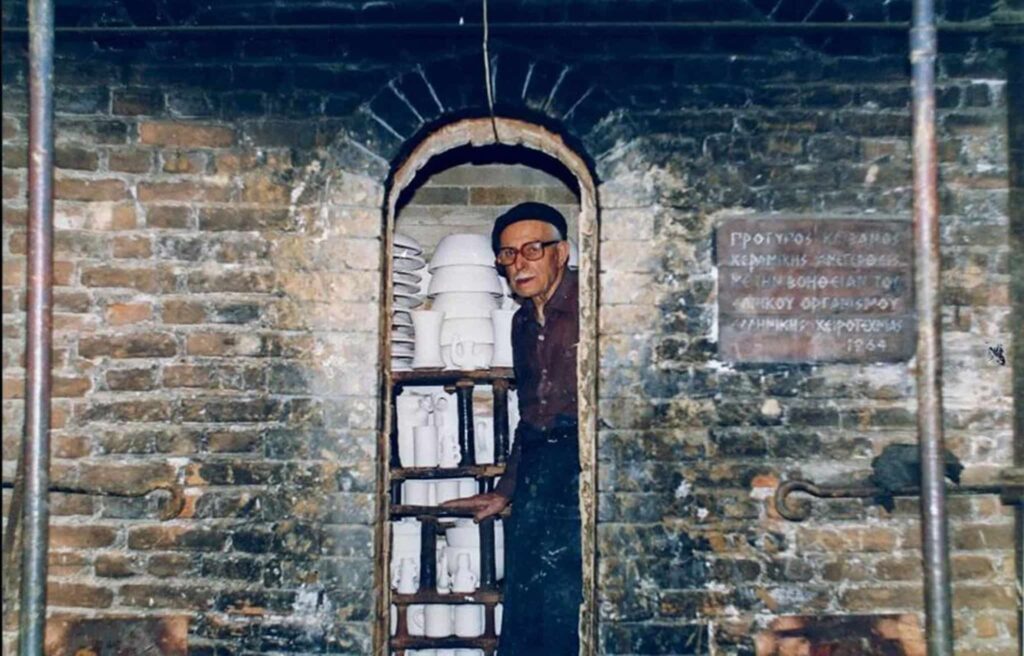

Beyond his craftsmanship, he possessed a rare ability to anticipate the times and understand what the market would be looking for before it even appeared.
“He was incredibly inventive,” she recalls. “He could launch a new line of production while continuing another, even though we are not talking about a factory but a small workshop where everything passed through the same hands.”
The workshop in Agiasos, which she visited almost every weekend as a child, bore little resemblance to a contemporary ceramics’ studio. The floor was damp earth, the workbenches were handmade by carpenters, and the tools were crafted by hand. Even the brushes were made in-house, while materials were processed within the workshop itself.
She still keeps one of her grandfather’s grinding tools, a handmade stone device used to grind glass into a fine powder for glazes. “It is very moving to look at it today,” she says. “We buy ready-made clay, ready-made colours and materials. Back then, they made everything themselves.”
The firing process was even more demanding. Long before electric kilns appeared, potters had to feed wood into the fire and monitor the temperature constantly, knowing that even a slight variation could ruin an entire batch.
“I truly believe what they did was heroic,” she says. “It required endurance, immense passion, perseverance and a deep understanding of fire.”
It was within this environment that the family’s famous black ceramics were born. One day, Nikos Kourtzis noticed that part of a vessel had turned black during firing while the rest had retained its terracotta colour. He broke the piece open to see whether the blackening had penetrated the clay body and, in doing so, came to understand the reduction-firing technique that allows colour to permeate the entire vessel rather than remain on the surface.
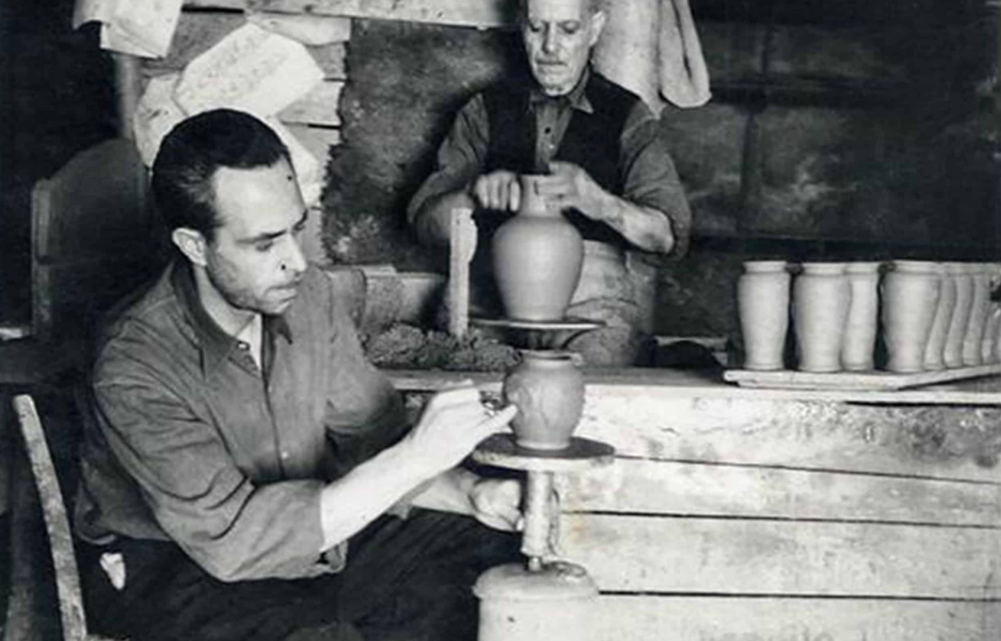
The celebrated “Kourtzi blacks” were not painted but darkened through the firing process itself. The technique earned him an innovation award at the time and went on to influence an entire generation of ceramic artists.
Although she grew up surrounded by this world, Elpida never imagined she would follow ceramics professionally. She studied in a different field and only in 2012 consciously decided to devote herself entirely to clay.
“I enjoyed it as a hobby,” she says. “I never imagined I would make a living from it.”
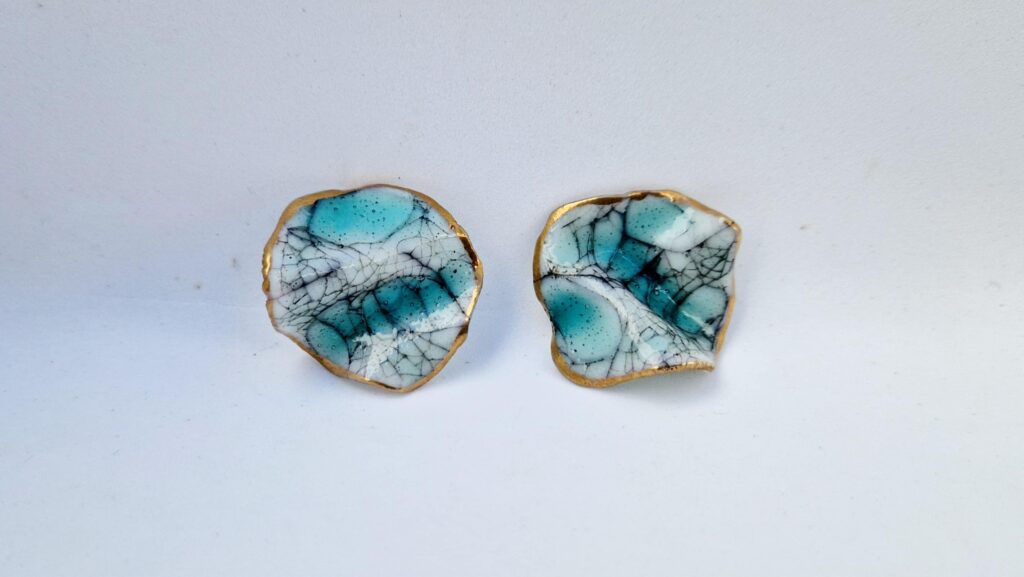
Today she works exclusively in ceramics, teaches the craft and creates contemporary porcelain jewellery characterised by delicate lines and 22-carat gold lustre. Each piece remains unique, as she consciously avoids repetition and mass production.
Her relationship with clay is deeply physical.
“There isn’t a single person who touches clay and doesn’t become attached to it,” she says with a smile.
For her, ceramics engages the entire body. It is not simply drawing or decoration but direct contact with matter, a process that demands hands, strength, failure and persistence.
“Failure is an inseparable part of ceramics,” she explains. “There’s simply no way you can make one hundred pieces and have all one hundred come out perfectly.”


Today, through her work, she strives to preserve not only a technique but an entire cultural identity. The workshop’s characteristic motifs, inspired by the culture and folk traditions of Agiasos, continue to appear in her creations. Daisies, flowers and decorative patterns first developed decades ago within the family workshop are now given new life through contemporary applications and interpretations.
“At a certain point in my life, I realised that all of this is my responsibility,” she says.
“Everything I create carries my energy,” says Elpida Kourtzi. “My story and the state of mind I was in at that particular moment.”
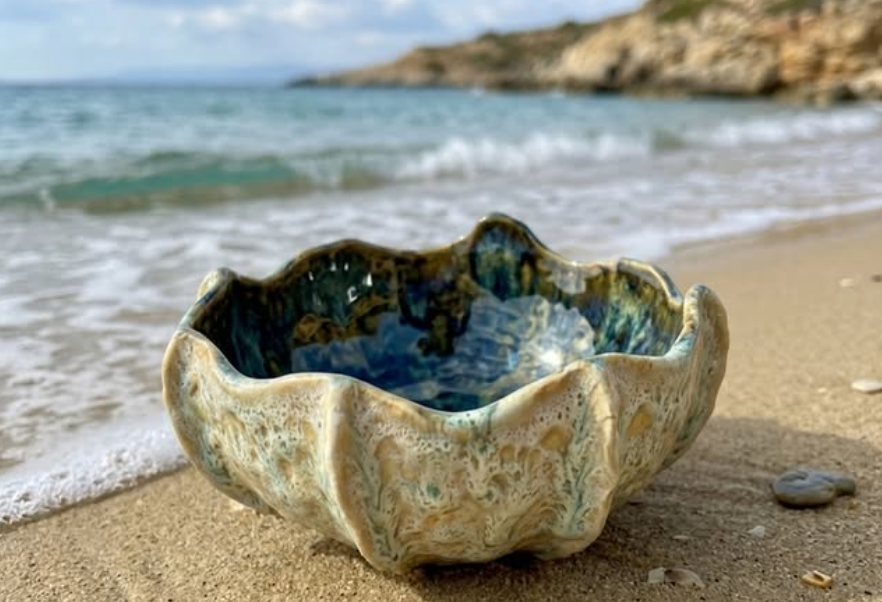


Although she lives and works in Athens, her connection to Lesvos remains strong. She returns to the island at least twice a year and continues to see it as a place that has managed to preserve its character. She speaks of an island with a rich cultural tradition, the homeland of Myrivilis and Elytis, but also of a place with remarkable diversity of landscapes. From the forests of the eastern side to the rugged western terrain and the Petrified Forest of Sigri, every corner of the island possesses its own distinct identity.
The pride with which she speaks about Lesvos extends beyond its history and culture.
“We are an incredibly productive place,” she says. “And I’m very proud of that.”
The island’s gastronomy is an essential part of this identity. Kalloni sardines, PDO Ladotyri Lesvos cheese, local cheeses, olive oil and traditional sweets remain important points of reference for both residents and visitors. She singles out stuffed zucchini blossoms, stuffed onions known locally as tsoglania, and almond sweets that are still prepared according to traditional recipes. Equally important are the women’s cooperatives that continue to preserve local culinary traditions through spoon sweets, jams and other regional products.
For Elpida Kourtzi, all these elements come together to form a Lesvos that remains authentic and deeply connected to its land and its people.

The Ceramic Tradition of the Kourtzi Family
The ceramic tradition of the Kourtzi family has been inscribed in the National Inventory of Intangible Cultural Heritage of Greece, recognising an unbroken lineage of six generations of potters in Agiasos, Lesvos, and the preservation of knowledge and techniques passed down from one generation to the next.
