
 KATERINA PARRI
By Katerina Parri
Artemis Baltogianni is the woman behind The Intermission gallery in Piraeus. She chose to found her gallery in 2019 at 37 Polydeukous Street, presenting mostly international artists whose work had never before been shown in Greece. Her daily routes trace a map between Los Angeles and Piraeus, Piraeus and Los Angeles, with stops in various places along the way due to her work as an art advisor.
The Intermission is her special bond with Greece—and more specifically with Piraeus. Although she had no prior connection to the area, she has grown to love it deeply, considers it part of her identity, and jokes that she suffers from “Peirai-asis,” feeling that a piece of her has become Piraeus-born.
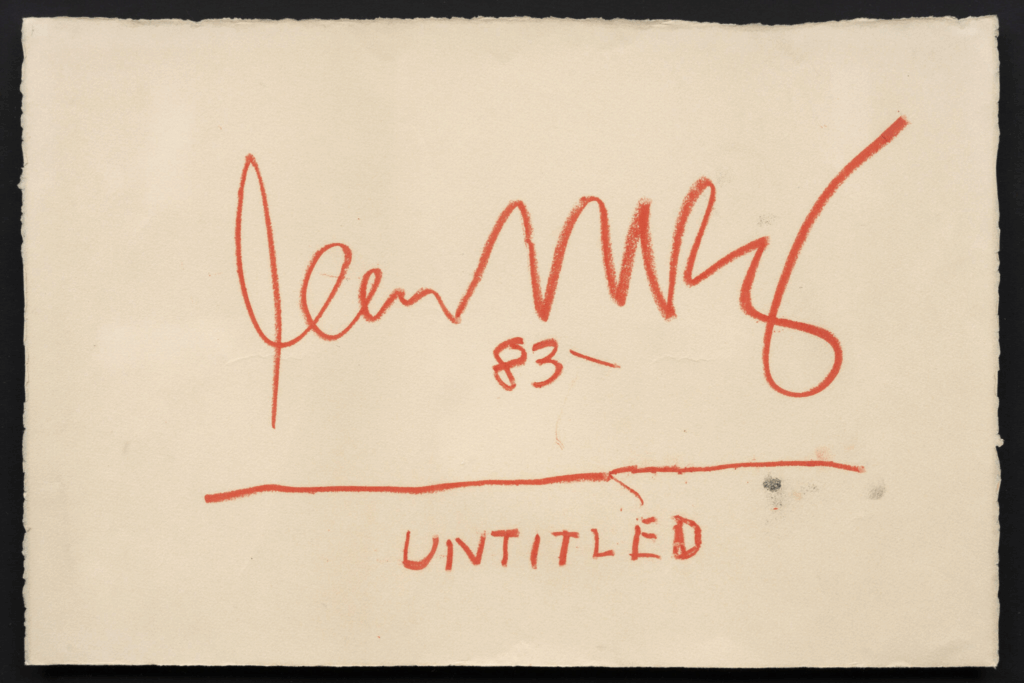
These days, Artemis Baltogianni’s name is making headlines as she becomes the first person to bring Jean-Michel Basquiat to Greece, with the exhibition “Untitled” in collaboration with Galerie Enrico Navarra. The exhibition will present works on paper, focusing on the artist’s pivotal 1981–1983 period.
In our conversation, Artemis Baltogianni spoke to me about the artists hosted by The Intermission, how she came to connect with this particular neighborhood of Piraeus, her excitement for working closely with artists, and of course, the new exhibition featuring Basquiat’s works being shown in Greece for the first time.
Before I move on to her own words, what struck me most during our discussion was her deeply human approach to art—what interests her is centered around the person, the soul, and the psyche. And I believe that the more The Intermission continues to grow, the more this orientation will become evident in everything Artemis Baltogianni has in mind for her space on Polydeukous Street.
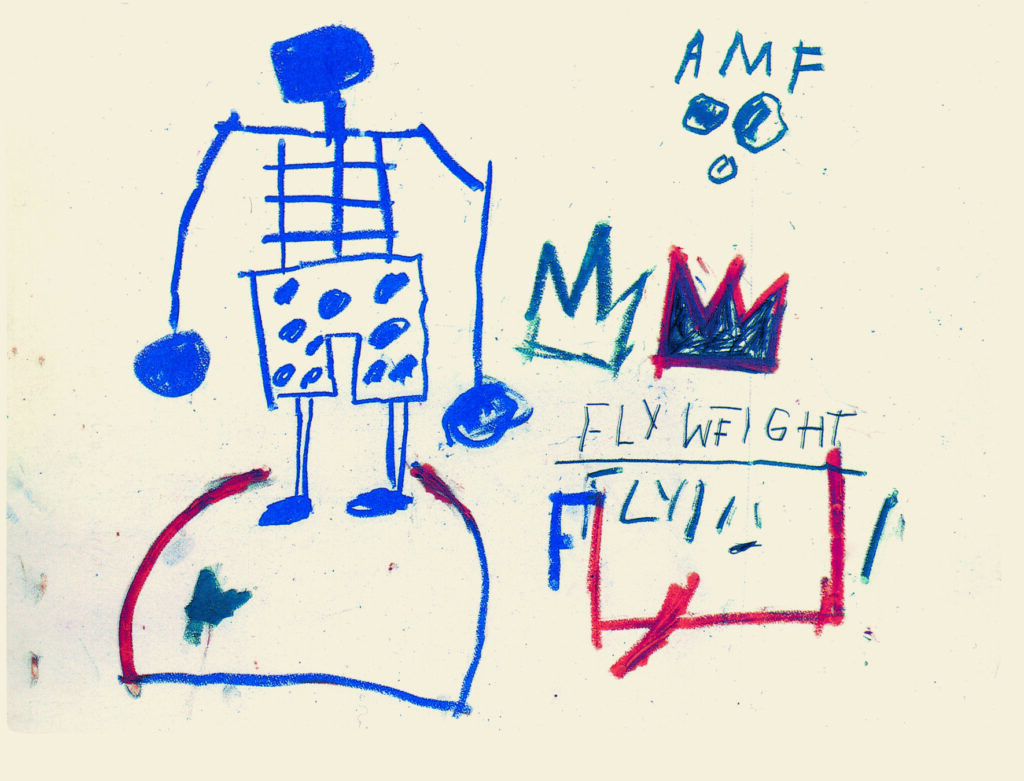
“It is an honor for me to bring Jean-Michel Basquiat to Greece for the very first time.”
“It is an honor for me to bring Jean-Michel Basquiat to Greece for the first time. At The Intermission, we prioritize artists who have never exhibited in Athens or in Greece before — a curatorial choice that reflects the core philosophy of our program. This approach was also a key factor in our decision to present this exhibition.
The fact that this is the first-ever presentation of Basquiat’s work in Greece has already sparked strong interest from both the press and the public, even before the official opening — undoubtedly expanding the audience our space reaches. Above all, though, what brings me the greatest joy is being able to offer Greek audiences access to works they would otherwise rarely have the chance to see up close. Especially when it comes to such a pivotal, historic, and globally influential artist as Jean-Michel Basquiat.
I had met Enrico Navarra, Dorian’s father, when he was still alive. While I didn’t have a personal relationship with Dorian, he sent me the catalogue of the Basquiat au Congo exhibition they had organized. As I flipped through it, I was impressed — and decided to propose bringing the exhibition to Athens and to The Intermission. I was well aware that his family holds one of the most important collections of Basquiat’s work worldwide. At the same time, I knew that Enrico Navarra also operates as a gallery — something that aligns perfectly with The Intermission’s model, which is based on collaborations with international galleries and institutions.”
“To me, Basquiat is a symbol. His work combines intensity, immediacy, and clarity — it carries something of the world’s harshness and, at the same time, the purity of a child’s gaze. He was an artist who worked with instinctive brilliance, as if he were in constant connection with something deeper, almost spiritual.
His untimely death crystallized his image into a figure that continues to move and inspire — especially younger generations. There is something about the way he worked, and what he represented, that remains alive and deeply relevant today.
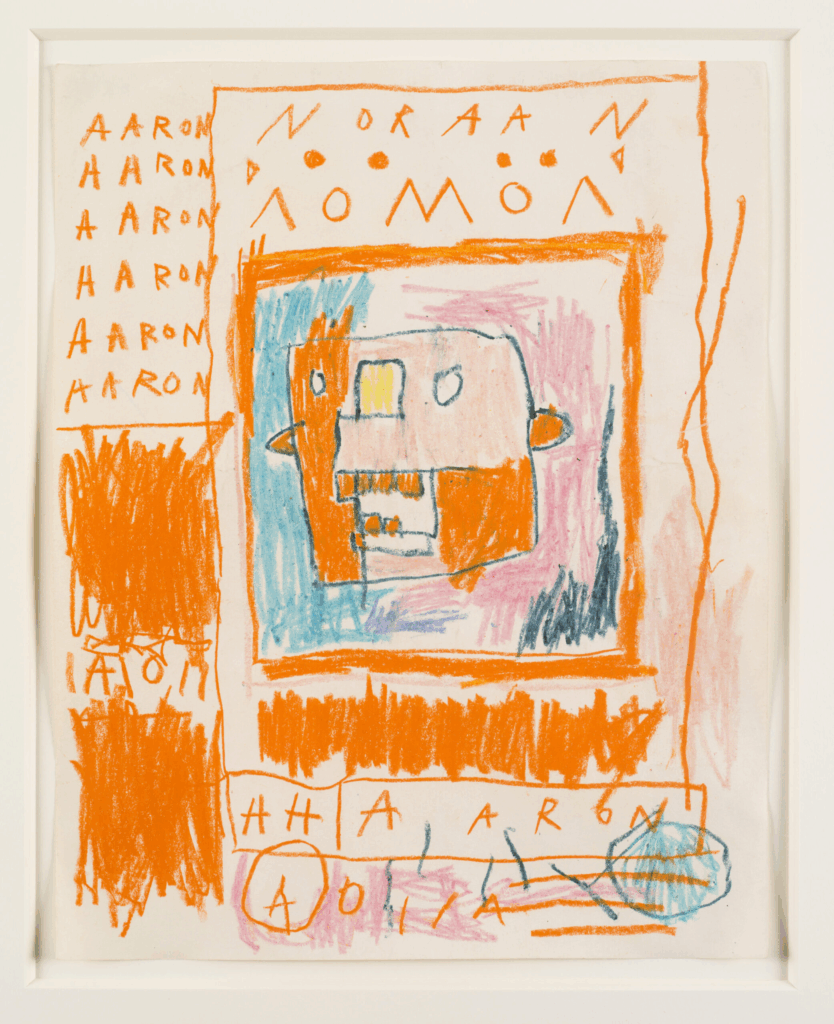
The selection of works was made by Galerie Enrico Navarra, which holds the pieces from its own collection. From The Intermission’s side, we knew from the outset that we would be working with works on paper — a decision that made sense, as Navarra possesses one of the most significant Basquiat collections in this medium.
I suggested focusing on the period from 1981 to 1983, which is also my personal favorite — and that proposal was ultimately embraced. Seeing the works selected for the show, I felt the gallery space needed to be reimagined in order to properly support the exhibition. I asked architect Stelios Kois — whose aesthetic I trust and admire — to create a proposal for this very delicate task. The result is a unique and visually striking transformation of the space.
The exhibition will not follow a chronological order. The works are linked through recurring motifs in Basquiat’s visual language. One element that runs throughout — and largely shaped the narrative flow — is the notion of rise and fall: the relationship with myth, the search for acceptance, and its simultaneous rejection.”
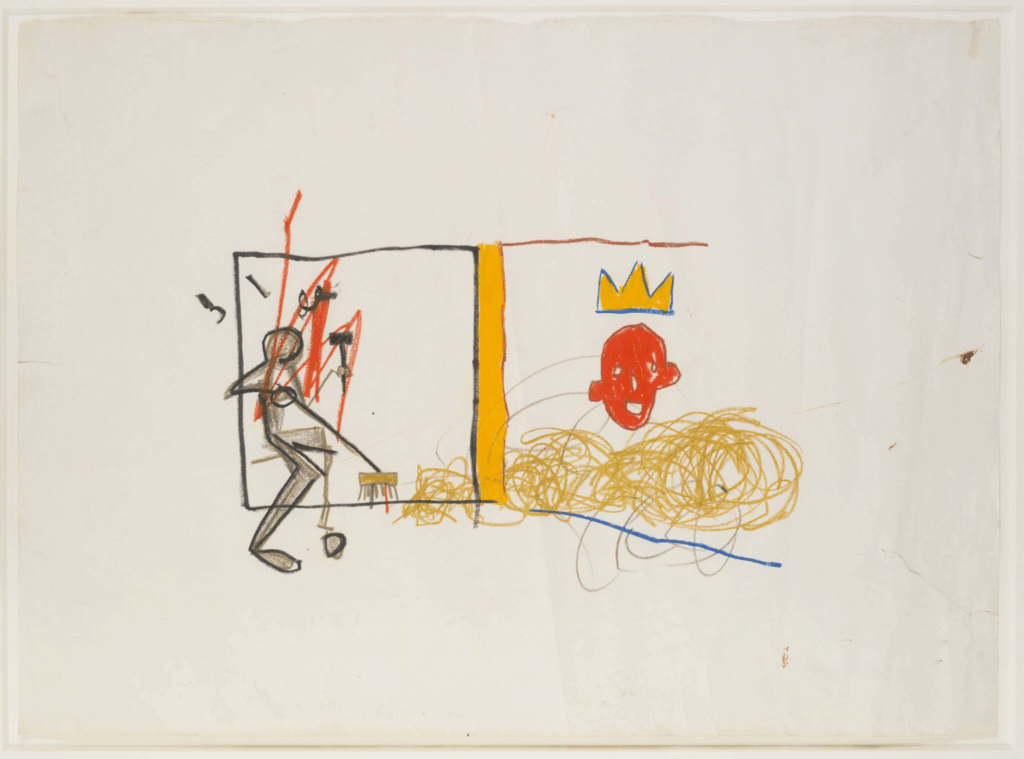
Basquiat in Piraeus
“One immediate — perhaps superficial, yet very real — connection is the urban landscape itself: this is an industrial area, and aesthetically, it resonates with Basquiat’s world — Brooklyn and Downtown New York of the 1980s, where he lived, worked, and moved. There’s something in the raw texture of the neighborhood that creates an underlying dialogue with his way of working.
On a second level, we’re witnessing the gradual emergence of a small cluster of contemporary creative spaces in Piraeus. Around our neighborhood, important venues have been established, such as Sylvia Kouvali’s gallery, Objects of Common Interest, music studios like Meadows, and initiatives such as BlueCycle.
The energy of this area can, in some way, meet the spirit of Basquiat. Of course, it’s not comparable to the freedom, disorder, and explosiveness of 1980s New York — but perhaps this ‘something happening here now’ has its own significance. And let’s not forget, above all, that Piraeus is a port — a point of transition, arrival, and departure. This quality of constant movement and flow, of different worlds and directions intersecting, aligns with Basquiat’s work: a body of work filled with shifts, tensions, identities that are constantly negotiating themselves within the world.”
“The essence of Intermission is to show artists we haven’t seen in Greece before.”
“My main job is as an art advisor. When the idea for The Intermission came about, it was a way for me to establish a connection with Greece. This place came to mind immediately. I had no prior relationship with Piraeus. I came here next to Sylvia (Kouvali), with great admiration for her program and what she’s doing. I also liked the spaces. I liked the idea that it wasn’t located in the center of Athens. Everything happened very quickly. I did one exhibition in 2019, then we hit the COVID years — one show in 2020 and another in 2021 — and then, practically, the program really started in 2022.
Even now, my programming isn’t fully fixed or regular. The selection process is based more on intuition — I see something, I like it, and a big factor is whether the artist has shown in Greece before. If not, I see it as an opportunity to give the Greek audience a chance to encounter something new. The essence of Intermission is to introduce artists we haven’t seen in Greece before.
The model of The Intermission doesn’t carry the pressure of a traditional gallery — it’s a different kind of structure. It doesn’t represent artists, but rather hosts them, bringing international galleries directly into the space here. This way, the local audience engages directly with the gallery from abroad, and the artists and institutions, in turn, get to know the public here or build relationships with Greek collectors and curators. It’s a sustainable model that also allows me to stage larger-scale exhibitions within a small art market.”
“Intermission Moments”: Nikos Baikas, Cooper Jacoby, Stella Zhong
“Nikos Baikas and Jannis Kounellis were both from Piraeus. Baikas hadn’t had a solo show in twenty-five years, and one of the main reasons he agreed to do the exhibition at Intermission (2021) was because he was deeply moved that it was taking place in Piraeus. He couldn’t believe it. I absolutely adore his work, and we had a really strong connection. The first time I went to meet him and propose the show, I traveled to Milan. He’s a conceptual artist. An ideological artist whose work is quite complex. I remember being nervous — I was sweating! I thought, ‘Will I be able to hold my own in a conversation with someone so academically rigorous?’
I surf, and Baikas used to be a surfer when he was young. In the end, we hit it off immediately, we laughed a lot, talked about everything. It was truly a great experience, and I’ve built a very good relationship with him and his wife. For the exhibition, he even created a new piece — something he hadn’t done in a long time. At that first opening, there were hundreds of people — all of my friends from across my life showed up. So both emotionally and experientially, Nikos Baikas’ solo show was very special to me.
Other exhibitions I highlight include sun is bile by Cooper Jacoby (2022), who worked exclusively on this body of work for two years during the pandemic — all the pieces were brand new. I also loved Stella Zhong’s exhibition Inertia (2024); she’s originally from China and based in the U.S., and she created a large-scale sculpture in the main space of Intermission.”
Why “Intermission”?
“I was thinking of it as a break. A gallery has its regular program and then might go on ‘holiday’ somewhere to do a show in a different space — that’s how I first imagined Intermission. But then the meaning evolved during COVID, because everything kept shutting down. So it became a much larger Intermission. Later, several artists told me that they felt — especially those who often show in museums — a great sense of freedom working here. Since it wasn’t a museum show and the space is smaller, they could create something in a freer way. And I started to realize that it was also an Intermission in their own practice — a pause that allowed them to experiment with new things they hadn’t done before.
I really love working with artists — it’s my greatest joy. As an advisor, I usually work closely with collectors. But what I really enjoy is having production happen here, exchanging ideas, thinking together with artists about new things we can do. Most artists pull you into their creative process, and that’s a powerful experience. Also, it’s a job where every project is completely different. Part of my work is waking up and reading about obscure subjects, ideas, ideologies. What a gift to have a job like that — to say, ‘I have to work today,’ and what that means is reading about a new concept or thought. And each artist works differently. They bring in new ways of thinking, new ideas, and new mediums to explore.”
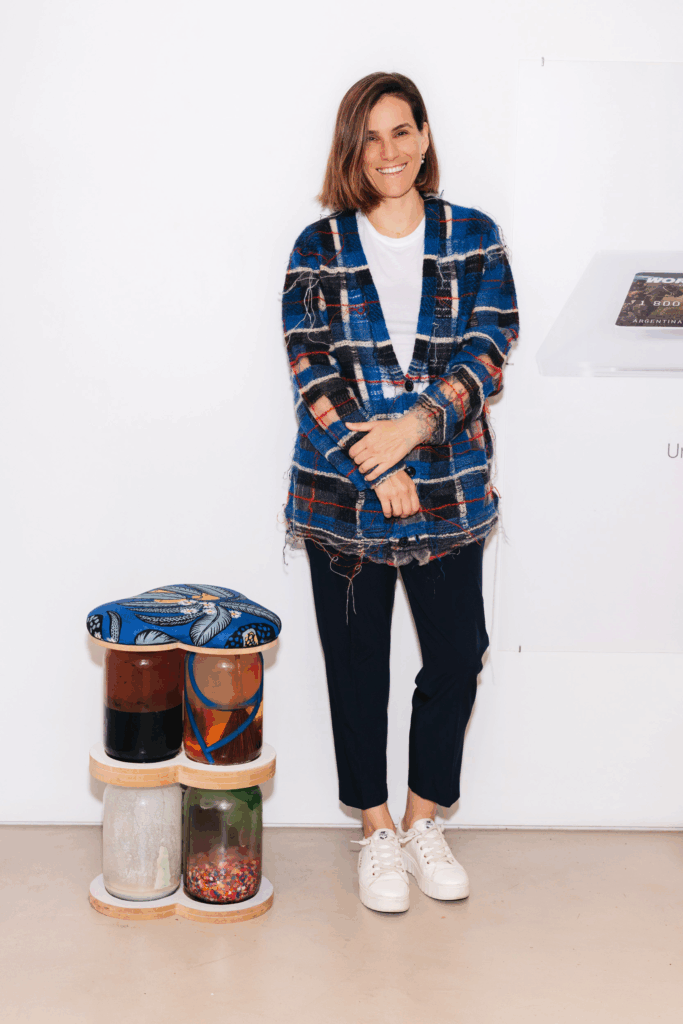
Art as Observation, From a Young Age
“Because of my mother, artists were constantly coming and going from our home. We looked at artworks together, and from a very young age she would ask me to check whether the pieces were real. She taught me how to study them and gave me catalogues, saying: You need to study and understand the difference — why is this work good or not?
I used to draw a lot. I wanted to become an artist from a very young age. But in my first year in the UK, during my studies, I realized I wasn’t particularly good. The truth hit me. Of course, in contemporary art, being technically skilled isn’t the most important thing — but I didn’t know that yet. I was doing studio work, painting, photography… but those skills mattered less. What mattered more was that I didn’t want to pursue something so isolating. I liked reading and writing. I loved ideas. I wouldn’t have minded being isolated doing that.
This is actually the first time I say this out loud and think about it as I speak. I found it much more isolating to sit and do the same drawing 60 times. Painting began to feel boring to me — as a process. Sitting alone in a studio and trying to get a color just right wasn’t the same as working through a concept. And ideas — well, you read them. So you’re engaging with others through reading. That’s when I decided to switch to art history, and I ended up at Goldsmiths. And everything fell into place from there.”
Info
Jean-Michel Basquiat: “Untitled” | The Intermission
Exhibition Opening: May 22, 2025 | 18:00 – 21:00
Talk: May 22, 2025 | 19:30 – 20:30
Reflecting on Basquiat: Personal stories from Tamra Davis & Lysa Cooper

