 PEPI NIKOLOPOULOU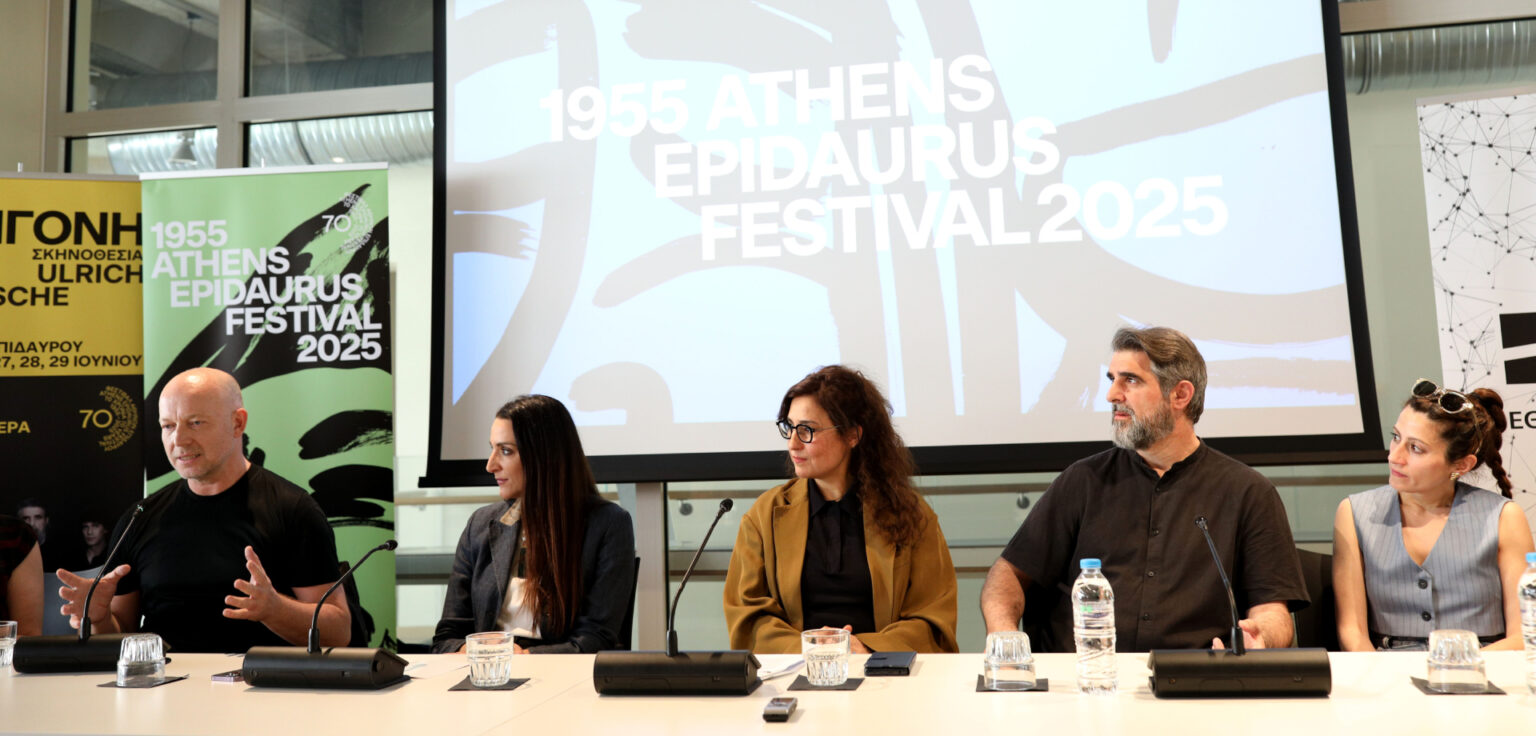
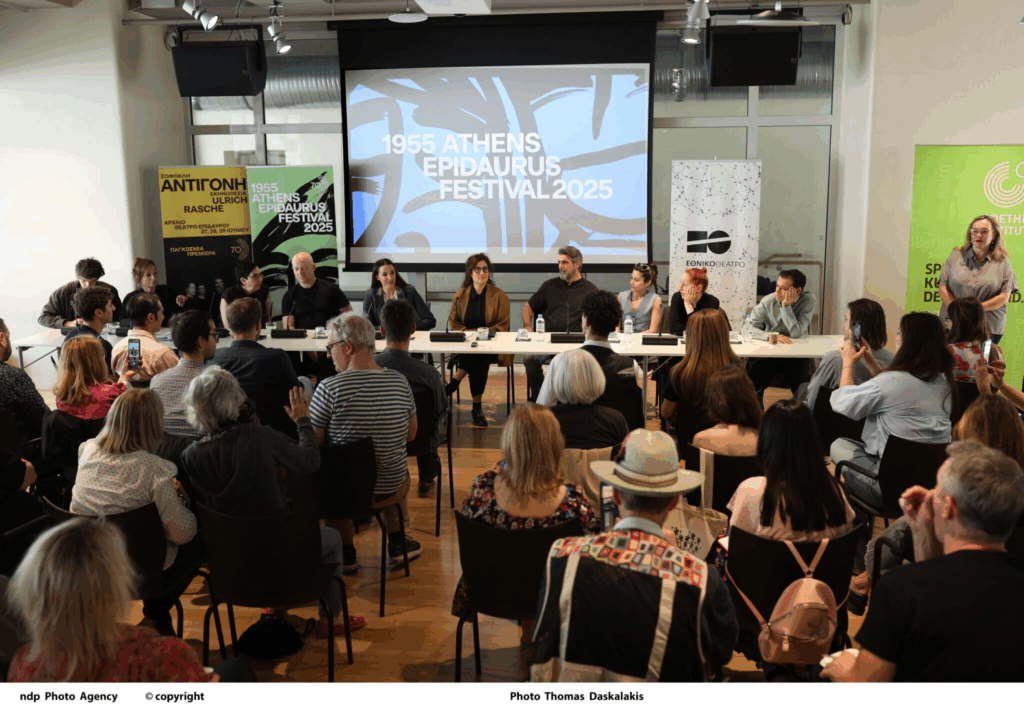
The first encounter with Ulrich Rasche’s world of Antigone took place during the press conference held by Katerina Evangelatou and Argyro Chioti, in the presence of the German director and the cast.
The Athens Epidaurus Festival opens this year with a political reading of Sophocles’ tragedy, directed by German director Ulrich Rasche, who returns to Greece with a production that confronts the very notions of democracy, justice, and community.
Ulrich Rasche, one of the most distinctive directorial voices in contemporary European theatre, returns to the Argolic stage three years after his powerful Agamemnon and five years after his first Greek Antigone in 2017. This time, he stages a meditation—on political legitimacy, on social cohesion, and on the ethics of disobedience.
“It is a particular honor to open this year’s Athens Epidaurus Festival, especially on its anniversary year. In Greece, I feel like I’m coming home,” Rasche stated meaningfully during the press conference held at the Goethe Institute, adding with emphasis: “Antigone belongs to the Greeks.”
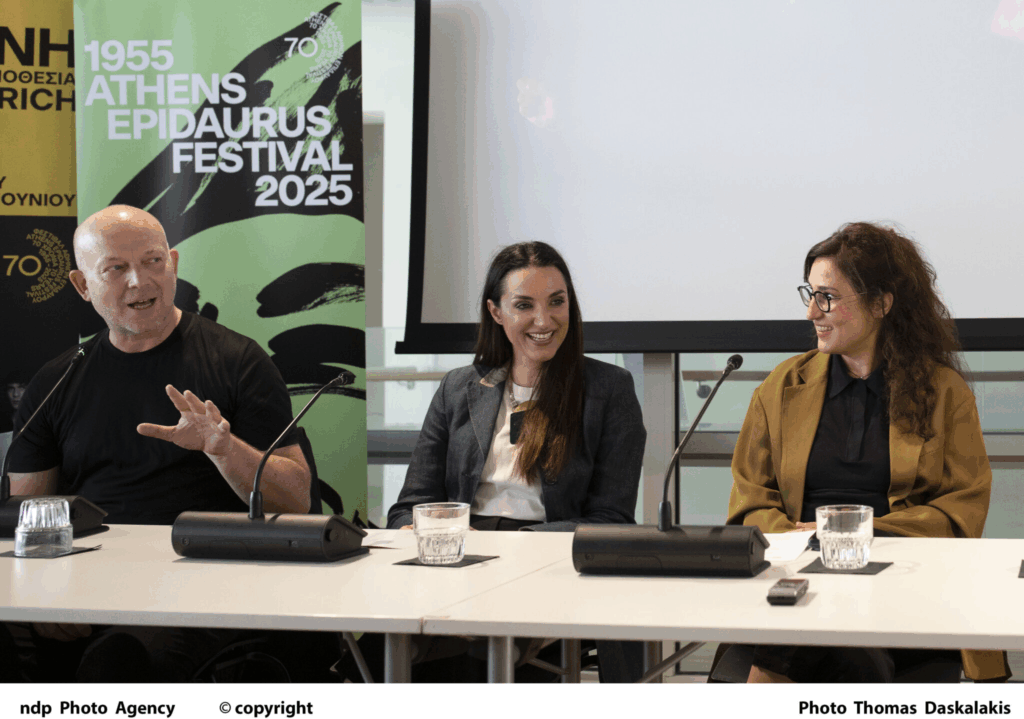
Although he does not speak the language, Ulrich Rasche never felt like an outsider in the process. “The way the team welcomed me, making me feel like one of their own, makes me feel a part of you,” he said. “I enjoy being here.”
That feeling seems to be shared by all, evident in the chemistry of the team. The actors in Antigone come from different generations and theatrical backgrounds, but they all share a common denominator: a total commitment to a method of work grounded in physicality, rhythm, and vocal intensity—key elements of Rasche’s stage language.
Despite the challenges of an international production, Rasche noted that the difficulties are shared across both countries: “It is absolutely essential that the state supports the creation of strong productions. The work carried out by artists is vital and must be supported by the public sector.” Yet beyond logistical concerns, what prevailed was the joy and challenge of the endeavor: the opportunity to engage again with Sophocles in a play that not only tests our values, but also restores the stage to its rightful place—as a public space for thought, rupture, and understanding.
Democracy under scrutiny – and the need to listen
In Sophocles’ emblematic work, which addresses the eternal conflict between individual conscience and state authority, Rasche chooses to focus on the core of the conflict without melodrama—a directorial approach that didn’t emerge in a vacuum.
Antigone, who refuses to obey Creon’s law and chooses instead to honor her dead brother, is not simply portrayed as a heroine. Rather, she becomes the bearer of an archetypal question: What is justice? And how do you defend it when it clashes with the Law?
Rasche also turns his gaze to Creon—not as a symbol of tyranny, but as a custodian of legal order. He does not condemn him. He explains him. And with him, he unpacks the broader framework within which a state must safeguard its unity, even at the cost of painful decisions. Rasche’s decision to approach Antigone through a complex, politically dialectical lens was no accident. “Maybe it’s important to also hear Creon’s arguments and see how we might balance the two.”
As he explained during the press conference, the inspiration for this interpretation arose from the condition of our current era: the blurred boundaries of freedom of expression in the digital realm.
“Everyone voices their opinions in an absolute way—perhaps excessively so. Everyone can say something. However, as you Greeks know better than anyone, living in the cradle of democracy, it is crucial to have a regulatory framework of rules for a functioning democracy.”
From that starting point, Rasche directs his attention to the heart of the tragedy. “Maybe it’s important to also hear Creon’s arguments and see how we can find balance between these two [voices],” he remarked. He adds: “I do not take the side of any authoritarian figure, like Creon. What I stand for is the need to find common ground. To listen to one another. What we have lost is our ability to listen.”
Through Creon, the man called to legislate and enforce the law, the director highlights the foundation of political existence: the community. “Democracy is eroding. So are its laws. It is important that we are able to understand and revise them. Because the world is changing.”
For Rasche, democracy is not a given. It is fragile. It deteriorates, as do its laws, which must be continuously reexamined. “It is vital in a democratic world to be able to understand and revise laws, because the world around us is changing,” he noted. And if Creon remains strict, the play seeks to present him not as a caricature of authority, but as a man trapped by the very rules he upholds. A man who must not only legislate but abide by the law—even when it destroys him.
The language of the body and the language of trust
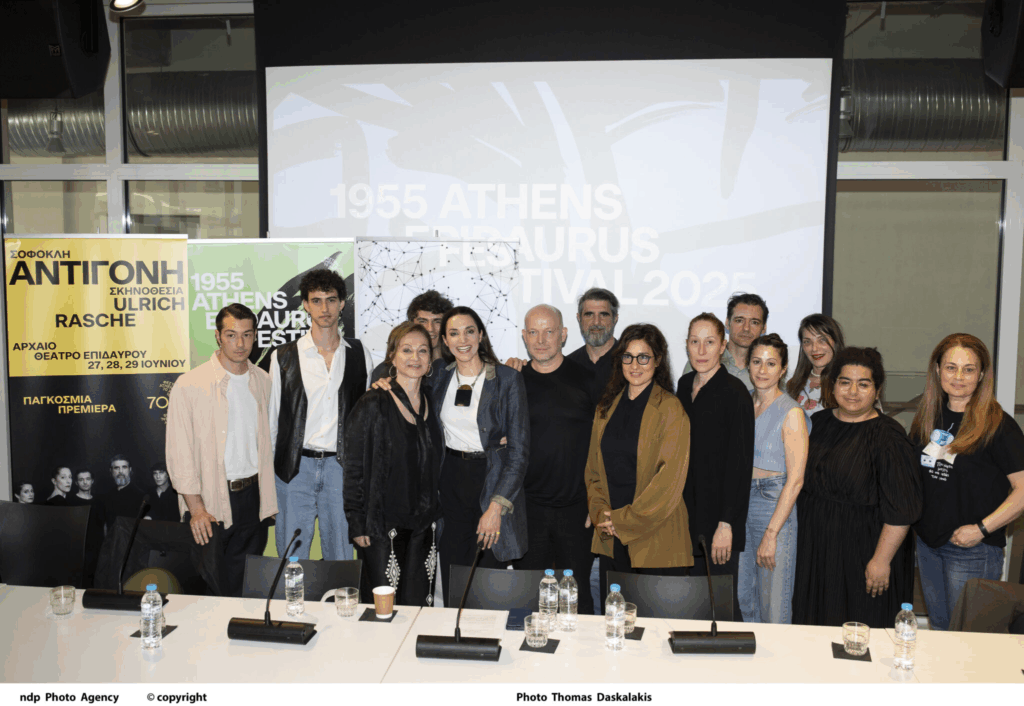
On the stage of Epidaurus, audiences will see a ten-member chorus of talented young actors, four musicians on stage, and a polyphonic cast engaged with movement, rhythm, and the architectural space.
In the role of Creon is Giorgos Gallos. Kora Karvouni portrays Antigone, while Dimitris Kapouranis plays Haemon. Filareti Komninou performs as Tiresias, Kitty Paitazoglou plays Ismene, and Thanos Tokakis appears as the Guard. During the press conference, all of them offered personal reflections on their roles and their collaborative journey with Ulrich Rasche. The respect for the director was unanimous and profound. Through their words emerged not only the challenge of performing in such a demanding theatrical universe, but also the trust built throughout the rehearsal process.
“I see this work as a triptych: speech, body, and emotional involvement,” commented Giorgos Gallos, who portrays Creon. “Each element supports the other, bringing Sophocles’ spirit to life.”
“When I met the whole team, I realized how much we need this transfusion of passion, energy, thought, and vision for the work,” said Filareti Komninou. “What we are doing is demanding, as we perform on a rotating platform in constant motion—something that requires practice but creates a powerful sense of ritual.”

Kora Karvouni, who plays Antigone, highlighted the depth of challenge in engaging with Rasche’s theatre: “It is a significant challenge for us Greek actors to enter the world of Ulrich’s theatre, which I call poetic and multi-layered. I believe the audience will be drawn to a place of identification and emotion, as they recognize their own existential struggle. The performance will create a whole new world around Sophocles’ Antigone.”
Kitty Paitazoglou, as Ismene, expressed her joy at being part of the ensemble and warmly thanked the two Artistic Directors for their essential support. Thanos Tokakis, who plays the Guard, emphasized the importance of polyphony in Rasche’s stage dramaturgy: “This approach fully resonates with me. It’s important that many voices are heard—especially in our times.”
Finally, Dimitris Kapouranis, the youngest actor in the cast who portrays Haemon, spoke with gratitude about the experience: “The fact that I get to work with this ensemble and team is a gift for me. This is how I want to exist on stage.”
The significance of this major co-production between the Athens Epidaurus Festival and the National Theatre was also emphasized by the two artistic directors, Katerina Evangelatou and Argyro Chioti.
“I feel happy and fortunate that this year’s anniversary Festival opens with such an institutional and artistic collaboration, and with this ensemble composed of the finest Greek actors across generations,” said Katerina Evangelatou. She added that from the beginning of her tenure, she aimed for Festival productions to be unique, almost unrepeatable, often bringing Greek actors into dialogue with international directors.

Argyro Chioti, Artistic Director of the National Theatre of Greece, acknowledged that although the planning of Antigone began under the direction of Yiannis Moschos, she is delighted to continue this exceptional partnership. “Ulrich Rasche’s theatrical language is so distinctive, dynamic, and unique that it invites us to view this work differently, to hear the text anew.”