
 KOSTAS KOSTAKOS (OLD BOY)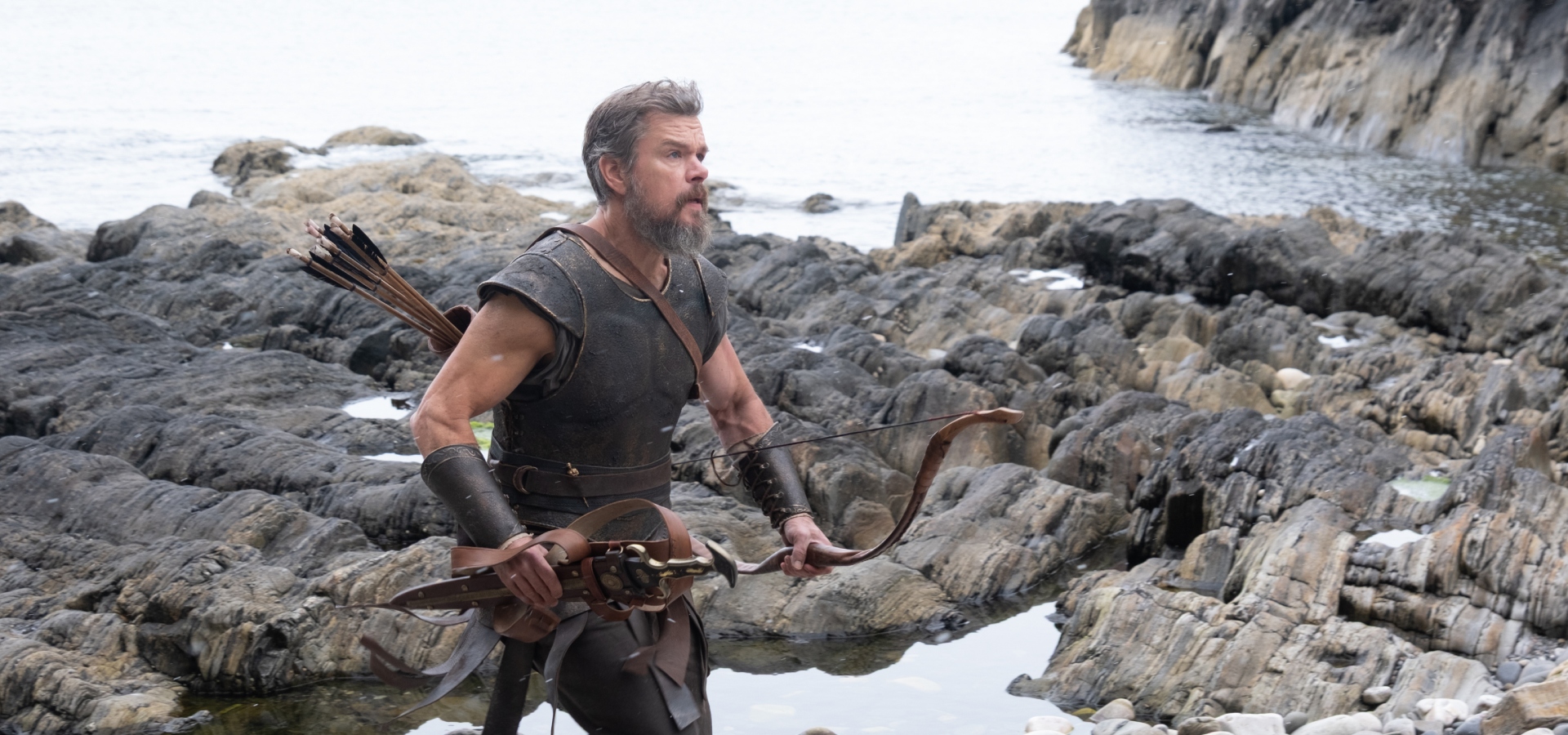
At the very beginning of The Odyssey, we see the Trojan Horse lodged diagonally in the sand by the sea. It is an image that recalls the unforgettable ending of Planet of the Apes, where audiences were confronted with the Statue of Liberty, also half-buried in the sand by the shoreline, and suddenly realised that the story they had been watching did not take place on another planet, but in the distant future of our own. Human civilisation had destroyed itself-most likely through nuclear war.
In his previous film, Oppenheimer, Christopher Nolan showed us how the first atomic bomb came into existence. After sweeping both the box office and the Academy Awards, his next project had to be another challenge. Not that his previous films weren’t already ambitious-Nolan has always treated filmmaking as a series of increasingly difficult artistic tests-but this time the stakes were even higher.
So what does a filmmaker like Nolan do after achieving near-total creative validation? What is the next level? He has answered that question himself in interviews: the Homeric epics represented a glaring omission in the history of cinema, a gap that needed to be filled. And so came the opportunity to marshal an enormous budget for a first-rate production that would finally bring The Odyssey to the screen with all the grandeur it deserves.
Did he rise to that particular challenge? Of course he did.
His primary ambition succeeds: one of cinema’s great absences has finally been addressed. Nolan delivers a lavish, three-hour spectacle, drawing on one of the foundational texts of Western literature to create a succession of genuinely epic set pieces. He transforms an archetypal journey into blockbuster filmmaking on the grandest possible scale.
But does the film also move us? Does it create emotional identification with its characters so that, beyond the memorable episodes, what lingers are the emotional stakes carried by Odysseus, Penelope and Telemachus?
In my view, not quite.

The spirit of Nolan’s Odyssey is unmistakably contemporary, and that informs every creative decision. He attempts to dress modern concerns in Homeric clothing, borrowing elements from the epic while discarding others whenever it serves his purpose.
To be clear, there is nothing inherently wrong with that. No sacred text is being violated. Yet rather than creating a genuine dialogue between the distant past and the present, the film often feels like a one-sided conversation: bring the ancient world here, then attach whatever modern ideas happen to fit.
More importantly, I don’t think this approach succeeds in creating real emotional involvement.
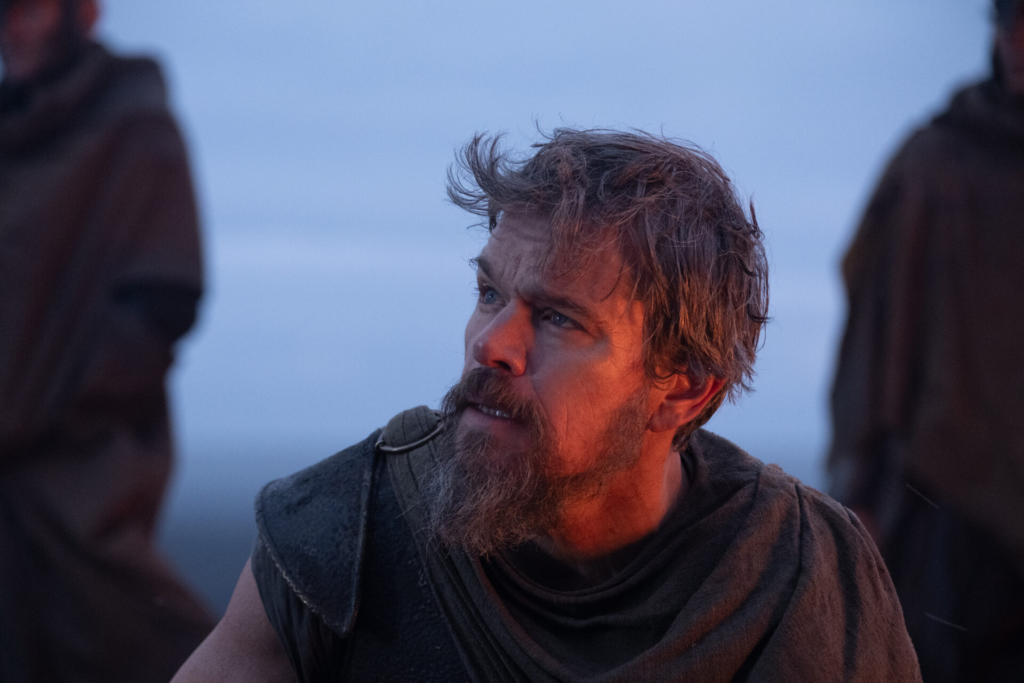
When it comes to characterisation, relationships and inner conflict, the film never fully convinced me. I was never able to forget my own preconceived image of Odysseus and gradually accept him as an autonomous cinematic character. I wasn’t watching Odysseus; I was watching Matt Damon-with a beard-convincingly, intelligently and subtly playing Odysseus while delivering lines of guilt and philosophical reflection in English.


That illusion is not helped by a scene in which he delivers the already-instantly-quotable line, “Ten years on this fucking beach.” It is exactly the sort of line one might expect in a Ben Stiller parody of The Odyssey or an Saturday Night Live sketch.
Beyond that, if the Homeric epics stand among the foundations of world literature, one could argue-especially in light of Nolan’s previous film-that the Trojan Horse becomes, in this reading, a kind of precursor to the atomic bomb.
War has never been fought on equal terms. Technological superiority and deception have always been among its defining weapons. Yet perhaps the Trojan Horse marks mythology’s first great transgression of every conceivable moral boundary: an act of hubris, overwhelming asymmetry and calculated annihilation that, thousands of years later, would find its historical counterpart in Hiroshima.
It is as though the Trojan Horse anticipates the atomic bomb.
That, I believe, is one of Nolan’s most original and genuinely fascinating ideas. His visual association with Planet of the Apes elevates the comparison even further.
Odysseus becomes a kind of Oppenheimer, standing before the consequences of his own creation.
His guilt is twofold. On the one hand, there are the Trojans slaughtered through deception rather than honourable combat. On the other, there are his own companions-his fellow soldiers, subjects and travelling companions-who failed to survive either the war or the long journey home.
Admittedly, one could question how this overwhelming sense of remorse sits alongside the massacre of Penelope’s suitors, which has just taken place. But that battle was hopelessly uneven in the opposite direction: one man against dozens. And yet, like The Bride in Kill Bill, Oh Dae-su in Oldboy, Bruce Lee, Chuck Norris-or simply Odysseus in Homer himself-he dispatches every last one of them.

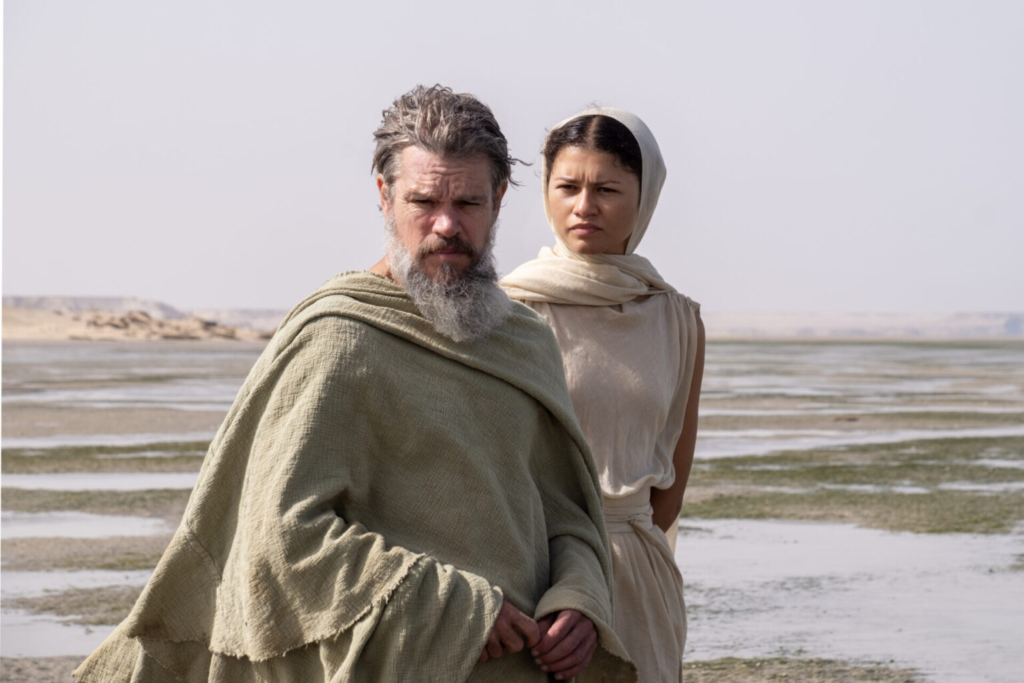
Νolan chooses not to depict the gods directly, limiting their presence largely to Athena. And here we can comfortably speak of a casting misstep. Zendaya genuinely feels as though she has wandered over from the neighbouring desert set of the latest Dune film to deliver a couple of lines she read only moments before the cameras rolled.
I won’t dwell on other casting choices or the actors’ ethnic backgrounds—choices that certainly extend beyond Lupita Nyong’o-as I find that debate rather uninteresting. What I do want to praise, however, is the fact that both Samantha Morton’s Circe and Anne Hathaway’s Penelope-Hathaway giving one of the film’s strongest performances—are allowed to look like women who have actually lived. Their faces finally bear the subtle marks of time instead of resembling characters who have just stepped out of The Devil Wears Prada 2.
I also think both the Polyphemus episode and, even more so, the Nekyia—Odysseus’ descent into the Underworld—are among the film’s most accomplished sequences.
Nolan’s The Odyssey is ultimately a film about the end of civilisations and the birth of new ones; about mistakes, crimes and catastrophic miscalculations that humanity repeatedly forgets, only to repeat them once again.
History unfolds as a circle.
Again and again we return to that image: thousands of years ago, the Trojan Horse lying half-buried on a beach; thousands of years later, the Statue of Liberty half-buried on another shore. Once the first atomic bomb was successfully tested, perhaps history could never have taken a different course. Nor, perhaps, could it have done so from the moment cunning Odysseuses and Darth Vader-like Agamemnons decided it was acceptable to violate every law, every moral code and every rule of war by slaughtering their enemies under the guise of an offering to the gods.
The foundations of our civilisation are built upon enlisting science-or, more broadly, human intelligence itself-in the service of destroying others.
And yet civilisation is also Homer’s epics. It is Travis Scott opening the film by rapping about a single man, much as the ancient rhapsodes once sang their tales. It is Christopher Nolan himself, his films, and his cinema in the fullest, grandest sense of the word. It is his towering ambition, together with the cultural imperialism he so masterfully embodies-and one that, if we’re honest, we surrender to with enormous pleasure.