 KATERINA PARRI
The first attempt to interpret and present the work of sculptor Theodoros after his death
Τhe Theodoros, sculptor – In Lieu of a Retrospective exhibition is the first attempt to interpret and present the work of sculptor Theodoros after his death. It brings together a significant body of his work, as well as the abundant archival material that the sculptor bequeathed to EMΣT | The National Museum of Contemporary Art, Athens. The exhibition aims to highlight his profound and forward thinking, the most notable examples of his oeuvre, and the overall trajectory of a contemporary artist who left an important legacy in the field of sculpture in Greece through his words and works. Theodoros, aimed to revitalise sculptural language and bring it to the fore in an era dominated by printed and audiovisual communication.
As part of this guest, he became a pathfinder of pioneering and contemporary creative practices, realising performances, sound sculptures, and conceptual works while also introducing early attempts at a unique institutional critique for the first time in Greece. Throughout his work, he emphasised the artist’s social and political role and the significance of incorporating creative voices into public discourse. Theodoros put these concepts into action by maintaining a consistent and distinct presence in the mainstream media, including newspapers, radio, and television. Drawing inspiration from Theodoros’ exhibition practice and critical commentary on institutional function, the exhibition design foregrounds the limitations and potentialities of a retrospective museum display.
To subvert the inherent single person-centric and past-oriented nature of a retrospective exhibition, works by five contemporary Greek artists – Nikos Arvanitis, Paky Vlassopoulou, Iris and Leda Lykourioti (A Whale’s Architects), Kostas Bassanos, and Yiannis Papadopoulos, – are presented in the exhibition. All have critically engaged with similar enduring problematics on their own, and are presented alongside Theodoros’ works.
The exhibition is part of the presentation program of the EMΣT Collection and takes place on the 2nd floor of the Museum. The exhibition’s scenography has been designed by architect and scenographer Yannis Arvanitis and organizes groups of works within specially designed new exhibition spaces that flow seamlessly into one another, culminating in an unexpected environment where the artworks and visitors coexist. The entire space has been radically transformed to also accommodate future exhibitions of the Collection.
The following sections form a unified path through different settings and atmospheres, bringing together and juxtaposing works from different periods. The scenography of the exhibition is the work of architect and stage designer Yannis Arvanitis.
INSTEAD OF A SCULPTURAL WORK
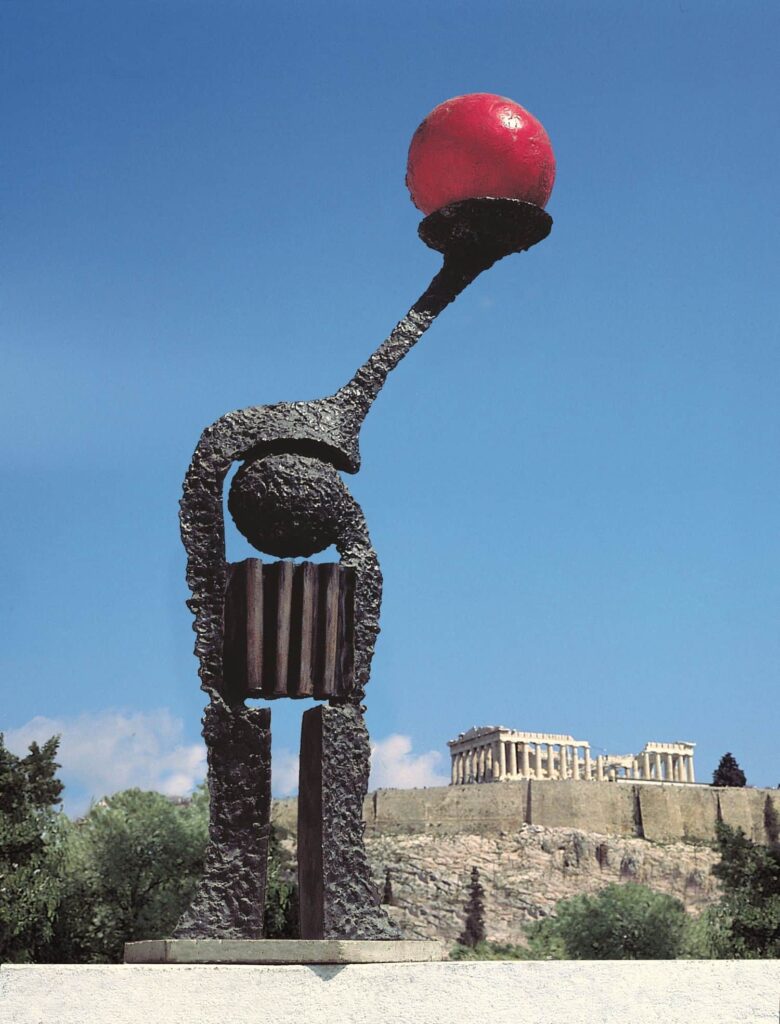
The sculptor Theodoros lived and worked in Paris for a decade before being forced to return to Greece in the late 1960s. At the time, the dictatorial regime required all recipients of state grants living abroad to settle in Greece or return their grants. The experience of the explosive atmosphere in Paris before May 1968, combined with the experience of life in Greece during the dictatorship, greatly influenced his artistic thinking. Realising that sculptural art could not remain as effective if it did not adapt to the new social and technological conditions, Theo introduced the spoken and written word into his work, visibly changing his artistic practice, which had previously been limited to traditional sculptural media. He calls this change “intersection” and begins to sign his name as “Theodore, sculptor”. The reasons for these decisions are discussed in the text Instead of a sculpture, which is presented in 1972 as a sculptural installation at the Desmos Art Gallery.
MANIPULATIONS AND TESTS
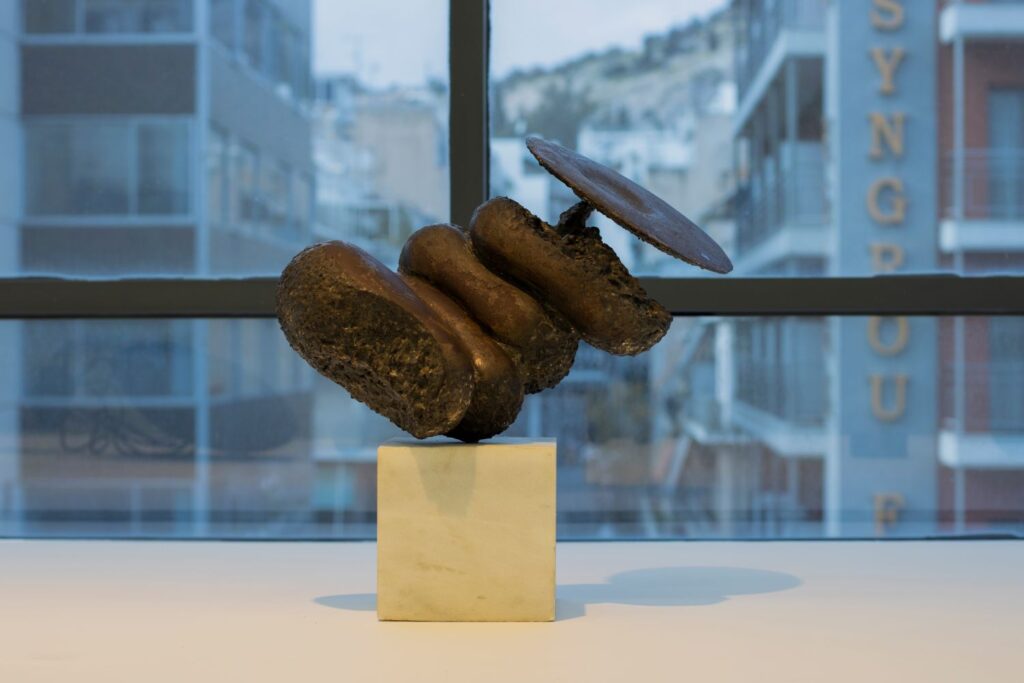
A special place in Theodoros’ work is occupied by the series of works entitled ‘Manipulations’, which he produced between 1973 and 1982. In these works, Theo explores the relationship between sculpture and other artistic practices, as well as the mass media. The title of the series refers to the intention to provoke a physical and mental reaction in the audience through sculptural stimuli, such as the form of each object. Vinyl records, catalogues, wall texts as well as sculptural works and installations in space determine to a certain extent the movements of the viewer. A few years before the works in the Manipulations series, Tests was presented in the exhibition Sculpture 73 = Touch + A Little Taste at the Desmos Art Gallery. Following on from the reflections analysed in Instead of a Sculpture Project, Theo demonstrates a series of sculptural language exercises in which the sculptor attempts to communicate with his audience through various sensations and stimuli: touch, taste, weight, texture, temperature, etc.
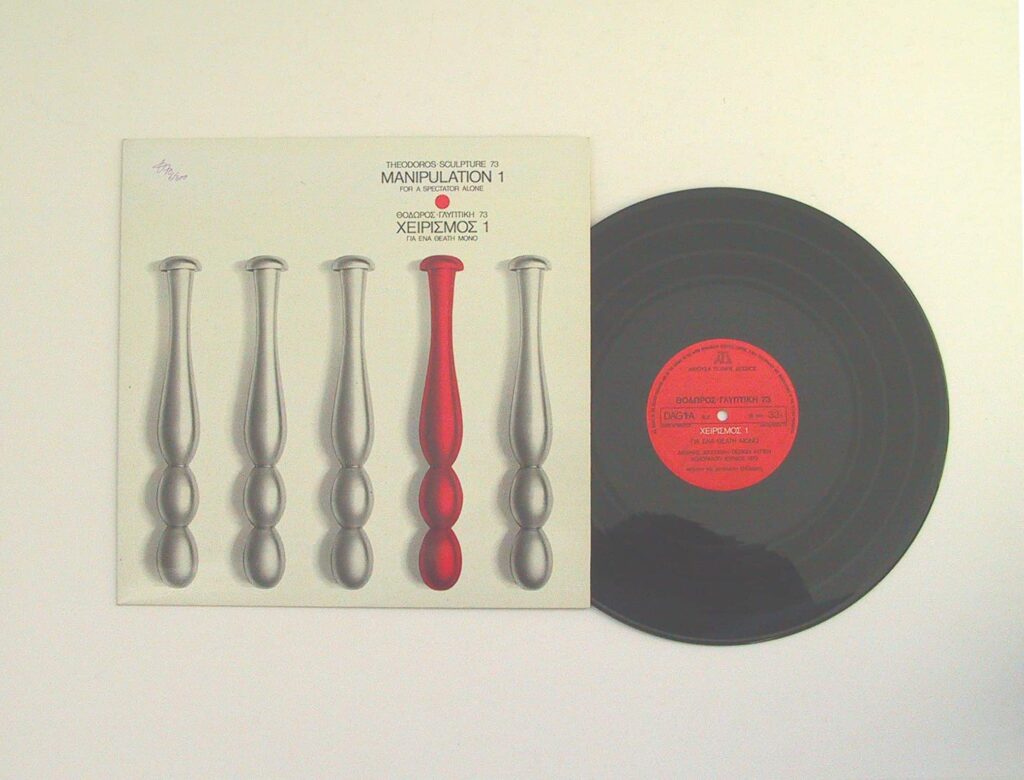
LP 12 in., paper cover 31 x 31 cm Edition 16/300 Donated by the artist, 2007
MATRAK-FALLOS
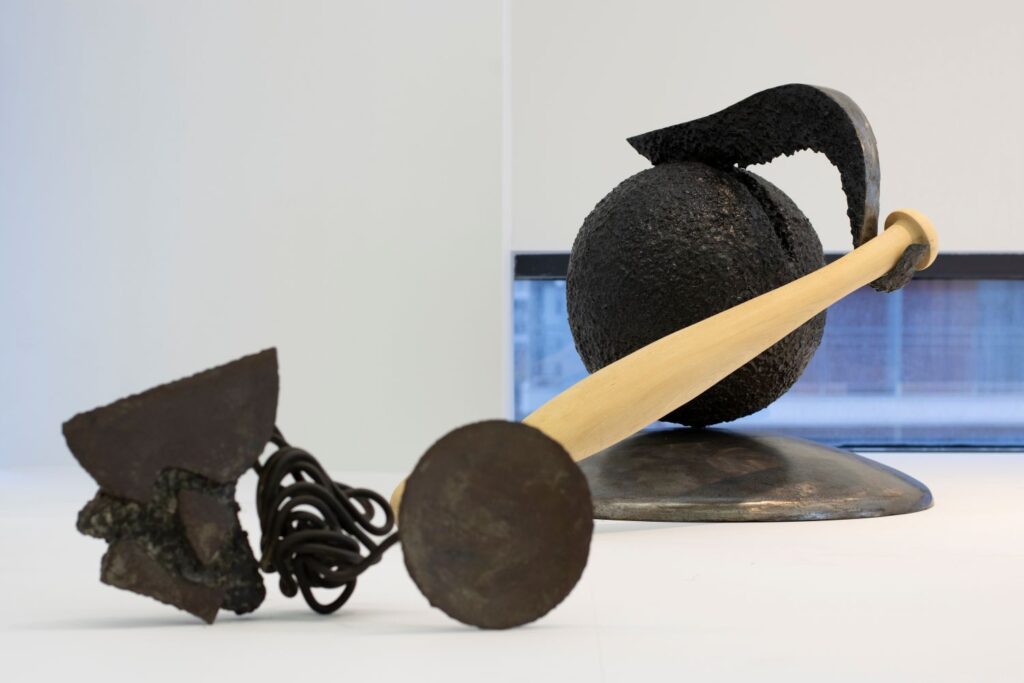
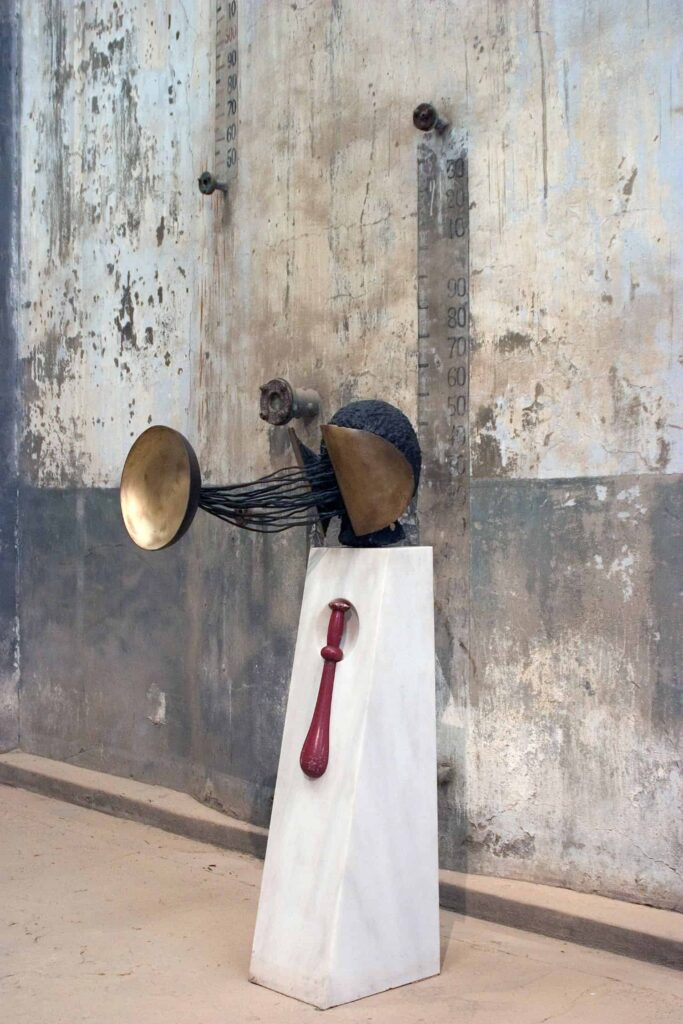
On the occasion of the murder of the student protester Sotiris Petroulas by the police in 1965, Theo realized and presented The Midnight Alarm Clock in the same year. This work was his first sculpture open to participatory gestures from the audience, as it included a baton, inlaid into the marble pedestal, which one could manipulate by tapping the metal part of the sculpture to produce sound. The baton, the tool that allows the viewer an ambiguous gesture, of violence or creation, would later evolve into the symbol of the Matrack-Phallus. This symbol combines the policeman’s baton, the sculptor’s hammer and the phallus – Theodore used it to indicate the complex of powers that influenced artistic creation while also providing a tool for hypothetical or practical use in his sculptural installations. As he attributed anthropomorphic elements to this symbol, he also used it to depict and mock artistic and authoritarian attitudes. Typical are the works from the series Variations for a Monument to the Known…, which begins in 1970, during the junta of the colonels, with reference to named military torturers. With each variation referring to a different torture, Theo realizes a series of counter-memorials to military violence, in contrast to the heroic depictions of unknown soldiers.
FROM GESTURE TO MANIPULATION
The romantic, abstract and undefined concept of the artistic gesture, which dominated post-war art, refers to artistic intention and fragmentary realisation in painting and sculpture as well as in the emerging conceptual trends. Theodoros radically departs from such a practice by placing the hand at the centre of his work. The sculptor’s materials, such as clay and metal, capture the energies of the hands and body in a material with eternal perspectives. Even performance is theorised as a morphing of energy into material, as in Anti-Theatrical Theatre in 1976: Two Sculptural Monoplays – Elegy of Homo Faber, for which the artist sealed the derivatives of two actions in metal cubes. The hand, its practice, the tools of manual labour and the knowledge of materials contribute to the creation of forms that convey complex information.
THE SOUND OF SCULPTURE
Artistic discourse was defined by Theodoros himself as a primary element of his mature work. Throughout the 1970s, Theo enriched his sculptural practice by incorporating texts, recordings or even direct live speech into his works. An example is Handling I, for one viewer only, where the work takes the form of a record and the audio content is the sculptural justification itself: “a voice you can touch”. With the two soundtracks of Handism III, he expands his thoughts, referencing both ancient engraved inscriptions and pop culture. For Theodore, the embodied and drawn participation of the artist was not an idiological differentiation – the transformation of the work into a performance – but an extension of his sculptural act.
BALANCE AND MOVEMENT
From his early works, such as the Delphic series of sculptures (1963-1967), Theodoros explores the concept of equilibrium by using the laws of physics in sculptures with suspended sculptures or sculptures with interconnected moving parts. This research gradually evolved, focusing on the balance of fragile and unbreakable materials, as well as on the alternation of dimensions.
Geometric compositions allude to an existential and metaphysical quest, dealing with the space and time of the sculptural act. With the installation ATOPON, 1997, as with other works in the same series, Theo refers to this precarious state – the balance between the fragile and the unbreakable, the ephemeral and the eternal.
TRACES OF TOUCH
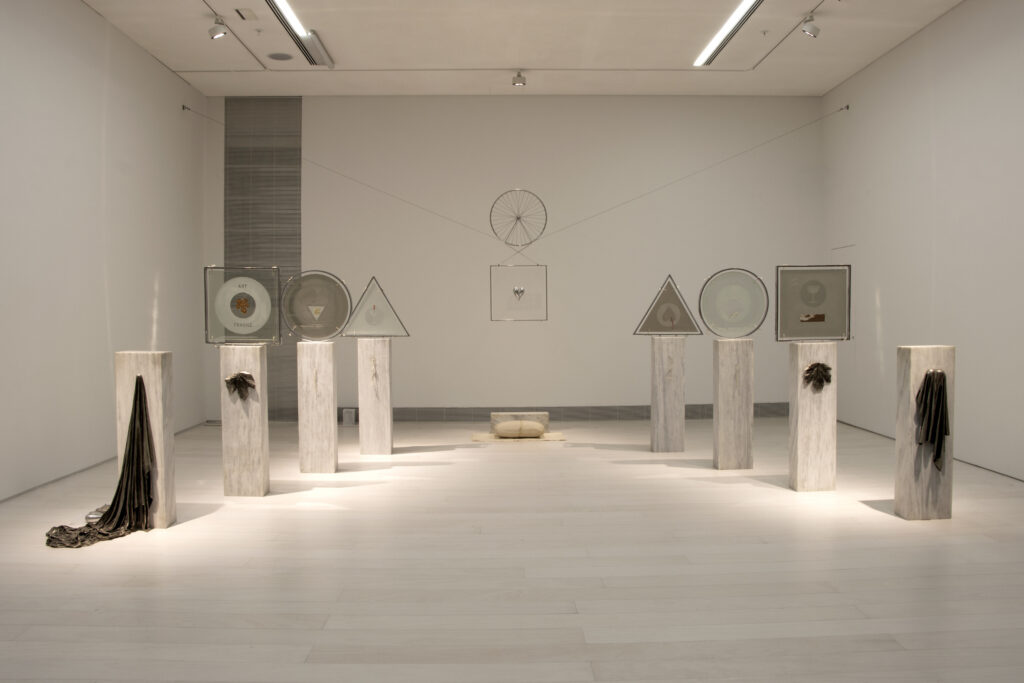
Through his work and his discourse, Theodoros argues that the artist must assert his place in the public sphere as it is shaped by mass media and information. Following the path paved by his Handlings series, Theo’s activity in television, press and radio was an extension of his sculptural practice, inscribing the artist’s discourse in the media, however ephemeral. This room presents Theo’s rich activity as a public figure, as reflected in his audiovisual and print archive.

MAINTENANCE – PRESERVATION
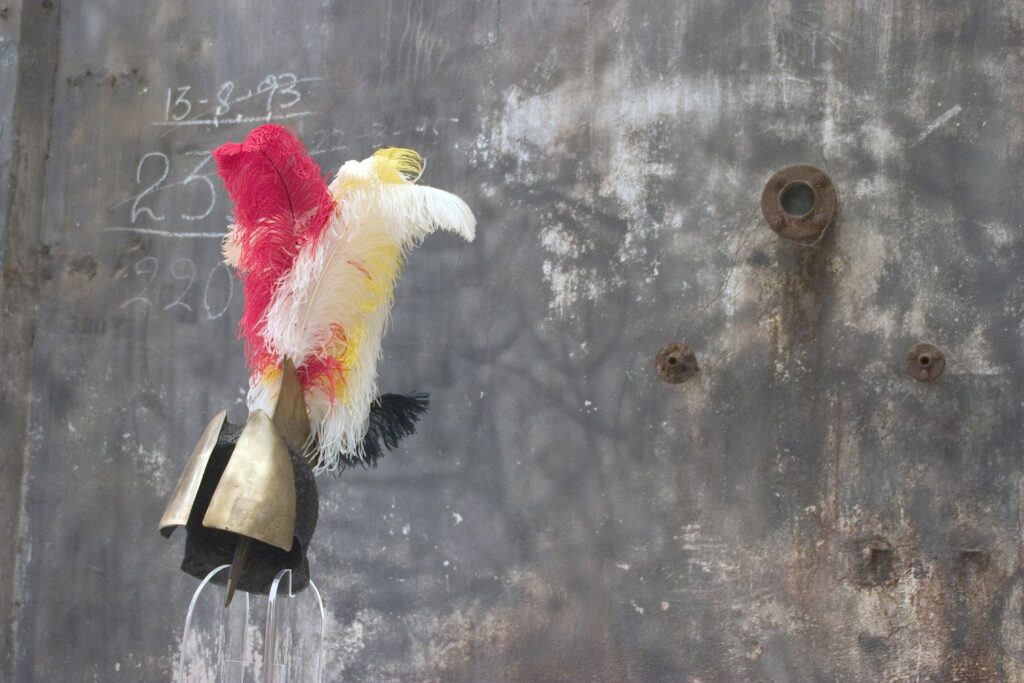
For Theo, sculpture – art in general – has a social function. In his discourse and work, he systematically addressed the ways in which this function is intertwined with the activities of cultural institutions and the art market. Theodore’s institutional critique differs from the corresponding practices of other artists who have been recorded and studied by art history, because he did not reject or undermine any artistic establishment – after all, until recently in Greece there were no institutions specialising in contemporary art and the market was unpredictable. On the contrary, his interventions aimed to raise concerns, to suggest limits and even to imagine a functional structure. He showed the museum as a mechanism of conservation, creating works through the deterioration of materials – using elements such as dents and rust – and he highlighted the limits of ownership by including messages to the buyer that the work had to be destroyed in order to be read. For example, in the installation Manipulation XII, Manipulation of the viewer/art buyer’s muscle power/energy, he invited the buyer to hit a helmet with a Matrac phallic, thus completing the work with a gesture of destruction.
TELE-MANAGEMENT
Tele-management is a unique project in Theodoros’ career, which cannot be easily categorized. It was made in collaboration with director George Emirza and is a film intended for television broadcast. The film includes footage of realized performances and actions, in which Theo addresses the viewers directly and were repeated especially for the camera. It presents his early sculptural work in motion, showing the sculptor’s hands at work, while the narration explains in depth the artist’s views on sculpture and mass communication. Through references to sensations that cannot be communicated through television, such as taste and touch, the limits of the television medium are highlighted: “The information carried by the works presented here cannot be transmitted through photography or language – television information. […] This contradiction is also evidence of the impossibility of art’s survival outside the mass media.”
ANTISPACTACLE
As a commentary on the emerging television culture of one-way communication, Theo contrasts his sculptural screens from the same period with the works in the Handlings series. Unlike the television screen, which projects two-dimensional spectacles and concrete views, Theo’s screens are sculptural, contain aromas, can be activated or shaped by the viewer, and pose open-ended questions. Among these works is HANDLING XXX – Individual sculptural-musical spectacle, 1980-1982, a sculptural installation activated by the artist to be filmed. This installation-performance is one of the last works in the Manipulations series, and Theo has singled it out as a work that captures the essence of this iconic series: the sculptural work is destroyed for the needs of the spectacle, while at the same time it comes back transformed by contemporary media.
THE GARDEN
Throughout his artistic career, Theodoros emphasised public sculpture and considered all his sculptures to be for public space. Against the shrinking of public and free space, he sought to shape the institutional field to develop two-way communication between artists and the public in museums, galleries and other art spaces. After 1967-1968, Theodoros added discourse and text to his works in an attempt to communicate with a wide audience beyond the elite of art experts and collectors. At the same time, he re-approached the presentation of his older works, activating them each time differently in relation to his newer works and the exhibition space.
For the exhibition Anti-Retroversion, a garden-like space was created specifically for the presentation of sculptures from Theo’s earlier series – Sculpture for Public Participation, Gates, Pegasus – for the presentation of drawings from his student years, and for the model of his later and now better known work for public space, the Metro Timetable, installed in the Metro station at Syntagma Square. An artificial garden corresponds to the function of the institutions that the sculptor imagined: an attempt, albeit unsuccessful, to adapt to all the needs of artistic work.
BIOGRAPHY
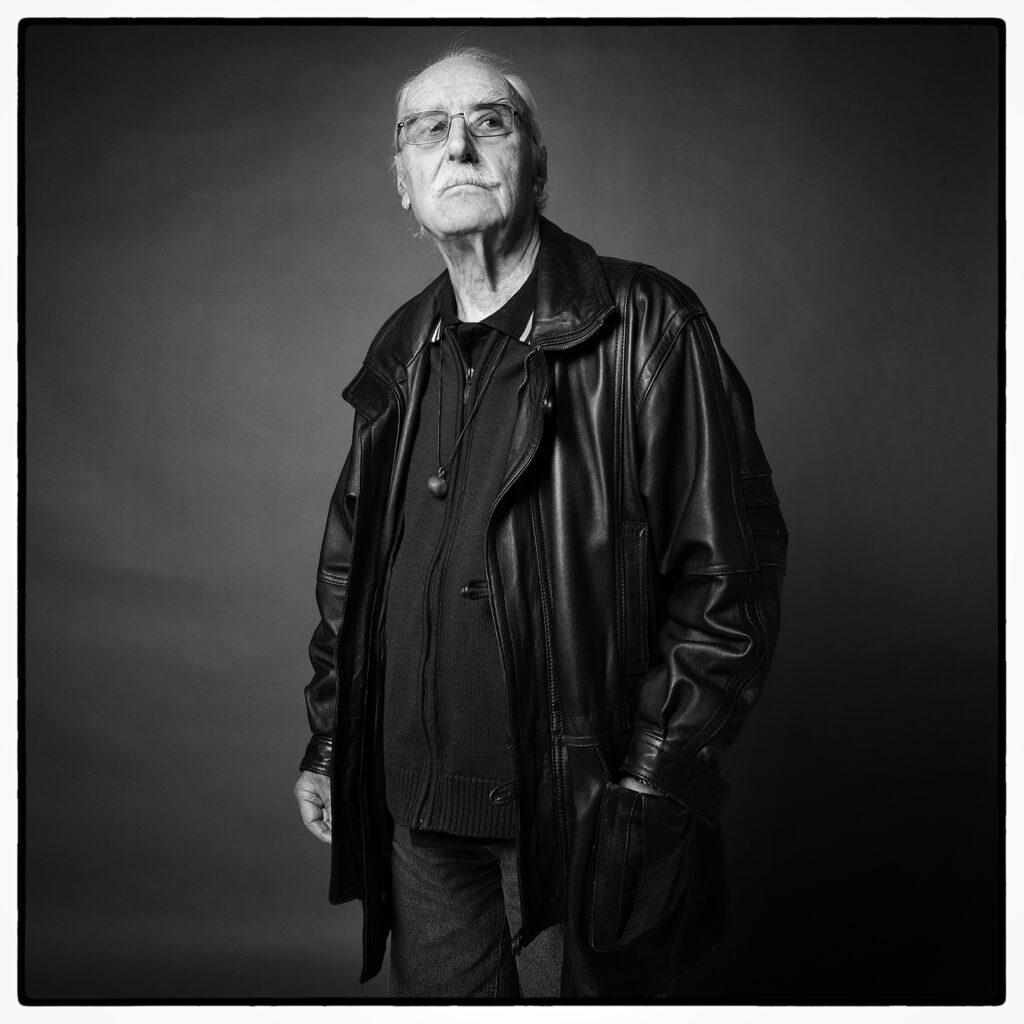
Theodoros (Papadimitriou) was born in 1931 in Agrinio, Greece. Between 1952 and 1957, he studied at the Athens School of Fine Arts. From 1959 to 1962, he continued his studies with a state scholarship in Paris at the École nationale supérieure des beaux-arts, as well as at the Académie du Feu, where he studied metalwork. He collaborated with the historic Desmos Art Gallery, where he staged most of his notable solo exhibitions, and with the Ileana Tounta Contemporary Art Centre. In 1972, Theodoros taught at California State University. He was elected Professor of Visual Arts at the National Technical University of Athens’ School of Architecture in 1980, where he taught until 1998. Among his most eminent exhibitions are his participation in the Europalia, Brussels, in 1982 with the performance MANIPULATION XXX One-Man Sculptural-Musical Show and the retrospective exhibition entitled Theodoros: Journey’s Marks, Traces of Touch–Objects, 1953-1983 at the National Gallery in Athens in 1984. He took part in many exhibitions in Greece and abroad, frequently revisiting his early work through numerous huge solo exhibitions. He died in Athens in 2018. In his will, he bequeathed 110 works and his studio to EMΣT | The National Museum of Contemporary Art, Athens.
Info
THODOROS, SCULPTOR ANTI RETROACTIVE | EMST
In the context of presentations of the EMST Collection
8 February 2025 – 8 February 2026 (2nd Floor)
Opening: Saturday 8 February at 18:30
The exhibition will be inaugurated by the Minister of Culture Lina Mendoni.
The musical curation of the evening is signed by Yannis Petridis and is inspired by Theodoros’ personal vinyl collection.
The DJs Dimitris Zougris and Tasos Stergios will play tracks from the 60s and 70s.
Entrance to the Museum is free of charge.
Opening Days & Hours:
Tuesday, Wednesday, Friday, Saturday & Sunday: 11.00 – 19:00
Thursday:11.00 – 22.00
Tickets
General Admission: 8 euros
Reduced: 4 euros
Online ticket booking: emst.gr
Address:
LEOF. L.E. L.E. CALYRIROIS & AMVR. FRANJI (FORMER FIX FACTORY)