 elc team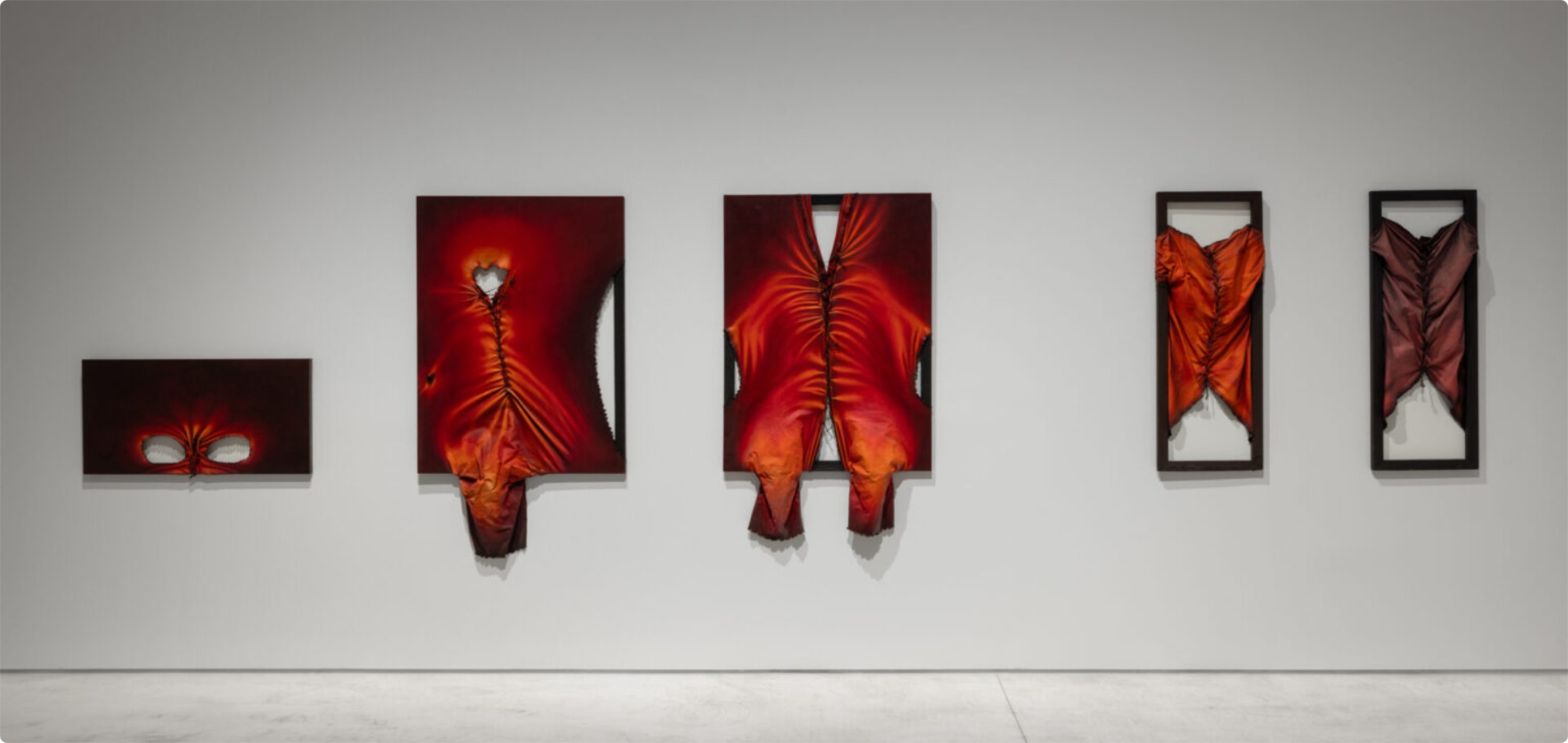
By Stelios Parris
Spring at EMST invites us to see clearly that cosmopolitanism is not a mere footnote in the histories of Niki Kanagini, Stathis Logothetis, and Yannis Christou, but the key to understanding them.
From April 2 to November 8, 2026, the National Museum of Contemporary Art presents three major retrospective exhibitions dedicated to the work of three artists who are no longer with us, yet whose work remains strikingly contemporary: Stathis Logothetis, Yannis Christou, and Niki Kanagini. Three artists in dialogue with the international currents and avant-garde movements of their time, who experimented with forms that were not purely visual. This is not a set of three parallel exhibitions, but a unified curatorial proposition, presenting the works within an exhibition framework that places strong emphasis on scenography and spatial architecture.
Niki Kanagini (1933–2008), Stathis Logothetis (1925–1997), and Yannis Christou (1926–1970) belong to the same generation, connected by cosmopolitanism. Cosmopolitanism is not an artistic movement, but rather an attitude, a condition, a mode of thinking that permeates art from the mid-19th century onwards and into the early 20th century across our broader geopolitical region. Within this framework, the artist does not think within national or local boundaries. Their work is shaped through movement, travel, and study. It draws influences from different traditions, sciences, and arts, engaging in real-time dialogue with international currents and ideas. Cosmopolitanism approaches art as a global field of exchange rather than a “national school,” and the cosmopolitan artist belongs more to the ideas and networks of their time than to their geography.
At a troubling moment marked by the rise of nationalism, wars, and political polarization, within this regressive landscape we inhabit, EMST comes forward to promote a more progressive narrative. It does not approach cosmopolitanism in its elitist sense; it rejects anything nationalist and presents the retrospective work of three artists who embody openness to the world. Three personalities in active exchange with the international movements of their time, shaped by a cosmopolitan worldview.
Walking through these three exhibitions and attempting to enter each artist’s universe, one could say that the impression left behind is that Stathis Logothetis “dissolves” painting, Yannis Christou “dissolves” music, and Niki Kanagini “dissolves” the object. All three transform the artwork into experience, into process, into participation. This Spring at EMST is not nostalgic but revelatory, as it reveals that a significant part of Greek art has yet to be fully assimilated or appreciated as it deserves. I must admit that, of the three artists, I was familiar only with Yannis Christou, due to my love for experimental electronic music. Thanks to this Spring at EMST, I came to admire and learn more about the work of the other two artists as well.

Photo: Paris Tavitian
On the 3rd floor, we encounter Enantiodromia by Yannis Christou, an exhibition in collaboration with the Athens Conservatoire, curated by Kostis Zouliatis, who has studied Christou’s work for over twenty years. Yannis Christou is a major figure in the musical avant-garde of the 20th century, despite his untimely death in a car accident at the peak of his creative period.
The exhibition’s title draws on a double reference: the idea of Heraclitus regarding the path of opposites, where ascent and descent form one and the same route, and Christou’s own work of the same name, inspired by the harmony produced through opposing movements. The exhibition unfolds as a large-scale score and timeline tracing the composer’s work. Visitors will encounter photographs, scores, books, correspondence, philosophical texts, handwritten notes, and personal objects from Christou’s studio, as well as rare audio documents from his creative output, including material related to ancient tragedy, given his collaboration with Karolos Koun on The Persians and Oresteia. Also presented is the composer’s ambitious plan for a radical opera, left unfinished due to his death.
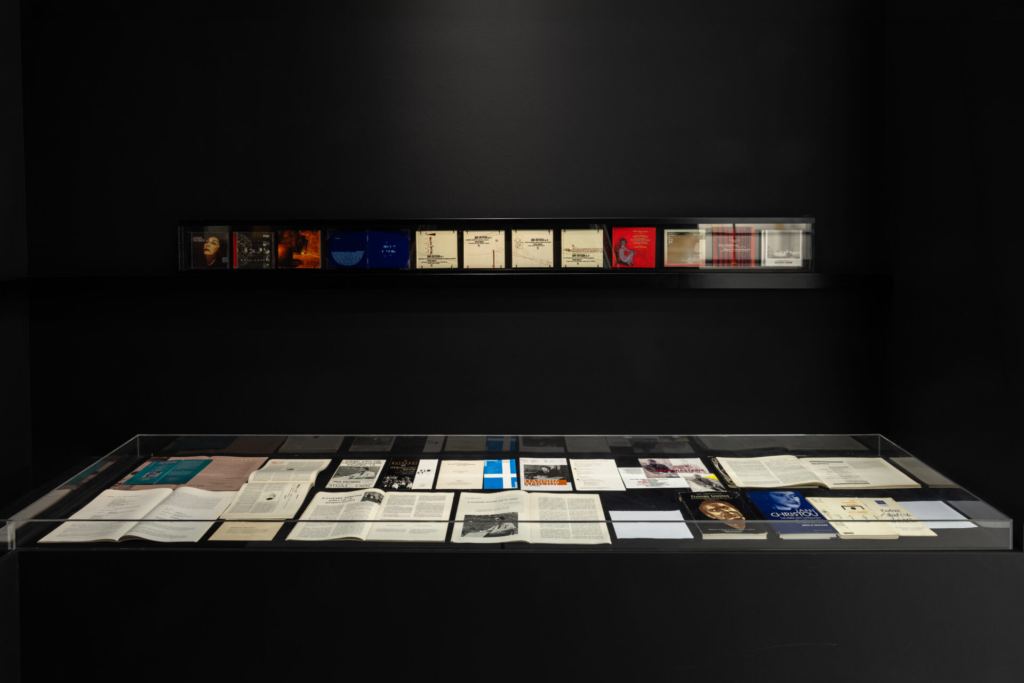
Photo: Paris Tavitian
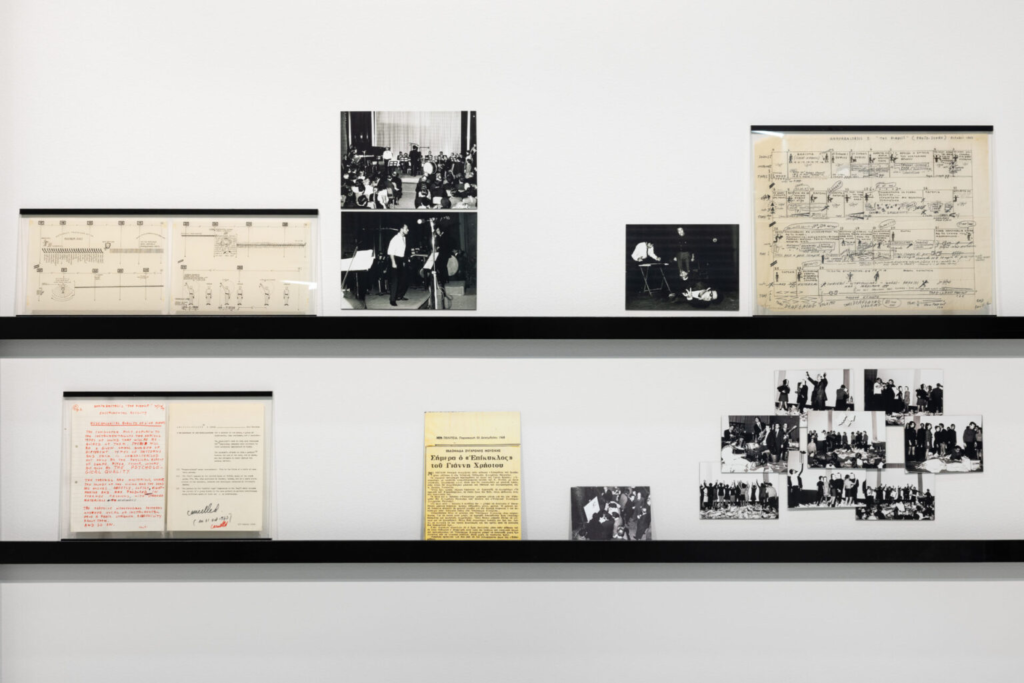
Photo: Paris Tavitian
What captivated me most was the specially designed “hidden room,” where you can listen to the complete recording of a work that even its creator never had the chance to hear, thanks to a new mix of recorded material and electronic sounds, the result of the research work of musicologist Ianos Iliadis. As Kostis Zouliatis notes in his curatorial text: “The totality of materials and audiovisual documents reveals today a unique philosopher of sounds, but above all a sonic philosopher: a creator who reflects through his own practice, a reflection that constitutes itself.”

Photo: Paris Tavitian
On the ground floor, we step “On Earth” with Stathis Logothetis, an exhibition curated by Stamatis Schizakis. Logothetis shaped his artistic practice in dialogue with European art of the 1960s and 1970s, and now, 29 years after his death, EMST re-evaluates his decisive contribution to contemporary art in Greece through the expansion of painting practice and its connection to performance and installation.
As a viewer, I must admit I was swept away by the journey into his “Earth,” in the large hall where his works dominate. They possess volume, and some function almost like costumes. For him, the canvas clearly operates as an extension of the human body. The frame exists but does not confine, while the red canvases that emerge seem to come alive, as if they once belonged to parts of a body which, as the curator noted, “symbolize trauma and its healing.” This red appears in almost every shade, from the brightest to nearly black, functioning like blood. Logothetis had also studied medicine, so the relationship between the body and his art is ever-present. These canvas-like costumes were used in performances and worn by the artist like a second skin.
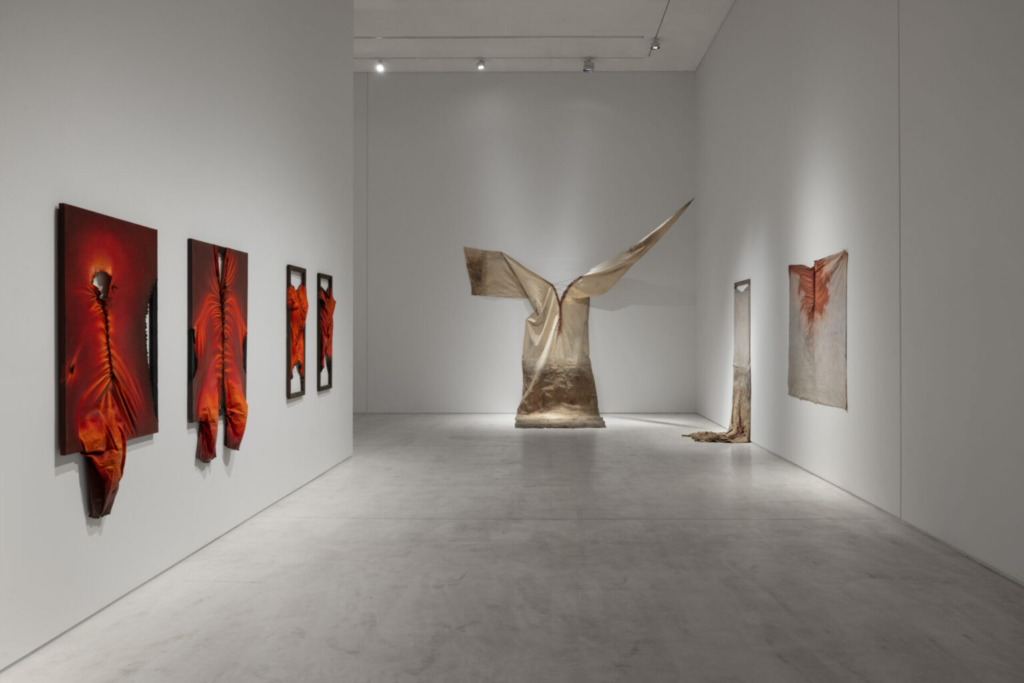
Photo: Paris Tavitian

Photo: Paris Tavitian
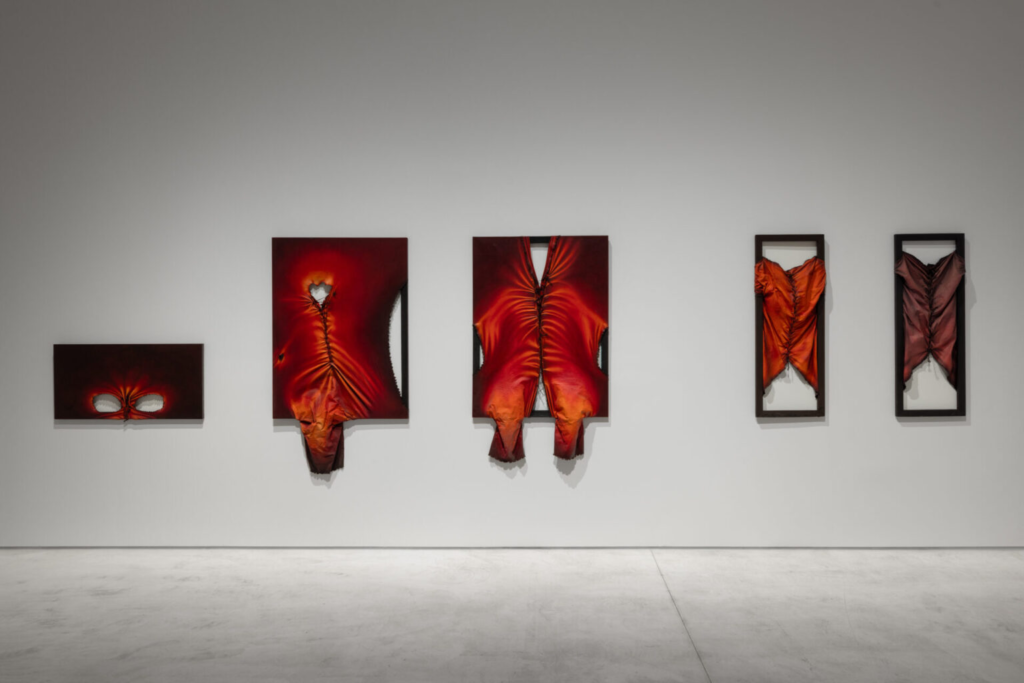
Photo: Paris Tavitian
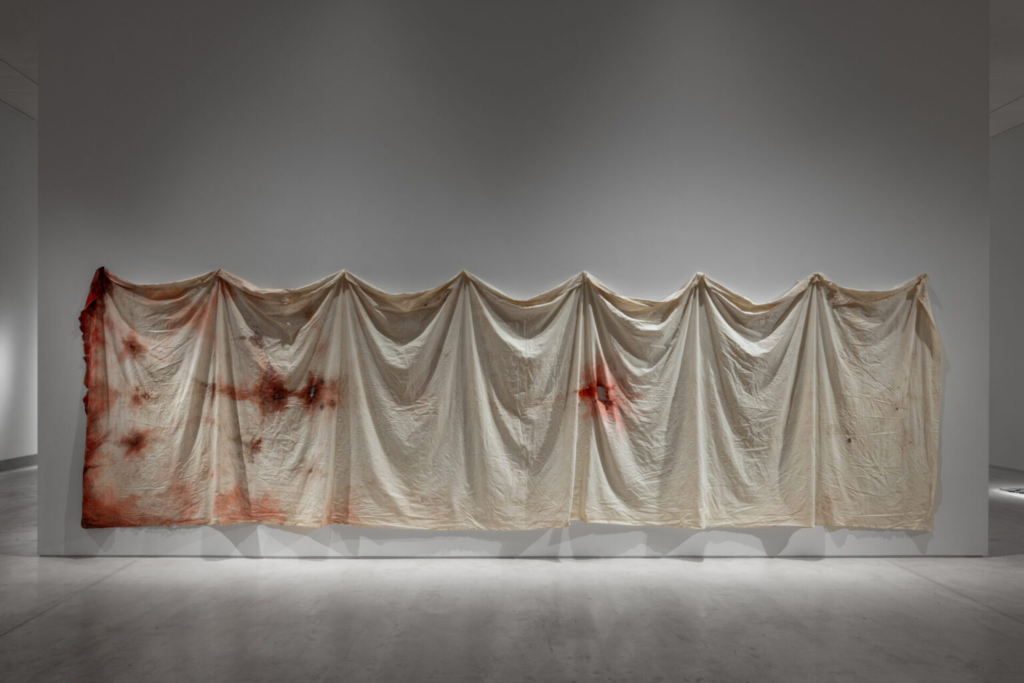
Photo: Paris Tavitian


As I observed his works, they dominated the space not only because of their scale or the intensity of the red color, but also because of their wear. The deterioration he intentionally subjected them to, exposing them to chance and natural forces, made them resemble living organisms in my eyes, much like the wear of human skin we all experience in life. By surrendering his works to nature, burying them in the earth, immersing them in water, he made decay a co-creator. Time becomes a material of art, and I believe this practice anticipated ecology and the politics of the human body, conversations that would emerge decades later. In this exhibition too, the spatial design plays a crucial role, this architectural treatment of the exhibition space that separates periods and works, creating depth and perspective, allowing the viewer to fully engage with them.
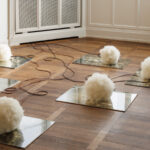
I left for last Niki Kanagini and her Ode to Things, the retrospective exhibition on the 3rd floor curated by Tina Pandi. The exhibition that moved me the most, as it truly felt like walking through a stage set. Her works, the “things,” dominate the space. The title Ode to Things derives from the poem of the same name by Pablo Neruda, found in the artist’s archive and a source of inspiration for her:
“Many things
told me everything.
Not only did they touch me
or were touched by my hand,
but they accompanied
my very existence.”
These lines echo the artistic quest and dedication of a significant creator to the everyday microcosm of objects as carriers of memory, time, and identity.
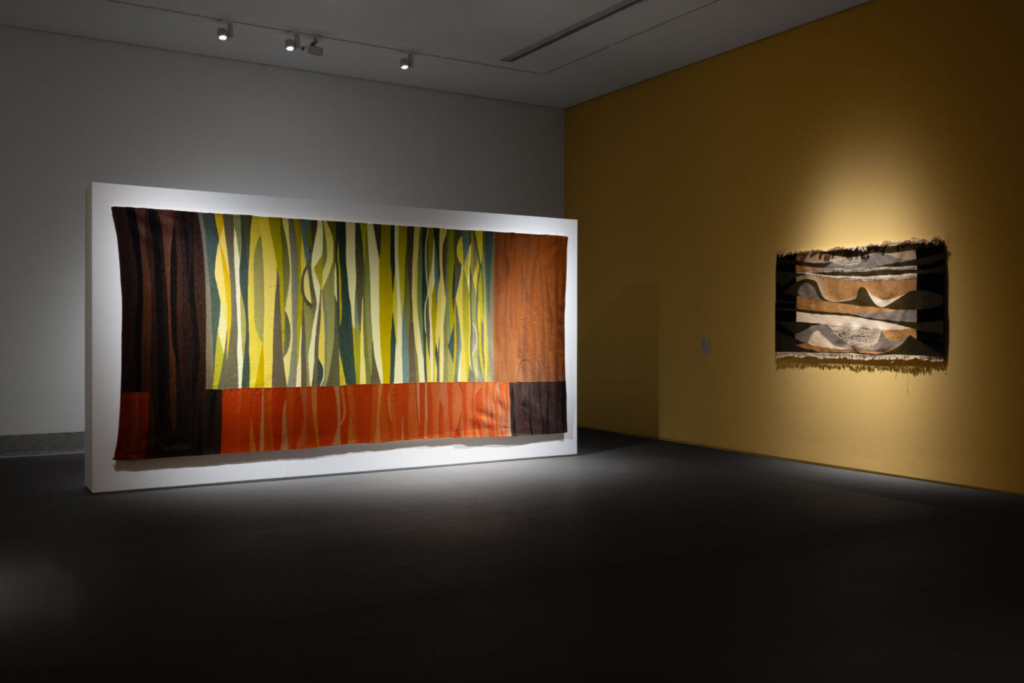
Photo: Paris Tavitian
The exhibition opens dynamically with the work Metakinisi (Movement). Enlarged monograms of the artist’s grandfather and grandmother, drawn from family needlework, where the diasporic experience, movement, and memory seem to be inscribed into the piece. This is followed by her tapestries and her experimentation, which ultimately leads to the creation of interior sculptures.
We then move on to the “manuscripts,” where graphite surfaces resemble an illegible script, inviting me to sit down and attempt to read them. Yet it was the section En Oiko (At Home) that truly won me over: here, everyday domestic objects are detached from their function and transformed into political commentary on female identity. Niki Kanagini was an artist who, from early in her generation (born in 1933), brought forward questions of gender identity and the position of women in a deeply conservative Greece of that time. She was also among the first to introduce themes of textile practices, women’s labor, interdisciplinarity, and audience participation. For this reason, the exhibition concludes with a participatory work, And the Walls Have a Voice, where visitors are invited to write their own messages.
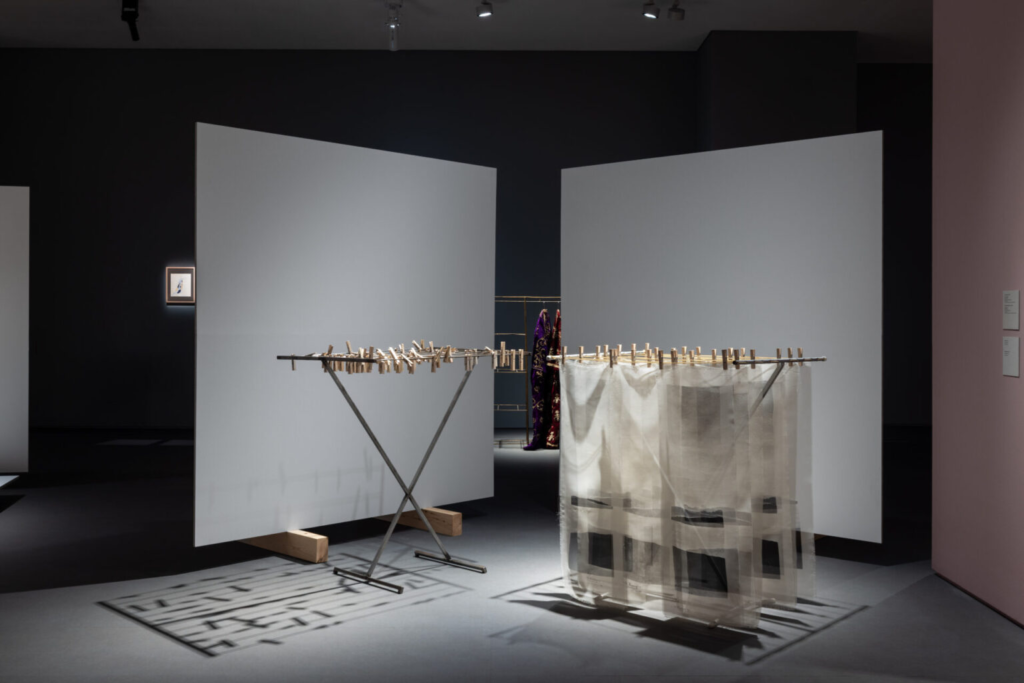
Photo: Paris Tavitian
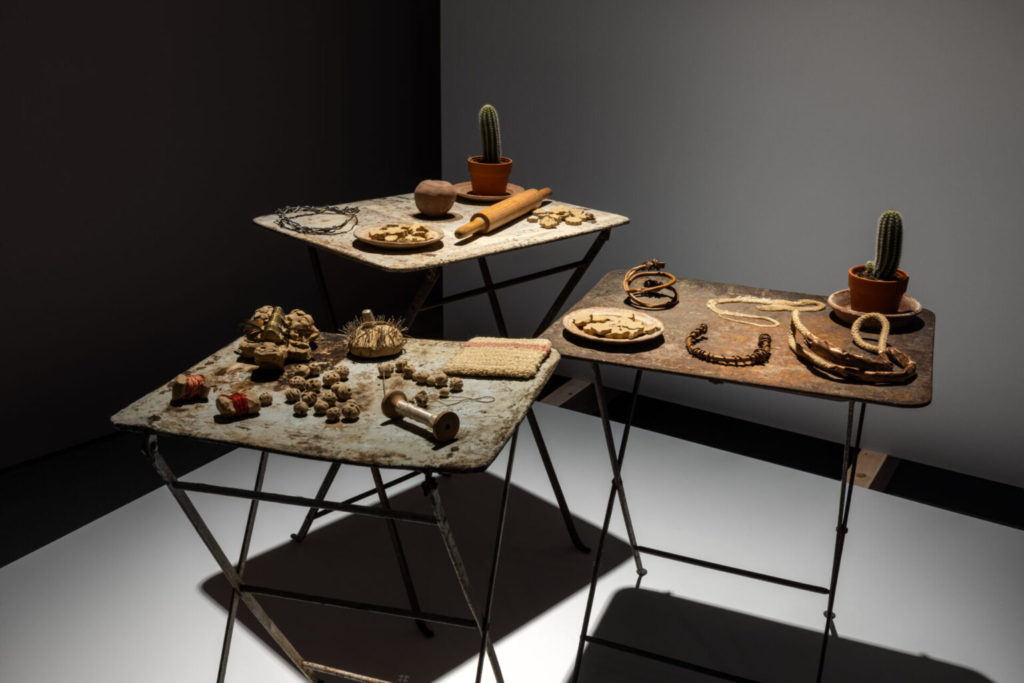
Metal tables, clay, wood, metals, threads, snakeskin
Dimensions variable
Private collection
Installation view of the exhibition Ode to Things. Niki Kanagini. Retrospective.
Photo: Paris Tavitian
Quite simply, the impression and conclusions I drew from experiencing these three exhibitions are the following: Stathis Logothetis expands painting into body and nature; Yannis Christou expands music into philosophy and ritual; Niki Kanagini expands the object into social experience. All three demonstrate that postwar Greek art did not develop in isolation, but within the very core of the international avant-garde. Each of them left Greece for different reasons, yet all eventually returned or settled back in a country that was not ready to absorb what they brought with them.
Spring at EMST invites us to see this clearly: cosmopolitanism is not a shared footnote in their histories, but the key to understanding them. To discover them, for those of us who were unaware, and to reassess them, for those who already knew their work.