 PEPI NIKOLOPOULOU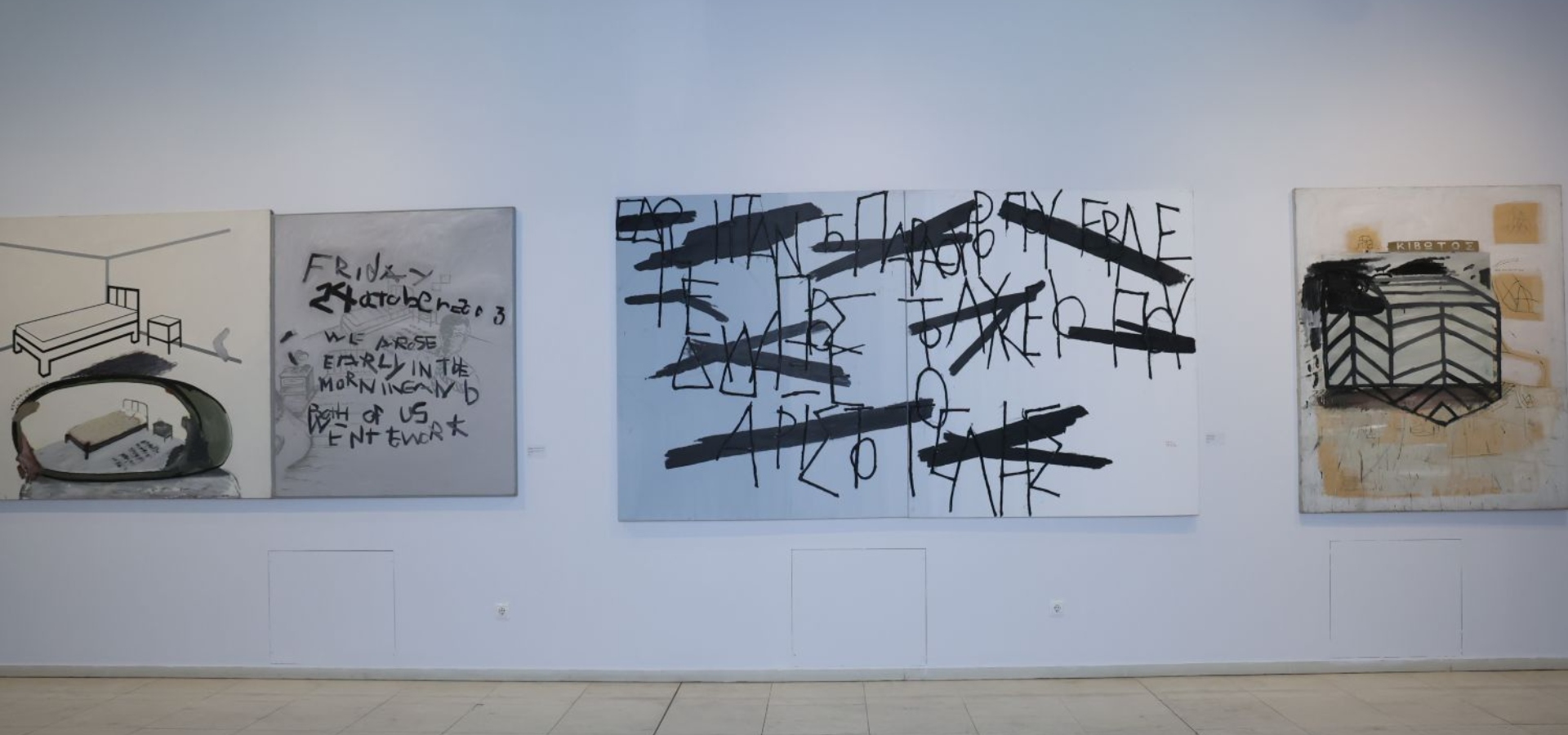
Katerina Koskina offers a guided journey into the world of Kyriakos Mortarakos and his major retrospective at the City of Athens Gallery
Kyriakos Mortarakos’ work constitutes a unified, coherent visual universe, where painting functions not merely as representation but as a mode of thinking, memory, and self-observation. From the earliest portraits of familiar faces to the major thematic cycles of his mature period-Cubes, Arks, Factories, Routes, Tables, and above all the Rooms–Mortarakos does not follow a linear progression. Instead, he returns to subjects, forms, and materials, re-examining them each time with a different gaze: ora empros, ora piso / look forward, look back.
I recently became closely acquainted with his extensive and prolific oeuvre after visiting the City of Athens Gallery in Metaxourgeio, where the retrospective exhibition of Kyriakos Mortarakos is presented, curated by Katerina Koskina (PhD in Art History, museologist). The exhibition unfolds across both buildings of the Gallery, from 27 November 2025 to 25 January 2026, and includes over 150 works, organised into thematic units that trace the artist’s entire trajectory-from his early years at the Athens School of Fine Arts to his mature and multifaceted visual production.
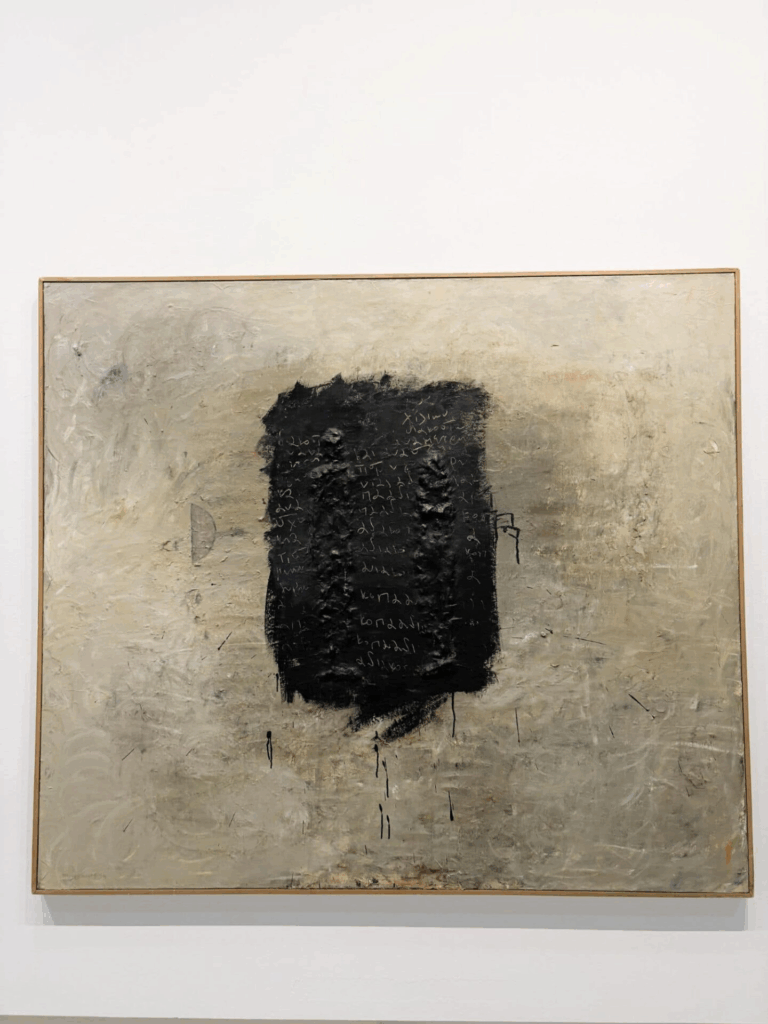
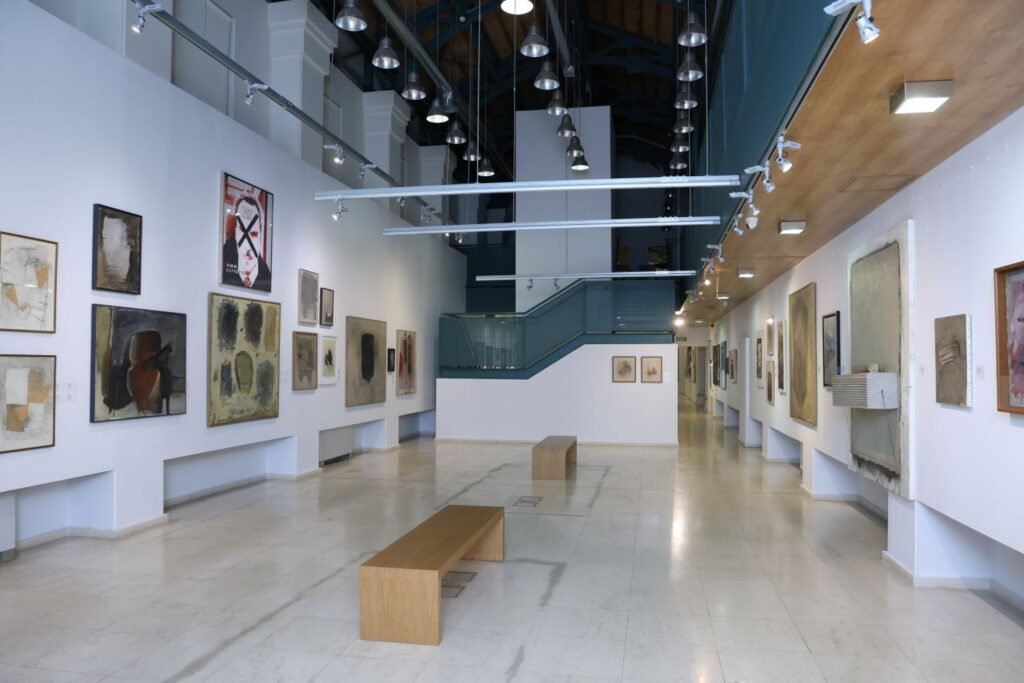
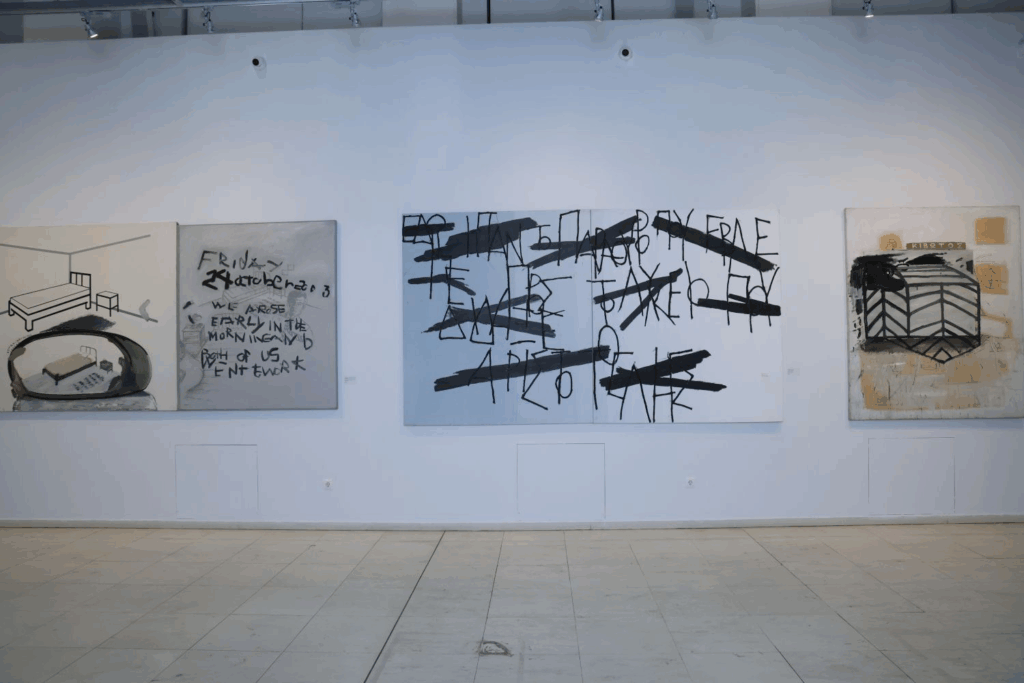
Upon entering the exhibition, the first thing that overwhelms you is the sheer number of works and the density of attention they demand; each wall is a universe of its own, each composition an entry point into the mind and memory of Kyriakos Mortarakos. The curator, Katerina Koskina, guides me almost narratively. The sections are not chronological-they carry emotion, image, faces. “It is as if they converse with one another,” Koskina notes. Taken as a whole, the work resembles a personal diary: not in the sense of confession, but as an ongoing act of recording, observing, and continuity. No mistake is erased. His painting relies on a personal code: dates that function as temporal anchors, textual inscriptions that open emotional or experiential associations, and the frequent incorporation of earlier works into later ones. Nothing is fully revealed. His intention is to leave room for suggestion-for “traces,” as the curator describes. The viewer is not asked to interpret but to complete, to become a co-participant in a creative puzzle of multiple narratives.
Alongside the works, rich archival material is also on display-printed, digital, and analogue-as well as installations and visual environments that illuminate the multilayered way in which Mortarakos conceives painting and space. After Athens, the exhibition will travel to Thessaloniki, where it is scheduled to be presented at the Municipal Gallery (Casa Bianca) in the summer of 2026.
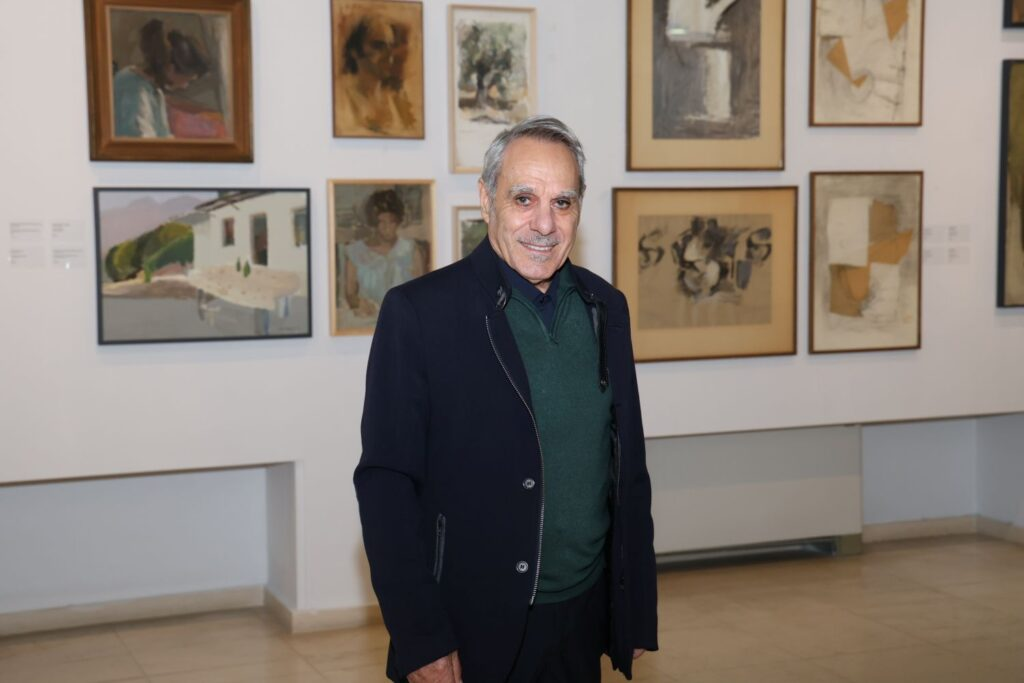
A visual universe in perpetual motion
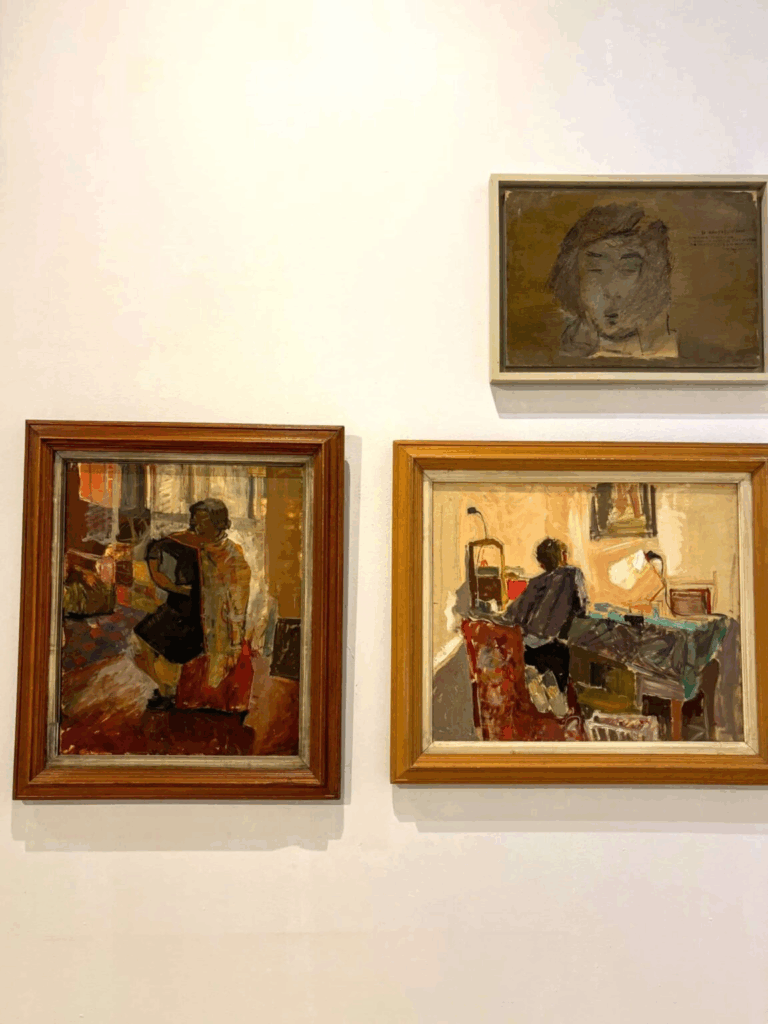
The retrospective exhibition of Kyriakos Mortarakos is organised without a strict chronological order; instead, it is guided by the logic of internal dialogues. Curator Katerina Koskina chooses to begin the journey with his early works, created even before his studies at the Athens School of Fine Arts-a period dating back to the early 1980s. On these first walls we see the roots: portraits of familiar faces, the artist’s mother, and Spyridoula Politi, an artist he met very young and who would later become his wife. An initial nucleus of a creative world shaped by memory and intimacy.
Characteristic of Koskina’s approach is her decision to place, within this same section, a much later work from 2013, which Mortarakos created after the death of his sister, from memory. “13 January 2016. I remembered Vasiliki,” he notes on the work. It is a conceptual curatorial choice, one that completes his desire to record what has been lost. “He lost his sister, whom he loved deeply. He found her again in his sleep and the next morning painted her face from memory. I placed it here because this section is the most internal, the most private, the root of his painting,” Koskina explains during our tour. Thus, the first section of the exhibition shows not only how a painter was born, but also how memory continually infiltrates his work, functioning at times as raw material and at others as a mechanism of recall.
From the late 1980s onwards, a clear shift is visible. His work acquires structure, repetition of motifs, and thematic “obsessions” that will follow him for years to come. “The guitars, the collages, the references to Braque and Picasso, signs of a period in which Mortarakos expands his visual vocabulary, tests material, surface, cutting, and gradually shapes his personal idiom,” as Koskina describes.
“With these works, the coherence of the whole oeuvre becomes evident, while at the same time the privacy of personal memory is ‘protected’, as it is never fully disclosed. One could speak of traces, interpretive ‘keys’ with investigative potential. In this sense, they become instruments of inner searching and carriers of meaning and emotion, not only for a hypothetical reading of the artist’s temperament, psyche, or biographical events, but also as prompts for reflection for the viewers themselves,” Koskina continues as we walk among the works.
After the early years, the exhibition moves into the large section of the Tables, a point where, according to Koskina, Mortarakos’ painting acquires true philosophical depth. The impetus seems to have come from something that at first appears insignificant: utilitarian objects of everyday life, the “surface-level” ones, as she calls them. These objects, seemingly trivial, become for the artist vessels of meaning; he studies them formally, conceptually, existentially. From the question “what is it that I see?” he shifts to “what is painting?” and, crucially, “why do we need painting?”
Here, in this section where guitars meet the first tables, Koskina chooses to place a self-portrait. “A belated self-portrait,” she explains. “But I placed it here so that it is absolutely clear-even to someone unfamiliar with Mortarakos’ work-who the person before them is.” The red, the X, the date of birth—and even more importantly, the tax identification number. Unlike other personal details that change over the course of our lives, this number remains fixed, unmovable—functioning here as a fundamental stamp of identity. She selects this work as a declaration of presence: anyone entering the exhibition meets first the person, then the painter, and only after that the works that unfold around him as a narrative.
What follows is the extensive Tables series, numerous works in which, for the first time, the smudge appears as an equal form of mark-making. Koskina explains: from this point onward, “erasure” and “painting” operate as two equivalent modes of expression. Erasing does not negate; it declares. The smudge becomes a structural and aesthetic element, part of the artist’s personal code, on par with colour and form.
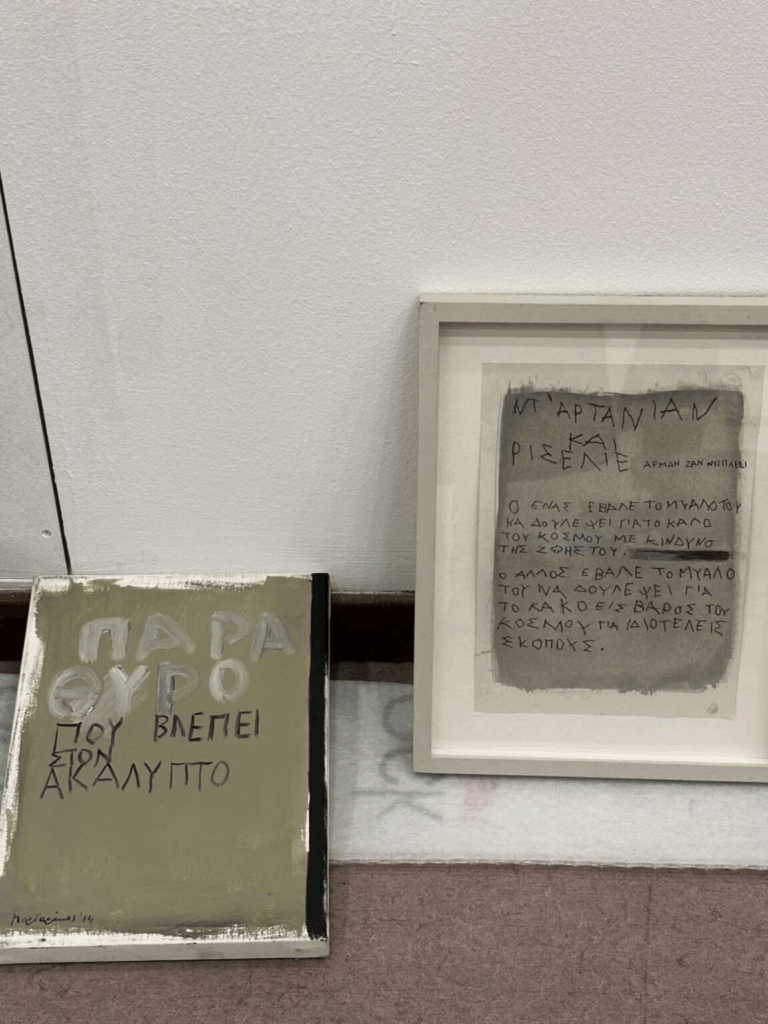
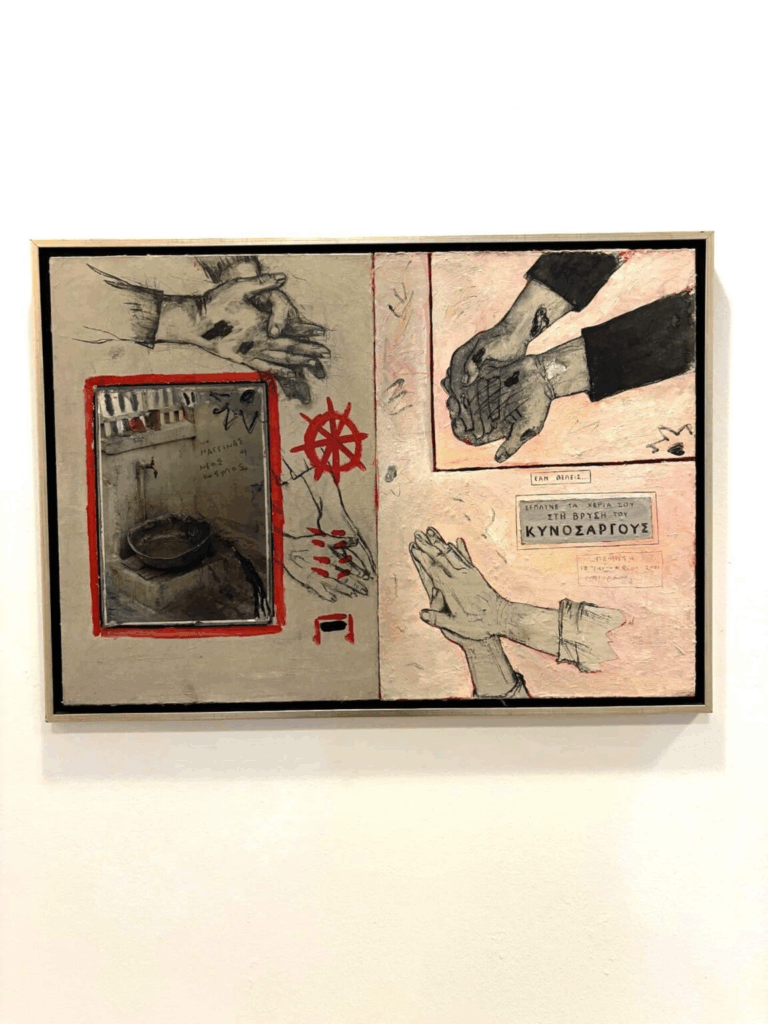
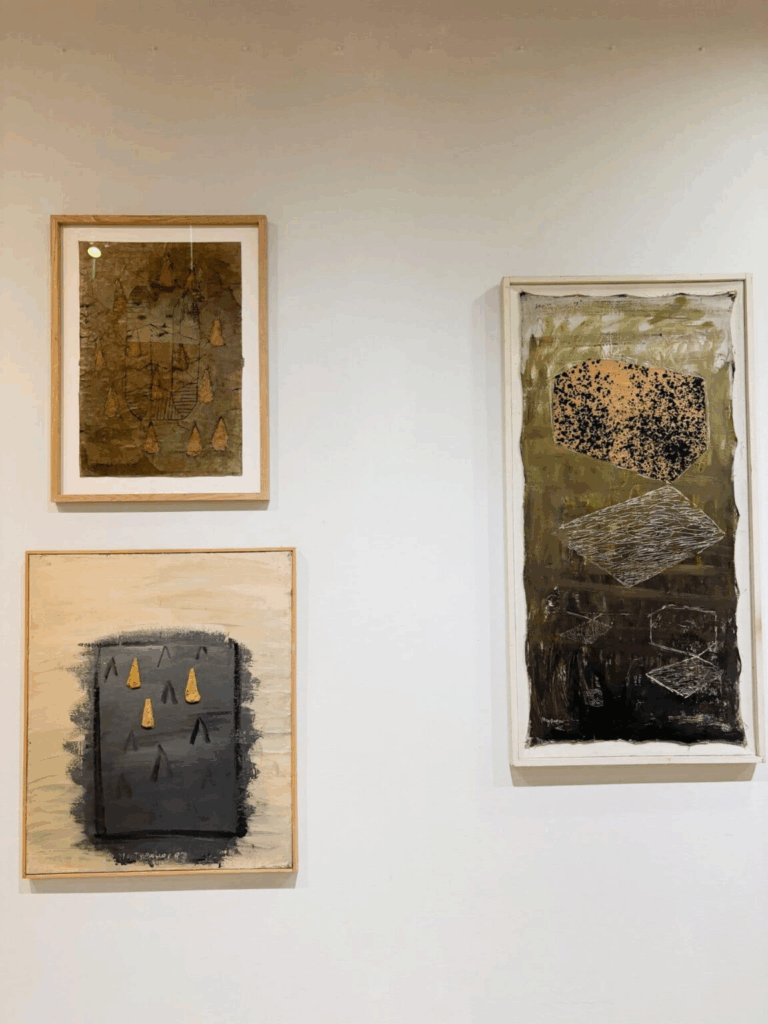
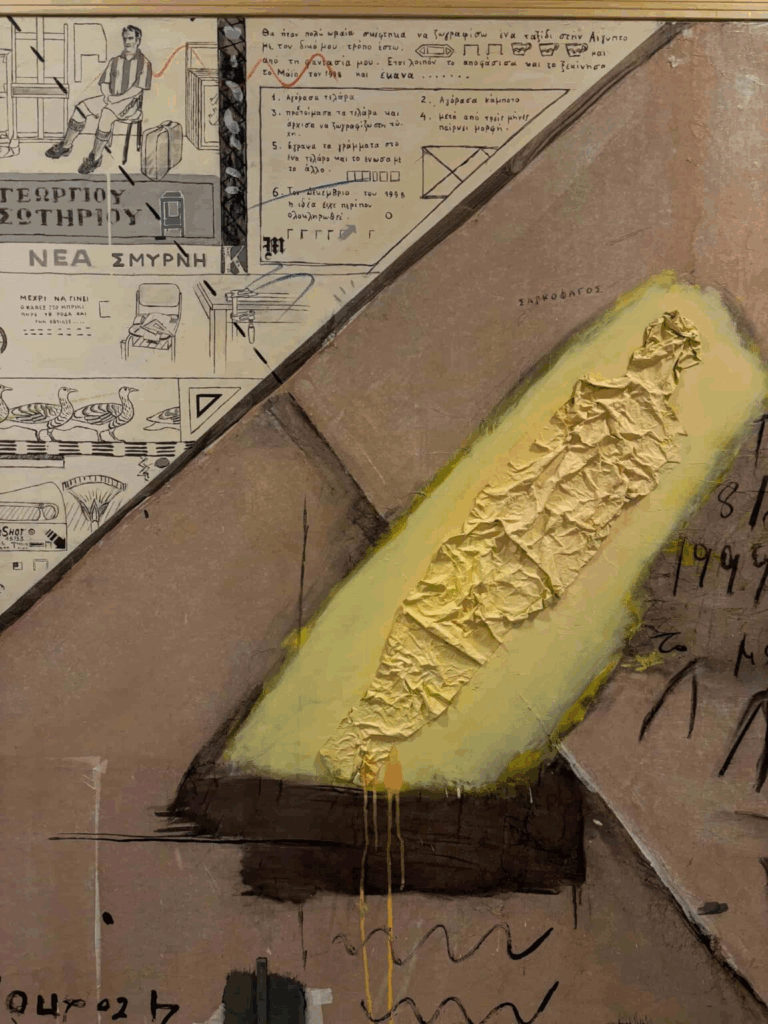
The entire Tables series functions as a continuous act of recording: days, months, faces, materials, mistakes, pastes, layers. Painting becomes a form of daily notation. And as in a diary, nothing is erased. Mistakes remain. Experiments are not removed. “From this point on, his practice begins to resemble a diary. A conscious diary,” notes Katerina Koskina.
This section concludes with one of the first works in which Mortarakos moves into the third dimension: a depiction of the first humans, Adam and Eve, powerful, almost raw, with a strong emphasis on matter. Relationship, couple, body, all appear here for the first time as central themes. Koskina suspects it may coincide with his meeting Spyridoula, but she insists: “The point is not biography but process. Matter precedes image. Painting precedes story.”
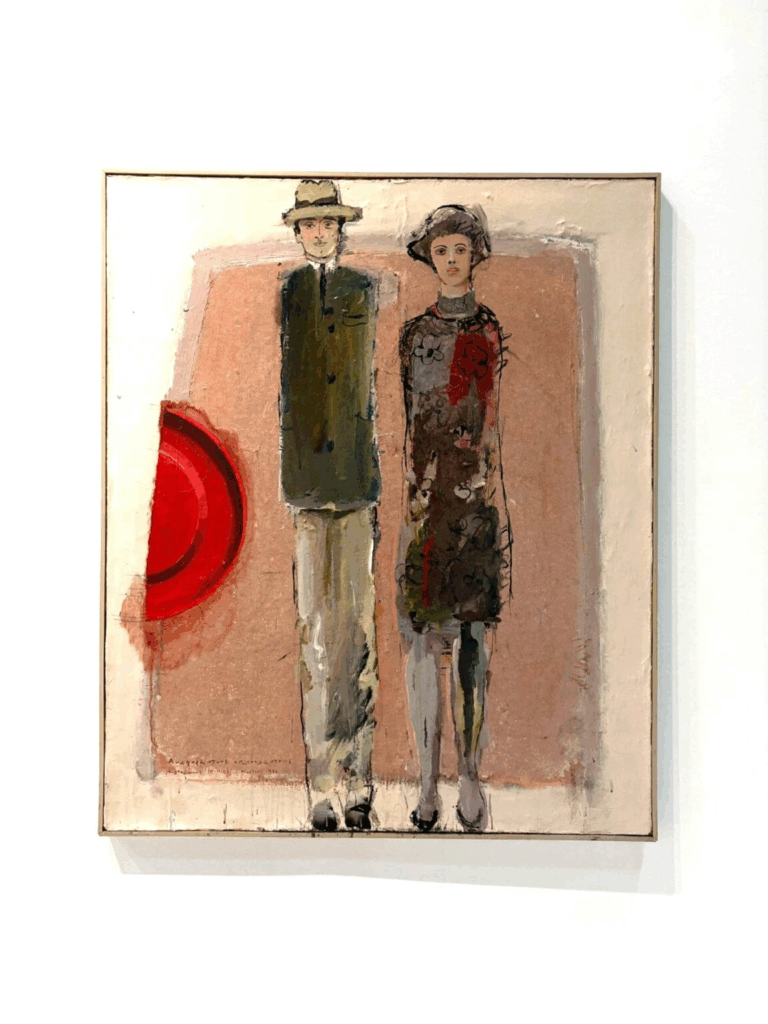
The Rooms section is one of the most important in the exhibition. Koskina pauses before it with emphasis: “The rooms are everyone’s microcosm. Mortarakos uses them to build it, deconstruct it, describe it, and reconstruct it.” Interior spaces, beds, walls, floors of soil, all become material.
The room is never presented as a place of habitation; it is presented as a field of meaning. We often see the bed, “the human measure,” as Koskina calls it. Bed–birth, bed–death. A point of beginning and ending. And always without human figure. The human is present precisely because he is absent.
A window may be real or imagined. A form that looks like a wall may in fact be a layer. “An opening might function like a mirror. Exits from the rooms are rare. Often a sense of enclosure emerges. Perhaps it is a poetic reference to the human brain. Mortarakos provides elements, and the viewer is asked to complete them. In the final stage of the Rooms, he reaches absolute abstraction. We no longer recognise the window, but the feeling of impasse. The only escape seems to be what the text reminds us of. We are not given an image, we are given the possibility to build one. The work is not completed on the wall but in the gaze that receives it, and in the viewer’s imagination.”
In the next section, Factories, Koskina points out that we now enter another terrain: more social, more collective, at times political. “Here, other issues unfold-social, political, revolutionary,” she says. The factories appear schematically, often with the rhythm and pattern we encountered in the tables, as if still holding the same origin, the same base, but in a different frame. The factory is not merely a building, it is a mechanism. A social commentary. A critique. These are not specifically Greek factories, nor are their forms tied to particular places. Koskina believes they could exist anywhere in the world in Greece, in Mani, in the Amazon, in a mine, in an industrial city, or in a psychic mechanism. “There are factories of labour, factories of the soul, creative factories,” she says, summarising the multiplicity of the notion.
As in previous sections, dates appear prominently. 1948-his birth. 1973-perhaps the beginning of his relationship with Spyridoula? 17 May 1996-a fact unknown to us but clearly charged for him; significant enough to remain unexplained, and therefore alive. The dates are left as a code. In some works, a religious element enters-not enough to turn the pieces into religious art, but to add a kind of spirituality without dogma.

“He is a remarkable artist-not because he never left a room, but because he travelled through it,” Koskina shares. The reference to Kavafis appears almost instinctively, perhaps because both creators proved that geography is not confined to the body, but can move with the spirit and the gaze. “I get the impression of a person whose life seemed somehow enclosed somewhere, but who read, saw, absorbed. He didn’t travel much, yet he holds experiences like someone who has travelled the entire globe.” And she adds: “He has produced a body of work with extraordinary narrative. It begins somewhere and goes somewhere else. He didn’t know it when he started, but he arrived.”
Here, his path condenses: painting as a trajectory without a predetermined end. As writing carved before him as he moves. As a journey ora empros, ora piso (see forward, see behind)- now forward, now back.
In one of the rooms, an entire wall consists of a composition arranged by Mortarakos himself. Words, phrases, and small painted fragments form something between a diary and a map of routes. Before me, the sequence alternates:
Reclining figure
Red square
Seascape
Room interior
And then two phrases that inevitably stand out:
“Here was the emblem of April 21, 1967.”
“Here was the photograph of Georgios Papadopoulos.”
Mortarakos writes these with silicone and then paints over them-wanting the trace of History to remain. Writing becomes, in his hands, a geology of memory.

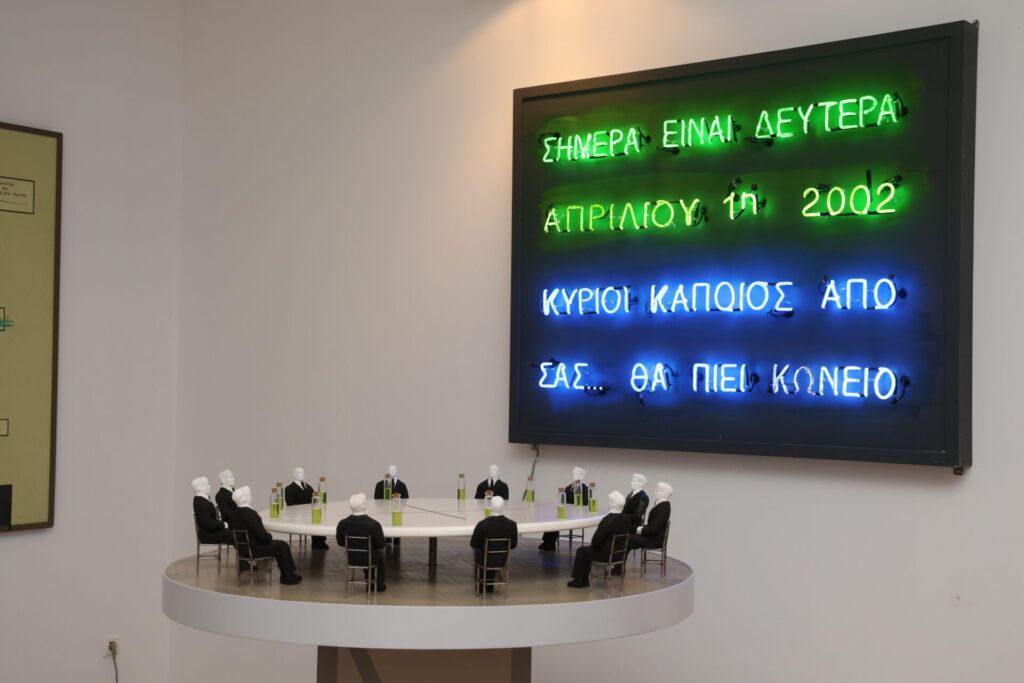
Before leaving, I ask Koskina why she chose to stage this retrospective now, and not later. “Because I wanted him to be present,” she replies. “I wanted him to be with me during the installation, to see his work, to admire it, to comment on it.” And I carry with me the words of a triptych that held me still for a long time:
The painter asked him
inside a strange, metaphysical, yellow space:
— Tell me, now that you no longer exist, you’ve died—how do you feel?
— Nothing, since I don’t exist.
— Shall I paint you so you can take shape?
— No, I don’t want that.
— Fine, then I’ll write only the questions and the answers.
— What colour do you like?
— Brown.
And the painter asked him again:
— Do you feel guilt?
— No.
— Are you carrying anything now?
— The windows.
— What are you thinking of?
— The festival in Kamaroula, the water in Palichoria, Takis and my tsoupes.
— What else?
— It’s too tangled.
— Now that you’re…
— Up in your fig tree, picking figs. And it hurts terribly. And he points to the place where the spleen is.
— How is it possible for you to hurt if you don’t exist!
— I don’t know. I didn’t change the windows.
— But now the image has formed—so I will paint you.
— No, I told you—I’ll see the doctor again.
— Alright. Leave it.
Info
Kyriakos Mortarakos – RETROSPECTIVE
27 November 2025 – 25 January 2026
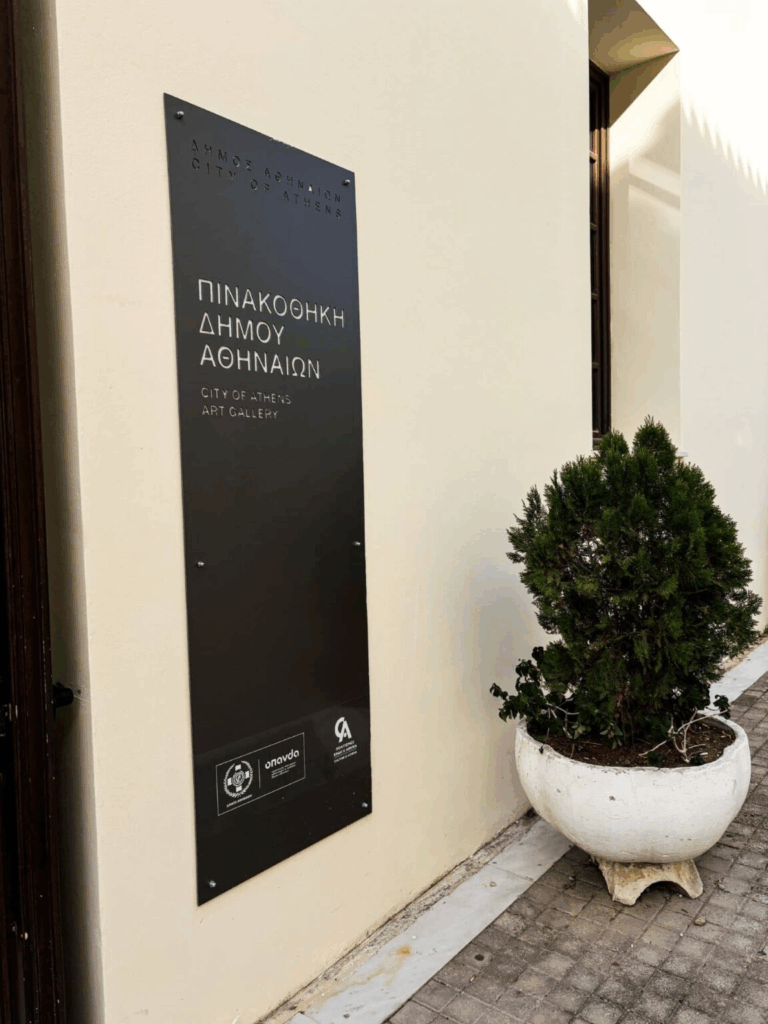
City of Athens Gallery, Metaxourgeio
Special acknowledgement is due to the sponsors (ERT, Second Programme, Third Programme, Athina 9.84, Athens Voice, Culturenow.gr, Ktima Kir-Yianni, Karavias Art Insurance), as well as to the lenders and donors who supported the realisation of the exhibition: Florika P. Kyriakopoulou, Themis Speis, and Kyriakos Tsiflakos.
The exhibition is organised by the non-profit organisation POLITES with the support of the City of Athens Cultural, Sports & Youth Organisation (OPANDA).