 PEPI NIKOLOPOULOU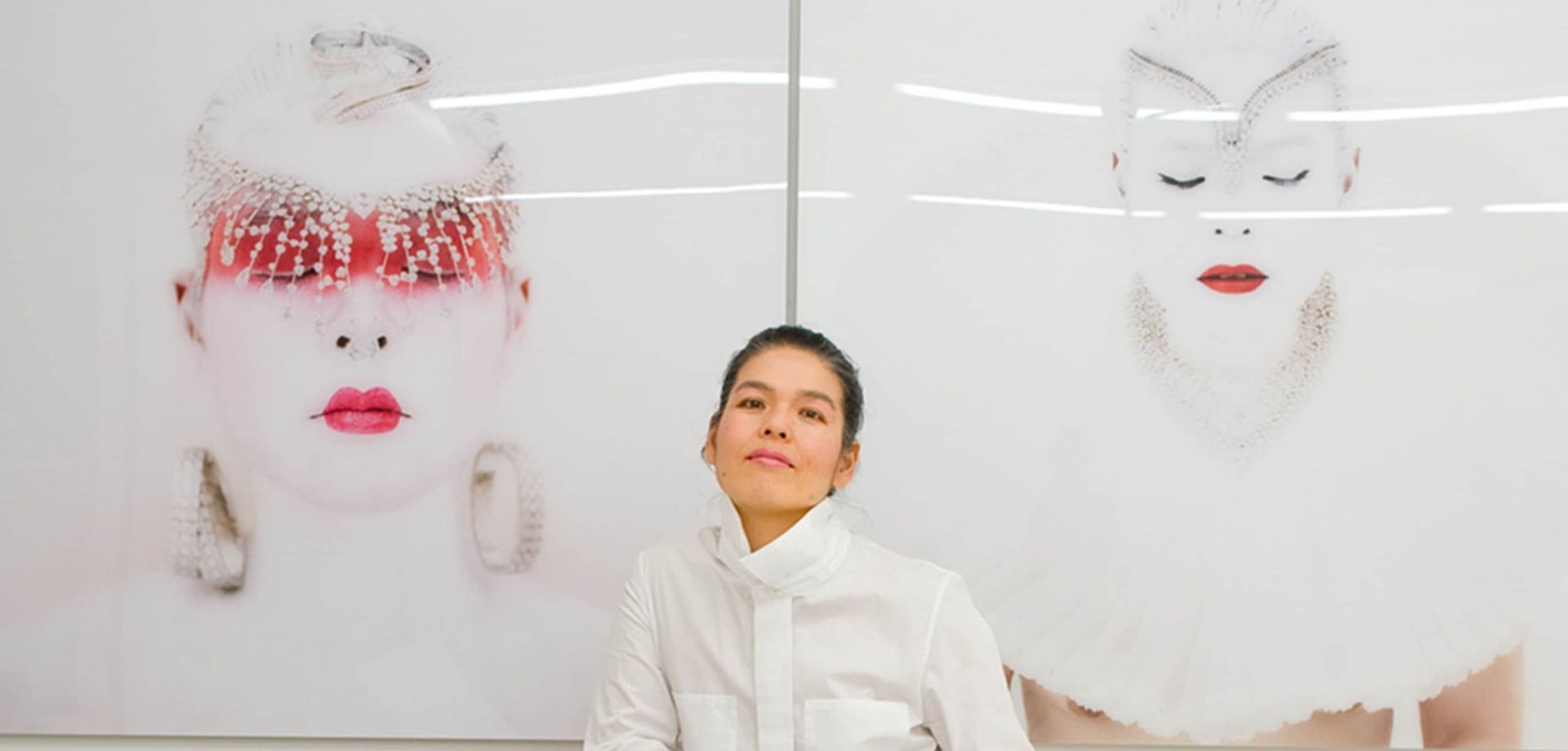
Kimiko Yoshida returns to Athens with “Mythologies – With the Face of Kimiko Yoshida” at Kourd Gallery, curated by Eleni Varopoulou. Through photographs and sculptures, the internationally acclaimed artist explores memory, myth, and transformation, turning the face into a space of disappearance and rebirth.
Kimiko Yoshida doesn’t simply photograph herself, she transforms herself. In her self-portraits, identity becomes a field of experimentation and the face a space of disappearance; a meeting point between memory, myth, and invention. On the occasion of her first solo exhibition in Greece, “Mythologies – With the Face of Kimiko Yoshida” at Kourd Gallery, curated by Eleni Varopoulou, the internationally acclaimed artist returns to Athens with a series of photographs and sculptures that invite the viewer to reflect on transformation and the feminine archetype.
Born in Tokyo and living between Venice and Paris, Yoshida has built a visual language that transcends borders, eras, and cultures. Her work – plural, meditative, and deeply symbolic – moves between tradition and contemporary identity, ritual and image. Ahead of her upcoming exhibition in Athens, she speaks to elculture about the memory of the face, the art of metamorphosis, and the silence that lingers behind the gaze.
In your self-portraits, the face becomes a field of experimentation. What does it mean for you to “disappear” through your work?
I consider my works as still lifes. What I show is the image of a corpse that could resemble me. If my images are dealing with portraiture, but never with self-portraiture, because I don’t feel like it is revealing anything of myself. It’s about obscuring my identity, erasing or obliterating myself. It’s not fantasy or pretending or narcissism. It’s not about me.
I feel I’m anonymous in my work. When I look at the pictures, I never see myself; they aren’t self-portraits. They are characters obliterating myself. In my images, I do disappear.
Where do you find the balance between your personal identity and the myths or forms you embody?
Self-portraiture is a solution of ease; as the material is myself, it presents itself as what I have at hand to say something other than what is shown: the subject is not a reflection on the representation of the self, which would be the manifestation of a uninteresting egotism, but a reflection on the conditions of possibility of an image.
My self-portraits are timeless and “abstract” portraits, that is to say free from anecdote, narrative and any form of storytelling. This peculiar fixity of the subject, this indifference, as if the image contained in itself its own absence of limits, reflects a very old technique of depicting infinite time within a restricted framework that dates back to the Flemish primitives and the Sienese school. This dimension of infinity is correlated to a conceptual protocol, a principle of repetition, a logic of abstraction that of course take these self-portraits beyond the issue of self-representation: the reflection focuses on the conditions of possibility of representation itself.

For you, is photography a medium of memory – or a medium of self-negation?
Photography is not for me a medium of memory: it records an absence, a lack, something that has disappeared. Any representation is the presentation of something that is absent. Re-presenting is showing something that is not present, it means there is something missing in the image.
It is therefore an absence that allows to re-present what is not present. And this is obviously verifiable in the history of painting as in the advent of photography.
In your exhibition Mythologies – With the Face of Kimiko Yoshida, you draw inspiration from the pantheon of myths and religions. How do you choose which myths become part of your visual narrative?
The gods are incarnated in multiple avatars they all have an identity in the process of becoming. Like the artist. Identity is nothing more than a fantasy, a construction resulting from an uninterrupted series of competing identifications. So-called identity stems solely from a multiple accumulation of roles and adornments, accidents and traumas, aspirations and ambitions, crystallizations, mimetic behaviors, borrowings, imitations, fascinations and successive idealizations. Identity is like art: a fiction, an accumulation of borrowings.

Myths often act as mirrors of our collective fears and desires. Which contemporary myth would you say we are living today?
The decline of the Roman Empire? Is it a myth?
Your images resemble rituals. What is your process of photographing like? Is it a physical, almost spiritual experience?
Yes, photography is for me a kind of ritual, a ceremony of disappearance, where I fade into color (monochrome), I vanish into otherness (multiple identities), I faint in timelessness (an unactualized fixity outside the narrative).
Art is a subtle process of transposition, an assiduous struggle with the state of things…
What is your relationship with time? You seem to suspend – or even abolish – it within your works.
My photography is like a present that presents itself as present: it is the Time that is.
The image, which is itself but the appearance of what has disappeared, brings about a destructive act that is wholly similar to death, which replaces the living being with a corpse that looks like him – this is the main point. My art has always been associated with disappearance; I’ve always wanted to disappear into my images, into the ultimate meaning of the image. My Self-portraits are images of disappearance where the figure lends the work its meaning by disappearing. Death is formalized in images that are apt to get the figure of the body across, make it disappear by obliterating it in color.
Your figures appear sacred yet genderless, feminine yet timeless. How do you perceive the female presence in contemporary art?
Yes, timeless and genderless are meanings at the heart of my art. Genderless means that masculine or feminine art are contemporary conveniences without relevance; their only significance is ideological. It is, in short, the submission to a woke ideology, which will disappear in the oblivion of contemporary vanities.
This is your first solo exhibition in Greece. What moved or inspired you the most in Athens or in your collaboration with Kourd Gallery?
We all know that Greece is the cradle of Europe, the cradle, in fact, of contemporary culture, democracy and art. And the historian Eleni Varopoulou and the gallery owner Haik Kourdoglanian came to pick me up in Venice: I immediately said yes with enthusiasm (and Eleni would point out to me that it’s a Greek word: inspired by a god!).

Is there an element of Greek mythology or culture that you feel particularly close to?
The great figures of Antiquity remain alive in European and therefore global culture: at the heart of art history I find all the deities of Olympus, in literature I find Homer and all his heroes (I am preparing an exhibition on the theme of Penelope’s reunion with Ulysses), I naturally frequent playwrights and philosophers of Antiquity (notably Heraclitus: Time is a child playing) or the Pythia of Delphi who knows so well how to put ambiguity, misunderstanding, and duplicity – all constitutive elements of language – at the heart of her speech.
What does “beauty” mean to you today?
Beauty is the whole point of art, whose best definition is certainly this: the war of taste.
What is the most important thing you have learned through your ongoing metamorphosis as an artist?
A work of art is a successful symptom, that is to say a transformed one. Art is what transforms. I see art as the boldest, most radical experience, the freest to signify the lack of being, to convert the symptom, to transform pain and unhappiness, to move beyond devastation and despair.
The only raison d’être of art is to transform what only art can transform. Transformation appears to me as the ultimate value of the work. Art has become for me the space of reversal, of free resonance, of everchanging metamorphosis – mutation, permutation, transmutation. My self-portraits, or what are called such, are merely the place and formula of transfiguration. Everything that is not me interests me. To be where I don’t think I am, to disappear where I think I am, that’s what is important.

Magnifique artiste
Un grand talent