
 Deana Kartsagouli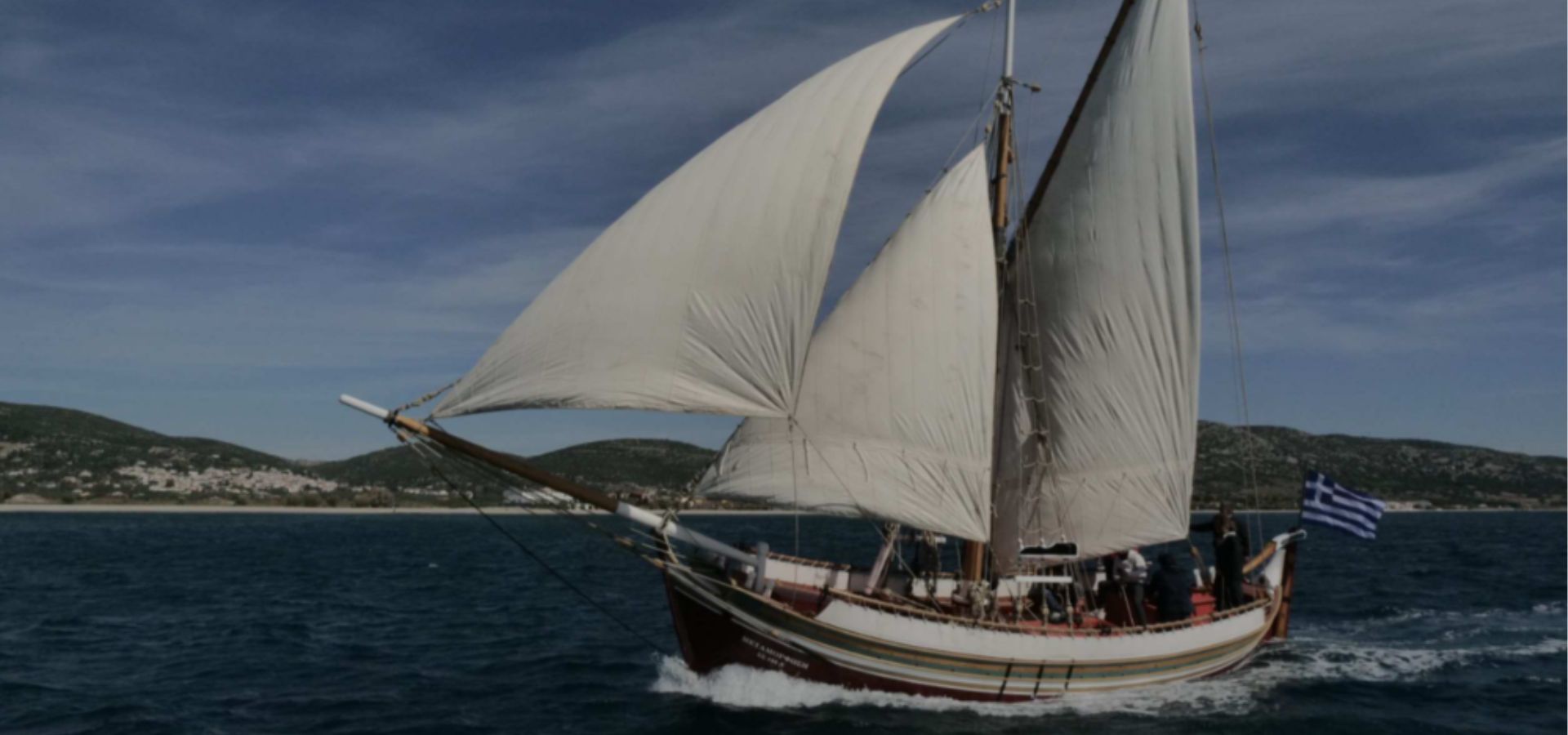
Its recognition as intangible national cultural heritage brings back into focus the traditional triangular sail that tamed the Greek seas for centuries.
The image of a white triangular sail gliding across the calm, deep-blue waters of the Aegean is emblematic of a country that has relied more than any other on the sea and its sailors. Today, this sail remains familiar in its simplicity, yet few know how to call it by its name and even fewer how to use it. This is one of the reasons that led to its inscription in the National Inventory of Intangible Cultural Heritage in 2024, in an effort to safeguard a craft that is at risk of disappearing.
It is the lateen sail, distinguished by its triangular shape and the way it is mounted on a long yard set at an angle to the mast. In the Aegean, its use was widespread until the early decades of the 20th century, offering advantages in the particular conditions of the archipelago, as it harnesses the intensity and variability of the wind. In this way, the vessel is protected from capsizing. This quality made traditional boats virtually unsinkable in the hands of experienced sailors who knew how to “read” the weather.
A sail tailor-made for the Aegean
“It is a Mediterranean sail. It existed in the Aegean and across Greece, but also throughout the Mediterranean -France, Italy, along the Dalmatian coast, everywhere. Even on the lakes of Switzerland,” says Kostas Damianidis, an architect with a PhD in traditional Greek shipbuilding, who, as scientific director of the Museum of Aegean Shipbuilding and Maritime Arts in Samos, was among the key figures behind the effort to promote this craft internationally and secure its recognition.
As Mr. Damianidis explains, a joint nomination has also been submitted with France, Spain, Italy, Croatia, and Switzerland for the inclusion of the lateen sail in UNESCO’s Intangible Cultural Heritage, as the sail of the Mediterranean.
He points out, however, that despite its shared Mediterranean roots, each lateen sail varied from country to country. The particularity of the Greek version lies mainly in the way the sail is rigged to the vessel and in its overall geometry.
“There are technical differences in the way the lateen sail is rigged in Greece compared to other countries. Ours is lighter in the construction of the yard and has different proportions in the mast, which makes it faster and more ‘responsive’ in manoeuvres between the islands of the Aegean,” Mr. Damianidis explains.
The making of a lateen sail is a complex process that begins in the sailmaker’s workshop. The panels of cloth are sewn with double stitching and overlapping seams following precise measurements. The craft of the sailmaker lies in the details, in the so-called “psaria” or “pines”, small adjustments in the fabric that allow the sail to form the necessary curvature to properly catch the wind.

A contemporary proposition of sustainability and continuity
Beyond its historical value, the lateen sail is today re-emerging as a practice of sustainability, with a zero-energy footprint, as it relies exclusively on wind and human skill. At the same time, it carries a body of knowledge passed down from generation to generation, still preserved today through communities and groups such as the Sea Scouts.
In Samos, at the MNΝΤΑ, three out of the fourteen vessels in the collection remain rigged with lateen sails and are launched into the sea every year, sailing around the island. This is part of the museum’s effort to remain “active”, preserving and transmitting the living knowledge of how one sails traditional boats.
A valuable opportunity to highlight the craft of the lateen sail will be the closing ceremony of the Aegean Regatta, the established institution of the General Secretariat for the Aegean and Island Policy, which will take place this year in Samos on August 28.
Notes | In the photo: Metamorfosi, a traditional tsernikoperama sailing with a classic lateen rig, featuring a half-lateen sail aft of the mast and auxiliary sails-a staysail and jib-set forward of the mast. The vessel is a faithful replica of a wooden caique originally built on the island of Samos in 1917 and is part of the collection of the Museum of Aegean Shipbuilding and Maritime Arts in Heraion, Samos.
Photo: Silas Michalakas.