 PEPI NIKOLOPOULOU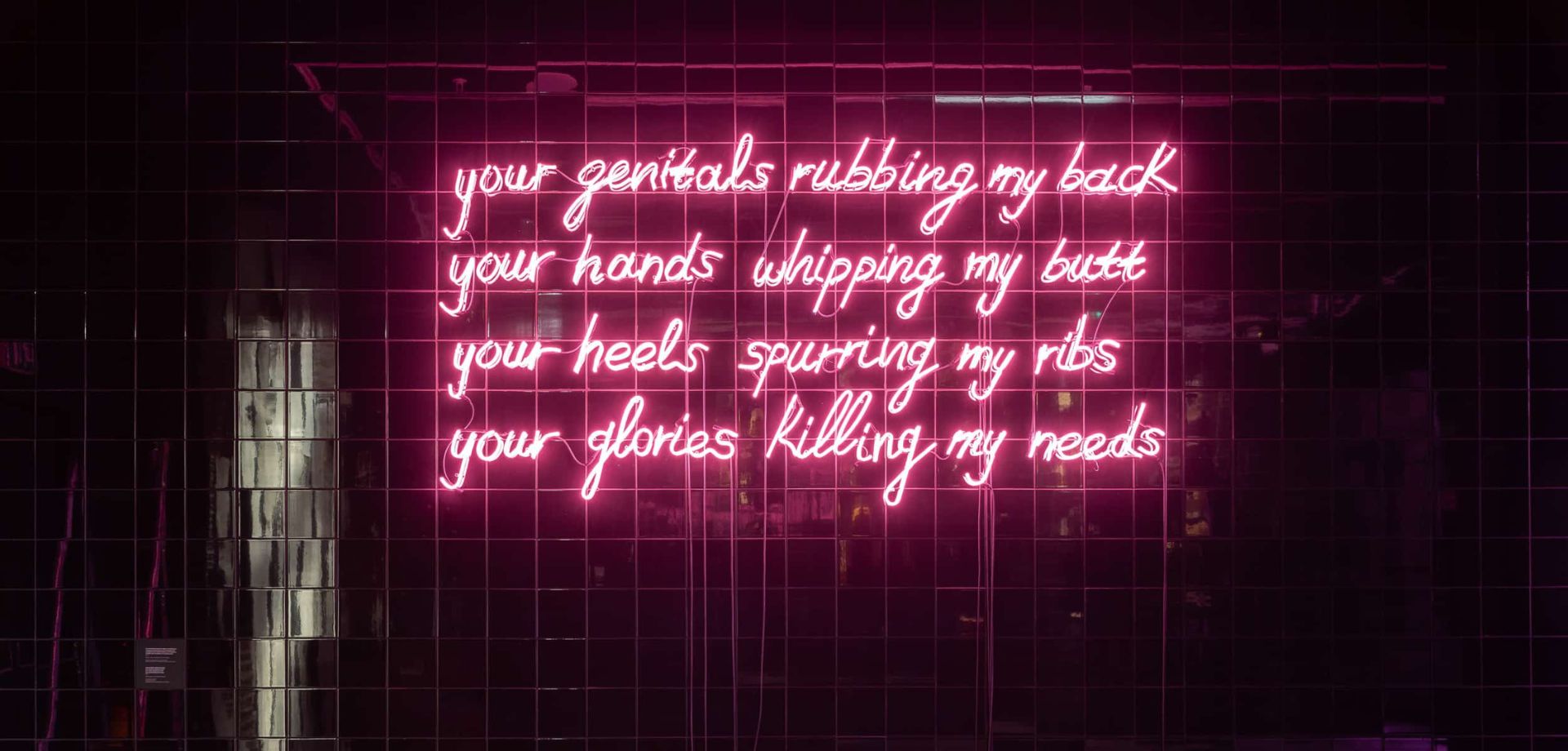
At EMST’s latest exhibitions, four artists — Janis Rafa, Sammy Baloji, Kasper Bosmans, and Emma Talbot — question the dominance of the human and give voice to the non-human gaze, through nature, history, and the realm of imagination
As you walk through the floors of the National Museum of Contemporary Art (EMST), it’s hard to believe you’re still in the heart of the city. The spring air seems to blow through the artworks—some grand and imposing, others more introspective—all conversing with one another through a shared thread: our relationship with nature, animals, time, and memory.
Today, the EMST opens its doors to a different kind of spring — one filled with images, shadows, colors, and unsettling truths about our connection to nature, animals, the body, and history. Four significant artists, through two solo exhibitions and two large-scale in situ commissions, offer their perspectives on what we call “human progress.”
“The exhibitions and artistic propositions we present always maintain coherence among them. That’s because we like to tell stories, especially about matters that are particularly relevant in a given moment. This year’s starting point revolves around the role of marginalized animals in society. Our coexistence with animals on this planet is a topic sidelined in modern societies. So, we begin this cycle as a prelude that will culminate in the major exhibition Justice for a Better Life, launching in May, emphasizing that animals are not machines, as Descartes once called them,” says Katerina Gregou, Artistic Director of EMST.
I start my journey in reverse today, in front of a 30-meter-long mural — my first stop. Kasper Bosmans’ The Fuzzy Gaze, a large-scale composition specially designed for EMST, unfolds like a ritualistic procession. It explores how animals’ roles in the human world have changed over time.

Horses, stuffed teddy bears, and felines parade through a strange, almost playful landscape that evokes both the circus and the zoo. With figures moving in an endless circular procession, the work addresses the instrumentalization of animals by humans — how we burden them with roles of companionship, entertainment, and commodity to serve our needs and desires.

Bosmans engages with the animal both as a symbol and as a daily tool in human hands. His visual scenes, from traditional patterns to enigmatic symbols, feel like a strange, colorful manuscript. As if recounting everything we know — or think we know — about our relationship with the natural world.
Echoes of History, Shadows of Progress | Sammy Baloji

One of the most gripping moments of the exhibition is Meandering (2025), a new site-specific installation commissioned and produced by EMST. The work bears the mark of Baloji’s long-standing artistic research on the history and contradictions in the formation of Congo, and the darker aspects of its relationship with Europe.
On the first floor, his solo show Echoes of History, Shadows of Progress opens a new field of dialogue: colonial legacy and the ongoing exploitation of natural resources. With a striking visual language, Baloji deconstructs the link between cultural identity and material plunder.
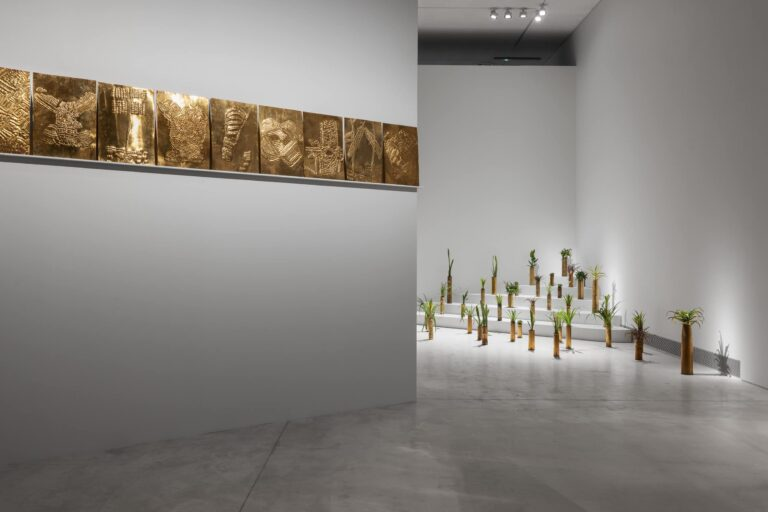
As you enter the space, your gaze is immediately arrested by embossed copper molds at the exhibition’s entrance. Acting as a prelude, the work investigates the connection between the traditional practice of scarification — bodily incisions as ritual and identity marker — and copper trade, a precious material at the core of colonial exploitation.
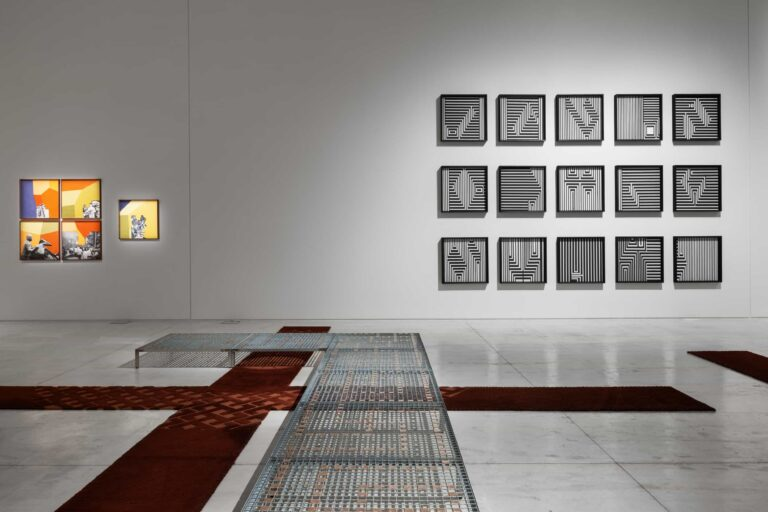
Before fully entering Baloji’s world, you’re welcomed by an 88-meter-long red carpet running through the central exhibition hall. Titled The Crossing (2022), it’s carved with geometric patterns and circular bands, reminiscent of intricate Congolese textiles and the exchanges between Africa and Europe — as well as Italian velvets, referencing trade and cultural routes that shaped both colonial and postcolonial landscapes. More than decorative, the carpet acts as a path of memory, inviting visitors to traverse the exhibition and connect the artist’s images and themes with each step.
For over twenty years, Baloji has explored the complex interplay between cultural identity, colonial history, and industrial exploitation, focusing on his homeland, the Democratic Republic of Congo. He places particular emphasis on Katanga, a mineral-rich province that remains a field of conflict and economic pillage.
His installation Meandering impresses not just aesthetically but through its critique of Eurocentric art history narratives. Baloji exposes how the West, since the Renaissance, appropriated Greco-Roman antiquity to construct a supposedly glorious cultural narrative — deliberately excluding the objects, memories, and cultural heritages of regions like the Kingdom of Congo.

Strikingly, the work also turns its gaze on contemporary manifestations of this logic, pointing out how even Greece — through the influence of classicists and archaeologists — has reinterpreted African presence in the Mediterranean in ways that reinforce colonial narratives. Meandering isn’t just an installation; it’s a web connecting history and present, the local and the global, nature and heritage. It reveals that the issue of exploitation is not merely historical — it’s painfully current: ecological, political, and moral.
Viewing his works, one cannot help but pause at how, without being didactic or loud, the artist tells the story of his country through its very material body — the land, the mines, the buildings, the scars.
In the Dream of Animals and Nature | Emma Talbot
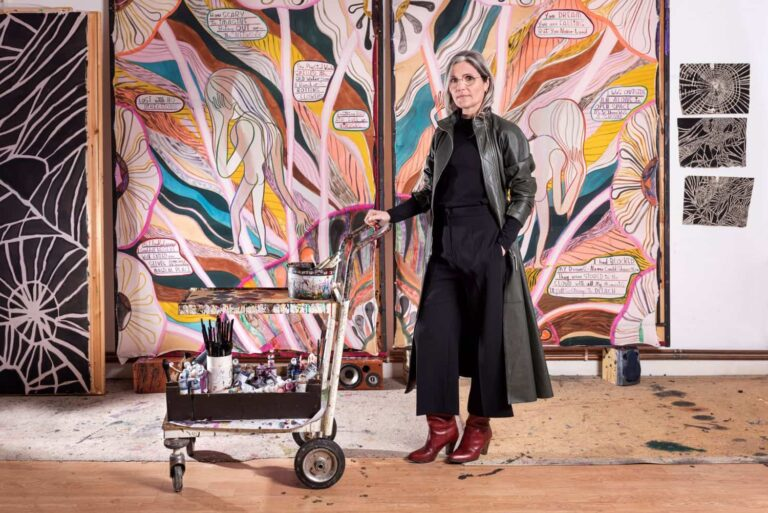
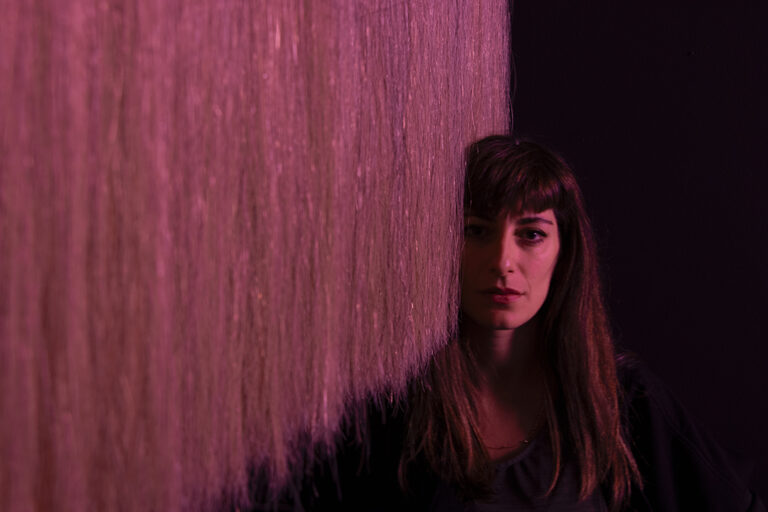
On the same floor, Emma Talbot weaves a story of silk, color, and silent, airy movements. Her monumental textile installation commands the space like a vibrant vision. You’re compelled to look up. In Human/Nature, silk becomes foliage, earth, and river all at once. The eye wanders over lines and patterns like a secret map. But at the center lies not only imagery, but a question.
A female figure — the artist’s alter ego — travels through the world, abandoning her human vantage point to enter the mind of animals. She smells like a dog, moves like a spider, sees like a creature that doesn’t define the world through words but sensations.
Talbot isn’t spinning a fairytale. She’s not seeking a return to an innocent nature that perhaps never existed. Instead, she asks: is an ethical return even possible? Can we look at nature without asking it to serve us?
She leaves the question open, wrapping it in silk and animation, inviting us to listen again to the faint song of the world that humans have forgotten how to hear.
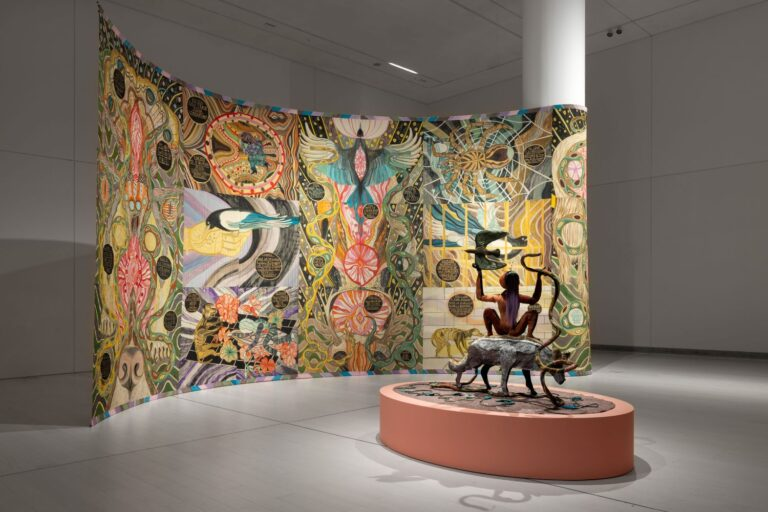

Nearby, her sculpture Chimera rises — a creature woven from textile fabric, combining characteristics of different animals, evoking ancient mythologies and nature’s own imagination. It stands there, almost alive, like an enigmatic guardian, a symbol of the attempt to understand the world through non-human eyes. It seems to gaze back as you observe it.
Talbot’s installation transforms the space into a field of reflection and sensory engagement. It’s not only impressive, but revealing. It challenges us to think beyond the image — to imagine ourselves outside human perspective, in a world where nature, animals, and people are entangled in a story yet to be written.
A Silent Requiem for Power | Janis Rafa
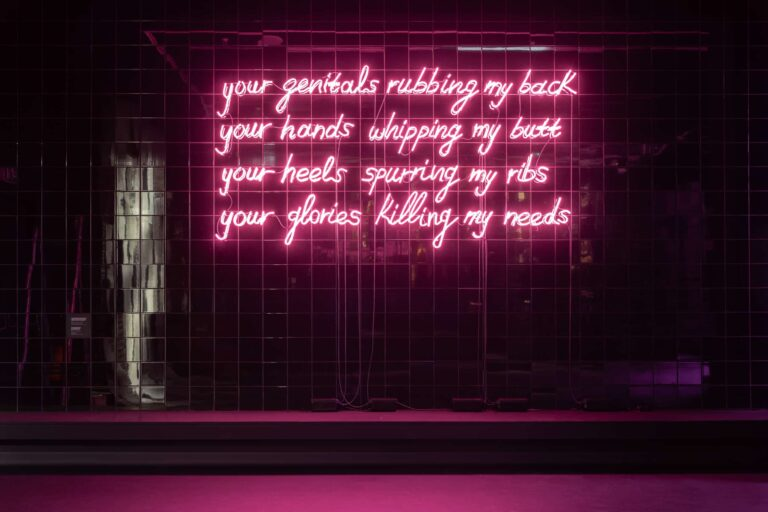
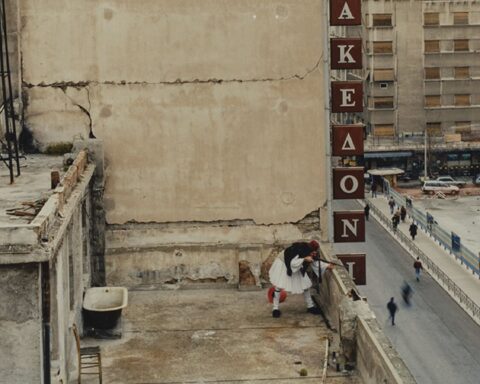
Janis Rafa’s exhibition is not just a visual proposal; it’s an immersion, a charged performative world. Entering the rooms feels like stepping into a ritual, a spectral landscape with the horse ever-present, yet absent.
The two transformed galleries are filled with traces — saddlery, objects, bridles, and saddles — suggesting the absence of the animal itself. The horse is missing, but its presence lingers through aesthetics and function, like a ghost returning to speak without voice.
The atmosphere is dark, almost sensual, like moving through a silent ceremony. Walls are covered with texts and new sculptures, and a two-channel video shot at an empty racetrack presents imagery of a history once heroic, now deeply troubling. The lighting is low, the soundscape muffled, echoing a space haunted by memory and domination. It all feels like a requiem — not just for horses, but for human desire to dominate.
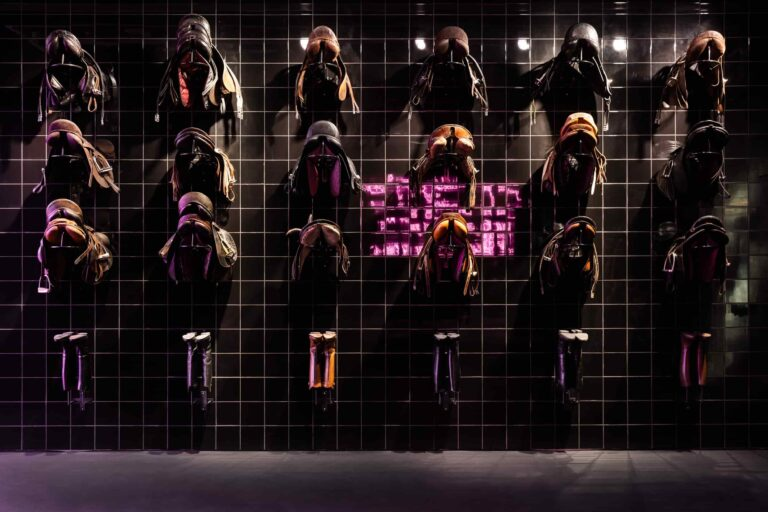
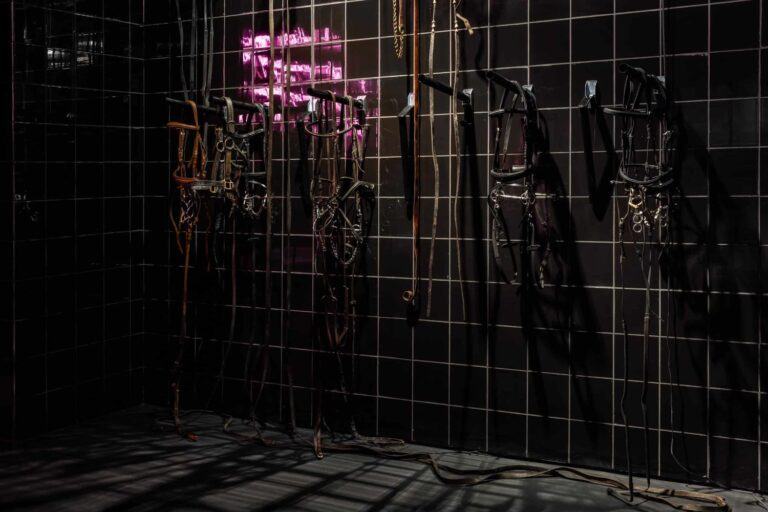
“The starting point is our relationship with the horse and our desire for its body. But more importantly, it’s about submission, desire, and the need for triumph. We don’t see the horse — only the human inventions of control and submission,” says curator Daphne Vitali.
Rafa doesn’t simply speak of the horse as an animal but as a “performed body” — a human invention, a symbol of domestication, glory, dominance, and imagined eroticism. She skillfully dissects this relationship: care and submission, love and power, fantasy and manipulation. Significantly, in this new work, the animal is almost entirely absent from view. What remains is its outline, its trace in space and object.
“There’s a strong autobiographical guilt in my work. The world of horses is dark once you strip away the sporting context. The lightness of domination, of riding bodies, of enjoying the power of control, has hidden sadistic undertones,” says Janis Rafa.
In the second space, the lights dim even further. A two-channel video plays in front of me, titled The Absence of Your Body Shaped the Spectacles of Our Past. The title itself reads like a verse. The setting is an empty racetrack, a place forgotten by humans and animals alike, the moving lights scanning through mechanisms, railings, galleries, and paths, searching for what is no longer there. Nothing “alive” appears in frame, and yet everything pulses. The gaze drifts, avoids protagonists, resists focus.
This exhibition’s experience is grounded and bodily, yet distancing. In the deserted racetrack of the film, in the sound of wind, in the non-human gaze of the camera, Rafa prompts us to ask: how deeply ingrained is our need to dominate other beings? And more urgently: can there ever be an equal relationship between humans and the non-human?
Her installation becomes not just an art space, but a place of reflection, questioning, and mourning — for what we call “love” for the animal.
Instead of viewing art as an object, this spring at EMST, we’re invited to stand before it — as if before a mirror. What do we see when we look at an animal? What does it mean to love something we dominate? How did we inherit the language of domination? And most importantly, can we unlearn it?
An exhibition that doesn’t offer answers — but inspires the most essential questions.