 ZOE LYMPERIS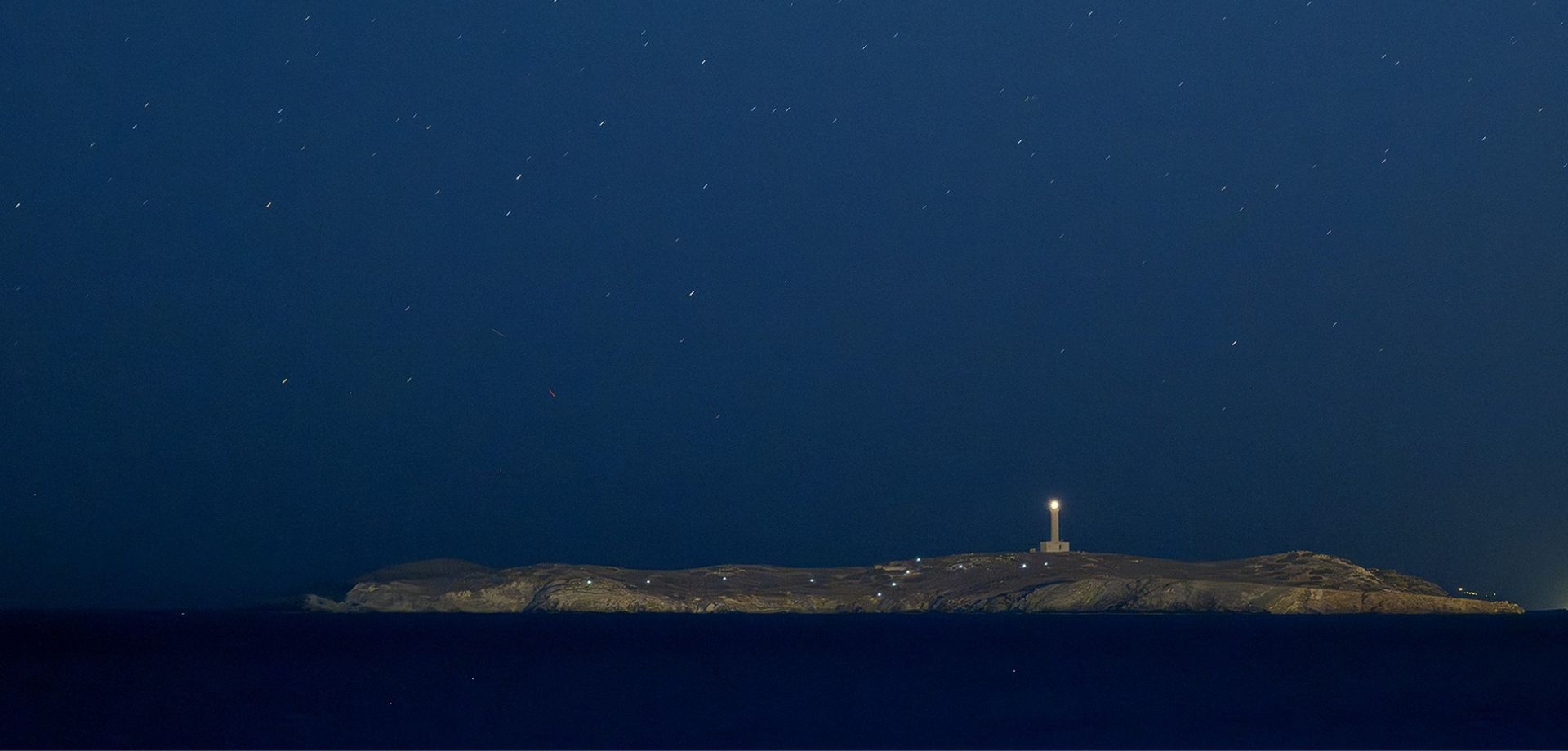
On the Greek island of Syros, the capital of the Cyclades, the Astrowalker Constellation-a new environmental night-time land art installation by Katerina Kotsala-will be unveiled as part of the 18th edition of ANIMASYROS International Animation Festival, taking place from September 22 to 28, 2025.
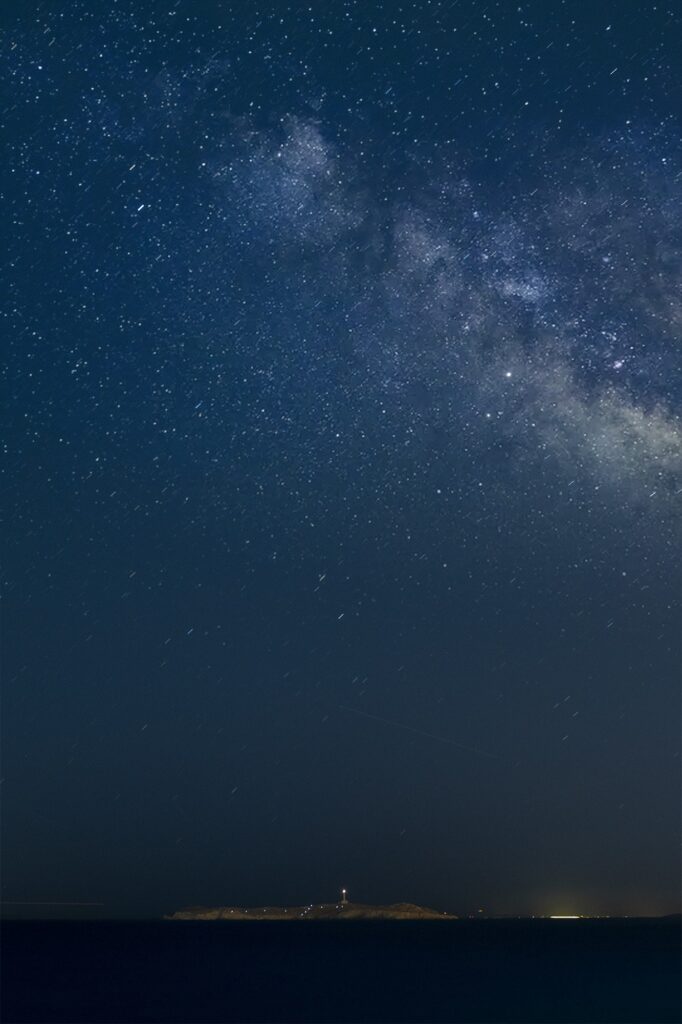
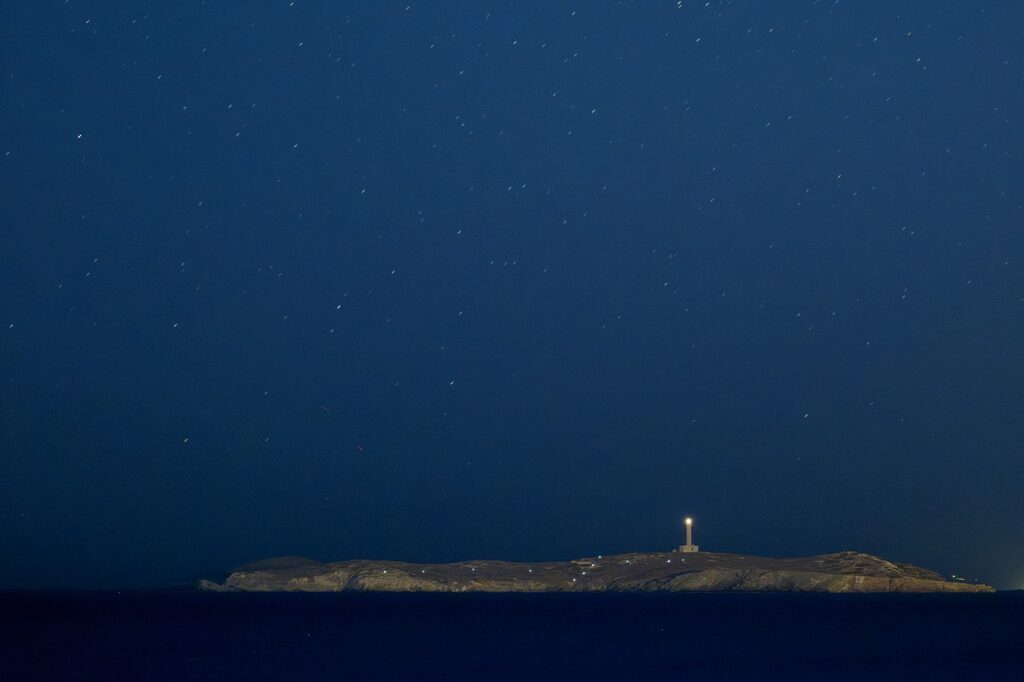
Composed of 11 solar-powered lights and spanning 357 by 158 meters, the installation forms an earthly constellation on the islet of Didimi, just across from Ermoupoli. Seen from afar, the illuminated points abstractly outline a human-bird figure: the Astrowalker.
“The Astrowalker Constellation is a poetic gesture in nature — a proposal for a contemporary mythology, an allegory,” explains Kotsala. “The Astrowalker, as a displaced constellation, reappears in dark, mysterious, and inaccessible places. Only there can it unfold its wings and be seen. On mountains, islands, in landscapes far from light pollution, it strives to unite with the other stars in the sky. Though this is ultimately in vain, driven by their difference, the Astrowalker keeps trying – led by its impulse for an ideal world.”
The work transcends individual artistic imagination, resonating collectively with the questions and anxieties of our times. It echoes philosophical reflections, such as those raised by Georges Didi-Huberman in The Survival of the Fireflies (2009), asking whether the stars – or fireflies – are truly disappearing, or whether a quiet, invisible revolution is beginning in remote, untouched landscapes.
Origins of the Astrowalker
Kotsala first encountered the human-bird figure in 2010, during a research program on prehistoric rock carvings in collaboration with archaeologists. Among the findings was a linear carving: two perpendicular rectangles forming an abstract human shape, tilted in a way that suggested flight. This early image, positioned eastward on the rock, sparked the creation of the Astrowalker persona, which has since appeared in a series of land art constellations beginning in 2012.
Each Astrowalker installation manifests in a different place, combining figure and idea while engaging with endangered ecosystems. By reinterpreting constellations on earth, Kotsala invites viewers to look beyond the visual — towards what connects humans, landscapes, and the cosmos.
Astrowalker Constellation at ANIMASYROS 2025
For its 2025 iteration, the Astrowalker Constellation takes shape on the islet of Didimi, home to Greece’s first lighthouse, built in 1835. The lighthouse itself becomes part of the narrative — a symbol of transition between eras, guiding both seafarers and stargazers, just as constellations have done since prehistory.
Through the installation’s 11 solar “stars,” arranged in a bird-like formation and subtly tilted toward the sky, Kotsala creates a delicate dialogue between earth and cosmos. As daylight fades, the lights — each emitting a soft 3.5 lumens – become visible from selected vantage points, including Manna, Syros Airport, and Agios Dimitrios.
Designed to minimize light pollution and leave no environmental footprint, the lights run entirely on solar energy and will be removed after the festival ends, returning the island to its natural state.
“The Astrowalker Constellation exists at the threshold between presence and absence,” says Kotsala. “It invites viewers to search, to focus, to discover. It is there, and yet it reveals itself only to those who look.”
By merging sustainability, contemporary mythology, and the poetry of space, the Astrowalker Constellation extends the boundaries of both land art and environmental storytelling – offering viewers a moment of stillness, wonder, and cosmic connection under the September sky of Syros.