 elc team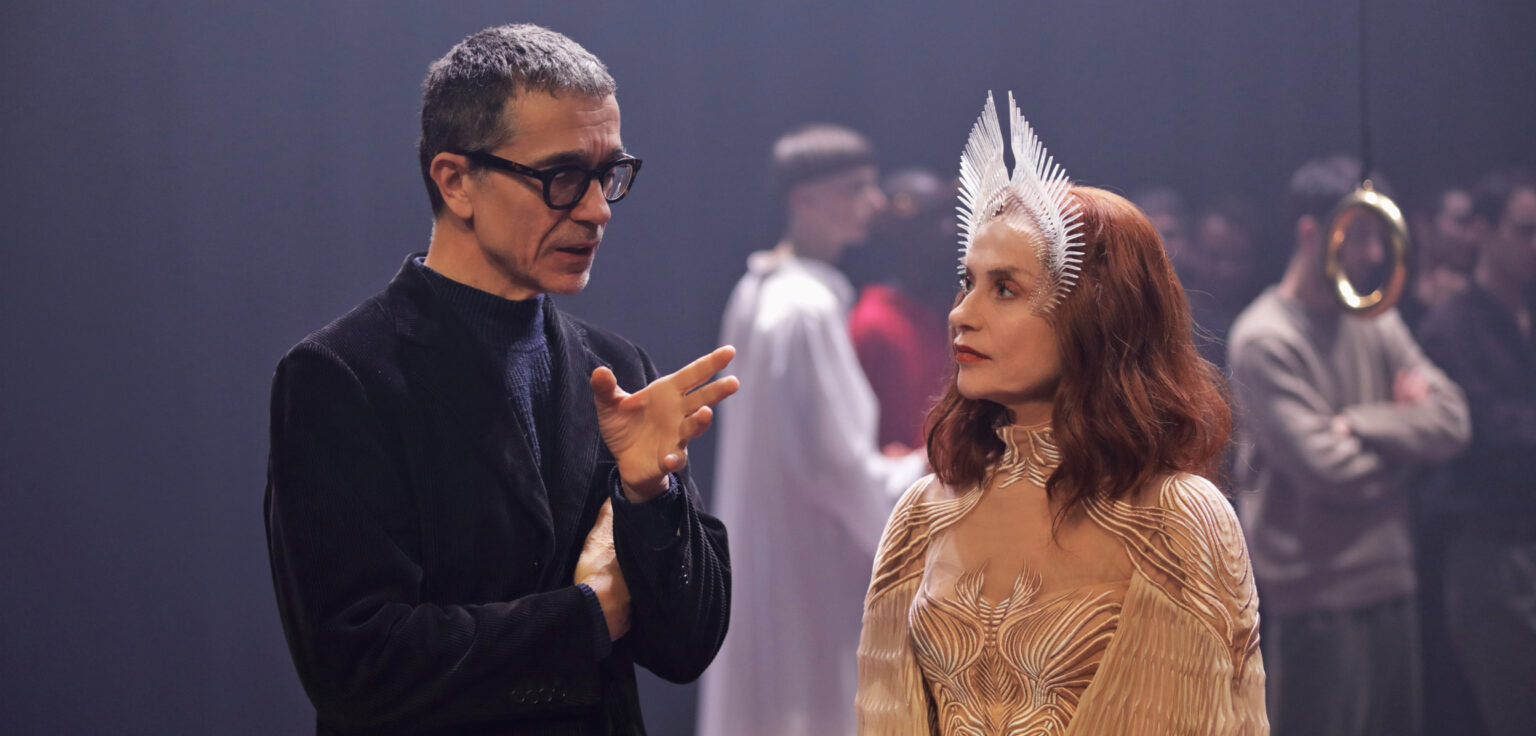
Βy Eleni Koutsilaiou
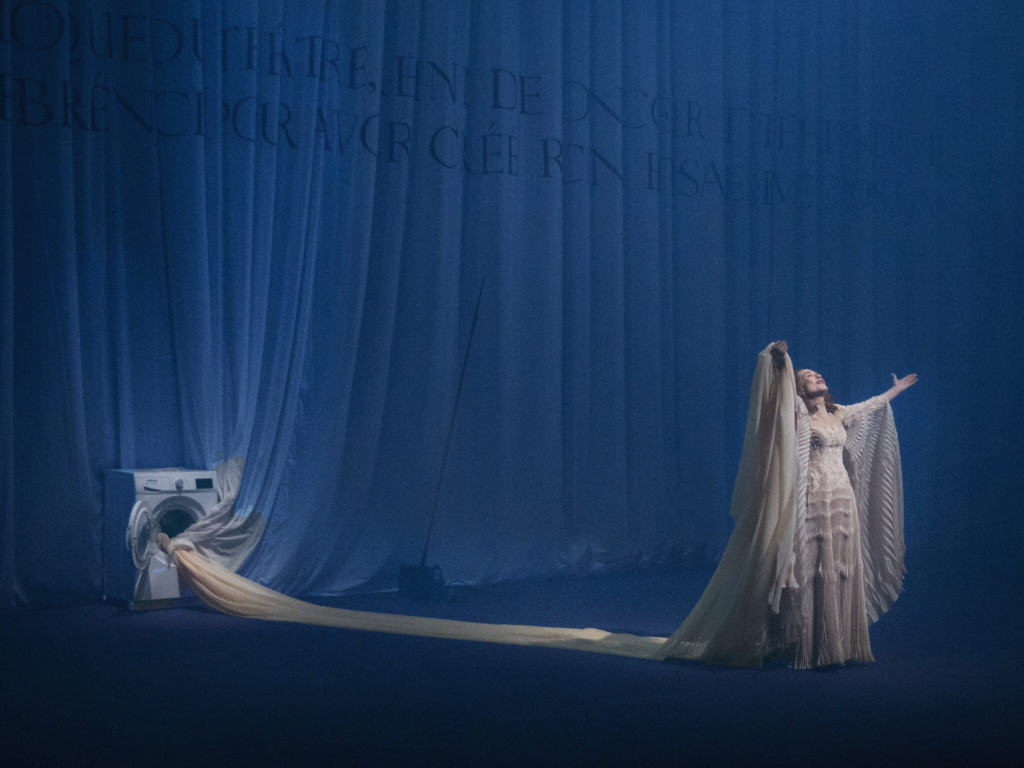
“On one side, Berenice, and on the other side, Isabel, piercing the stage like a flame. It’s like a fire. A great fire in the middle of the stage.”
A monumental writer of classicism, a colossal director, an iconic actress, an international production of the Onassis Cultural Center all combine to create a memorable stage event that we will have the unique opportunity to witness from March 26 for five days on the main stage of the Onassis Cultural Center. Rakina’s “Berenice” as envisioned by Romeo Castellucci and embodied by Isabel Ieper.
I had the distinct pleasure of being in a journalistic conversation with the great creator. Romeo Castellucci has managed to negate the cold digital condition with his particular charm, his disarming kindness and his particular humour. Surprisingly accessible, he answered a mosaic of fruitful questions, creating with the depth of his thought a web of concepts, reflection and aesthetics.

Everything Romeo Castellucci told us about…
…the story of “Berenice”
“The “Berenice” of our show is a historical figure taken from the Bible. She does not come from the area of myth. Like Titus the General, the son of Vespasian and future Emperor of Rome, who was also the destroyer of Solomon’s temple and destroyed the temple in Jerusalem forever.
This is the second destruction of the temple, the first was by the Babylonians, the second and last was by Titus. Berenice was a princess, in love with him, the one who destroyed the temple. In love with the one who was against her people and that is a composed political condition. But, in any case, we are talking about historical figures, not mythical ones.
Berenice will go to Rome as Titus’ future wife. It’s really impressive how the play relates to historical events. For me, of course, “Berenice” is a wonderful love story. I believe that Titus’ love for her was real. He loved her. There are many, many interpretations. They say he wasn’t truly in love with her, but I don’t believe it. I think it was a real love. But in order for him to be crowned emperor he had to leave her.
…choosing the play – Language as “a monument to the solitude”
“I feel that in a way I did not choose the play, ‘Berenice’, but it chose me. That’s usually how it happens. But, if I have to justify why I chose it I will say because I am fascinated by the conception of tragedy. And Racine -he was a poet- a wonderful poet who was constantly trying to recreate ancient Greek tragedy. An impossible attempt. But this effort of his moves me very much. And especially “Berenice,” it’s a wonderful play about the annihilation of language. It is, in my opinion, a kind of monument to loneliness.

Words mean almost nothing. The more Berenice speaks, the more her loneliness grows. A cancellation of communication. This kind of loneliness in language becomes a desert: the more we speak, the more alone we are. And this is tragic. Even in the Greek spirit. This kind of loneliness is very modern. It’s a feeling that everyone has felt, each of us, I think.
And so, for that reason, I chose to keep the original text as far as the character of Berenice is concerned, while I preferred the other characters in the play to disappear. I erased all the characters to keep only Berenice, as an island…
She is the only female character, surrounded by political men. It’s like she’s talking to ghosts. She’s completely alone. And her only act is to flee. Exit. She had to leave. She has to leave all over again. And that’s very moving. She chooses to leave Rome. And this is a wonderful moment. It’s a kind of triumph.”
…about “Berenice” and the 14 silent male characters
“The male figures around “Berenice” are like ghosts, like spirits, immaterial. If you read the play carefully you will see that her real adversary is Rome. It is the Senate. Rome represents the state. The state is like Leviathan and where the state prevails, all possibility of Love is gone. Love is against the State, the State is against Love. So, because Rome symbolizes the State, it eliminates Love. This is the tug-of-war of two opposing forces colliding: State and Love. The law of the State and the language of love.
The language of love, expressed by the emotion of Berenice. She is the only sincere but instinctively abstains from any kind of physical contact. There is no hugging, no kissing, no caressing. Only words. And words are looking more and more like poison, becoming more and more a kind of wound. They cause a gaping wound.
“Berenice” is a drama without any action. Only words. There’s something in common with Samuel Beckett. People get trapped in words. They can’t move. It’s like… they can’t move anymore. Because talking creates a trap.”
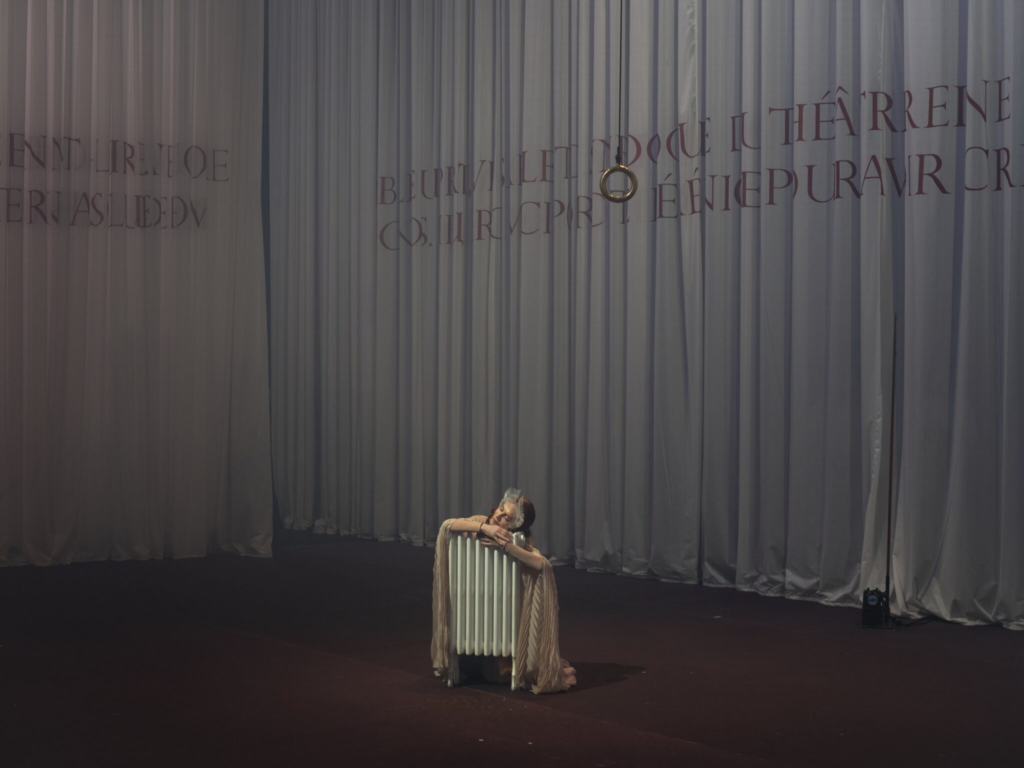
…about Love – the only reason for existence
“For me, love is the only reason for existence on earth. But love means struggle. There is no right love. Love is associated with wrong, at least that’s what the literature of Western civilization stands for. But this mistake is the beauty of all love. Love, in a way, is always wrong, because it has to do with madness.
And this is also true with Berenice. She is possessed by a kind of madness, but because of Racine’s linguistic idiom this is expressed in a formalistic, geometric way. The geometry is created by poetry, by Alexandrian verse. So everything is very precise and formalistic, but behind this perfection you can feel an abyss, you can also feel a kind of eroticism.
Racine is, famous for his contradiction between the perfection of language and the rigor that covers an instinct, almost animalistic, extreme as an abyss. And this is a wonderful contradiction for love. For in love there is always something dangerous. If you love truly, you are ready to die. And we can feel that in the play.
The play is strongly related to language, its main architecture. It is not the content, but the language. The play begins with absolute respect to the metronomic Alexandrian verse, but slowly, Berenice loses control and becomes more and more immersed in language. It is like a ship leaving port. And then she abandons the language to find herself. This performance signifies the abandonment of Language. At the end of the play, Berenice finds herself and leaves Rome, but she pays a very heavy price.”
Political theatre or erotic tragedy?
“The most striking part of the play – which is hidden – is the political part. Because politics, in terms of power, make Love difficult. The state, the Leviathan. It is the forces, the very dark ones, that crush Love.
There is nothing peculiar about Berenice and Titus’ love, but the State is against all Love. Because the law of the State cannot understand the law of Love. So it happens always. Love opposes. Love is also fragile… Lovers are always the victims. This is not a choice. It’s always like that. Maybe because in the end, in a way, they’re always the ones who win. But the Law of the State has penetrated language. Real emotion is not expressed in words, but through other emotions, via a different language, a different sound, that of the body. Silence and waiting and all this kind of vocabulary becomes a very rich vocabulary next to the words expressed by Berenice. When she trembles, when she cries, when she complains… There is a differebt kind of vocabulary.
She’s completely alone. That’s what makes the character so wonderful and so close to us, in a way, close to me. She’s a woman, for sure. So there’s also that kind of, I think, strength, struggle. But for me, it’s the sense of femininity that’s inherent in all of us. We have to be women to love. Yeah…”
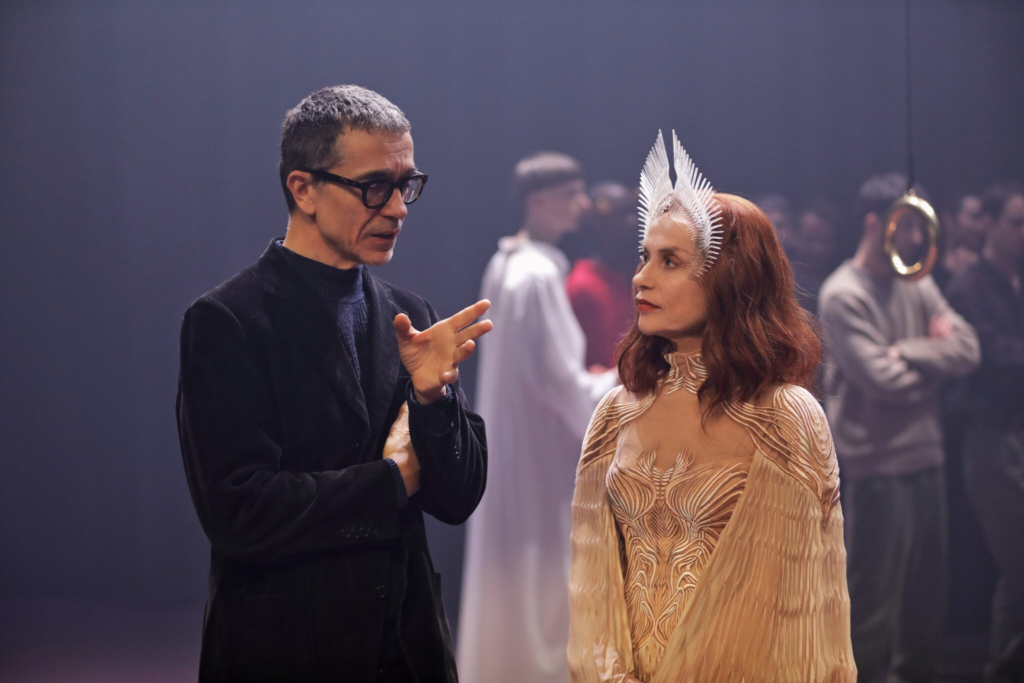
…on the connection between “Berenice” and the tragedy of Tempi
“It’s a very difficult question, mainly because I don’t know in detail what exactly happened in Greece. But from what I do know it is certainly an unspeakable tragedy, representing the conflict between the State and the Law against real life.
The fact that you have a body, the fact that you are a human being. The tragic hero is always someone who at some point opposes Authority. You know, you have to fight against Power. There’s always this battle between the Power and the hero. Always. So action -I don’t personally believe in activism in theatre and art- is the beginning of every political action. For this reason, I believe that Berenice gave the right answer. She’s gone. She marched into another world. She suspended all the rules of the game. It’s another game, another life, another possibility. I mean, to me, it’s perfectly legal and right to go out on the street to fight.”
…on Berenice as the totem of the “foreigner”
“It was impossible for Rome, at that time, to accept a foreign queen. Impossible because it was required by ‘blood purity’. Cleopatra was treated in the same way. The Romans, that memory was fresh in their minds… And so, there was no chance of them accepting Berenice as their Queen, because she was not a Roman. This is something that happens in our time: This kind of horrible sentiment that pervades our society. But I didn’t comment on this political issue, not in the slightest, because it was already obvious, but this issue as a political dimension certainly exists.”
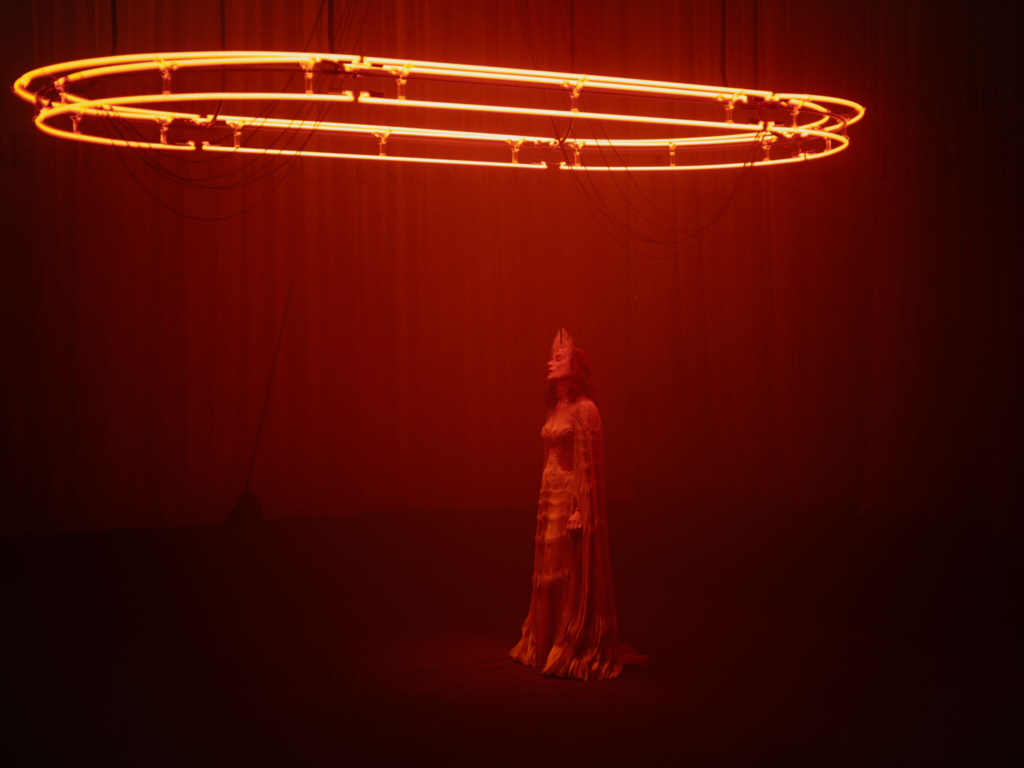
…on the protests from the Paris performance
“Indeed, there were protests in Paris, especially in the first days, but, for me, the protest is good news. I think the audience in France was disappointed, because they expected a certain stage interpretation of the play. And that felt like the right reaction. I wanted to delve into the philosophical dimension of Racine, because in addition to being a playwright, he was also a poet and a philosopher. I dealt with his philosophical aspect in a dense way and did not focus on the stage adaptation of the drama.
I did not stage it as a drama, but as a monologue. With absolute respect for every word, every comma of the text that belongs to the character of Berenice. Everything else is a desert. I was inspired by a text by Roland Barth, who says that everything is interconnected with language. He wrote that language in “Berenice” is like fog, like a battlefield, and that allowed me to be open to other senses, for example, sound: we worked with Isabel and Scott Gibbons creating a musical composition, something like a continuous song. I believe that we shouldn’t treat a text with the mentality of faithful stage representation. That’s how we deaden it. You have to feel the flesh of the drama. You have to feel the language, you have to feel the characters. To perceive the society, the world, but it has to penetrate your body first. And the body of every spectator. I think my own vision on the play brings out something very internal. Very intimate. There is no external action. There’s absolutely nothing happening. It’s the most crippling drama of all time. Beckett’s Happy Days, I think, is very close. Both represent the crisis of language: There’s nothing that can allow us to communicate.”
…on Isabelle Ieper: “She herself is a representation of the theatre.”
“I met Isabelle Ieper many years ago. It was a very cordial meeting. And we, at that moment, expressed a desire to work together, and yes, at the time, it was a desire, but “Berenice” was really the opportunity. “Berenice” without Isabelle Ieper does not exist, because to face off against this iconic play we need a personality of the same magnitude, but also a true human being.
She is a great actress, because you can feel on the stage, even on the screen, a human being very radical, very generous, who lets herself be exposed, without any protection needed. I love her radicalism, her generosity, and so I don’t know what came first: “Berenice” and Isabel go together. Like a double portrait. On one side, Berenice, and on the other side, Isabel, piercing the stage like a flame. It’s like fire. A big fire in the centre of the stage. Behind the text, the meaning, the literature, we have a flaming existence. It is also a kind of tautological presence: it represents theatre on stage, its hard core. It is itself a representation of theatre. It is theatre itself.”