 elc team
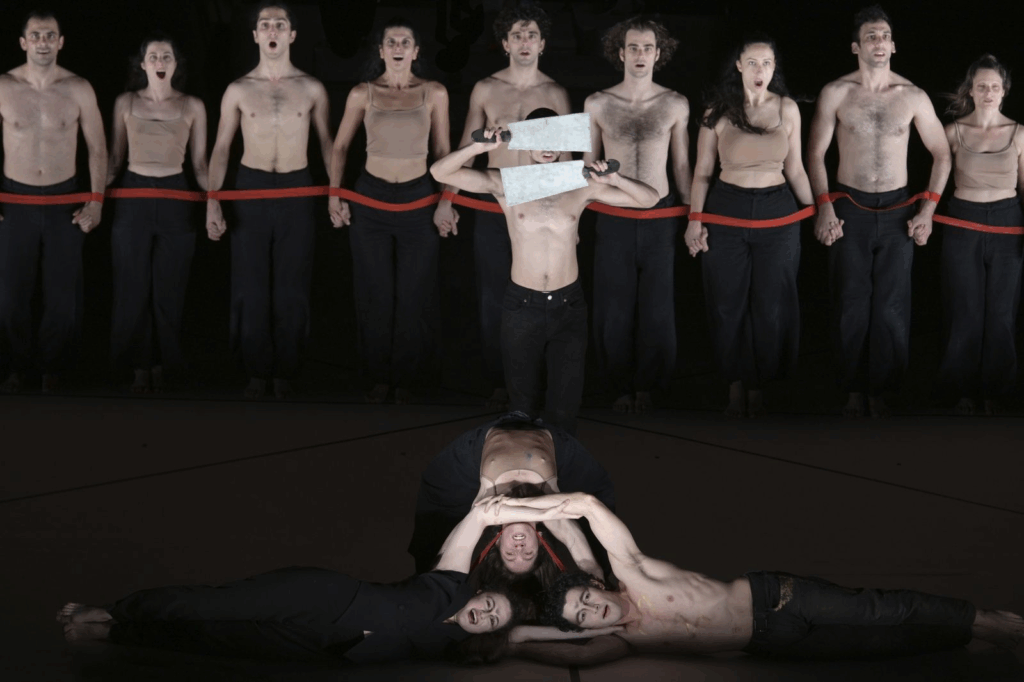
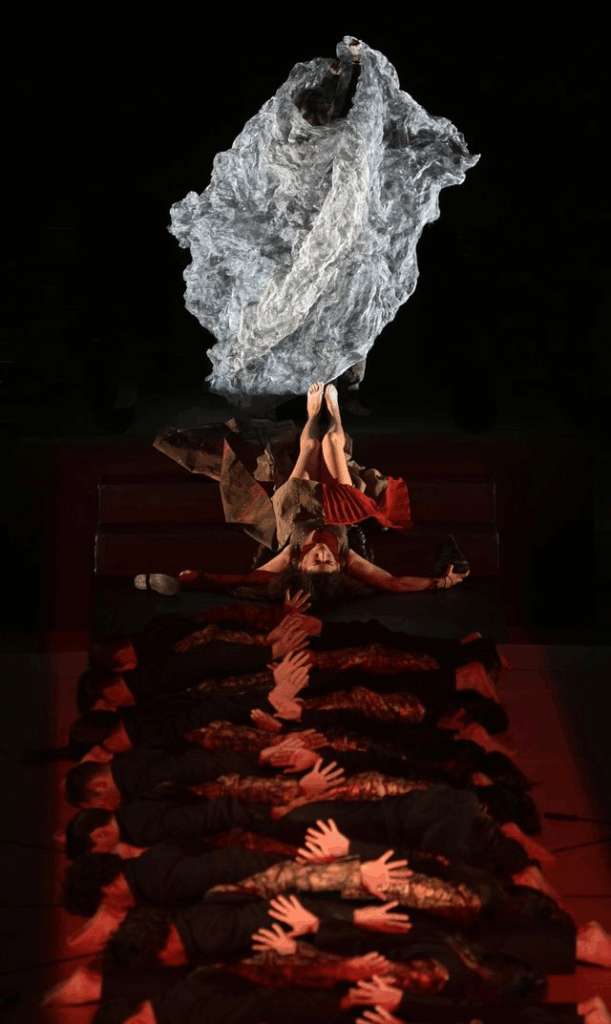
The first collaboration of internationally acclaimed Greek director and teacher Theodoros Terzopoulos with the National Theatre of Greece, Aeschylus’ emblematic Oresteia, returns for a second year on August 22 and 23 to the Ancient Theatre of Epidaurus – the very place where its thrilling journey began – bringing the Epidaurus cycle of this year’s anniversary Athens Epidaurus Festival to a close. An unrepeatable experience for those who wish to encounter – whether for the first time or once again – this historic production, which, with its shattering energy, ultimately narrates the story of humanity itself.
The Oresteia premiered at Epidaurus in 2024, followed by a tour in Greece and Cyprus, before being presented in Vicenza, Italy where it opened the 77th Cycle of Classical Performances at the historic Teatro Olimpico, as well as in distant China, at the Huichang Theatre Village. As an act that is undeniably political and an experience that is profoundly spiritual, the production received an ecstatic reception from the thousands of spectators who attended it, as well as from domestic and international media.
After performances at the Theatre of Rocks in Vyronas, the Ancient Theatre of Dion in Katerini, the Open-Air Floka Theatre in Ancient Olympia, the Forest Theatre in Thessaloniki, the Phrynichus Theatre in Delphi, and the Ancient Theatre of Philippi in Kavala, and just days after its historic return to the Ancient Theatre of Epidaurus, the production will travel on August 29 and 30 to the International Theatre Festival Art Carnuntum in Austria.
About the Oresteia
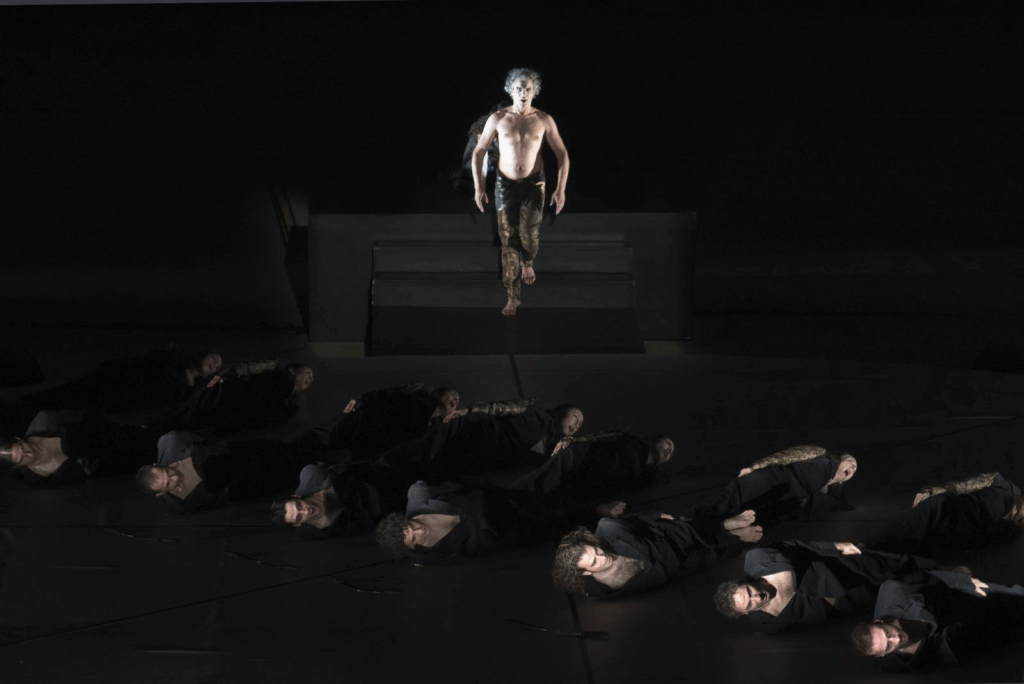
In 458 BC, during a time of violent social and political upheaval, Aeschylus presented the Oresteia (Agamemnon, The Libation Bearers, The Eumenides) at the Dionysia festival. It is the only surviving trilogy of ancient drama and Aeschylus’ final extant work, completed just two years before his death, reflecting many of the rapid transformations of his era.
At the heart of the trilogy lies the tragic fate of the House of Atreus, the blood curse that permeates all the characters and the chorus through successive stages, moving from destabilization to deadlock. This situation is exploited by Athena, who uses it to establish a contentious peace.
In the first two parts, Agamemnon and The Libation Bearers, the murders that end the tyrannical reigns of Agamemnon and Clytemnestra mark the climax of a new period of crisis and destabilization, which is mirrored in The Eumenides. The Erinyes, chthonic deities embodying instincts and impulses, safeguard memory. Aware that any conflict with the gods is a predetermined defeat, they revolt and threaten the city’s order. Orestes must pay so that not only the crime, but also its repetition, may be punished, keeping alive the memory of conflict.
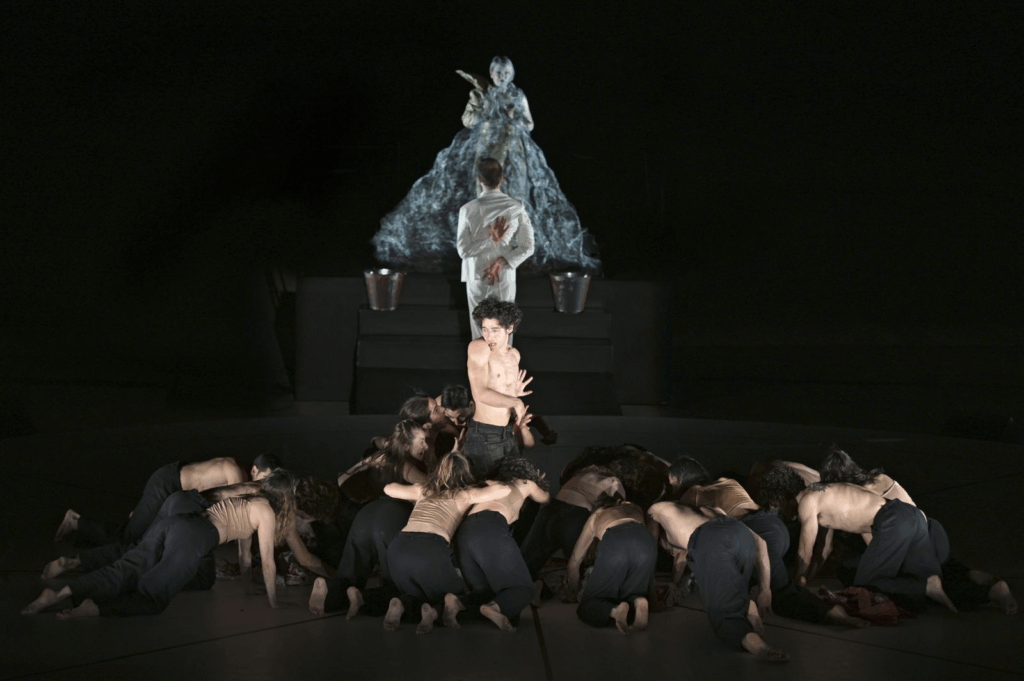
Athena strives at all costs to secure a “peace pact” between the gods and the Erinyes, offering concessions and privileges. To achieve reconciliation, she shifts violence into the realm of language. Her rhetoric introduces deceitful persuasion, lies, and manipulation into the political sphere. The Erinyes submit willingly. Clad in the distinctive crimson garments of resident aliens, they are renamed the Eumenides and removed from the city’s core. They are driven into obscurity, into oblivion, into the depths of the earth. Democracy has been established but not without cost. Whatever is incompatible with the new order – the living part of the body tied to memory, instinct, and primal force – has been exiled. The new system is imposed by mechanisms of power in such a way that these vital forces appear as if they never existed.
The Erinyes adapt and accept the social role of outsiders, yet their inner structure remains unchanged. Like natural phenomena that never disappear from the earth but follow a spiral course of transformation, escalation, and de-escalation, so too may we imagine the chthonic deities retreating and withdrawing, only to resurface again in ever-new, unexpected forms.
Director’s Note
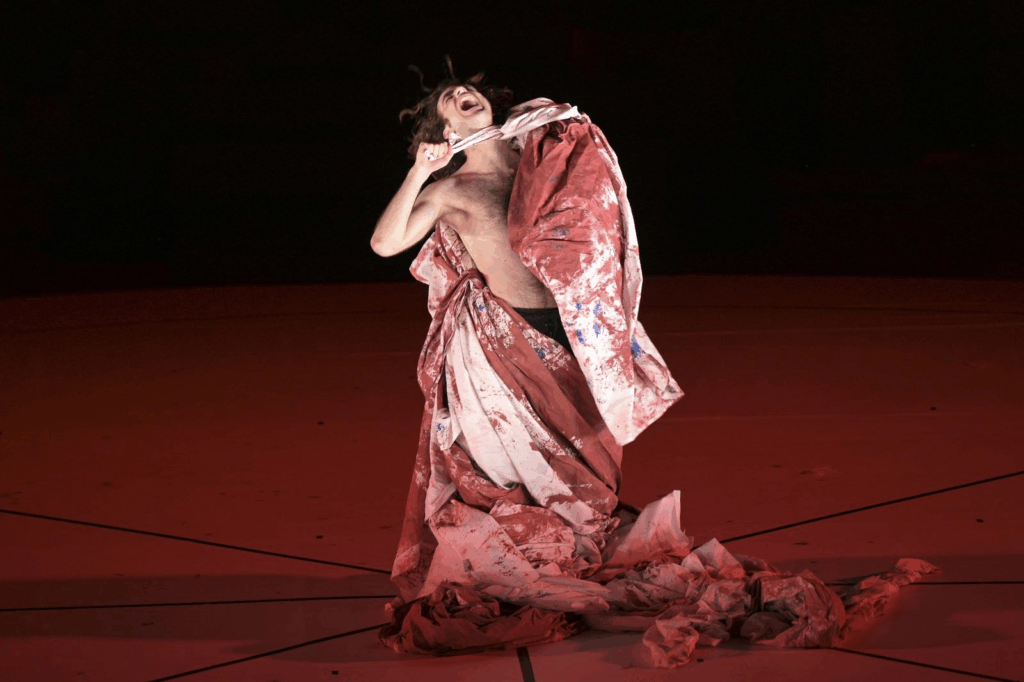
Why does the Oresteia continue to exert such a terrifying allure? One possible answer might be that humans yearn for a deeper connection with Myth. The myth of the Oresteia is dangerous; it belongs to the realm of the uncanny and the strange. It evokes dread because it exposes the unruly, the violent, and the laws of depth that cannot be tamed. Clytemnestra invites us to shatter the mirror together, so that from its fragments a new nightmarish image may be born – one that nevertheless preserves the dark roots of the myth.
Our intention is to probe the depths of the Oresteia myth and to pursue the unpredictable, the unusual, the paradoxical. The characters offer their bodies to the altar of the uncanny, posing relentless questions and dilemmas. The production’s aesthetic emerges from the dynamic relationship of Body with Myth, Time, and Memory. Once again, we pose the fundamental ontological question -“What is it about?”- a question that admits no definitive answers but continuously propels us toward deeper investigation of the roots of sound, word, the multiple dimensions of the human enigma, and the reconstruction of a new Myth. – Theodoros Terzopoulos
The Oresteia at the National Theatre of Greece
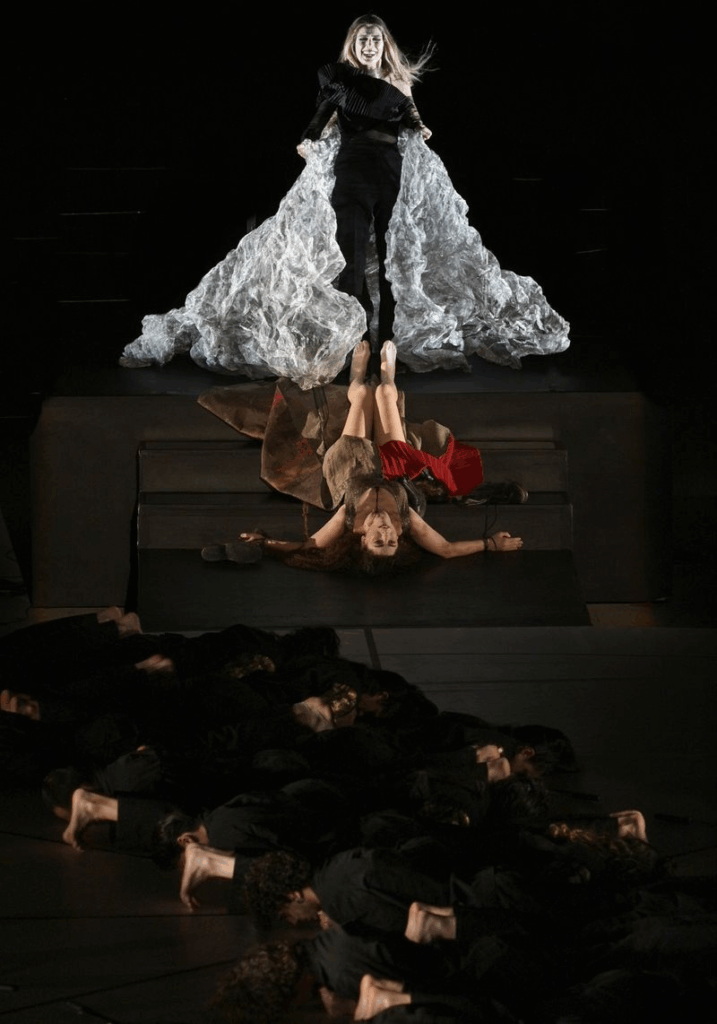
The Oresteia has been staged by the National Theatre at Epidaurus five times to date: in 1954 and 1959, directed by Dimitris Rondiris; in 1972, directed by Takis Mouzenidis; in 2001, directed by Yannis Kokkos; and in 2019, when Io Voulgaraki, Lily Meleme, and Georgia Mavragani each directed Agamemnon, The Libation Bearers, and The Eumenides, respectively, marking their first directorial appearance at Epidaurus.
Credits
Translation: Eleni Varopoulou
Direction – Dramaturgical Adaptation: Theodoros Terzopoulos
Associate Director: Savvas Stroumpos
Set, Costumes & Lighting Design: Theodoros Terzopoulos
Original Music Composition: Panayiotis Vellianitis
Dramaturgical Consultant: Maria Siciliano
Production Dramaturg: Irini Moutraki
Assistant Director: Theodora Patiti
Costume Assistant: Panayiota Kokkorou
Lighting Associate: Konstantinos Bethanis
Artistic Associate: Maria Vogiatzis
Cast (in alphabetical order):
Babis Alefantis (Pylades), Evelyn Asouad (Cassandra), Tasos Dimas (Guard / Chorus Leader / Herald), Konstantinos Zografos (Orestes), Elli Inglezi (Nurse), David Malteze (Aegisthus), Anna Marka Bonisel (Prophetess), Nikos Dasis (Apollo), Dinos Papageorgiou (Herald), Aglaia Pappa (Athena), Myrto Rozaki (Electra), Savvas Stroumpos (Agamemnon), Alexandros Tountas (Servant), Sophia Hill (Clytemnestra / The Ghost of Clytemnestra)
Chorus:
Babis Alefantis, Katerina Amplianniti, Evelyn Asouad, Christoforos Vogiatzis, Natalia Georgosopoulou, Katerina Dimati, Pyrros Theofanopoulos, Elli Inglezi, Vasilina Katerini, Thanos Maglaras, Elpiniki Marapidi, Anna Marka Bonisel, Lygeri Mitropoulou, Rozy Monaki, Aspasia Batatoli, Nikos Dasis, Dinos Papageorgiou, Vangelis Papagiannopoulos, Stavros Papadopoulos, Myrto Rozaki, Yiannis Sanidas, Alexandros Tountas, Katerina Hill, Michalis Psalidas
Photography: Johanna Weber
Video: Nikos Pastras
Ticket Presales: ticketservices.gr (all tour venues except Epidaurus) & more.com (Ancient Theatre of Epidaurus)
Duration: 200’
Info
Oresteia
August 22 and 23 to the Ancient Theatre of Epidaurus