 PEPI NIKOLOPOULOU
“An actor’s work holds the secret pleasure of revealing their own life through the story of another.”
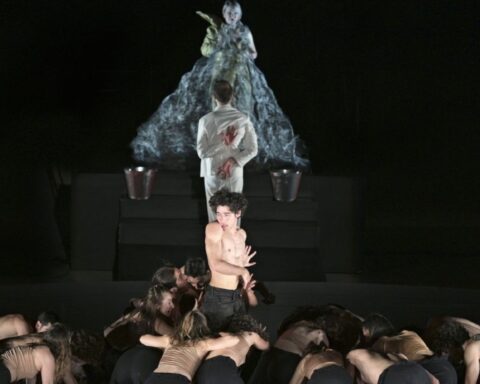
Aeschylus’ Oresteia, directed by Theodoros Terzopoulos, returns this year to the Ancient Theatre of Epidaurus for a second run (August 22 & 23), closing the Epidaurian program of the anniversary edition of the Athens Epidaurus Festival, with PPC as its grand sponsor.
This marks the first collaboration between the National Theatre of Greece and the internationally acclaimed director – a production that has already traveled to Greece, Cyprus, Italy, and China, receiving rave reviews.
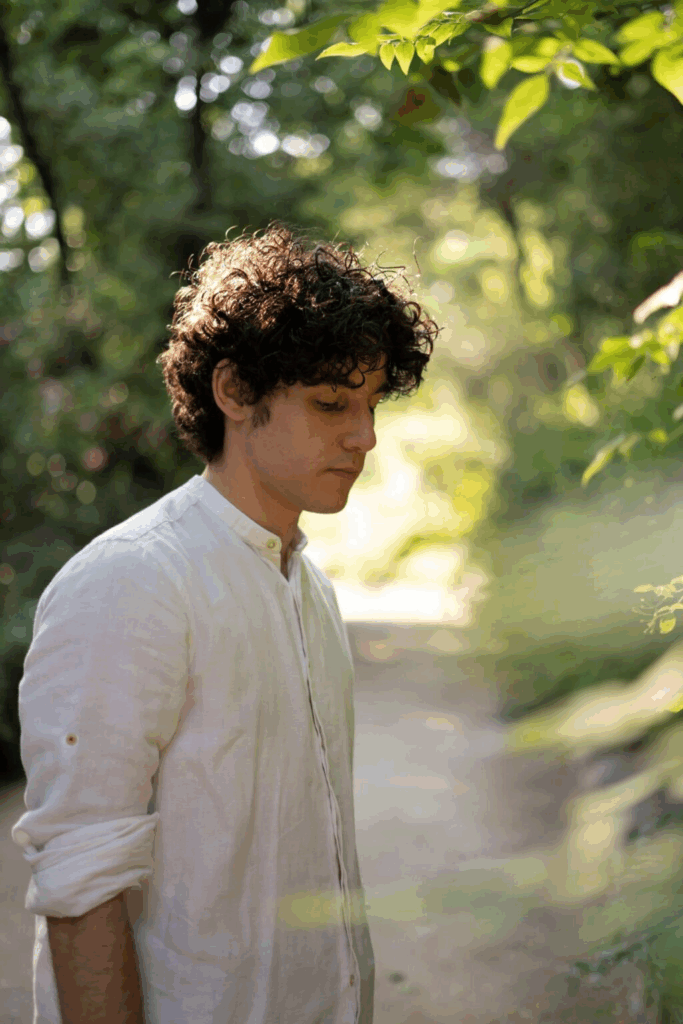
In the role of Orestes, we find Konstantinos Zografos, a young actor who has come to know firsthand Terzopoulos’ strict yet liberating method. As he told us in our recent conversation, their collaboration began in June 2023, when the director was seeking young actors for Oresteia. “It was a moment that couldn’t have been more fitting,” he recalls. For him, the production is not only an artistic success but also the mature vision of a creator who let the work ferment within him for years, until the time was right.
The actor speaks of Orestes as “Hamlet’s ancestor, unprepared for action,” of how he worked with the words before ever stepping into rehearsal, of the freedom that comes with Terzopoulos’ physical method, and of the unique experience of standing in Epidaurus in front of 10,000 audience members holding their breath as one. Oresteia, as he emphasizes, still concerns us today because it boldly raises the great political and ontological questions of humanity – about the nature of guilt, the limits of power, the mechanisms of suppression and transcendence.
How did your collaboration with Theodoros Terzopoulos begin, and what did it mean to you?
I first met him at his office in June 2023. He was looking for young actors for the Oresteia of the National Theatre. I can’t imagine a more fitting coincidence. I already had a few years of stage experience and felt ready to absorb more of his method. He told me later that he had carried this work within him for years, letting it ripen, patiently waiting for the right moment. Beyond its success, the production is deeply moving to me, because it’s the vision of a director who didn’t rush but waited to realize it.
What was the first thing he told you about Orestes?
That he is Hamlet’s ancestor — unprepared for action, struggling throughout the play to become a killer.
Orestes is neither just a victim nor just a perpetrator. How did you trace your internal path?
The text is very helpful. The characters hide nothing: they speak openly about their thoughts, fears, and desires. They even locate their emotions in their bodies, their guts; they give them color and shape. If you truly listen to the words, you can clearly hear their anguish. That’s how your path is formed. I worked a lot with the text before even stepping into the first rehearsal.
Terzopoulos’ method is physical, demanding, almost ritualistic. How did it affect you?
It’s exactly that. And it’s a gift for a young actor to work with a director who has such a well-structured system of work. The more precise the method, the more it frees you – as long as you trust it. I tend to operate with a lot of control, which sometimes becomes self-censorship. During rehearsals, when my body was tired and surrendered to breath, I heard my voice hitting unexpected intonations. That was a revelation.
What was it like standing on the stage of Epidaurus?
An incredible experience. Before you, a giant, dark mass of people breathing with you. And that moment when everyone holds their breath… that second when 10,000 people are in sync – it’s priceless.

Is there a moment from the premiere you’ll never forget?
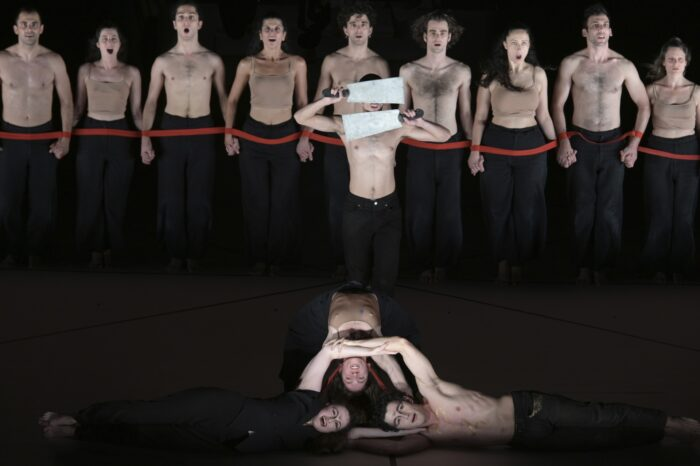
Yes, from this year’s premiere in Budapest. Along with Myrto Rozaki, we were the only two taking on new roles for the first time. I felt both joy and anxiety. Right before the performance began, the members of the Chorus – most around my age – came one by one to greet me in their own way: a nod, a hug, a few words. “Whatever happens, we’ll be there with you.”
That solidarity, invisible to the audience, is what stays with you. It’s not a given — and when it happens, it justifies the effort and anxiety of this work.
Why do you think Oresteia is still relevant?
Because it dives into the unexplored realm of human instincts and the great ontological questions: What is the nature of the divine? How is guilt inherited? How is civilization built through mechanisms of suppression, transcendence – or even arbitrariness? And of course: how much legitimate violence can power wield? Unresolved political and existential questions that unfold on stage through a poetry that fully absorbs human suffering, lifts it in all its weight, and redeems it.
You’ve studied Law, Philology, and Theatre. How do these coexist within you?
They’re all related to logos, to language. “Speech is action.” Law is immensely interesting — as a science, as a way and structure of thinking. It’s pure logic. I was especially drawn to public law, particularly international and constitutional law. I also remember reading legal philosophy courses and constantly connecting them to plays, to the universe of relationships they create.
Especially in tragedy – but also in all great dramaturgy – the more you read, the more you realize that every character has a point. Another thing I took from law is the precision in phrasing. Every word always has a weight in real life. Add or remove a single “and” from a legal provision and everything changes.
I studied Philology after graduating from the National Theatre School. I started in 2020 and graduated last year. From morning till afternoon, I was immersed in literature, ancient Greek, Latin, modern literature, art history, narratology – a paradise… And in the evenings, I worked in the theatre.
I realized that practical experience on stage makes you a more sensitive and perceptive reader. You appreciate the printed page differently.
How do you choose your projects?
The director is crucial. Because they shape the framework: the team, the reading of the text, the stance toward the present, the risk, and the possibilities they give you for each role. Communication with the director is the basis for contributing a part of your personality to a collective vision.
How much do you identify with your characters?
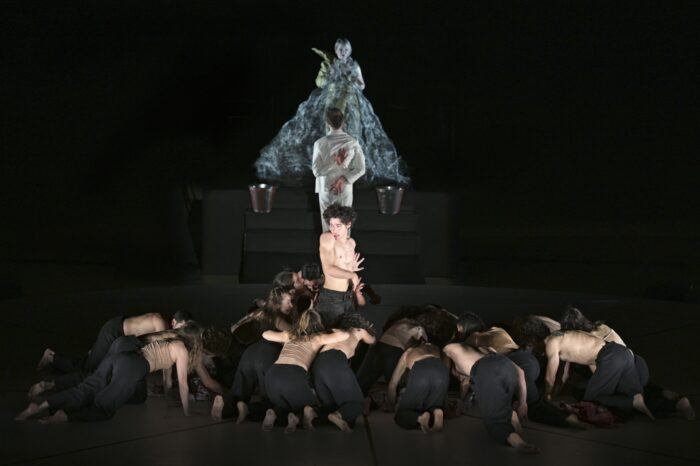
If you try to understand the character you’re portraying – to think about their story, the circumstances under which they act and decide or don’t decide – identification comes naturally. Because people’s lives, more or less, revolve around the same issues.
Identification with a role, despite various myths, is a very joyful process for actors. You don’t “lose yourself,” but you invest yourself – through technique and imagination — in a character that never existed before and now exists with your voice, your body.
In the first year of drama school, I remember a teacher, Dimitris Imellos, saying something that opened my mind in a fertile way:
“The audience isn’t coming to see Orestes. They don’t care about that. They’re coming to see your Orestes.”
In other words, we inevitably lend our personality, our sensitivity to the role. The function of the actor contains the pleasure of speaking about their own life while narrating another’s. Of finding your own words inside the hero’s speech. It’s not about endurance, but about awareness and decision — about how much understanding you’ll offer to something that seems foreign, and how much honesty you’ll show toward yourself.
What are you seeking in theatre in the years to come? Are there things you feel the need to express but haven’t yet found the way or the space to do so?
All these years, theatre has given me a great deal of space for exploration and meaningful collaborations. That’s why I had given it priority. In the near future, I’d like to challenge myself with artistic projects beyond theatre – things I’ve always been deeply interested in but haven’t yet had the time to pursue.
Info
Aeschylus’ Oresteia
National Theatre of Greece – Theodoros Terzopoulos
🗓️ August 22–23, 2025 | 🕘 21:00
📍 Ancient Theatre of Epidaurus