 ZOE LYMPERIS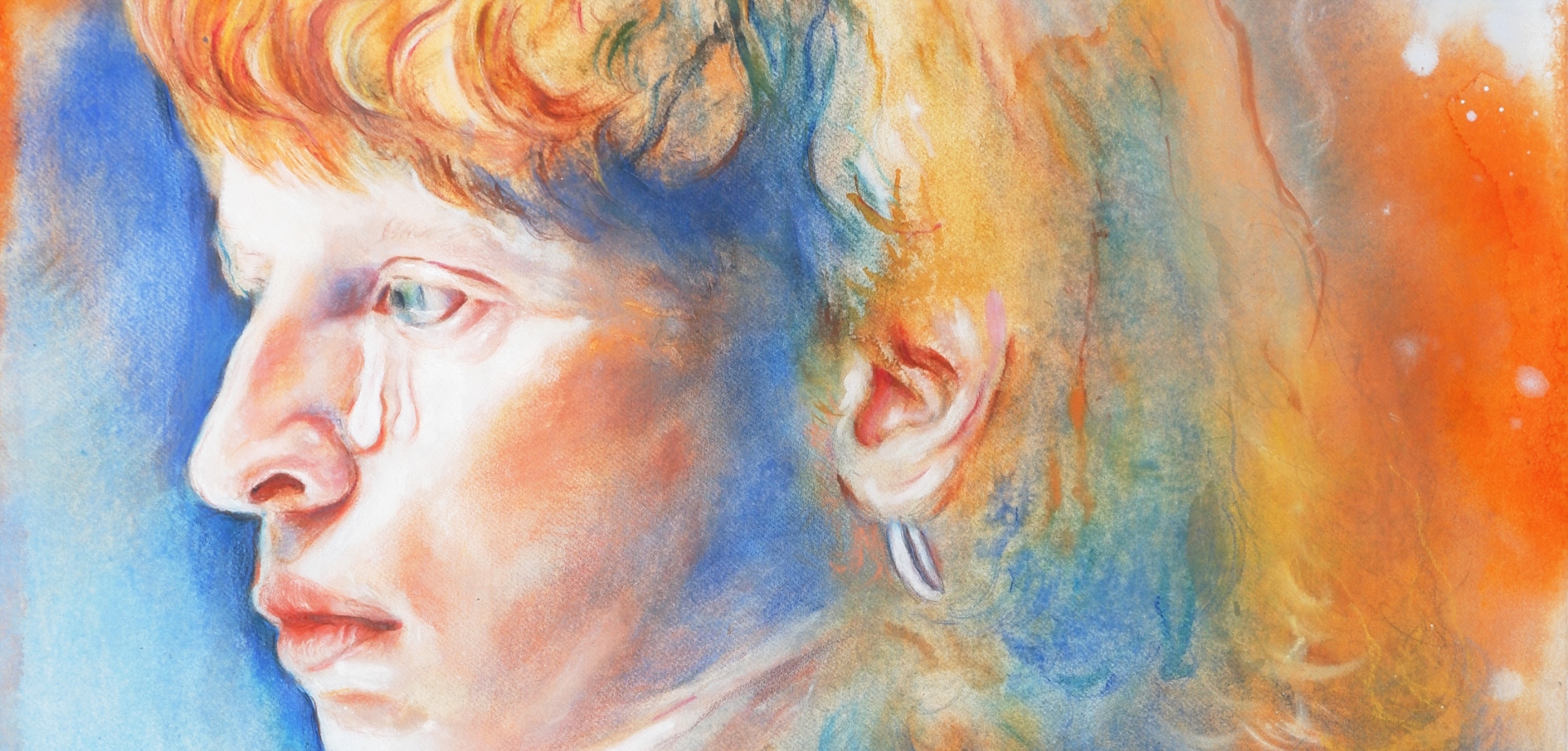
CAN Gallery presents, from February 5, the solo exhibition of Marianna Ignataki titled “Soft, Sharp and Hollow, Like their Breath”, featuring sculptures, paintings on canvas, and works on paper.
The exhibition highlights a mature and defining moment in the artist’s trajectory, continuing her ongoing dialogue around the body, gender, and image.
Marianna Ignataki belongs to a generation of women artists who redefine painting and sculpture not as means of representation, but as fields of critical inquiry. As Griselda Pollock has noted, feminist practice in art does not simply add new images, but changes the very terms of visibility. In Ignataki’s work, the gendered figure does not function as an object of the gaze, but as a site of tension, transformation, and resistance to fixed categories.

In the paintings and works on paper, the portrait is stripped of any psychologizing certainty. Double, blurred or veiled faces, withdrawn gazes, and details that disrupt a sense of stability compose images that oscillate constantly between dream and reality. Their aesthetic ranges from minimal, elliptical representations to more complex, timeless scenes referencing the circus, theatre, and role-play, forming a world where the performance of form can be authentic or constructed, permanent or temporary.
As Judith Butler writes, gender is the repeated stylized shaping of the body – a set of reiterated acts within a rigid regulatory framework. In other words, gender is not something we are, but something we do again and again. In Ignataki’s work, this idea is translated into an ambiguous condition of recognition, where forms remain open and non-final, shifting the responsibility of interpretation onto the viewer.


In the sculptures made of fabric and hair, synthetic materials and wigs act as three-dimensional extensions of this painterly exploration. Soft yet sharp, they resemble bodies that have been assembled, worn, and abandoned – like shells left behind after an exhale. The use of masks and hybrid bodies echoes what Hélène Cixous described as “writing the body”: a practice in which the body is neither explained nor represented, but speaks through ruptures, excess, and transformation.
In an era of expanding visibility and expression of gender and bodily identities – alongside intense backlash against the, Ignataki’s creatures form an alternative community. The strange, the monstrous, and the “other” are not presented as threats, but as shared ground. As Donna Haraway notes, “We do not need clean identities, but relations, affinities, and hybrids.” This idea runs through Ignataki’s universe, where everyone belongs and no one is required to stabilize into fixed forms.
The exhibition “Soft, Sharp and Hollow, Like their Breath” does not propose narratives or illustrate positions. Instead, it presents forms in constant transition – images that breathe, empty, and return – offering a space of slowing down and resistance, where the image can remain an encounter or experience rather than an answer. Ignataki thus repositions painting and sculpture as spaces in which the body can exist freely, without boundaries or certainties. Materiality, in her case, does not serve to mimic the body but to evoke its memory; materials function as traces, often familiar and intimate, like remnants of a breath that has not yet faded.

About the artist
Marianna Ignataki (b. 1977) was born in Thessaloniki and in recent years has lived and worked in Berlin. Her practice spans painting, sculpture, drawing, and video, focusing on the creation of a personal mythological universe where bodies and subjects appear fluid and constantly shifting. Her work explores themes of identity, self-perception, and otherness, as well as the attraction to horror, the fascination with the carnivalesque, and the use of the mask as a means of freedom and transformation.
She studied Architecture at the Technische Universität in Vienna and Fine Arts at the School of Fine Arts in Saint-Étienne, France. Between 2010 and 2017 she lived and worked in Beijing. She has presented numerous solo exhibitions in museums and galleries in Greece and abroad, and has participated in major group exhibitions across Europe, China, and the United States.
In 2025 she presented the solo exhibition The Wise Ones, the Green Horses and a Few More Creatures at MOMus – Museum of Contemporary Art in Thessaloniki. She is represented by CAN Christina Androulidaki Gallery (Athens) and collaborates with frontviews (Berlin) and Reiter Galleries (Berlin–Leipzig).
Her recent group exhibitions include: The Allure of the Strange, National Gallery of Athens (2025); TERRA DIASPORA – Changing Worlds, Kunstverein Göttingen (2024); A:PRÉS D:ESSÉRT, A:D: Curatorial, Berlin (2023); Kreatur, Reiter Galleries, Berlin (2022); Drawing Wow, Minuseins, Vienna (2022); Common Ground, MOMus – Museum of Contemporary Art, Thessaloniki (2022); Idyllia Road, Museum of Contemporary Art of Crete and Technopolis of the City of Athens (2022); CRUSH, The Finnish Institute in Germany at Feld + Haus, Berlin (2022); CHARTA II: Identity and Narration, frontviews at HAUNT, Berlin (2021); KINIMATA, Bouboulina Museum, Spetses (2021); Gods and Monsters, Kunstverein Montez, Frankfurt (2021); Homeostasis, frontviews at Heit, Berlin (2019); Overview Effect: Encountering the Cosmos, MOMus – Museum of Contemporary Art, Thessaloniki (2019); Athens Photo Festival, Benaki Museum (2019); Am I that Name or that Image, MoCA Skopje (2019); What is Eros, MOMus – Museum of Contemporary Art, Thessaloniki (2019); among many others.

Info
Opening Reception: Thursday, February 5, 6:00 – 9:30 pm
Exhibition Dates: February 5 – March 14, 2026
Opening Hours:
Tuesday – Friday: 12:00 – 8:00 pm
Saturday: 12:00 – 4:00 pm
Location: CAN Christina Androulidaki Gallery
Chalkokondili 19, Athina 104 32