 PEPI NIKOLOPOULOU
Her monumental textile installation Human/Nature at EMST stands tall like a multicolored vision. Silk becomes foliage. Lines and patterns unfold before the viewer’s eyes like a secret map. But at the center lies not just an image — it is a question.
A female figure — the artist’s alter ego — moves through the world, leaving behind the human position to enter the minds of animals. She smells like a dog, moves like a spider, sees like a creature that doesn’t use words but senses. Talbot isn’t telling a fairytale, nor is she longing for an innocent return to nature. Instead, she asks: Can there be an ethical return? Can we face nature without appropriating it?
All the works in the exhibition are new, created this year, and Talbot treats them as a narrative:
“Like turning the pages of a fairytale. There is a sense of continuity, like when reading a novel. Even in the animation — although it is inherently sequential — I tried to create the feeling that you are moving through something, experiencing it in your own way, without being told how to ‘read’ it,” the artist shares with elc.
A fairytale where the gaze roams freely. Just like turning the pages of a book, there is continuity here too, but without strict linearity. The audience moves through the work, collecting experiences and impressions, without being confined to a single way of interpretation.

The installation is structured around three worlds, three distinct units that follow one another like an inner journey.
Talbot didn’t try to “correct” the architectural elements of the space — such as the large column that dominates the center — but instead integrated them creatively into the narrative flow, guiding the viewer’s gaze around them and turning the act of walking through the space into part of the experience. As she explains:
“I conceived the exhibition as three worlds, three proposals. Katerina Gregos invited me here to see the space and think about how it could expand. There are some very interesting elements, like this large column in the center. Instead of seeing it as a problem, I worked with it as part of the piece. I wanted to create something that leads the viewer to move around it — like a narrative experience.”
The work reflects deep contemplation on our relationship with animals and nature. Talbot’s approach to the subject of animals was born out of a recognition of distance. Despite all the research and texts she read — including those of John Berger — she felt a lack of personal closeness to animals. Yet it was precisely this distance that became the driving force. It led her to imagine what it would be like to enter the mind of another creature — to experience the world as an animal, through senses rather than verbal thought:
“At first, I felt very detached from animals. I read theoretical texts, like John Berger’s, but I didn’t have a personal experience of closeness. That made them even more mysterious to me. I was fascinated by the idea of entering the minds of animals — imagining the world through their senses.”
Her research brought her face to face with wondrous phenomena: the way dogs perceive a limited range of colors, their incredibly powerful sense of smell, their sensitivity to magnetic fields. All of this revealed a world where experience is shaped differently. For a human being, the attempt to understand this other mode of existence with empathy becomes an act of profound connection.

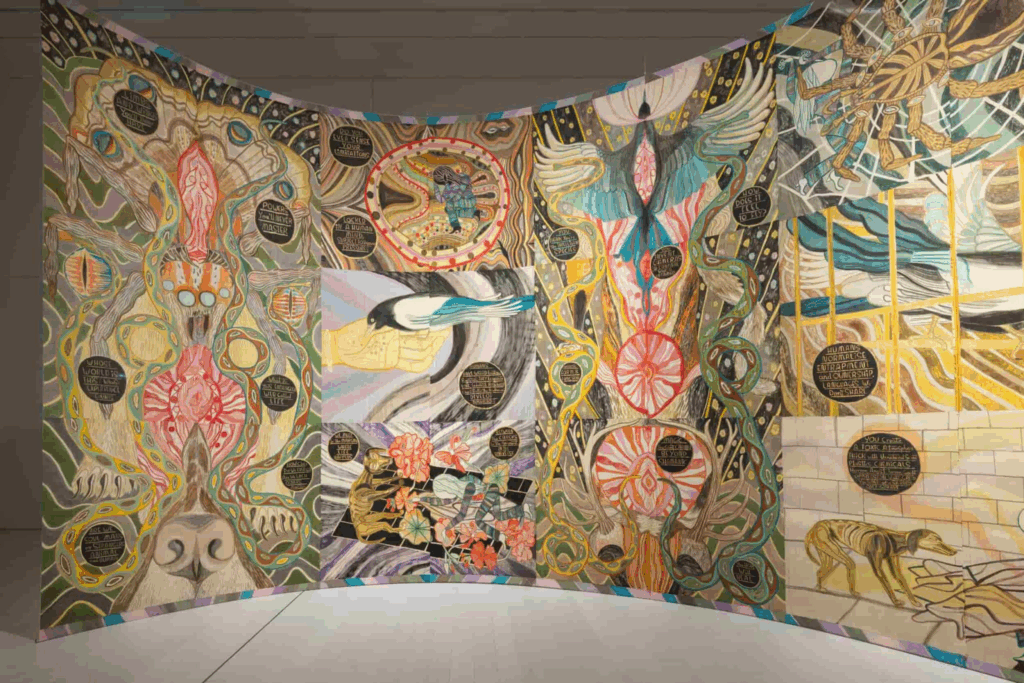

In the visual realm, these ideas were transformed into columns that incorporate animal features: claws, insect eyes, snake forms. The patterns traced upon them evoke both the exterior and the interior of creatures. The entire installation becomes a unified space of coexistence, where the boundaries between the human and the non-human dissolve:
“In the columns of the installation, I combined animal features — claws, insect eyes, snakes. Their patterns refer to both the inside and the outside of the body. At the same time, the silk creates a space where all of these coexist — a field of existence.”
A key symbol within this landscape is the Chimera: a woven sculpture that combines characteristics of different animals. It’s a reference to mythology, but also to the very imagination of nature. The Chimera does not merely stand as a monster or hybrid — it becomes an enigmatic guardian of the unknown world we are trying to understand.
Behind all of this lies a contemplative commentary on structures of power. For Talbot, our relationship with nature is inextricably linked to the question of who holds power, how it is exercised, and with what consequences. What do we allow to flourish? What do we destroy? These questions permeate every level of contemporary life and are becoming increasingly urgent in our time.
Even the technique of the installation is closely tied to its content. In her studio, Talbot uses panels to spread the silk in layers, painting and photographing its progress. In the end, the pieces are cut and joined using magnets, maintaining a sense of unity and lightness — like a moving mural.
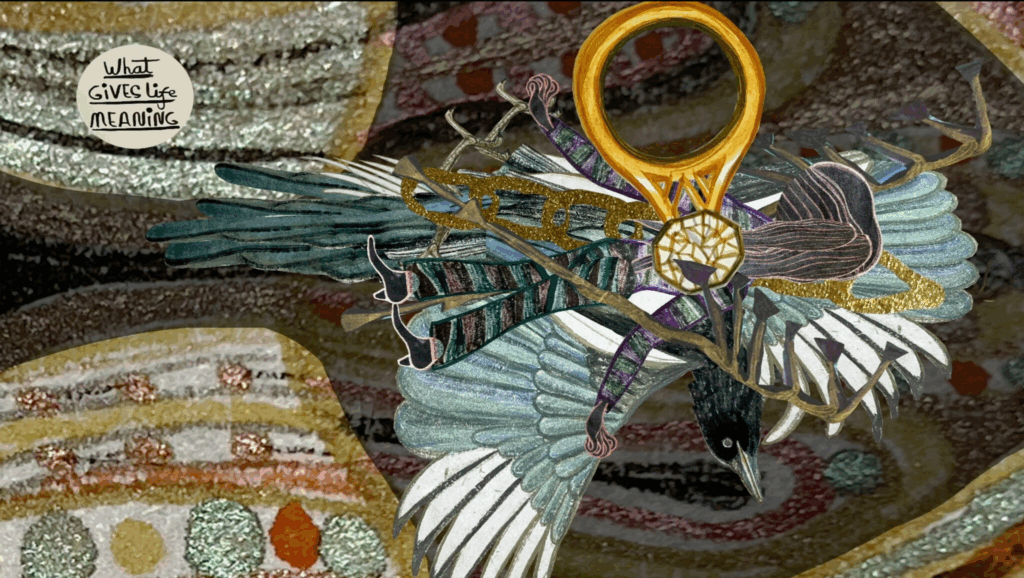
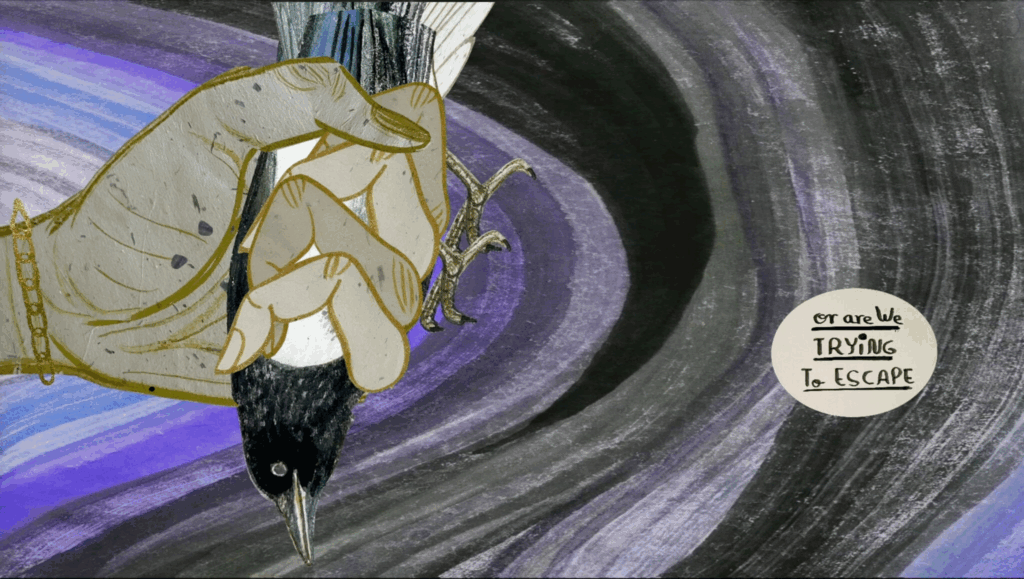

More than anything, Talbot wanted the work to open a space for reflection — to offer an experience in which each visitor could contemplate what it means to be human, what it means to relate to the natural world, how we live and what we value. The faces depicted in the works are deliberately faceless, allowing each viewer to project themselves into them, much like reading a novel written in the first person:
“It’s like reading a first-person novel where you can insert yourself into the story. I want the work to invite personal engagement, not just passive observation,” Talbot explains.
When I asked her what she would like visitors to experience in her exhibition, she said:
“I hope the work gives them space to reflect on what it means to be human. To question their relationship with nature, what they value, how they act. I don’t want to tell anyone what to think. I want to create a space that’s open to contemplation.”
In Human/Nature, Emma Talbot offers a place of experience and inquiry — an invitation to reimagine the world, not through the lens of dominance, but through the sensitive gaze of interdependence.
Info
Emma Talbot: Human/Nature | EMST
April 3, 2025 – February 15, 2026
Exhibition Space, 2nd Floor