 KATERINA PARRI
By Old Boy
With his third film in three years, Yorgos Lanthimos treats Emma Stone for a third consecutive time not as an ordinary woman, nor even simply as a remarkable one, but as a sui generis being, something outside our world, endowed with non-human qualities. In front of my lens, in the stories I’m about to tell you, stands a creature that surpasses us. And we try to decode it: sometimes by studying the body, sometimes by inflicting harshness upon it, sometimes by allowing the body to align with the spirit, to find its own path, pulling the rest of the characters and the audience along with it.
In Poor Things, he turned her into a grand experiment of humanity and a technological miracle: resurrecting her freshly dead body with the brain of her infant, resulting in an adult body with an infant’s mind, rediscovering the human condition from zero hungrily, without constraints, without the social indoctrination built through childhood and adulthood.
In the second of the three Kinds of Kindness stories, after her disappearance, her husband (Jesse Plemons) finds her again. He notices small yet telling changes, grows suspicious, understands, knows she is no longer his wife, but a clone leading him to amputations and tortures to uncover what she really is.
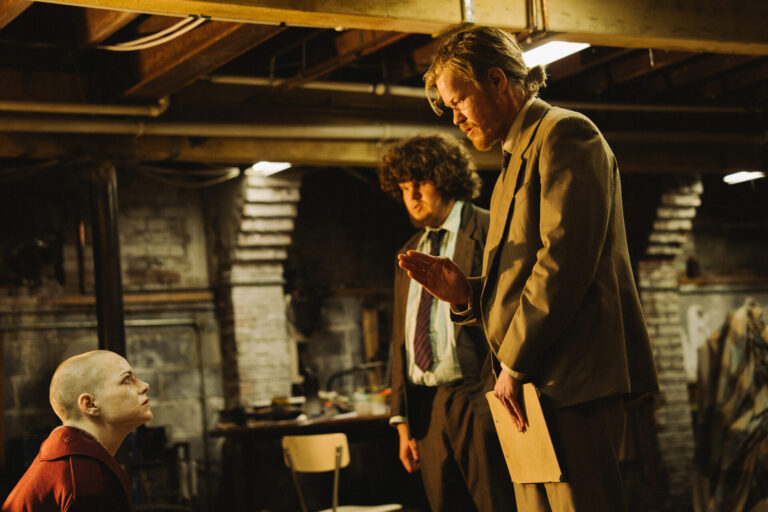
And now, in Bugonia, it is once again Plemons who kidnaps her and locks her in his basement, convinced she is an extraterrestrial not from Earth but from Andromeda. And perhaps out there, far beyond, there are no strange, beautiful lonely beings seeking companionship, but a civilization intent on wiping ours out.

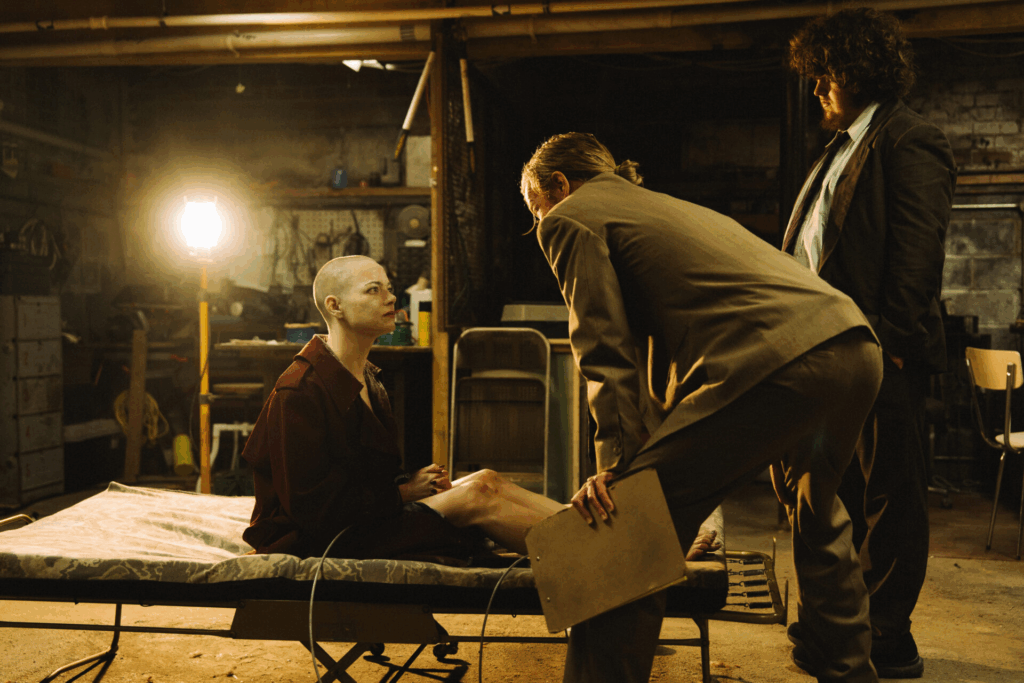
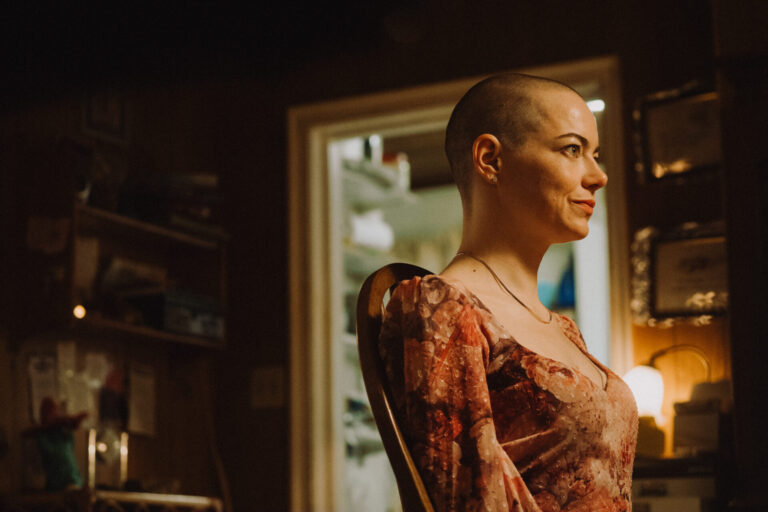
He keeps her hostage knowing that in a few nights the Andromedan ship will land. He intends to negotiate the salvation of humanity and the planet. The stakes, in other words, could not be higher. And once more, through Plemons, Lanthimos continues the “body as evidence” procedures he began in Kinds of Kindness. Most of them here are recreations and illusions, not real harm. But yes he does shave her head, leaving her bald, because, as “anyone who has done their research” knows, Andromedans communicate through the hair on their heads.
As the final touch, once he shaves her, he starts mocking the shape and imperfections of her face like someone who has spent far too long studying and meditating upon it.
So, we have an unofficial trilogy in which Emma Stone is not treated as a real woman or at least not as such by those around her. Let’s avoid spoiling whether Plemons’ suspicions were justified in Kinds of Kindness. In Bugonia, however, things are clear from the outset: he is a full-blown conspiracy fanatic, accompanied only by his cousin, who appears “different” because he is neurodivergent, on the autism spectrum.
Yet even if she is not literally an alien, she is close to being a metaphorical one: CEO of a pharmaceutical megacorporation, a member of the 1% perhaps even of the 0.1%. Doesn’t that class form its own separate human species? Those who determine the fate of millions—of workers, of consumers, even of ecosystems and a planet straining at its limits. Aren’t they, in a way, the ones exterminating our bees with viruses?


Bugonia is an adaptation of the 2003 South Korean film Save the Green Planet! whose protagonist was also a beekeeper. Perhaps these are my own associations, but I can’t resist noting that Dimitris Koufontinas was also a beekeeper and that the radical group 17 November, like here, operated strongly on family bonds. Decades ago, Stone’s character would likely have been a target for an organization like 17N. Perhaps this kind of ideologically driven terrorism has now been replaced by extreme conspiracy thinking who cannot withstand even minimal rational scrutiny.
Plemons’ character who could easily pass for a Trump-era QAnon type insists he has tried every ideological path before discovering the Andromedan plot he now believes he must stop.
A triumphant woman of the world, imprisoned by two losers—one loser and an even bigger loser two incels who take things to extremes, transforming their involuntary abstinence into a voluntary crusade. In the film’s opening shots (which carry a faint Blue Velvet aura) Plemons explains to his cousin that what bees do to flowers is “like having sex, but cleaner, and without anyone getting hurt.”

The film’s opening close-ups of the natural eroticism of flowers, references to dissolving viruses and billions of lost beings drifting without a home—promises something conceptually layered. That is, after all, the hallmark of Lanthimos’ cinema, whether collaborating with Efthimis Filippou or Tony McNamara.
Here, Will Tracy (of The Menu and Succession) does not reach the towering heights of his predecessors, and the film gradually reveals itself as less complex than expected. Compared to the Lanthimos universe post-Kinetta, it feels somewhat thin whereas even his weaker films until now brimmed with undeniable conceptual richness.
Ari Aster, who originally developed the remake before Lanthimos, is a producer here. And his own latest film also centers conspiracy thinking. In a moment when distinguishing truth from fabrication is increasingly difficult, art that wants to matter cannot avoid confronting this confusion these parallel realities we inhabit.
If official discourse is manipulative and filled with distortions and lies, and resistance has abandoned the political for the conspiratorial, and now we’ve moved from human-generated fake news to AI hallucinations, and if even our own eyes can no longer be trusted—then what remains? What can we still believe?
Fiction. Narrative. Cinema and literature. Which are manipulations, too but declared ones. Truths that do not pretend to be truth.
So perhaps Bugonia, seen through this lens, is not a farce at all but something genuinely subversive disguised as one.
Finally, a personal thank you to the officials of the Greek Ministry of Culture who not only banned the filming of a scene on the Acropolis (for absolutely no reason, as the film clearly proves), but also leaked the story to the press spoiling the film and reducing the viewer’s experience. Not content to “protect” the sacred rock, they also managed to spoil the movie.
Whatever one thinks of Bugonia, even if the reaction is not enthusiastic, it is hard to deny that the images Lanthimos gives us in the finale are those of a truly great creator.