 elc team
“In times that were difficult for women, I’m talking about the 1930s, 1940s, when women were in the kitchen, cooking in their aprons. She was out there saying what she was thinking. She always said, ‘Think like a boss and act like a lady’.”
By Stelios Parris
Ute Lemper is a German artist. Music, singing, dancing, acting, painting with some awards for her performances and gold records. I personally know her because of the songs by Kurt Weil and Bernard Brecht that she has performed as well as for providing the voice of Ariel and Esmeralda for the German dubs of Disney films. I had never seen her perform live so when I heard that she was coming to Athens with her performance of Rendezvous with Marlene Didrich, a show based on the three-hour phone call that Didrich made to her, I wanted to talk to her and got lucky.
You have prepared the show Rendezvous with Marlene that the Greek audience is going to enjoy in Athens, this isn’t your first time in Greece though?
Oh, no. My first performance was probably 1990? So 35 years ago. I’m doing this music thing for a long, long time. I think when my first records came out, that’s when really suddenly an international attention started it was 1987. The Kurt Weill records and so and so and then parallelly, I had the stage of performances and so. But I think because of the records and the recordings, I was already quite known by the end of the 80s, so I was invited to come to Athens, I think, and one of the first performances was at the Acropolis in this beautiful theater right underneath Herodes Atticus. I was like, so overwhelmed by the beauty of that old thousand and thousands of years old theater in this historical setting. And then I came many, many times back. I mean, I can’t count how many times, probably altogether ten times.
So you got a very good start with the greek audience in the Odeon of Herodes Atticus underneath Acropolis.
It was so magical, and obviously the acoustics in that theater unbelievable. I was surprised how intimate it felt acoustically, despite the fact that it was such a large theater, but the reflection of the marble stairs and the beautiful setting behind me it’s just really a very magical space. I always preferred that space to any kind of indoor theater in Athens.
You had the opportunity to speak on the telephone with Marlene Dietrich at some point in your life. I know the story. They were comparing you with her, you were the “new” Marlene Dietrich of our age. But how did you feel about Marlene, you grew up in a Germany that treated her as a traitor.
Well, this is a complicated story. It is indeed a very big, complicated, also tragic story. So when I was a child growing up in Germany, I only knew Marlene Dietrich from the movies, the Hollywood movies. She was this incredibly gorgeous diva on the Hollywood screen. I didn’t really knew exactly her story, but when I got a little older, I understood what happened. And the fact that she was a German expatriate and she fought in the war for the Americans against Nazi Germany, which is incredibly brave you know. For 20 months, she was out there at the front lines in France, Normandy, Africa and Italy. After the war the Germans didn’t want her back because she had fought against them, but of course she fought against Nazi Germany, but for some reason they couldn’t handle it. They treated her as a traitor. This is a really tragic, very worrisome story about the Germany I grew up in. That was a Germany who really couldn’t deal with the past. They didn’t confront the crimes of the past, obviously otherwise they would have said “Marlena, thank you for coming back. What happened to us? Thank you for your bravery to fight against the Nazis”. Instead they said “Get out of here. Screw you”. They hated her. That is just like an unbelievable tragedy of the German consciousness in those years. And it continued in 1987 when I spoke to her, what I really felt in her voice was the bitterness and the sadness and the melancholy about the fact that she never could return to Germany. Never. And she said to me on the phone, “I want to go back one time to Germany when I’m dead in a coffin. I want to be buried in Berlin, next to my mother, on the cemetery”. She said that to me, five years later, 1992 I was now in Berlin playing theater, I was now playing her part in the Blue Angel. Lola, that was my role and exactly then she died when I was almost getting ready for the opening night. Her coffin was flown, as she had said in her will “I want to go back to be buried in Germany”, to Berlin. And the funeral was in Berlin, and it was still very dark, very mysterious, very ridden by guilt and surprised that she would come back to Germany. Then I played her part a week later in the theater so there’s a strange conjunction points with her. With the conversation, me at the same time in Berlin with her and then ten years later, at her hundredth birthday, 2001, I was invited to Berlin to come and sing her songs. You know, in Berlin, because now, 2001, now Berlin was reunited it was a big capital city of Germany again, and they needed a status symbol so they used Marlene Dietrich. Suddenly “Our Marlena, our”, after they had thrown her out of the country for 60 years.
Is this story part of your show?
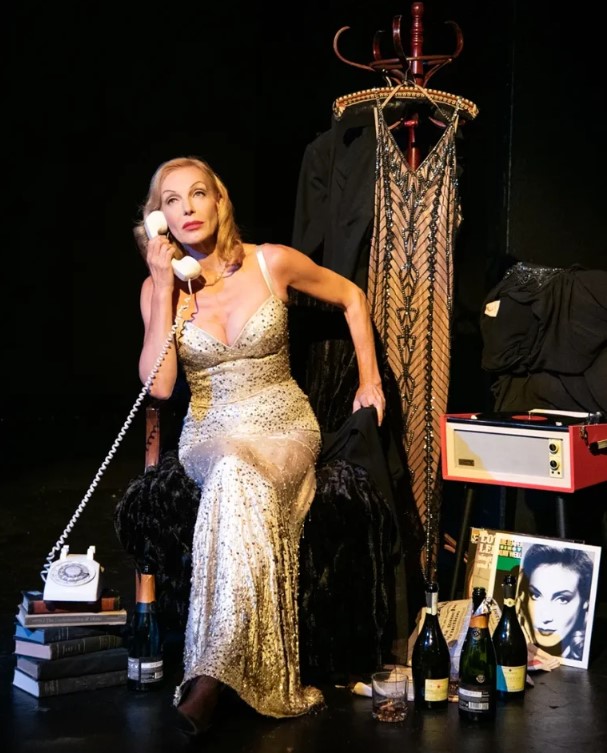
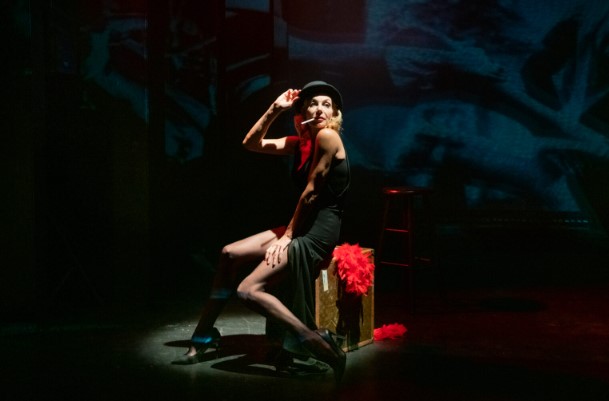
The show is not just about that really incredibly tragical also political story, it is about her as a woman.
You were inspired by this phone call and created the Rendezvous with Marlene?
Well, the phone call was in 1987 when I was 24 years old. I was really young she was very old, 87 years old. And I do remember that I felt this load of information and heavy emotions and bitterness and a little craziness of the old woman. I just, you know, kept it as an incredible impression and memory. And then 30 years later, when I was older, I live in New York now for 26 years. I felt like, it’s time to tell her story before she’s forgotten, because people forget so quickly nowadays. The young generations don’t know who Marlene Dietrich is so I wanted to write this theater play. Now, as an older woman myself can channel the older Marlena sitting there alone in her living room in Paris, abandoned, lonely and telling me the young Ute her story. So it’s like, uh, an interesting twist in the story that I’m becoming her telling me, the young me, the story.
So this theatrical play is something more than a collection of her songs and parts of her story.
It has songs of course but I’m channeling her. I’m telling the story as Marlena to me, to the young Ute.
So this channeling between you two is like a trip.
A trip in the past.
Now that you live in New York you feel less European?
I don’t have an American passport. I could long have the American passport because I live here for so long. All my children have American passport and European passports. But I don’t want the American passport. I don’t feel American. I feel a New Yorker, but not American. I am not American, I’m so very much a European. So I’m still here on green card now for 30 years, since 1994 I have a green card.
Then I better be careful with my questions, because I don’t want you to end up with the rest of the immigrants that they are planning to deport from the States.
Yes, I know, it’s really a catastrophic situation, and we can’t believe it. It’s so scary and, uh, so fascist, you know, and so radical the things that he puts on with executive orders. We were like, oh my God, please. I just really hope that he’s not dragging down too many innocent people, women and children, the immigrants. The diversity offices and agencies he closes them down and the whole connection with Elon Musk is so scary. Politics and money all in one pocket.
You are an actress, a singer, you have studied arts, so you are familiar with the way that the body moves. So in any case, that you wanted to throw your heart to the audience there are plenty of ways to do so.
About the Hitler salute, you mean. Yeah, I don’t know. I tend to believe he didn’t mean that. And he just made a faux pas. But he should have apologized, at least. I’m still missing from him recognizing that it was something very similar to a Hitler salute. He didn’t apologize, right? Did he?
No, he pulled out from X this specific video moments of his act. We live in dark years that we don’t know if these platforms are going to be against us or with us. We need freedom of speech and not fake news.
Now I really don’t want to go on at all because now anybody can say anything, and there is so much fake, stuff now out there that you can’t believe a thing. You might as well watch like, a soap opera on TV, because it’s also all just made up. The only thing I watch here in New York is BBC news, because every news channel is completely manipulated. You don’t know what to believe anymore.
On the other hand, we have AI, you like the use of AI or you are against?
Well, in Rendezvous with Marlene there is projection but it’s not AI, it’s real projection, like images from her in the movies and collages. So I’m using a multimedia, but not AI. I did use AI on my last two videos of my own songs. If you go to YouTube and check my last album Time Traveler, I made like very cool AI videos. For the song Time Traveler and In My Flame I have like an incredible AI animation around me. And then my third video also from my last album, which is called Permanently Confused that’s the opposite. It’s all taken with an iPhone, it’s all completely personal and very intimate and private. But I love all of them. I love the AI it’s like really very cool visionary stuff and I like the very personal one too.

You always wanted to be an artist.
I always loved music and wanted to do something with music. I wasn’t sure at the beginning should I be a dancer? And I had the dance training and a musician or a singer or an actress, all of this in the beginning. At one point, once I was on that road there was no way out. There wasn’t another road for me, but I was interested in other things, you know, I was interested in science and biology and literature. I could have done other things I had many interests, but somehow this was my way.
I’m glad that you are also political in your way. You speak freely stating your opinion and you also do projects like the one for the anniversary of the liberation of the Auschwitz camp.
I did a concert that is dealing with the songs from the ghettos and concentration camps with the Jewish prisoners. That’s a very important project that I created nine years ago. I tend to perform that project always in January at the liberation date or in November at the Kristallnacht Date. That’s a very important project for me to remember and to pay tribute to the 6 million people that were killed by the Nazis.
You know your Weill, you know your Brecht so I couldn’t expect less from you.
This year we celebrate the 125th anniversary of Kurt Weill, 125 years. So yesterday night I just performed in New York here, a Kurt Weill evening and the night before too. Only Kurt Weill as a tribute to Kurt Weill on his 125th anniversary.
You have this artistic bond with Kurt Weill.
You know I recorded a new album with Kurt Weill. It’s coming out in April. It’s a completely different approach to Kurt Weill is re-imagined with a completely contemporary vibe of arrangement, and it’s an experiment. So, you know, maybe some people will like it, some people won’t. But it’s not the old Kurt Weill, it’s a new Kurt Weill but in really interesting songs. Well, I have to say it’s so much fun to sing this music. It’s unique there’s nothing like it, especially the poetry of Bertolt Brecht. I just feel that it’s so strong and powerful, the words are so authentic there’s nothing fake about it. And obviously it’s about society, about capitalism, about fascism, about outcasts, about exotic people and it’s about our world. Brecht wash always an incredible poet and a man of the theater and somebody who saw reality. Who saw the world. The seduction and money. Money is power, power is money. All of that and the way people get twisted by this force. And, I can only say with the Trump administration and again, the collaboration between politics and private companies, it’s like basically a material for Bertolt Brecht.
Are you proud of yourself by the way you treating Marlene Dietrich?
Yes, I go into her very deeply of course, also very entertaining when I go back into the fun songs and I make fun and it’s ironic. For me its a very deep experience to channel her, I have internalized it by now, really very well. So, I just fall into this different life and this different human experience that she is.
If I were speaking now with Marlene channeling through you, what do you believe that she would like to say.
Well, she said a really interesting quote, because she was involved, you know, she picked up the phone even in her old age. She spoke to Gorbachev on the phone and to Margaret Thatcher and to Ronald Reagan. There is something really interesting that she says “History wanted to be a good teacher, but it couldn’t find any students”.
She was a wise lady.
Wilde. She was the most progressive woman for her time. She was bisexual, she was contesting gender men women role models, all that. She broke all the rules, and she was extremely powerful and emancipated, naturally. And in times when women really were not, you know, that I’m talking about the 1930s, 40, when women were in the kitchen cooking with their little aprons on. She was out there telling what she thought. She always said, “think like a boss and act like a lady”. A very free spirit and could definitely level with the men at any time. She was way ahead of her time.
And its a very good timing to bring Marlene here in Athens
I’m really glad I can bring the show finally to Athens. I tried many times, and since the pandemic, things are really different. It was really hard to get any shows scheduled because the audience was not there. And the promoters, they only do the big commercial stuff they don’t do the special projects, you know. So it was really hard but I’m glad it finally worked and hopefully it will start again that I can come more regularly.
We need artists like Ute Lemper to come to Greece. She speaks freely and that is what I took away from our conversation. Freedom of speech, which we must not lose, and Marlene Dietrich, which we must not forget.
Info
UTE LEMPER: Dating Marlene Dietrich
February 3 at Pallas Theater
Time: 9:00 pm – 11:30 pm
Voukourestiou 3-5
Athens, Athens 10564 Ελλάδα