 KATERINA PARRI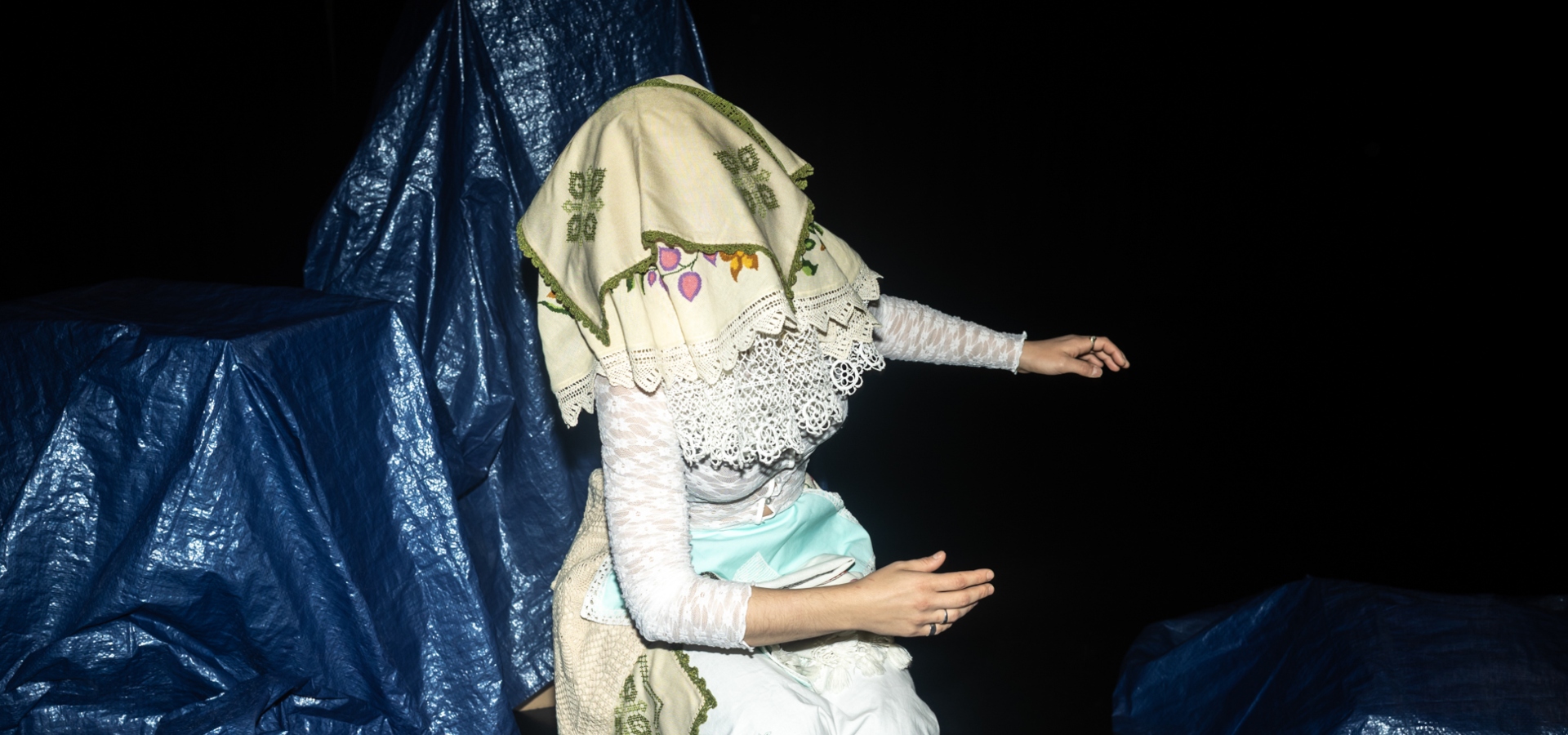
By Stelios Parris
“What happened to those dances we no longer dance? Where are they inside our bodies? If Mo Better has closed, where do we dance like we used to at Mo Better? And if we no longer dance somewhere like Mo Better, what remains of it in this body?”
Choreographer Katerina Foti presents “(REST IN) BLUE” as part of Onassis Dance Days 2026, a dance performance that balances between personal mourning and the collective memory of Athens. Its starting point is the blue tarpaulins covering buildings under renovation across the city: places where marble sinks are thrown away, mosaic floors are hidden, and neighborhoods are transformed into impersonal Airbnbs. Within this landscape, Katerina Foti creates a “choreographic autoethnography” that audiences can witness from February 5 to 8.
We spoke just before she headed to rehearsal, and before sharing our conversation, I want to pause on the creator’s note she wrote a text that deeply moved me:
“To the girls who became mothers.
To the baby blues and the identity crises.
To the hangouts that closed.
To the hangouts we abandoned.
To our birthplaces and to those who gave birth to us.
To our villages.
To cassette tapes with dedications.
To the best folk songs.
To Mo Better and Decadence.
To turning forty.
To my father Giorgos, who left in April 2024.
To my son Giorgos, who was born in December 2024.
And to Dionysis, who became the thread connecting the Giorgoses and turned my darkness into light.”
I want to congratulate you on this powerful creator’s note – it’s poetic and it generates memories.
Thank you so much. It inevitably generates memories, because that was the goal of this work: to enter the “rabbit hole” of memory and travel far – not only into recent memory. The note emerged very organically.
I wouldn’t call it a “rabbit hole.” Since your starting point is the blue tarpaulin covering buildings, I felt as if you were revealing what lies beneath it.
Exactly and that’s a huge part of what the piece is about. Which memories lie underneath, haunting the walls, trapped there. Like the Bridge of Arta that needed a human sacrifice to stand firm.
What did we sacrifice for this reconstruction to stand?
We sacrificed our youth unwillingly. Athens now feels like it’s on the edge of becoming a “Development Park.” It has lost many parts of its identity. Very few places truly belong to us anymore. The word “rabbit hole” refers to how all this has been pushed into darkness. Everything that shaped the city’s identity over the past decades feels locked in a chest and hidden away. The chest, the wall, the tarpaulin – all evoke coldness, darkness, concealment.
Seeing mosaic floors ripped out of Athenian homes breaks my heart.
Mine too. Everything now looks like cheap Airbnbs, with fake floors pretending to be wood. It’s sad. I’m not an architect, but this is about the city’s aesthetics on many levels.
Sometimes I see marble sinks thrown in the trash and it hurts replaced with…
Fake, cheap, disposable materials. There’s no sense of permanence.
Do you think your body – since you perform the piece yourself – can act as a living archive of these stories?
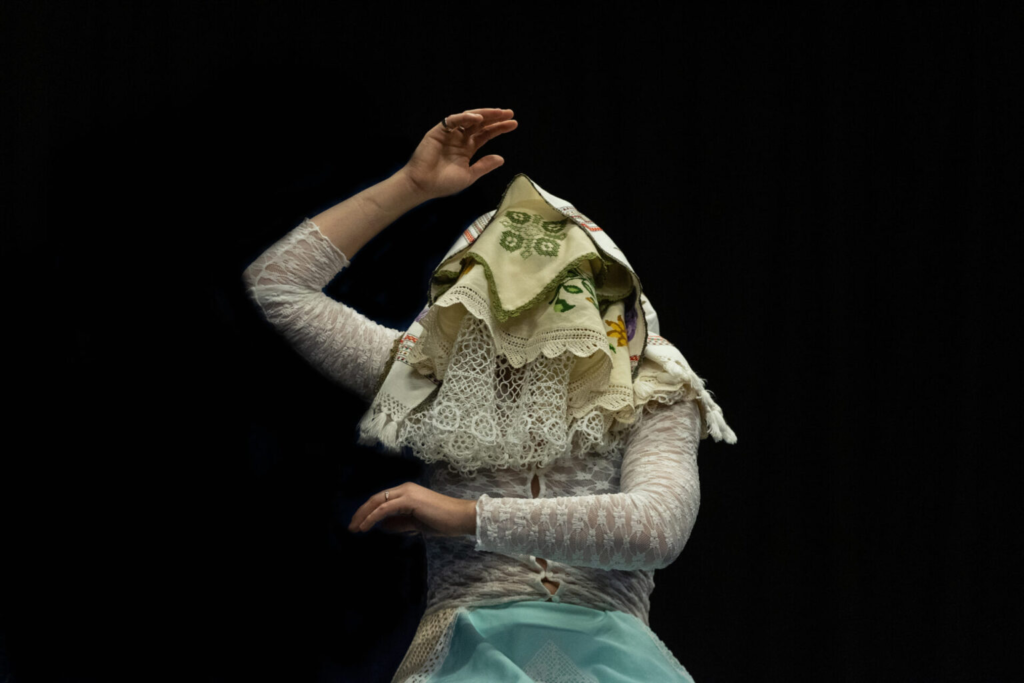
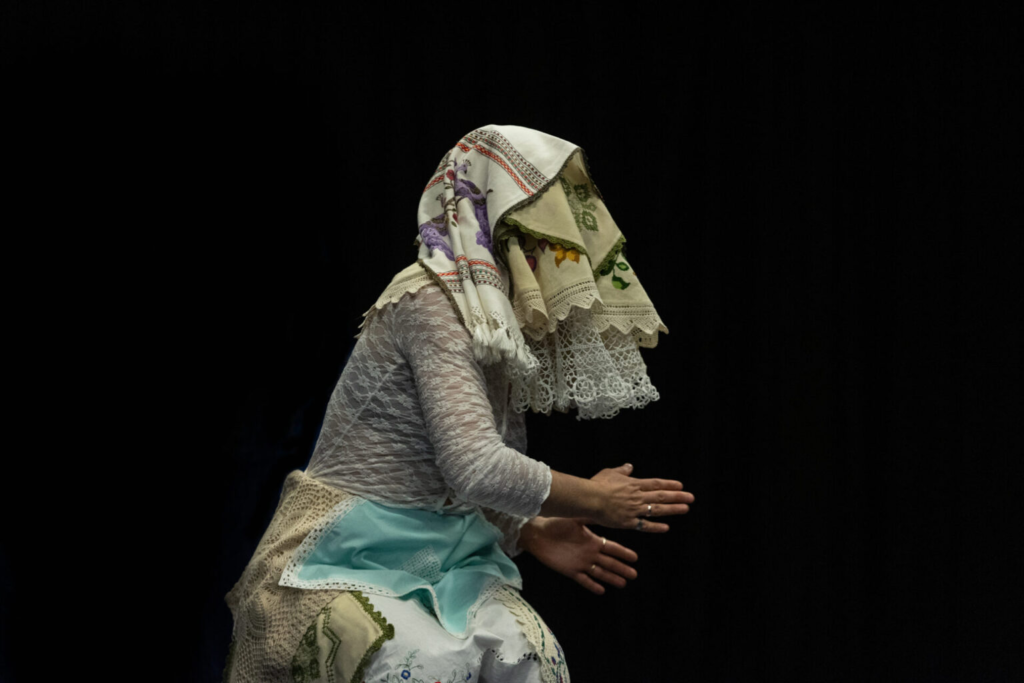
One hundred percent. It’s a chain of “movement DNA” passed from generation to generation. The way we dance combined with how our parents moved, how our grandparents moved, and the rhythm of the city itself create a bodily identity of the present. The “now” never exists without the past. The body remembers hugs, farewells, greetings, shared dances. At the same time, it carries the daily routines of those who came before us.
So it’s not imitation – it’s memory.
Exactly. It’s recording and memory. Just like children learning to walk – they don’t imitate exactly; they transform what they receive into something of their own. That’s how I worked on this piece. I took what my body remembers, combined it with how my father, grandparents, and mother moved, and how all of this lives inside my body in Athens in 2026 tired, nostalgic, longing for those dances we no longer dance.
During your research you lost your father and “gained” a son.
Yes. That’s how life goes. One leaves, one arrives nine months apart.
That must have influenced the work deeply.
Inevitably. The piece became a memorial of fundamental loss, connected to how grief is experienced in today’s fast-paced city. Motherhood is overwhelming love and fulfillment but it also carries mourning, for things we will never do again in the same way.
Your tool is your body. Has your relationship with it changed?
Completely. I danced while pregnant – a long transition from one body to another. Hormonal, psychological, physical changes not negative ones. I believe the body is reborn, gaining depth and substance.
You carry personal objects on stage during a “moving house” scene. Are they yours?
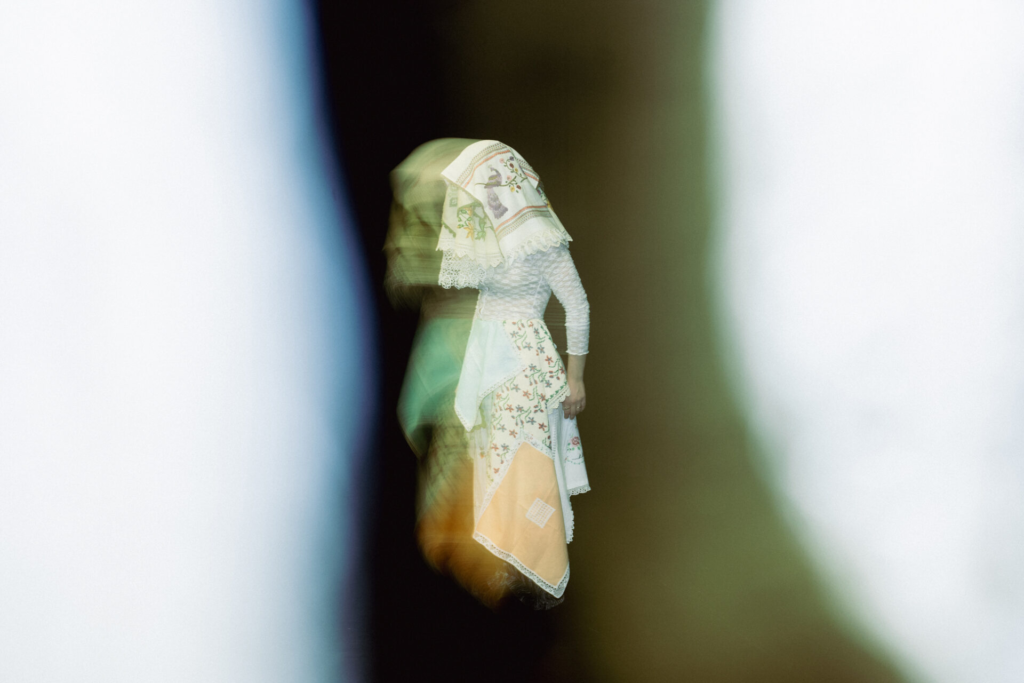
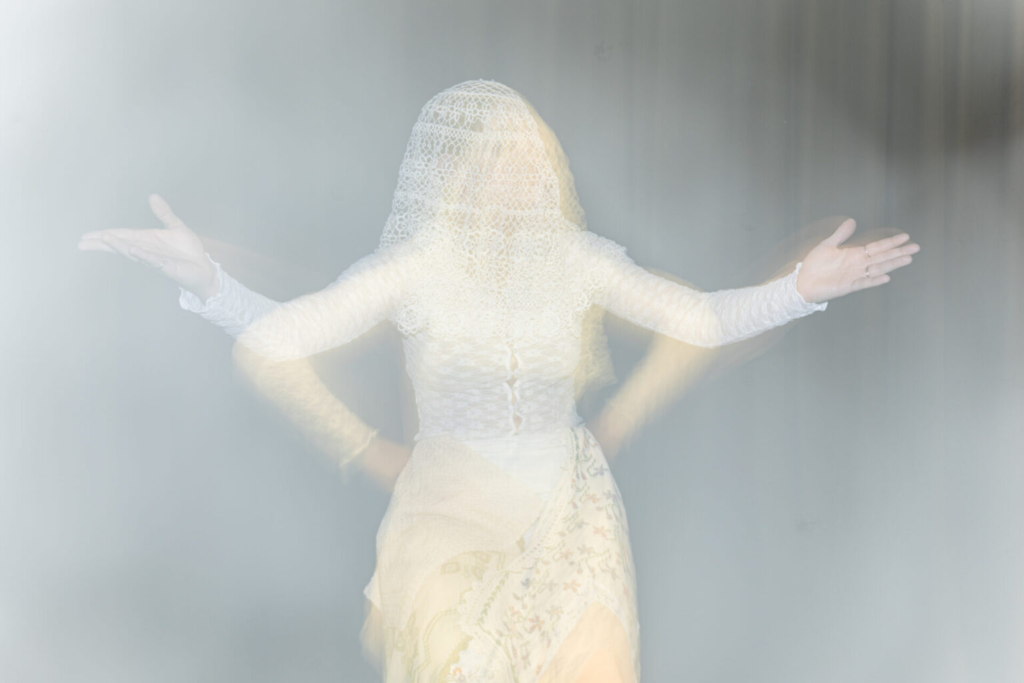
Yes -especially the lace doilies. They represent our roots and personal confession. Other objects belong to different decades, suggesting time passing through generations.
Is there one object that symbolizes the essence of the work?
The Walkman, it plays a central role.
What soundscape of Athens did you choose for the performance?
The music is by Giannis Angelopoulos. It begins with the refrain of “Tsopanákos” from Greek Radio — something tied to my father’s memory. Then it evolves through rhythmic fragments and post-punk elements, mirroring the decades from the 1950s to today. The music, like the choreography, moves through time.
You describe the piece as autoethnographic.
I encountered the term during my dramaturgy master’s studies. It combines personal experience with collective characteristics. I use real life events, personal objects, fragments of history — exposing them within the work.
So there’s deep personal exposure in “(REST IN) BLUE.”
Yes. To truly communicate, you must expose something personal. Gentrification concerns us all, but to speak about the city’s melancholy you must find what has been shaken within you personally.
Ideally, what would you like the audience to feel afterward?
That many of us miss this city. That many of us see our identity fragmenting. We are a generation of multiple disappointments – but together, tomorrow can bring something new. It’s a call for collective reflection about the future, using the memories we carry.
After this emotional journey, where do you land?
The stage becomes a house that generations lived in, now demolished to become Airbnb apartments. I land in my new identity, carrying everything from that house, those decades, and this city. Unless something strong happens collectively, this won’t heal.
Where will we plant our roots again?
Exactly. The city will not be the same in twenty years. But those core memories will pass on to the next generation.
Those blue tarpaulins and what they hide beneath them.
In fifty years there will be new tarpaulins, and someone else may speak about the same cycle. It’s both hopeful and futile the eternal cycle of life, identities passing from one generation to the next.
Photos: © Pinelopi Gerasimou
Info
ODD – Onassis Dance Days: “(REST IN) BLUE” by Katerina Foti
Thursday 5 February – Sunday 8 February, 18:00
Small Stage | Onassis Stegi