 KATERINA PARRI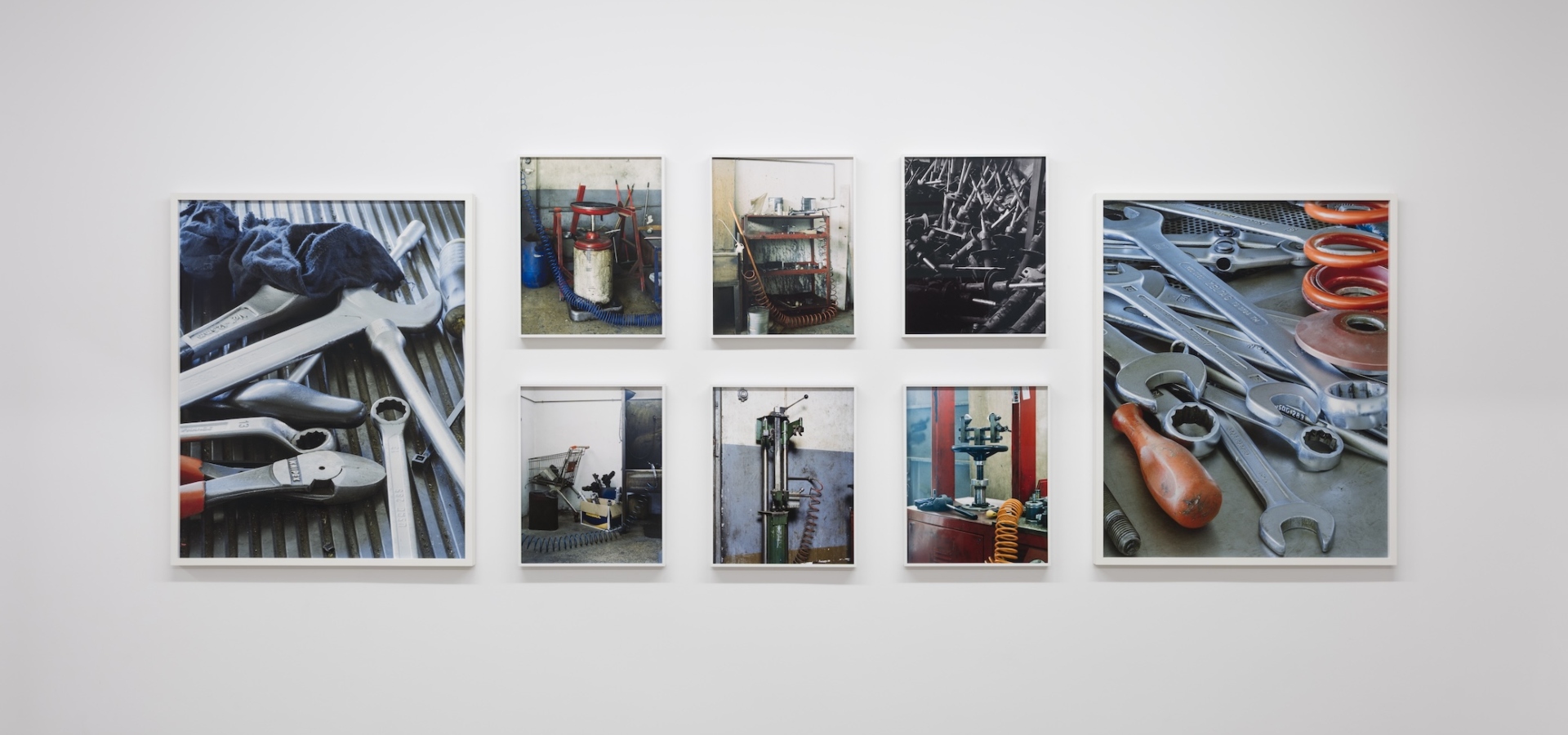
By Katerina Parri
“I’m deeply interested in the material nature of tools, in the struggle between the new and the old.”
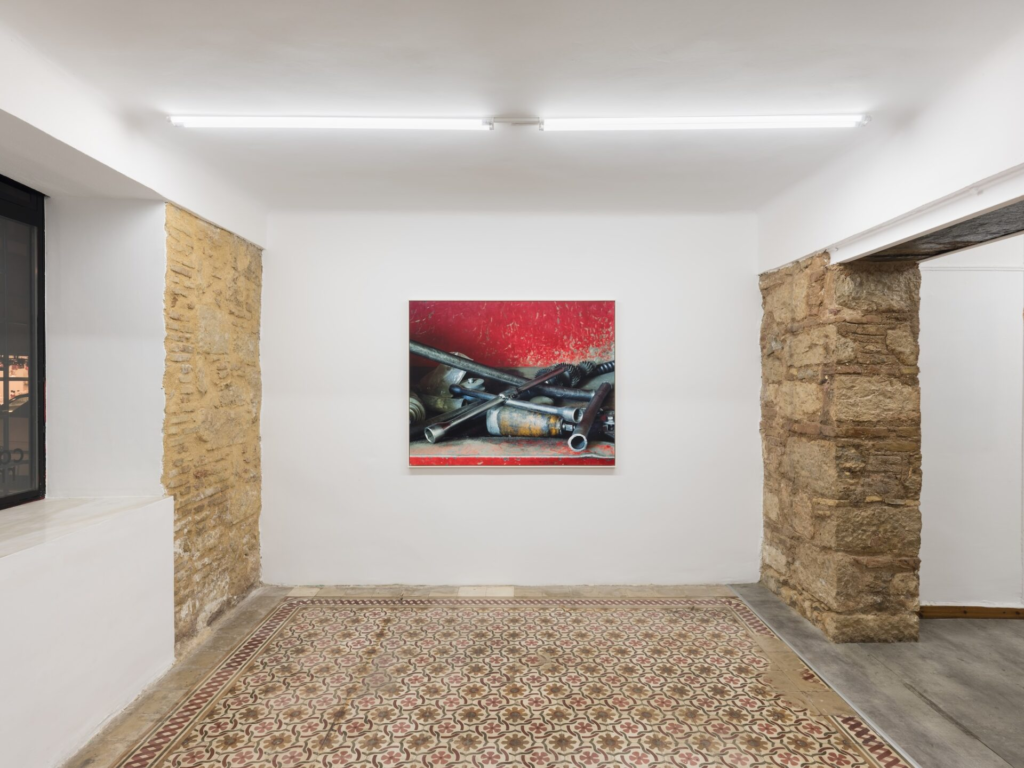
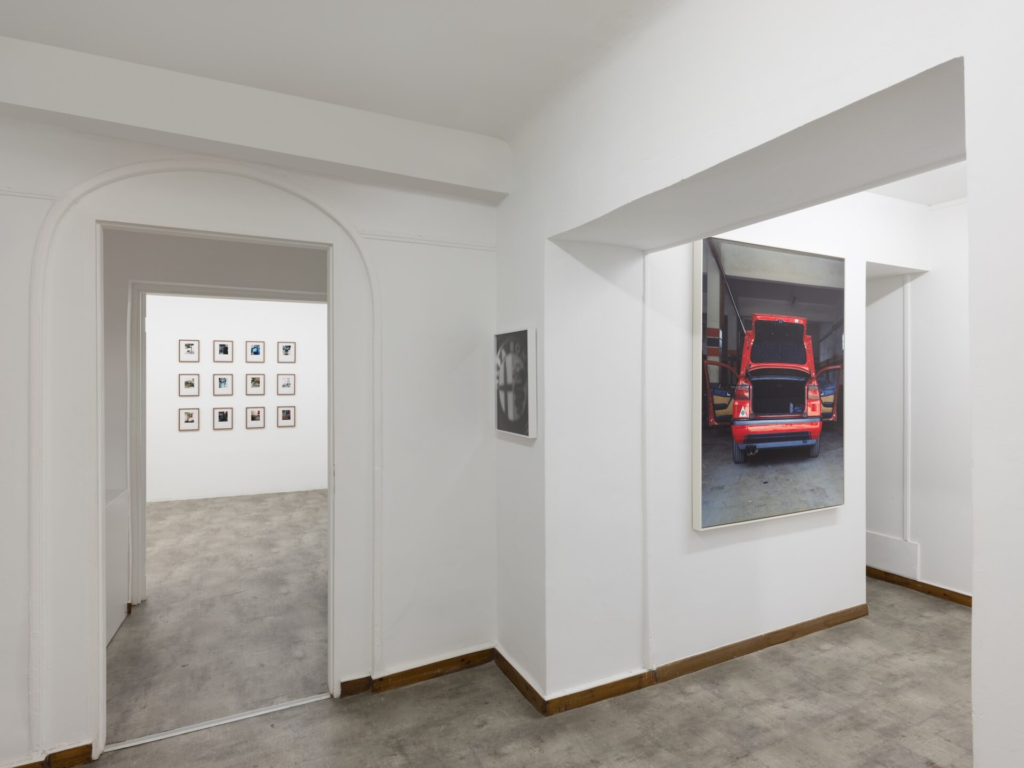
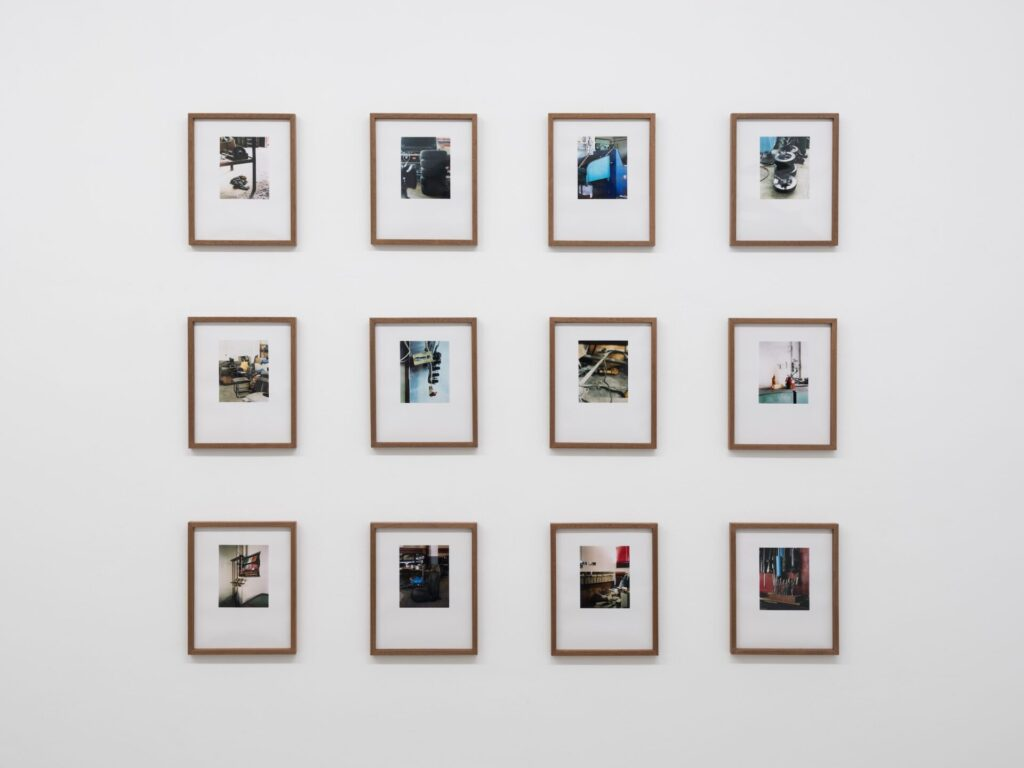
In the exhibition “Refinements/Βελτιώσεις ” by visual artist Nikolas Ventourakis at Callirrhoë, you encounter large and small works that meticulously capture the textures, colours, and materiality of objectsexactly as he experienced them in his daily visits to a car repair shop in Kallithea specialising in Alfa Romeo vehicles. This particular workshop is far from incidental in the artist’s life; it belongs to Elias, who is preparing to close it down, and it is the place Ventourakis visited from a very young age with his father to “take care” of the family car, which eventually passed on to him.
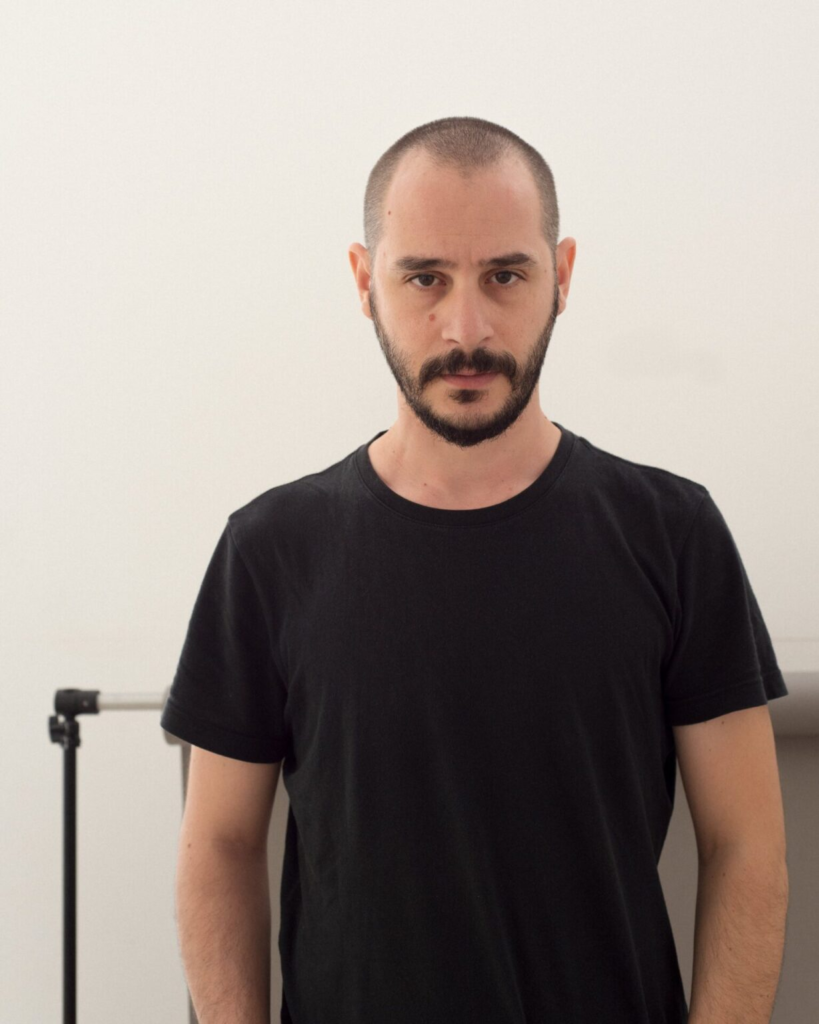
A visual artist working primarily with analogue photography, Ventourakis guides me through the exhibition, and from the very first moment it becomes clear how intensely he meditates on and labours over the gaze in his work. He explains the analogue process he followed for this project in detail why he chose it, how he approached the act of depicting things and shares what currently concerns him artistically: the material nature of tools, and the tension between the new and the old.
The starting point: Elias’ workshop as lived experience and the “patenta” that is disappearing
Drawing on his personal connection to Elias’s workshop, Ventourakis speaks about his point of departure when approaching subjects in his work, making clear that he does not come from a technophobic perspective but he has noticed the disappearance of the old-school “patenta,” the inventive workaround:
“All my projects are personal; they all begin from a personal relationship I have with the things I depict. But I’m not interested in autobiography per se, or in stories that are 100% personal. It simply starts there, because that’s the point from which I can truly approach something and sustain my interest. An idea may be extremely interesting, yet hold no interest for me personally so I won’t create work around it. There has to be a connection that keeps me there and generates new ideas, which appear as you keep working.
I also have a tendency not to work immediately on something as soon as I encounter it. I may return to an idea years later, once enough time has passed for me to form a relationship with what I’ve seen, a bond formed through prolonged exposure.”
“I’ve been going to Elias’s workshop for as long as I can remember. My father was among his very first customers when Elias opened, and both he and my uncle drove Alfa Romeos. As a kid, I would sometimes go along when my father took the car in. Then I grew older, and when he got his next car which has been mine since I started driving in ’99–2000-we kept going to Elias. My siblings now take their cars there too. It’s close to where we grew up, so dropping by was always easy-even just to say that something small wasn’t working. It was a very organic relationship.
I remember how gigantic everything looked to me as a child, how things that once shone grew old over time, how spare parts seemed to grow…
There’s this notion of something that once was new – an icon of its era, like the aesthetics of the ’80s we grew up with. We now look back with nostalgia. But at the time, the future we later lived hadn’t yet arrived. So the workshop holds all that memory: a place that once constantly repaired new cars, but gradually became a workshop for vintage vehicles and cars on the brink of collapse. They still service modern cars, of course but the profession has changed dramatically. Big manufacturers don’t want independent workshops anymore, and new cars are essentially computers. A huge part of the process of inventive ‘patenta’ solutions has been lost. Something breaks now, and there’s no direct, tactile relationship with the machine.”
Elias’s workshop is nearing closure. Elias is almost 80, and Christos-the younger mechanic-is approaching 60. No successor appeared; it’s hard work, and the pandemic years didn’t help. Personally, Ventourakis feels the loss of all that knowledge that was never passed down. “There is simply no one left who knows how to fix these old cars.”
“I had my first computer in 1984,” he continues. “I’ve always been close to technology-I had the internet by 1995–96 -so I’m not coming from a technophobic place that claims analogue is superior. Not at all. But I observe this: the kind of intimate relationship Elias had with a car over thirty years, the ability to ‘hear’ something with touch and experience… it’s gone. In large workshops now, every time you go, a different technician looks at your car. They check the digital file, and you end up explaining the same things again and again.”
I notice the four-leaf clover emblem on the red car in the photograph, and our conversation turns to the symbolism of Alfa Romeo itself a brand with a particularly strong presence in Greece. Ventourakis explains:
“In Greece, Alfa Romeo has a unique presence that it doesn’t have in other countries. In the ’80s, ’90s, and 2000s, so many people dreamed of owning an Alfa. Outside Italy, I think we’re among the very few countries where its presence was so strong, workshops everywhere. On Khamosternas Street alone there are five workshops specialising in Alfas. It symbolised a whole generation.
There were two types of drivers: those who wanted German cars and those who wanted Italian. The Alfa crowd was distinct. Many of these drivers are now 60, 70, 80 years old—and they still bring their cars to Elias. You get the sense that they are all fading together, slowly. Few younger drivers choose a workshop like this today.”
The materiality of tools and the idea of “refinements”
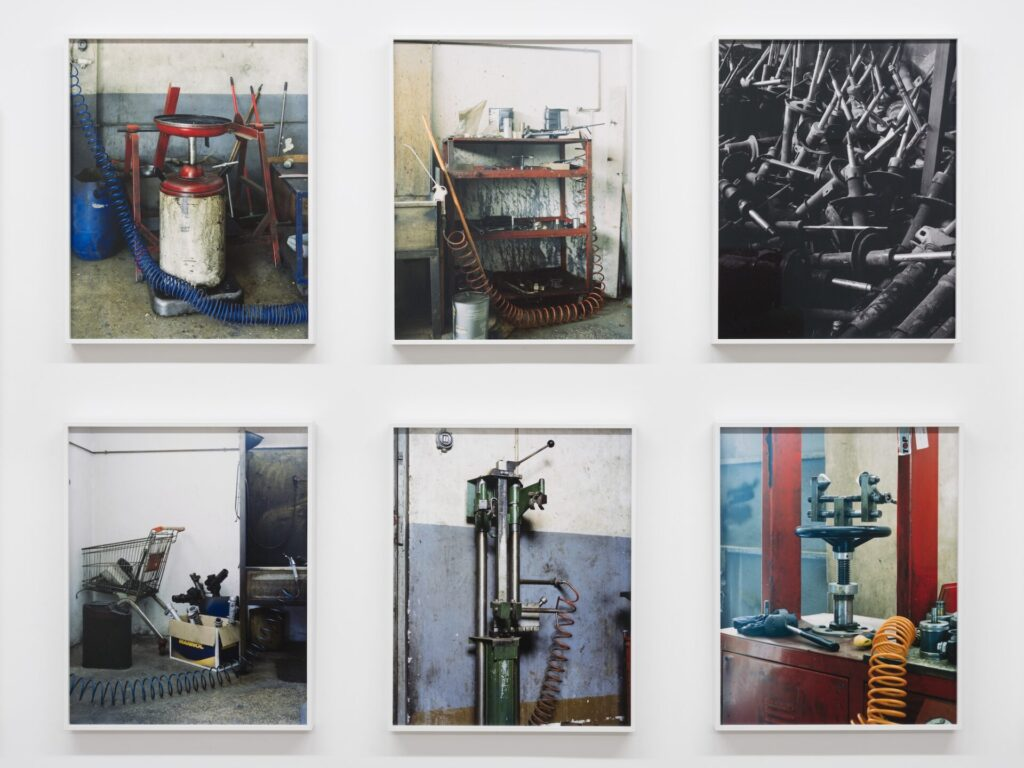
“A workshop is a hymn to materiality,” Nikolas Ventourakis shares. “And I think it’s one of the few places-something I only recently realised – where you can actually see things aging. You go there with a new car, and fifteen years later, returning to the same workshop, the car is now old. But we don’t have many places, apart from our homes perhaps, where objects physically age before our eyes: plastic cracking, colours fading, things showing their wear, especially when all the cars around them are brand new. I became aware of all this inside that space.”
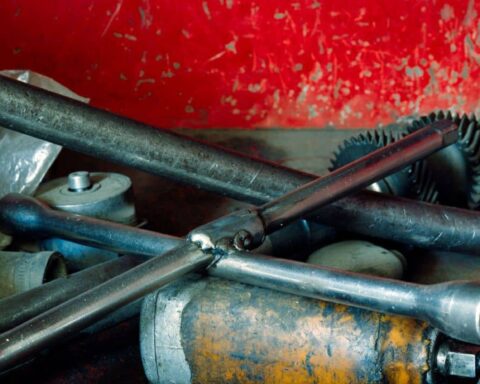
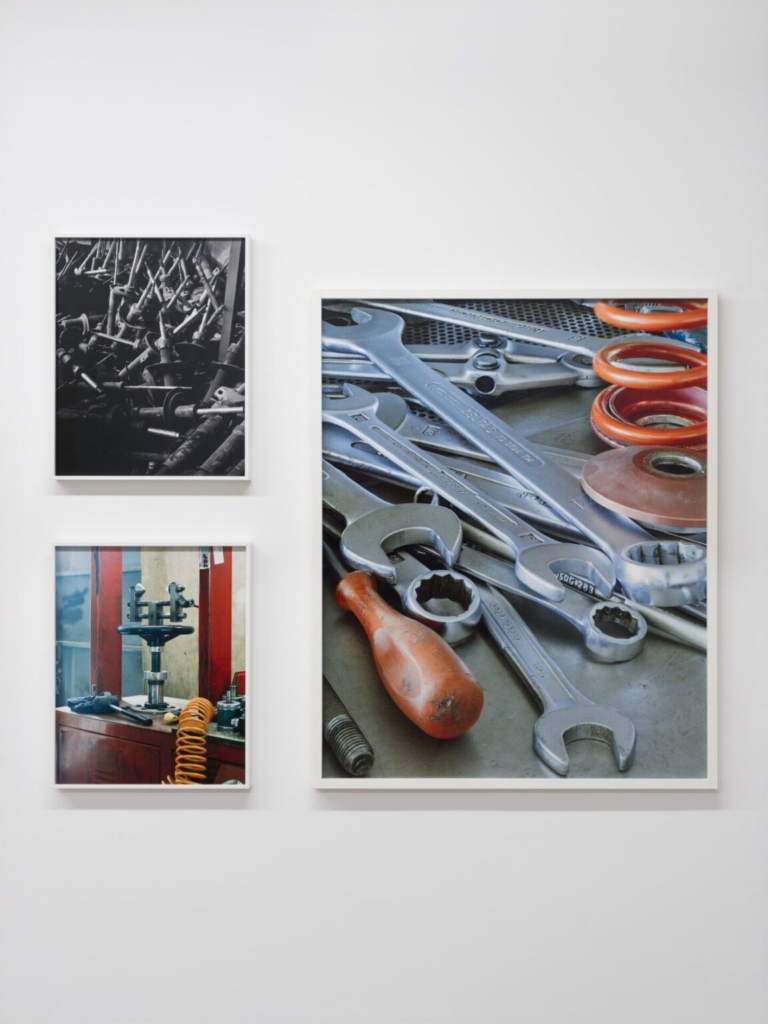
Ventourakis points to the works where he photographed the workshop’s wrenches and elaborates:
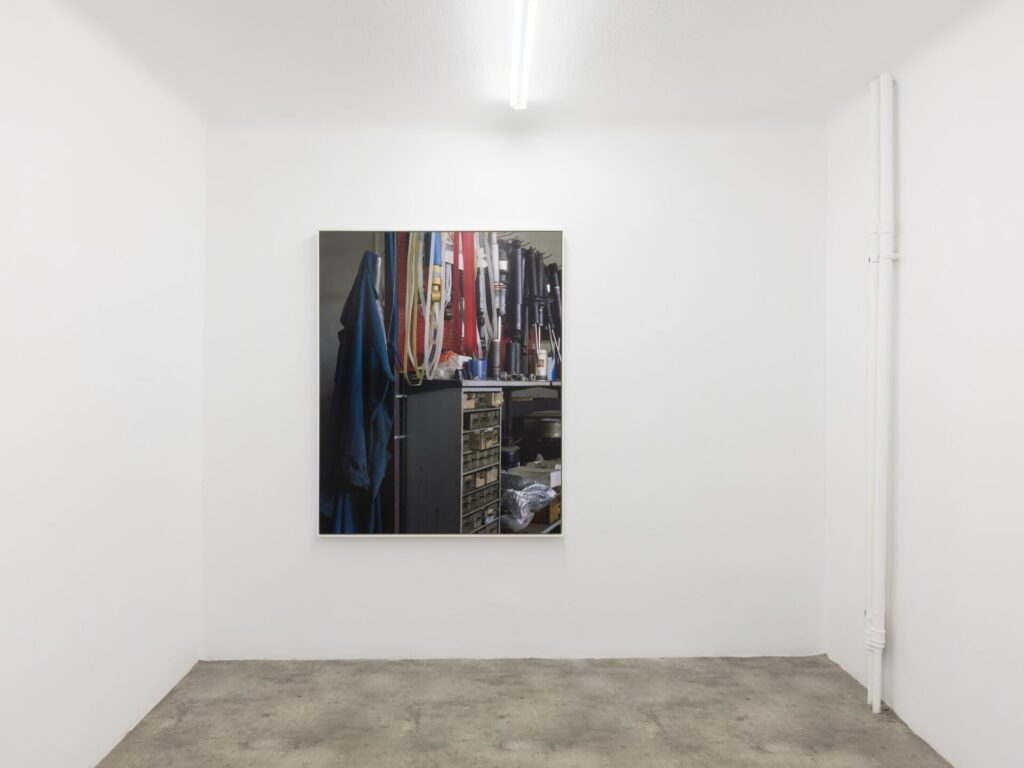
“I’m deeply interested in the materiality of tools the struggle between the new and the old. Here you can see all the years this tool has lived through; maybe it has repaired 200 cars. And what I really love, technologically speaking, is that this tool has reached its peak. Its form hasn’t changed for a hundred years. Everyone knows what a wrench looks like. And it’s unlikely that something drastically better will ever be invented.
“But at the same time, what fascinated me was that alongside repairs, the workshop also made suspensions, modifications. The business has two levels: the repair shop and the part-making, which is also disappearing. And then there is this whole idea that things aren’t black boxes; you can intervene, you can make something a little better. You can improve it but only if you know what you’re doing. That’s where you might break it during the process. Today, though, there’s a tendency toward the exact opposite: to want the result immediately. With ChatGPT and AI, for example, we go straight to the end point: ‘I want the result.’ But when you go directly to the result, you can’t refine it. You don’t know the process. What does it require? How can you tweak it? You’re left powerless. And to some extent I felt the same at the workshop watching them repair my car without really understanding what they were doing.”
“First of all, the medium itself guides me”
The creation of the works, both the conceptual path and the photographic process, began in June and lasted through August and September. Ventourakis visited Elias’s workshop daily, absorbing its rhythm. With his camera fixed to its tripod for this project, he chose to work in analogue photography, letting the medium itself direct him:
“The process is analogue, using large-format film essentially plates. These can’t be developed in Greece anymore, so I need to develop them myself. There are no local labs left that can handle this kind of film, and I can’t ship them easily to the labs I work with in the UK either.
“First of all, the medium guides me. You simply can’t work fast with large-format film. And you can’t be wasteful unless you have infinite resources. On another level, it was also because I needed to re-approach my relationship with the space. I was wandering around and spending long hours there. I would sit and listen to the workshop at work slowly tuning into the rhythm of its daily life, which was something I had never experienced before.
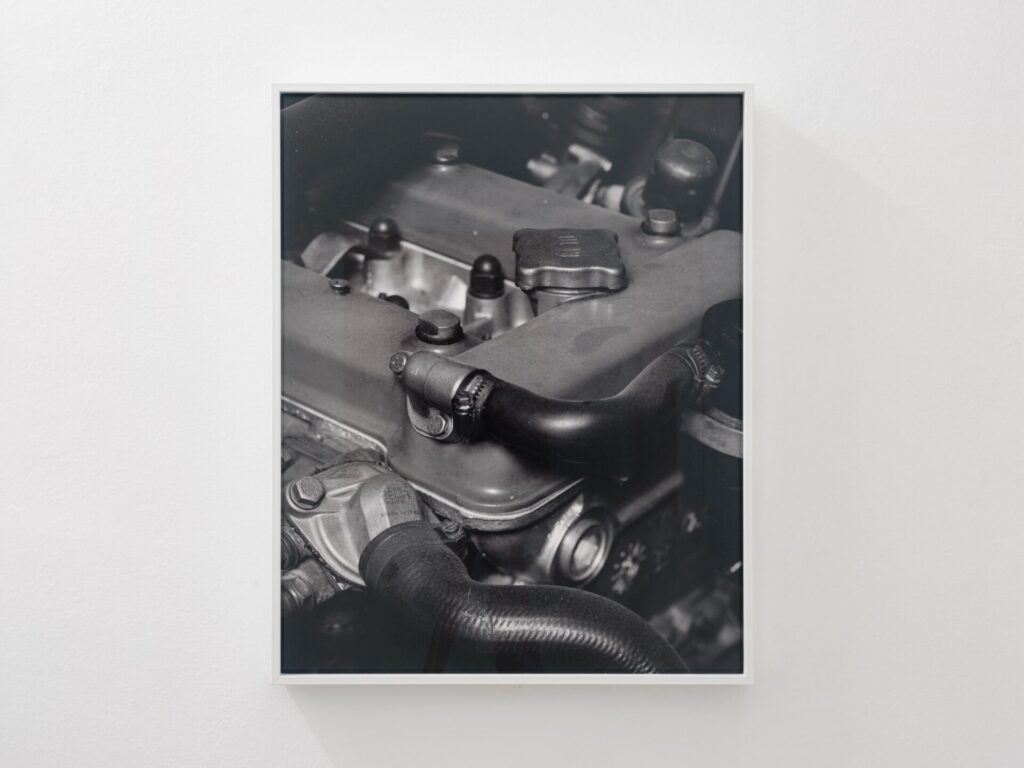
“I’m interested in texture -this is, after all, a visual art project. Choosing analogue photography was essential for documentation, for detail, for colour, all of which needed to be of a very specific type. Something I had not done for many years, and decided to return to, was hand-printing. Everything is printed in the darkroom, directly from the negative onto photographic paper using the classic analogue process. Up close, you can feel that texture of pure analogue.
“Some of my other works are also analogue, but they go through scanning and digital printing. These ones hold the softness the lens gives; they hold imperfection. When you print analogue, you’re working with the colours the film itself can produce its strengths, its limitations, and the possibility of mistakes. In one of these prints, for example, you can see a small dent caused during development. We left it intentionally, because it’s part of the process, even though we could easily have made a new print. For me it was important to preserve the trace of the physical procedure.
“Analogue photography carries a sense of hyperrealism and transformation that isn’t immediately visible because it corresponds so closely to the world we know. You get absolute perpendicularity in what you choose to photograph, without distortion. The perspective shifts—and that specific shift afforded by this medium is closer to the effect I’m after, as well as to the relationships between things.”

A “still life” of workshop tools and the pleasure of chance
Ventourakis explains the depth of colour he sought through analogue processes, how the works sit within the space of Callirrhoë, how colours interact, how images resonate with each other, and how a visitor may carry certain visual rhythms into the next room:
“I tried,” he continues, “to give the sense of the object itself to make someone feel as if they could almost touch it. But of course, the works also refer to the history of the medium and the history of art. Still life is a strong presence, so that it doesn’t look like a documentary about a workshop closing down. I’m not talking about the closure. I’m talking about space, time, and the materiality of a place. By giving certain cues—references someone versed in contemporary art might recognise as still life—the viewer slowly begins to see everything through that lens.
“There are also personal fixations. I like instability in some images, how the tools rest, just on the edge. It makes the composition feel as though an object could easily fall, yet at the same time it’s tightly held together, as if a painter had arranged the elements left and right, like in a Dutch Golden Age still life. This tension pleased me. It happened naturally as I visited daily and observed how the tools had been left that day.
“Some days I wouldn’t photograph them because they didn’t ‘sit’ right, and I didn’t want to arrange them myself. I wanted to catch that moment of chance how, at some point, the cable would fall in just the right place and that would be the time to take the photograph.”
Car repair shops, differently… with sensitivities
Certainly, after this exhibition and the guided tour, the space of the car repair shop will never look the same to me again. Through his examples, Nikolas Ventourakis draws correlations and connections I had never imagined.
With recent family health issues-his own included-bringing him into close contact with hospitals over the past three to four years, the images of those spaces registered powerfully in his mind. He now observes surprising parallels between two seemingly unrelated worlds: the car repair shop and the hospital. As he notes:
“I look around at the objects, the specialisations, and the way things are approached on the body in order to fix it. You insert a mesh, you place a pacemaker and somehow the workshop reminded me intensely of that. The fluids that gather, the oils drained away, the band-aid applied until you find the real issue, even the gowns people wear in both places.”
He also shares an intriguing observation about the vocabulary that circulates in a car workshop:
“There’s this duality: the space carries a strong masculinity there’s no denying it yet it also contains an incredible sensitivity. A sensitivity to how something should function, be fixed, not break down, how to ‘take care’ of it. You hear words you wouldn’t expect to hear in such an environment.”
More broadly, he tells me that, among the human qualities of this space, there is also a particular kind of pride: the insistence that the job must be done right, that the car should leave the shop in such a condition that it never needs to return for the same issue. “It’s a real wound,” he says, “if a car has to come back, because it means, ‘I didn’t manage to fix it.’”

Closing the loop: the video cassette
In the exhibition, a videocassette plays a recording shot inside Elias’s workshop using old technologies—Hi8, with none of the contemporary crispness of 4K or HD. As Ventourakis explains:
“Beyond being an artwork in itself, the video creates an additional frame that expands the horizon a bit—but it isn’t something the exhibition requires in order to work. It stands entirely on its own as an extra stimulus. Someone might sit and watch only the video for twenty-five minutes; it doesn’t depend on the other works, nor do they depend on it.”
In the footage, alongside scenes from the workshop, Elias appears and speaks (the audio rises and falls at moments). When the video ends, we hear him say:
“The part has been tested, the customer is satisfied, that’s it.”
Info
Refinements – Nikolas Ventourakis
21 November – 23 December 2025
Opening Hours: Tuesday, Wednesday, Friday: 11:00–19:00 | Thursday: 11:00–20:00 | Saturday: 12:00–16:00
Venue: Callirrhoë, 9 Sina Street, Athens