 PEPI NIKOLOPOULOU
Ceramic artist Aundrea Bell has been steadily shaping a distinct presence in Athens, where her work draws on ancient Greek forms while speaking in a contemporary sculptural language. Earlier this year, she was selected to present two new Owl vessels from her ongoing series Timeless Creatures at the international exhibition 1000 Vases, held in parallel with Paris Design Week. The pieces brought together her interest in mythological archetypes and the tactile possibilities of clay, and they were acquired by a collector during the opening.
Timeless Creatures has since expanded into a full sculptural presentation now on view at Eltop Material & Design Center in Kolonaki. The series sits within a broader practice that moves between ceramics, sculpture, and installation, often exploring the threshold between the functional and the symbolic.
In our conversation, Bell reflects on the origins of her work, the influence of Athens on her artistic path, and the quiet, attentive state of mind that clay continues to teach her.
You’re originally from Canada but now live and work in Athens. What first drew you to Greece, and how has living here reshaped your artistic perspective?
I was completely under Greece’s spell long before ever arriving here. Initially, I was drawn to what everyone finds captivating: the sense of living history, the seemingly-tangible mythology, and the raw, natural beauty of the landscape. Coming from Canada, it felt wonderfully exotic to be in a place where all of these elements coexist with daily life.
After ten years of family visits and summer holidays (my husband is Greek), the unpredictable happened. We found ourselves here with our two small children during the early days of the pandemic, and what began as a two-week vacation became a permanent relocation. We had arrived with only sandals and swimsuits, and as the weeks went by, the idea of returning to Canada felt like trying to step back into a life that no longer fit us.
Over time, I’ve absorbed Greece’s cadence and customs, its way of marking time through the natural world: by the produce at the laiki (neighbourhood market), the wildflowers in bloom, and the changing temperature of the sea. That rhythm has seeped into my work, making me more attuned to cycles, repetition, and the quiet gestures that shape a creative life here.


Greece has a deeply tactile relationship with its landscape and materials – marble, clay, stone. How has this environment influenced your sense of form and materiality?
Working with clay here feels almost sacrosanct, as if I’m drawing from the same earth that shaped the architecture, the vessels, even the myths themselves.
Living here has also heightened my sensitivity to texture and surface: marble worn smooth by passing feet, mineral traces gathering on raw terracotta, algae clinging to fishing nets. Those patterns of erosion and renewal often find their way into my work, giving the clay a sense of life and continuity.
Does the cultural dialogue between your Canadian roots and your Athenian present manifest consciously in your work, or does it happen intuitively?
Being Canadian can mean so many things, its diversity is one of its most defining features. For that reason, it’s hard to separate what comes from national identity and what comes from personal history. Being Canadian has given me a certain freedom: the ability to explore influences that might feel overly familiar to a Greek artist, and to translate them through my own lived experience.
In Greece, I’ve become more deeply connected to myth, material, and place, things that once felt abstract to me. I’m drawn to transformation and liminal spaces, and I think both my Canadian roots and Athenian present shape that pursuit. The dialogue between these two worlds feels mostly intuitive: a merging of the imaginative openness I associate with Canada and the layered symbolism that feels inescapable here.
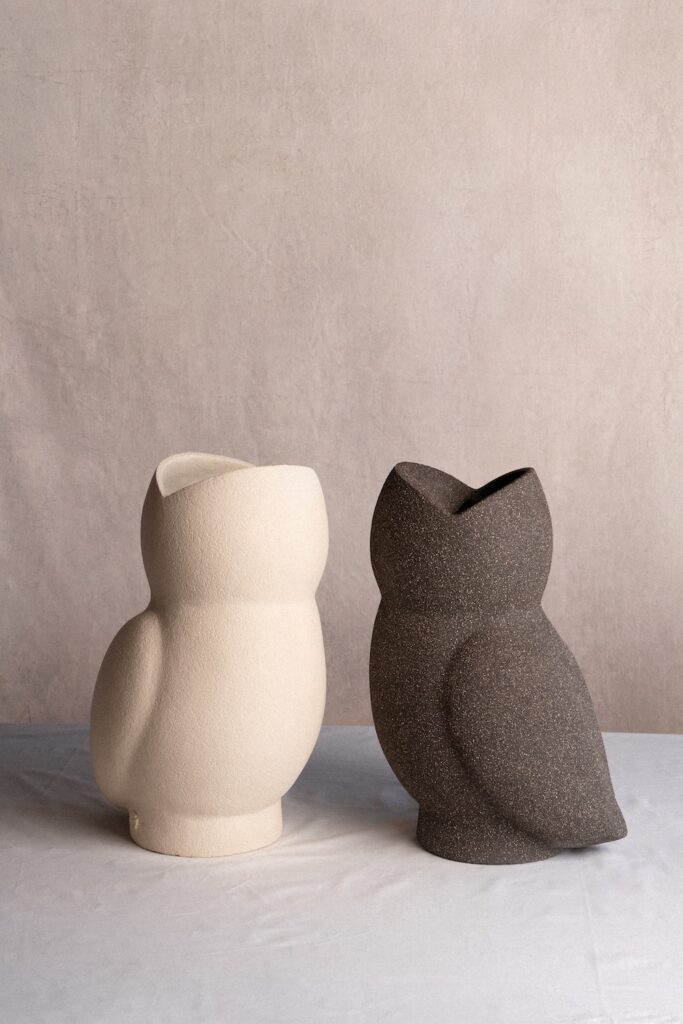
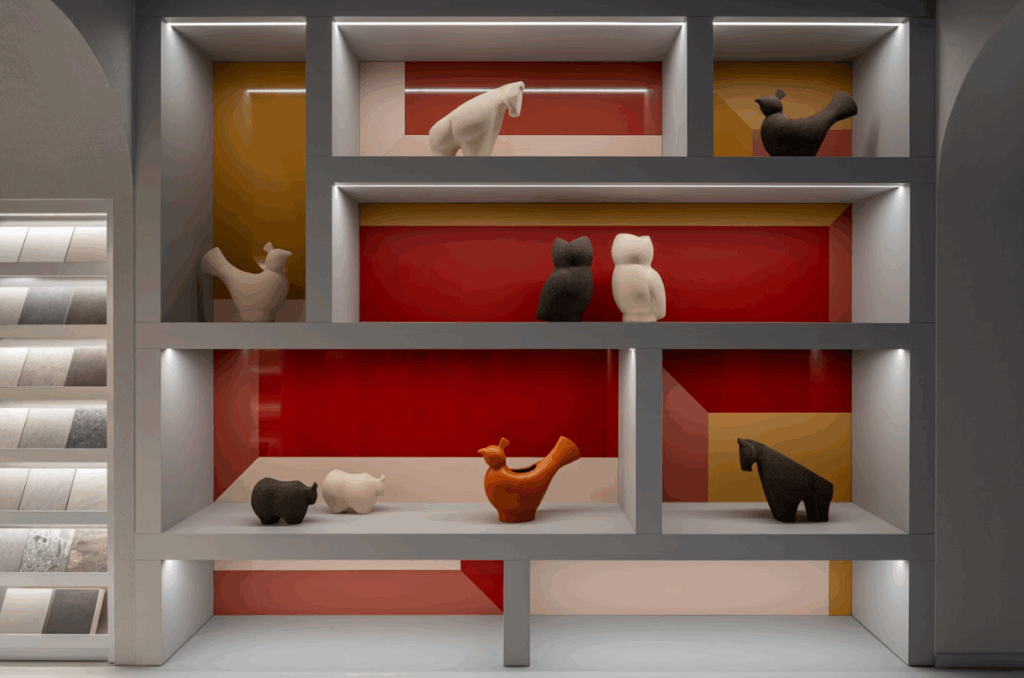
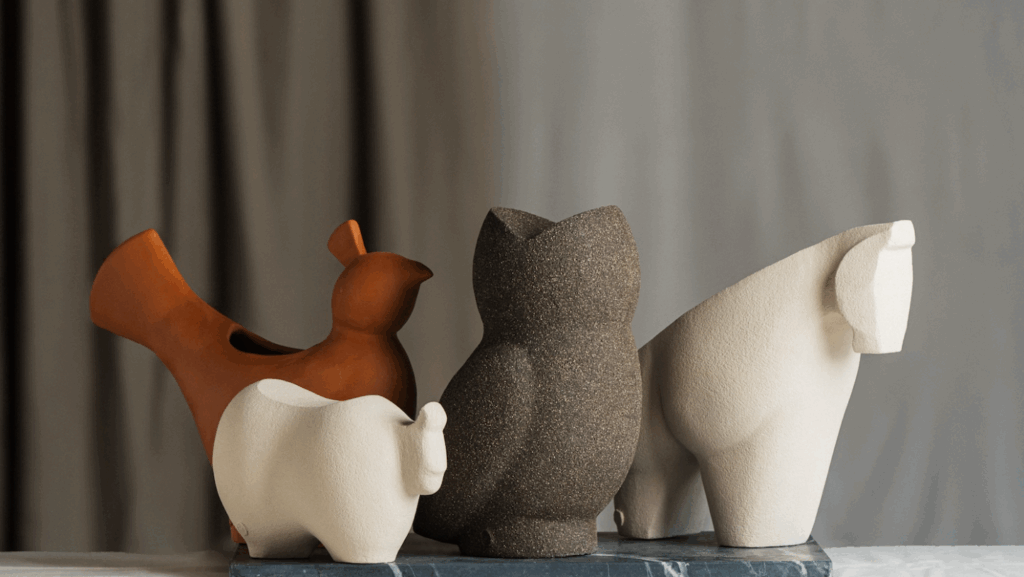
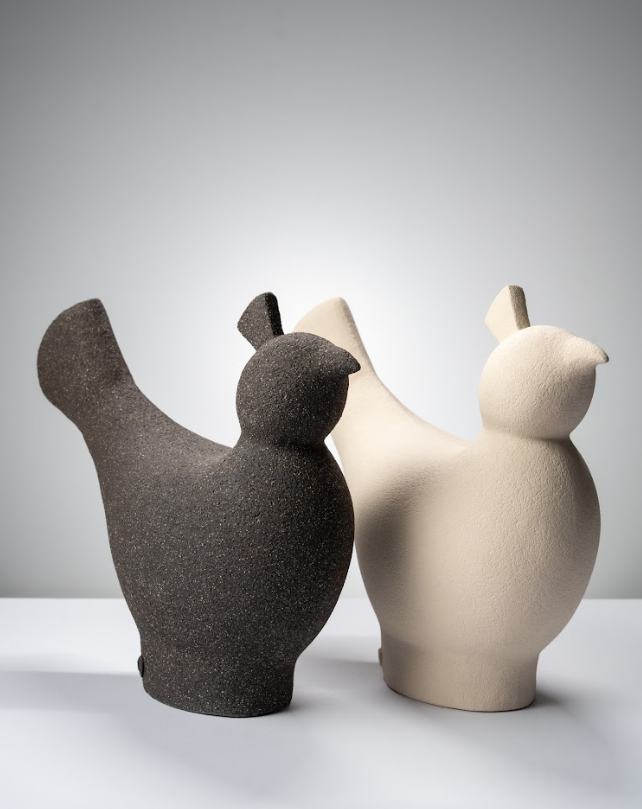
Your series Timeless Creatures merges animal symbolism with sculptural forms. What was the starting point for this dialogue between sculpture and mythology?
Timeless Creatures was developed with Ciarmoli Queda Studio for Camere Con Vista at The Architect Show in Athens (2024). Centered on form and materiality, the series grew from a shared interest in symbolism reimagining the votive function of ancient figures in a contemporary context.
My process always begins with drawing; through pencil and paper, I explore lines and volume until a form emerges, a kind of north star. For this series, I wanted to capture the spirit of the animals without citing specific myths, leaving space for viewers to shape their own living folklore.
Many of your works reference ancient archetypes, yet they feel distinctly modern. How do you navigate this balance between the archaic and the contemporary?
Balancing the archaic and the contemporary feels essential to my practice. I’m drawn to ancient forms and symbols, but I try to engage with them without direct replication. My work feels most alive in that space between reverence and reinterpretation. I’m especially interested in female-centered archetypes; because they’re inherited and universally understood, already existing across time. They’re timeless frameworks that invite transformation and allow me to explore enduring ideas through material and form.
You often speak of raw materiality. Could you expand on what that means in your practice – is it philosophical, aesthetic, or both?
I find it elegant to distill an idea down to its simplest, purest form. In my work, that’s expressed through both material and shape. Simplicity can be demanding there’s nowhere to hide, but deeply satisfying when it feels resolved. I think of raw materiality as a philosophical approach with an aesthetic outcome. Clay has an inherent connection to the earth, and the same is true of glazes. It’s a medium that’s as much chemistry as it is creativity, and what is chemistry, after all, if not raw material?
Life in Greece
Was there a defining moment when Greece truly started to feel like home for you?
There are so many possible answers to that question. Receiving my permanent residency card. Scheduling a dentist appointment entirely in Greek. Changing the “home” pin in Google Maps to my Athenian address.
But more than any of those things, it’s my children. Any parent knows how time becomes measured through your kids’ milestones. My son and daughter have now lived more of their lives in Greece than in Canada, and for them, this is simply their home. I think that’s when it truly became home for me too.

Is there a Greek tradition, habit, or small daily ritual that you’ve embraced as your own?
I’ve definitely loosened my grip on planning and pace. Here, a coffee with friends can turn into picking figs from an abandoned tree, then a beach day that ends with a meal somewhere between lunch and dinner. I love that spontaneity, the feeling that anything could happen. It’s taught me the value of letting things unfold more naturally, both in life and in the studio.
Is there a particular place in Greece that holds special meaning for you – perhaps where you find inspiration or calm?
Yes, definitely. Porto Rafti, a small seaside town just outside Athens. We spent the early months of the pandemic there, and it became a refuge from the uncertainty of that time. Our backyard was the Aegean, framed by pine-covered mountains and the ancient temple of Artemis nearby in Vravrona. We learned the names of wildflowers, tasted strawberry-tree fruit, and befriended George, the farmer who let us roam his fields dotted with ochre and poppies. When I could, I painted: a branch from a pistachio tree, a few oleander blooms, chestnuts, a half-ripe pomegranate. It was a quiet, grounding chapter for us as a family, and it remains a place I return to whenever I need calm or perspective.
Finally, what advice would you give to someone considering moving to Greece – especially an artist looking to make it their creative base?
The real secret to unlocking Greece is realizing it offers so much more than endless summer and sea. You don’t need to travel far to find a town or village with its own distinct identity: shaped by geography, topography, traditional craft, and the echoes of neighbouring cultures. It’s an incredibly rich environment, full of texture and contrast.
There’s a beautiful tension here: between east and west, mountain and sea, wilderness and culture, future and past. For me, that complexity has been endlessly generative, it’s at the heart of what inspires me.