 elc team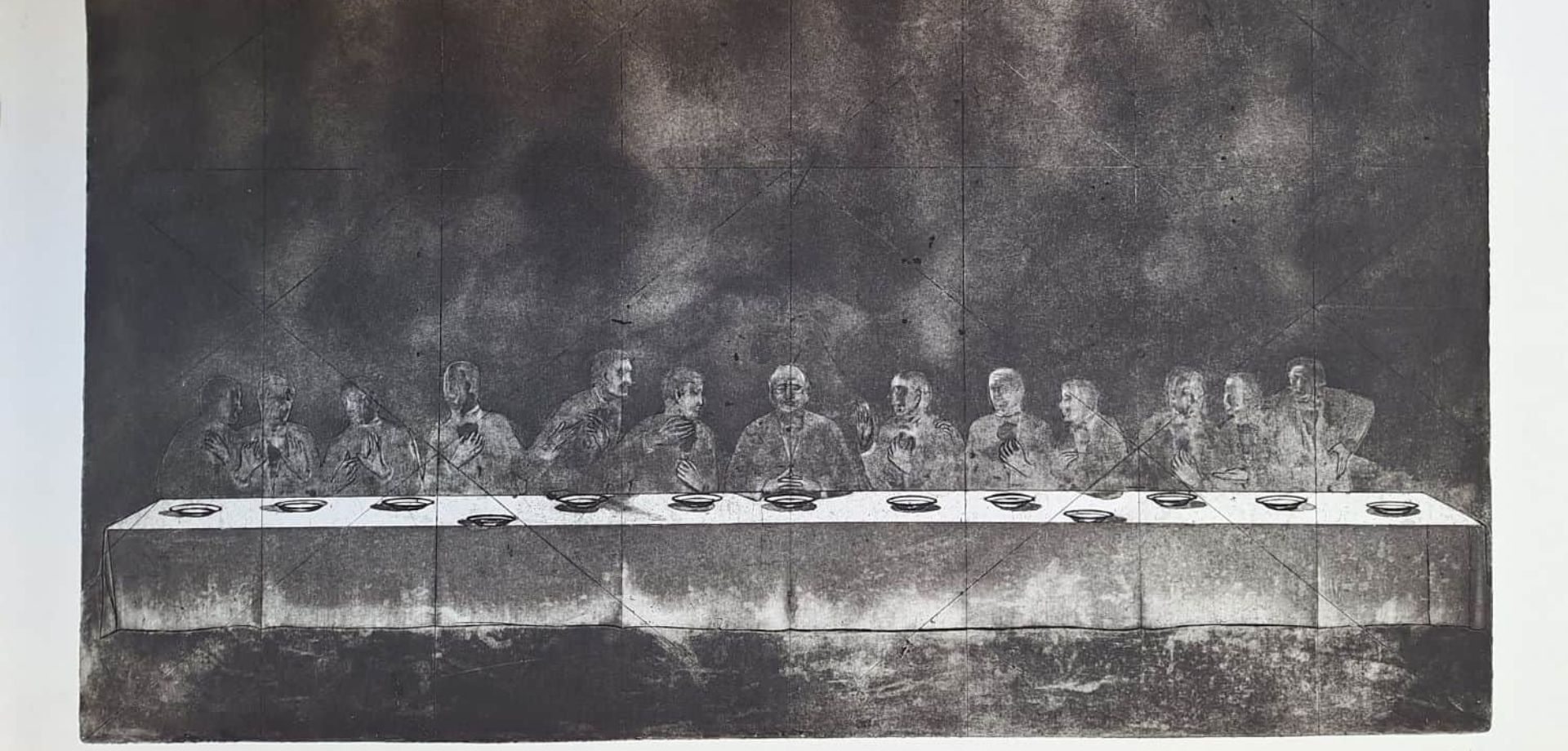
Anatomia Humana challenges the viewer to reconsider the body not just as a biological entity, but as a site of narrative transcendence
Black Bird Rook art advisory presents Anatomia Humana, an exhibition that examines the body’s contradictions, its force and its fragility, inviting us to consider what it means to be human.
Anatomia Humana is an exhibition that examines the body’s contradictions – its force and its fragility, inviting us to consider what it means to be human. Through diverse media – painting, drawing, collage, sculpture, photography – 23 contemporary artists contemplate flesh, bones and psyche, revealing the strange and often uncomfortable truths of life. Here, the human form is structure and myth, a complex organism. Inspired by ancient thinkers like Empedocles, who saw the body as a blend of elemental forces,
and Democritus, who viewed it as a dynamic assembly of atoms, Anatomia Humana frames the body as both timeless and ephemeral.
The smallest anatomical fragment – a hand, an eye, a rib – ignites exploration. The body unfolds as a surreal landscape, while the landscape itself becomes bodily: an extension of human perception; a proof of touch; an imprint. Each artist offers a unique perspective on this terrain, presenting the body not as a fixed entity or mere biological specimen, but as possibility and transformation.
Empedocles proposed the universe to be governed by two fundamental forces; Love and Strife. These forces are in constant interplay, and shape everything, including the human condition. Love binds us together while Strife, pulls us apart. The human body reflects this duality – our organs and cells work in harmony yet are subject to forces of disease or decay. And while we seek love and trust, we face conflict, separation and loss. The human condition is a delicate balance of opposites.
Anatomia Humana challenges the viewer to reconsider the body not just as a biological entity, but as a site of narrative transcendence.
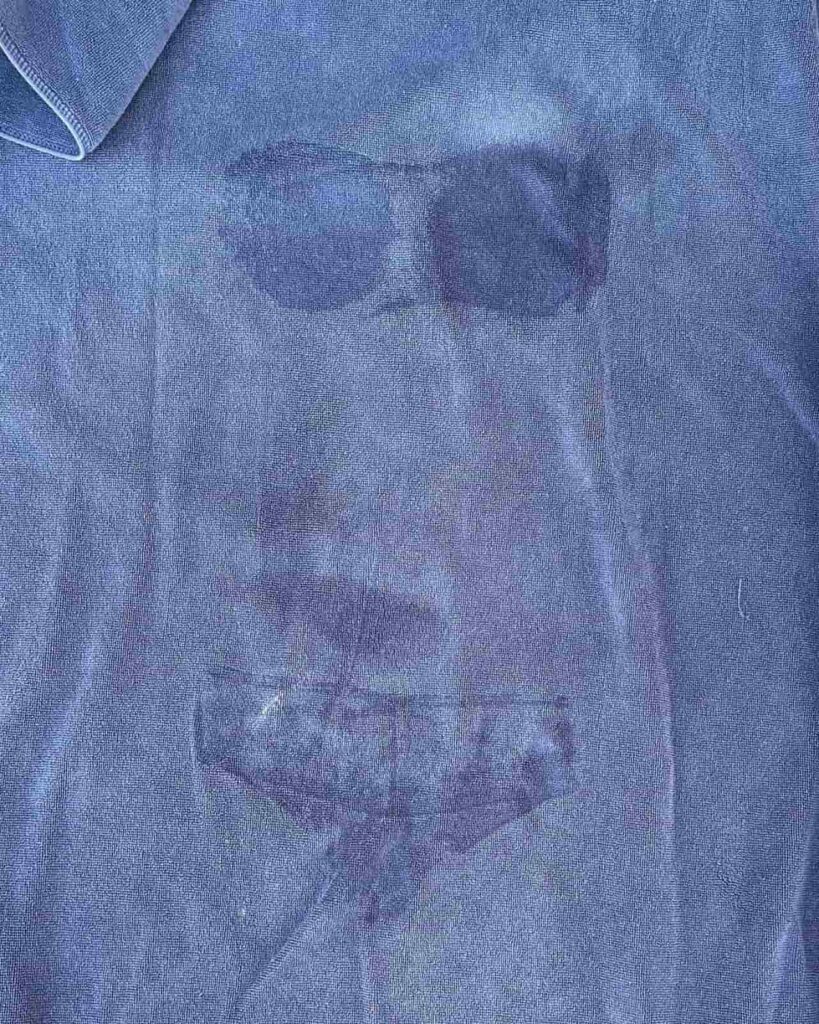
Kasia Kay
Beach Days, 2023
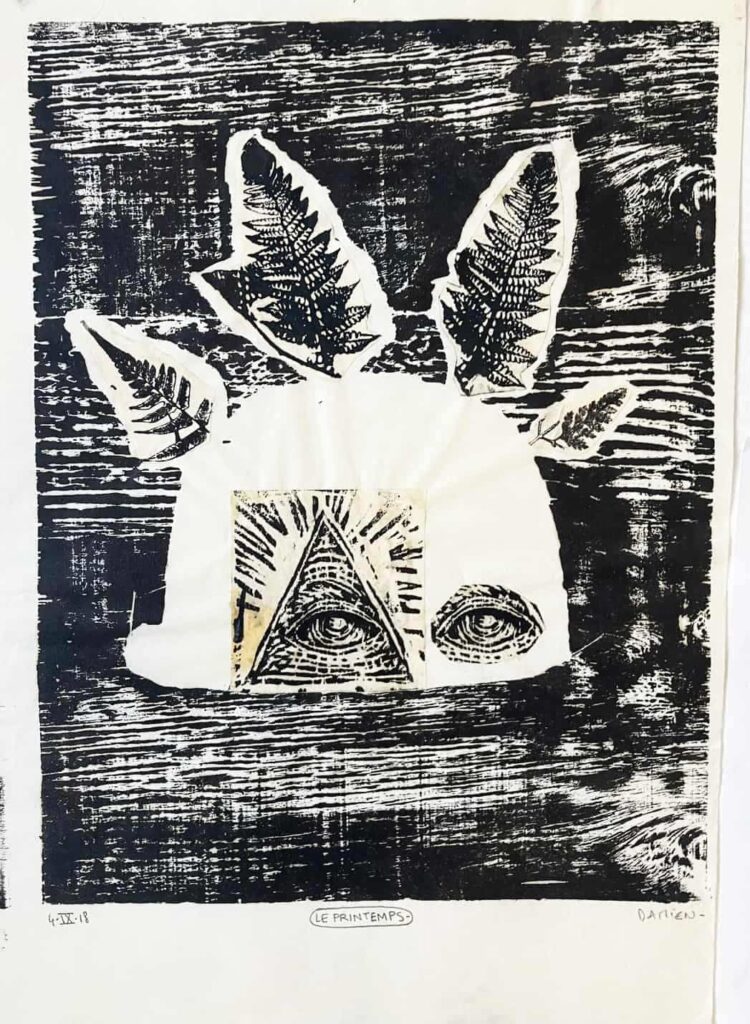
Damien Deroubaix
In Cerith Wyn Evans’ collage on paper, the viewer is gazed upon by an unidentified woman, peering –
perhaps through a peephole. Is she an intruder, a potential threat? What secrets is she uncovering, and whose privacy is at stake? Spectator and spectacle blur, evoking a history of shifting roles and the dynamics of observation, as old as humanity itself.
Photographer Eftihia Stefanidi reimagines the landscape as both body and potential, reflecting humanity’s fractured relationship with nature. In her work, a bridge extends toward a haunting void, its failed connection symbolizing our inability to reconcile with each other and the world around us.
Didier Marcel presents a sculpture of one lemon balanced atop another, transforming a simple arrangement into a subtle reflection on civilization. Marcel bridges the ordinary and the ancient, imbuing these electric green lemons with a vivid, ceremonial presence. The precise balance serves as a contemplation of our connection to the natural world and the delicate equilibrium that sustains it.
In the work of Eleanna Horiti, landscape is a fluid, uncharted territory that invites for intimate mapping.
Imaginary roots and pathways unfold organically, offering interchangable scales and mediums through
which to navigate nature.
Damien Deroubaix portrays a woman surrendering herself atop a horse, her body in complete abandon to the creature’s strength. Beside the horse, a smaller, enigmatic male figure—perhaps a voodoo doll—gazes directly at the viewer. The artist captures a moment of primal connection between man, woman and nature. Through a striking combination of drawing and collage, he weaves a narrative that is as ambiguous as it is intense, inviting the viewer to navigate its mystery.
Emerging sculptor Marilena Kranioti reflects on the body as a conduit that trascends time and space.
The Athens based artist addresses universal themes through powerful symbols and ritualistic remnants.
Her works carry a mythological aura, rooted in ancient storytelling and imagery.
In John Stezaker’s work, a suited figure sits alone, his head severed with scissors, cropped from the frame.
Present yet absent, he becomes a cipher—a mystery man suspended in isolation. A homage to the ordinary, the anonymous, and a clin d’oeil to humanity’s desire to be seen, photographed, celebrated. Above all, the artist’s playful game of hide-and-seek runs through his work, balancing what’s shown with what’s hidden. In a striking act of juxtaposition, a poem covers the factual confines of a newspaper.
Paris Koutsikos’ delicate verses offer a personal response to the realities of the world. The artist writes in bold Greek letters, words that speak of moist hair, the moon, a skeletal tree, and a burning cloud. The poem contrasts sharply with the surrounding reportage, and suggests that eros serves as a counterpoint to conflict.
In her photographic work, Chicago based Kasia Kay reclaims historical iconography, notably the Shroud of Turin, layering it with feminist symbolism. By simply lying on a beach towel in a damp bikini, she disrupts and reframes centuries of traditional narratives. Her act of simple defiance questions the role of women in historical and religious contexts, offering a long awaited, alternative perspective.
Augusta Atla’s delicate ink drawing of the female form becomes an act of liberation. The work celebrates
sensuality and self-possession, reclaiming it not only as a vessel of strength but also as a conscious agent of its own desires. Through the female gaze, with the promise of pleasure, the Danish artist positions the body as both creator and creation. In her hands, it is not a passive subject but a site of deliberate choice.
Hanna Krzysofiak’s Flower Stand is a poignant interpretation of despair. In the painting, objects fracture,
melt, and seem to come alive, as if sorrow itself has invaded them. Through this dissolution of form, the
Warsaw based painter captures the distortion of reality that accompanies emotional grief. This work is a
meditation on solitude and the struggles that define the human experience.
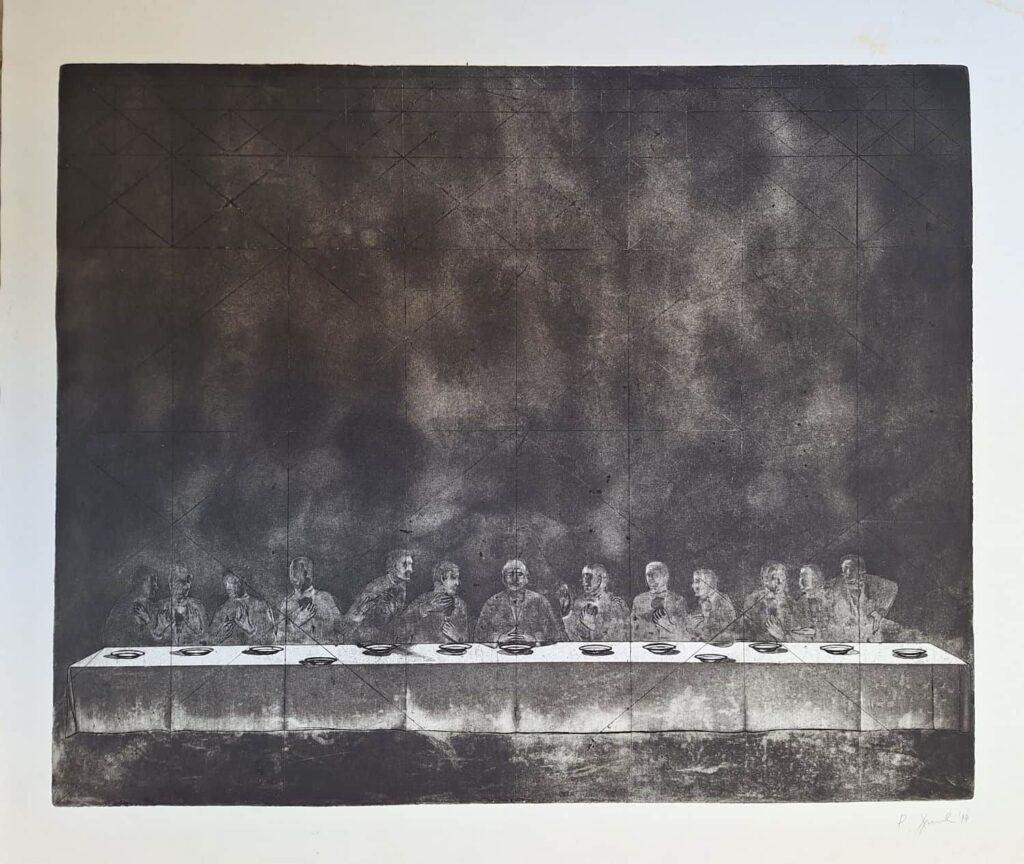
In his etching Stage for Supper, Dimitris Christidis reimagines the disciples as ordinary men. The scene grows darker, shadows deepen and Christ is reduced to a shadowy figure—more man than deity—raising the question: is the mystic slipping from human grasp? Yet, above them, the artist carves out a vast, smoky expanse, heavy and high, that evokes divine presence. This composition becomes a meditation on the solitude of humankind in the search for meaning and the sacred.
The Principal is an alternative tale of Eve, imagining her and Adam separated immediately after the Fall,
each wandering alone. Filmed by a drone, Geneva-based artist Sofia Kouloukouri captures Eve’s naked form in solitude, reframing the biblical narrative and challenging traditional roles and religious paradigms.
Marianna Hatzinikolaou captures the often-overlooked poetry of human touch with subtle elegance. In a
drawing of two hands entwined, contrasting skin tones blend harmoniously. In another work, she evokes a
woman’s solitary bond with nature, held under the moon. The scene is bathed in ethereal light. Through her images, the artist ‘forces’ us to think about our own connection to the world.
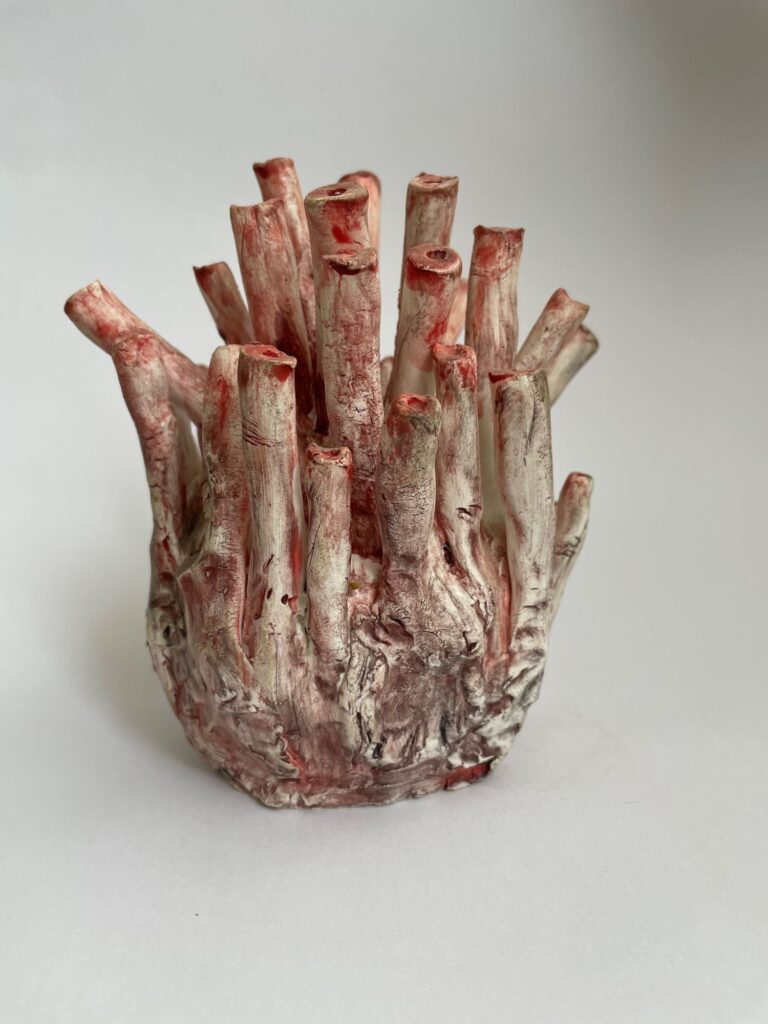
Zoe Xenaki | Growth, 2022
Roma based Raffaele Lo Monaco presents two black-and-white drawings inspired by scenes from Béla
Tarr and Jean Cocteau films. These small scale works explore recurring human behaviors and the hazy
veil of dreams. Through the reappropriation of fundamental cultural references, Lo Monaco engages with
the artist’s need to carve out a place within art history, selecting and fragmenting its vast narrative like an
anatomist dissecting time itself.
Andreas Vais presents a spectral ballet suspended between life and death. His delicate drawings of dancing skeletons merge the poetic with the paranormal. A 3d veil of bones in motion unfurls before the viewer. They move into the light – fluid, transparent. Can the dead dance?
Peggy Kouroumalos turns iconic films Frankenstein and The Outsider into custom made oil painting book
covers. Her imaginary sleeves craft the narrative as she envisions it, revealing the story on her own terms. In another work, the Montreal based artist paints posters and photographs of The Cure, pinned to the walls of a young fan’s room—fragments of a life’s anatomy, where adolescence itself feels like a visceral cut.
The works of Zoe Xenaki trace the contours of imaginary anatomies. Her clay sculptures oscillate between the earthly and the corporeal and resist literal interpretation. Mysterious and suggestive, they invite tactile
exploration. Their forms unite object and experience, and appear as if they were made to be caressed,
echoing the intimacy of the human body.
In his drawings, Paris based Vassili Salpistis interacts with an iconic Man Ray photograph, dissecting art
history with bold, anatomical precision. This act of appropriation demonstrates artists’ enduring fascination with art history and their desire to inscribe themselves within its narrative. In another drawing, Salpistis depicts an ordinary lighter, held between a man’s fingers—a modern echo of fire as a primal tool and symbol of human dominion.
Ioanna Papageorgiou exhibits a pencil-on-canvas tondo that shifts between fragility and density, evoking the quietness of a distant planet. This celebration of subtle traces, invites the viewer into an intimate dance of perspective. It reflects the microcosmos and macrocosmos of nature and the human body and ignites a conversation between the intimate and the universal.
Doreida Xhogu, an artist of Albanian origin, draws her late father’s reclining figure. In this deeply emotional, allegorical work, the remains of the father give rise to a flower -a symbol of the circle of life, where death and renewal intertwine.
Sébastien Marteau depicts tribes of bearded men, their silent gazes meeting without conflict or tension. These contemplative male figures seem to have discovered a way to co-exist beyond the noise of history. In addition, the french born artist draws stark black and white knives on handmade paper. They are raw, elegant and haunting, and they suggest the duality of human nature; capable of both exquisite creation and devastating harm.
Irini Karayannopoulou presents drawings of fingers that twist and interlace in rebellious ways. In this
choreography of broken codes, fingers transform -becoming legs, arms, and other body parts. Freed from
their utilitarian purpose and their predestined function, they take on psychedelic roles and re-imagine the
body’s limitless potential.
Anatomia Humana positions the body as both locus and metaphor, a site of connection and fracture—within ourselves, among others, and with the cosmos. This exhibition examines the allure and the imperfections of the human condition and emphasizes the fragility of connection. Often, our presence looms too large, our imprint too forceful. How about learning to tread more lightly? Empedocles saw the body as a place where love holds things together, and strife tears them apart. Democritus thought we’re made of tiny pieces, the same ones that build the world. Between the two, they remind us we are fragile, held together by forces we barely understand, part of something bigger than ourselves. As Democritus observed, “The world is a stage, life is our entrance and exit” a reminder to move with care and to honor the balance we so often disrupt.
Info
Anatomia Humana
An exhibition curated by Irini Karayannopoulou
The London based gallery invited artist Irini Karayannopoulou to curate an exhibition on its online viewing room at artsy.
To view the show and access the works please follow this link