 elc team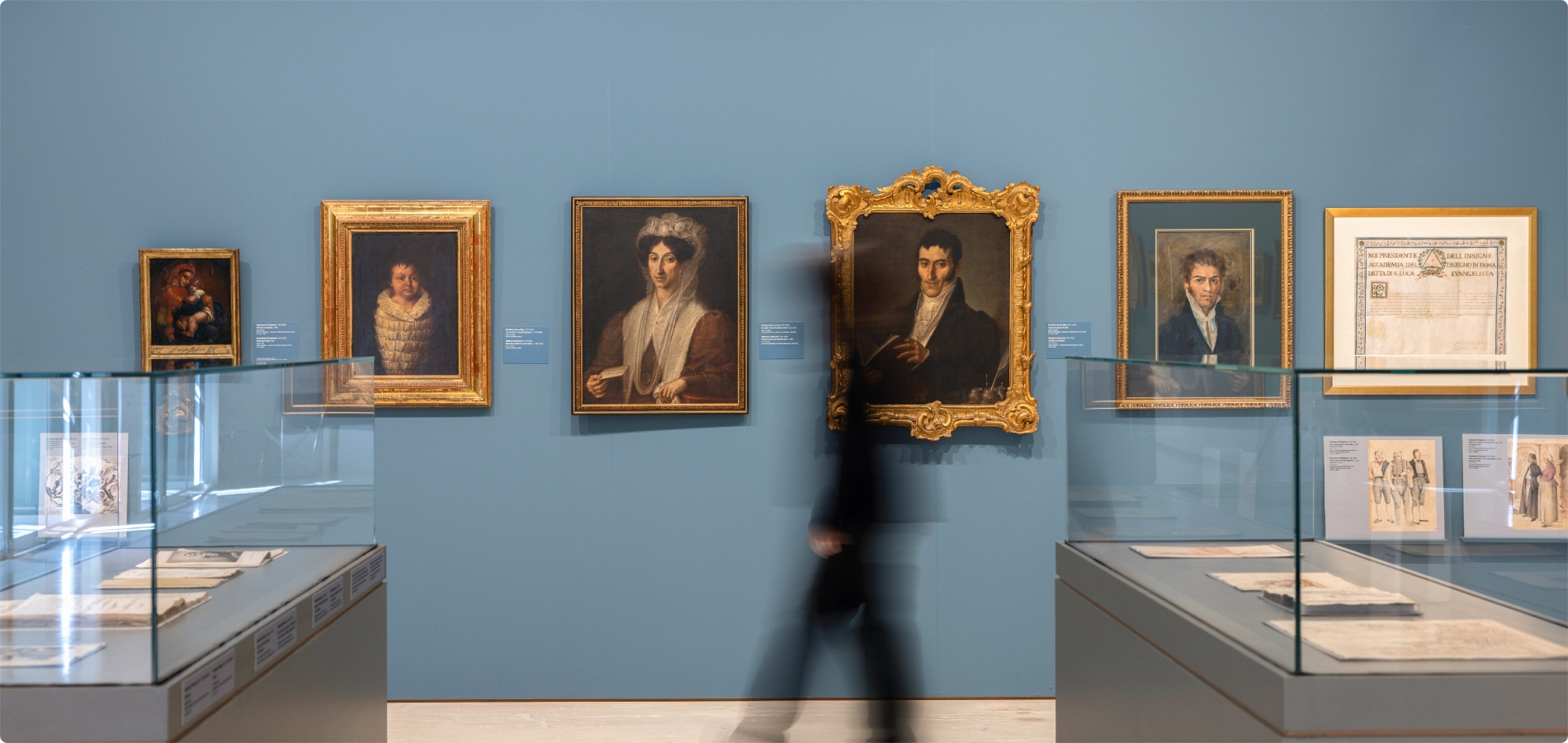
By Katerina Parri
We traveled to Corfu for the rare exhibition “Painting in the Ionian Islands: 18th–19th Century,” bringing together a large number of works from the Heptanese artistic tradition
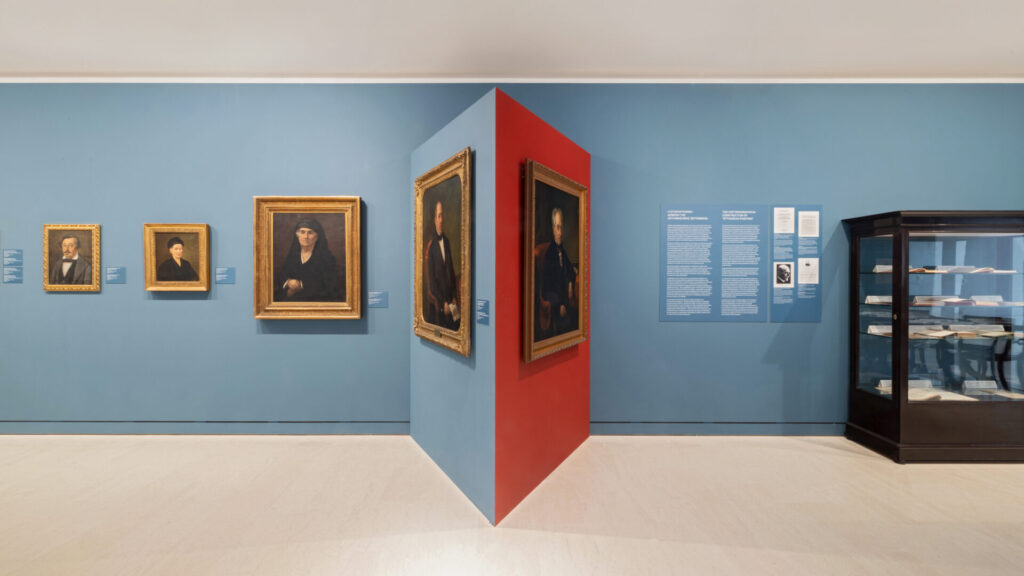
I look at the poster of the exhibition “Painting in the Ionian Islands: 18th–19th Century,” which features the image of Isabella Theotoky-Albritzi. Her portrait –painted by Petros Pavlidis-Minotos –leads me to the Annex of the National Gallery in the “enchantress,” as Palamas once called it, Corfu, specifically in the area of Kato Korakiana. There, I will encounter “in person” the famed Italian salonnière at the Castellino Building, which houses the newly renovated Annex of the National Gallery.
The exhibition was organized on the occasion of the 200th anniversary of the founding of the Ionian Academy, in collaboration with the Ionian University and the National Gallery – Alexandros Soutzos Museum.
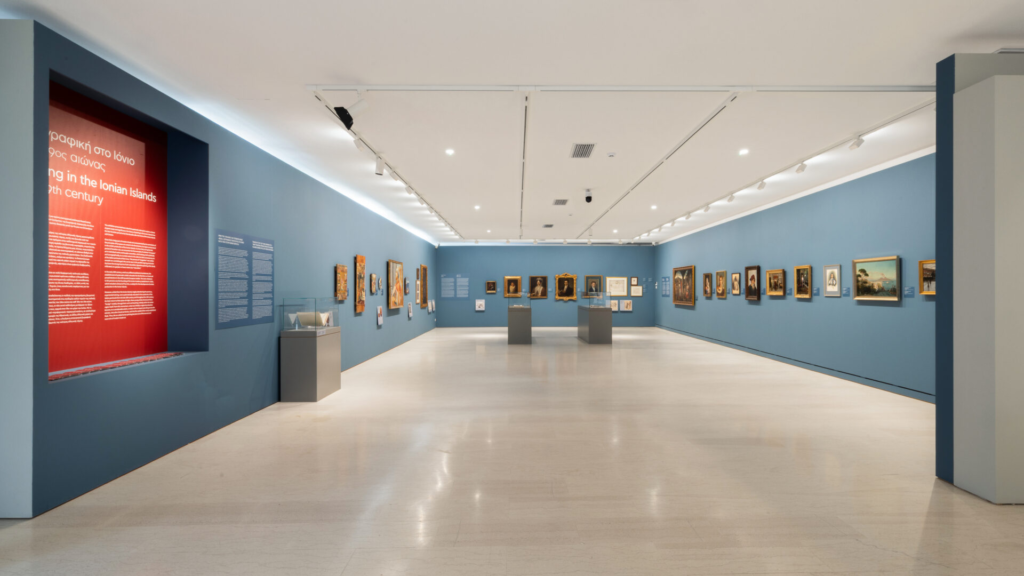
Its significance also served as the ideal occasion, or starting point, for upgrading the facilities of the Corfu Annex, in order to enhance the visitor experience and present – according to contemporary museological and exhibition standards – more than 70 paintings by 30 artists (tempera works, oil paintings, drawings, engravings), as well as archival material (handwritten treatises, printed editions, and documents) related to painting in the Ionian Islands.
Tracing the footsteps of history, I set out to discover who Isabella Theotoky-Albritzi truly was… I read that she was born in the summer of 1760 to a Corfiot father and a Venetian mother, Countess Nicoletta de Vejia. Her father took particular care in her education, selecting distinguished tutors. At the age of 16, she married Carlo Antonio Marin, and after the birth of their son, they moved to Venice. Isabella Theotoky-Albritzi never returned to Corfu, yet her mind surely remained there, as she supported –through her intellectual means –the struggles for the freedom of the Ionian Islands and often spoke about Greece.
After her separation, her second husband supported her personality and character as a charismatic hostess and writer, with her home becoming a gathering place for intellectuals. It is worth noting that personalities from across Europe held discussions in her literary salon, including Goethe, Lord Byron, Chateaubriand, Sir Walter Scott, Ioannis Kapodistrias, Andreas Moustoxydis, among others. It is even said that in her salon one could hear conversations in as many as 20 languages and local dialects simultaneously.

This, then, is precisely the first striking element I identify in the exhibition “Painting in the Ionian Islands: 18th–19th Century”: it inspires you to delve deeper into history, beginning with the personalities encountered in its portraits. The artworks, the archival material, and their historical context –together with the accompanying information –provide the impetus to further explore the so-called Heptanese School. Although widely known, I believe it has not been illuminated as much as it deserves in terms of its significance, its influence, and its place within modern Greek art.
The exhibition chronologically traces painting in the Ionian region from the late Venetian period to the first decades following the Union in 1864. As Marina Papasotiriou, Curator of the National Gallery Annex in Corfu, notes:
“It is rare to see so many works of Heptanese art gathered in one museum, one gallery. We are very happy that the ‘reopening’ of the Annex in Corfu has taken place with an exhibition dedicated to the Ionian Islands, as we are in the Ionian Islands, and it is no coincidence that the National Gallery chose to establish its Annex here. Corfu has always stood at the crossroads of innovation and new trends between East and West.”
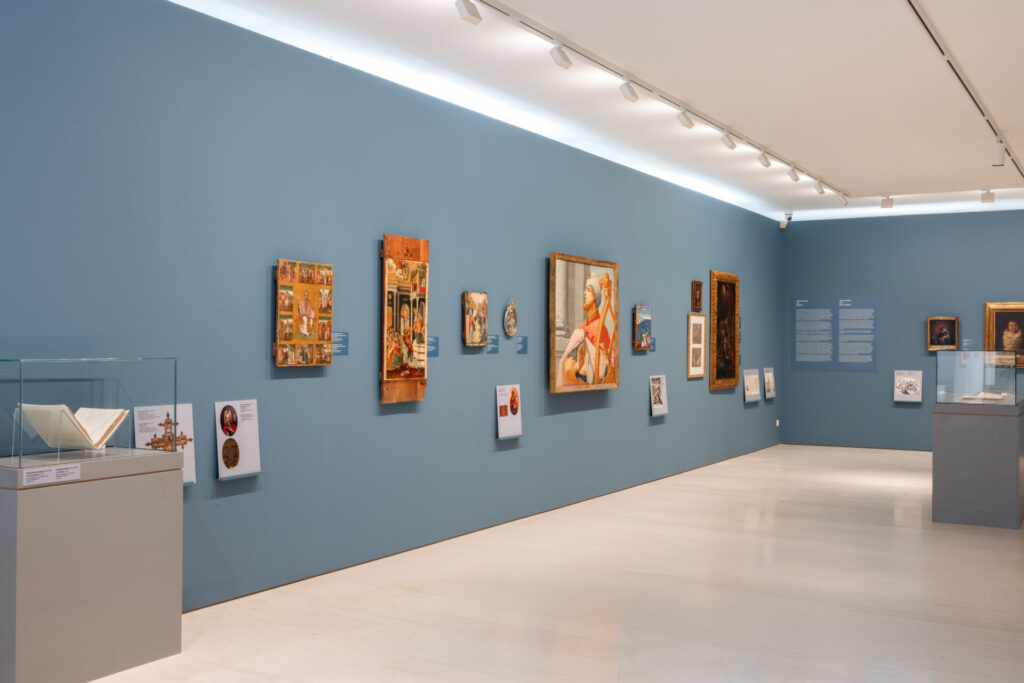
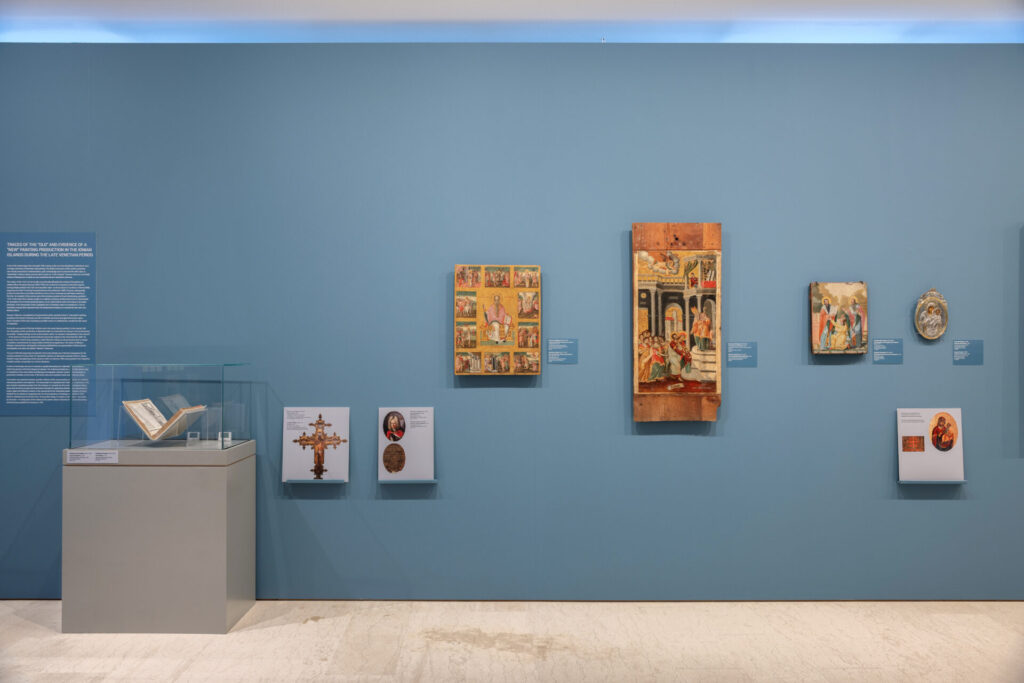
The exhibition opens with something you would not necessarily expect from a painting exhibition: the manuscript of Panagiotis Doxaras, featuring his translation of texts by Leonardo da Vinci–a rare artifact from the National Library of Greece, which has left Athens for the first time to travel this far.
The exhibition’s scientific curator, Panagiotis Ioannou of the University of Crete, elaborates on the archival material presented:
“What we wanted to highlight was not just a general and abstract exhibition of artworks, but also how artistic production in the Ionian Islands is documented, and how it gradually evolves into what we have come to call the ‘Heptanese School.’ We also wanted to show how a region becomes a center that, to some extent, influences the national core–particularly after the Union of 1864.
One of the key aspects was the connection with the Italian peninsula, or what we commonly refer to as the West. Our aim was to bring forward the distinct artistic production that takes place in the Ionian Islands from the late Venetian period to the first decades following the Union, and to show how this early body of work may have had formative characteristics for later artistic production in Greece, as well as in the Eastern Mediterranean.
For this reason, the selection begins in the 18th century with Panagiotis Doxaras, considered the founder of modern Greek painting, and opens with the theoretical, foundational act: the manuscript “On the Art of Painting” (1724). From there, the exhibition unfolds to reveal how, throughout the 18th century, both the artworks and the archival material demonstrate this gradual absorption–or assimilation–of artistic practices from the Italian peninsula.”

In this exhibition, we encounter many names–some of them truly great–but all are worth mentioning, as each becomes an entry point into exploring both their body of work and the lives of the painters themselves. It is a history that feels vividly alive: stepping out of the Annex and walking through the island of Corfu, you will come across these names again–on street signs, on markers indicating their homes–while some of their landscapes appear before you almost unchanged, as if brought to life.
(Georgios Avlichos, Aristeidis Varouchas, Themistoklis Varouchas, Dionysios Vegias, Spyridon Ventouras, Nikolaos Viskontis, Angelos Giallinas, Panagiotis Doxaras, Konstantinos Iatras, Nikolaos Kallergis, Nikolaos Kantounis, Nikolaos Koutouzis, Georgios Miniatis, Vikentios Bokatsiambis, Nikolaos Xydias-Typaldos, Charalambos Pachis, Petros Pavlidis-Minotos, Gerasimos Pitzamanos, Ieronymos Plakotos, Eleni Sp. Prosalenti, Pavlos Prosalentis, Spyridon Prosalentis, Georgios Samartzis, Periklis Tsirigotis, Dionysios Tsokos, Raffaello Ceccoli.)
Elena Chamalidi of the Ionian University, who had the overall coordination of the exhibition and conceived its initial idea, shares during our guided tour that many of the works are being presented for the first time and were conserved by the National Gallery, highlighting the extensive process this required. She also draws attention to the important figure of Gerasimos Pitzamanos, who studied at the Academy of Fine Arts in Rome, with his self-portrait and diploma included in the exhibition.
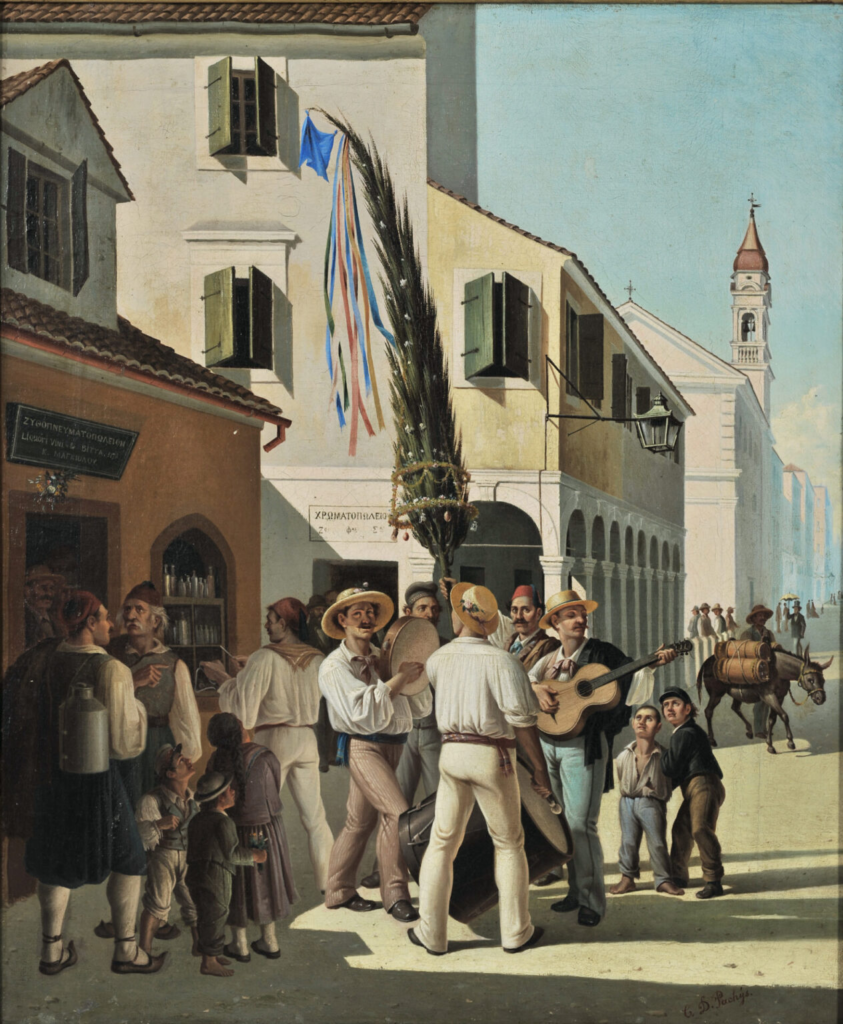
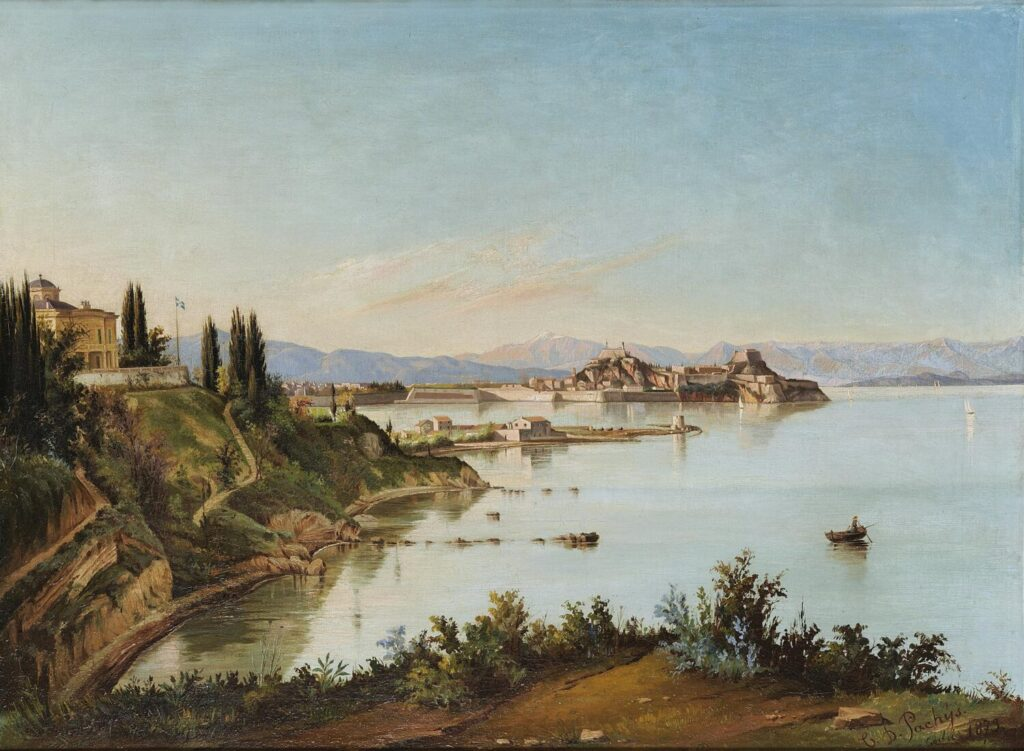
As the exhibition unfolds, religious themes dominate at first, gradually receding to give way to portraits, landscapes, and scenes of everyday life, such as “May Day in Corfu, c. 1875–1880” by Charalambos Pachis. “Essentially, it is a process of secularization,” as art historian Elena Chamalidi notes.
Within these works, one can trace how the Ionian artists–whether self-taught or initially trained alongside a priest-painter or another artist–continued their studies in Italy. Venice, Naples, and Rome were the three main centers where Ionian artists pursued their education. “And here we have works,” as Marina Papasotiriou points out, “which are, for the most part, copies of works by other Italian painters. This is because, next to the Academy, there was usually a small gallery that functioned as a pedagogical tool for the students. These artists would observe, copy, and practice drawing, color, and composition. This constitutes a very important section for the flourishing of Heptanese painting, as they returned from Italy with a very strong academic foundation in their hands.”
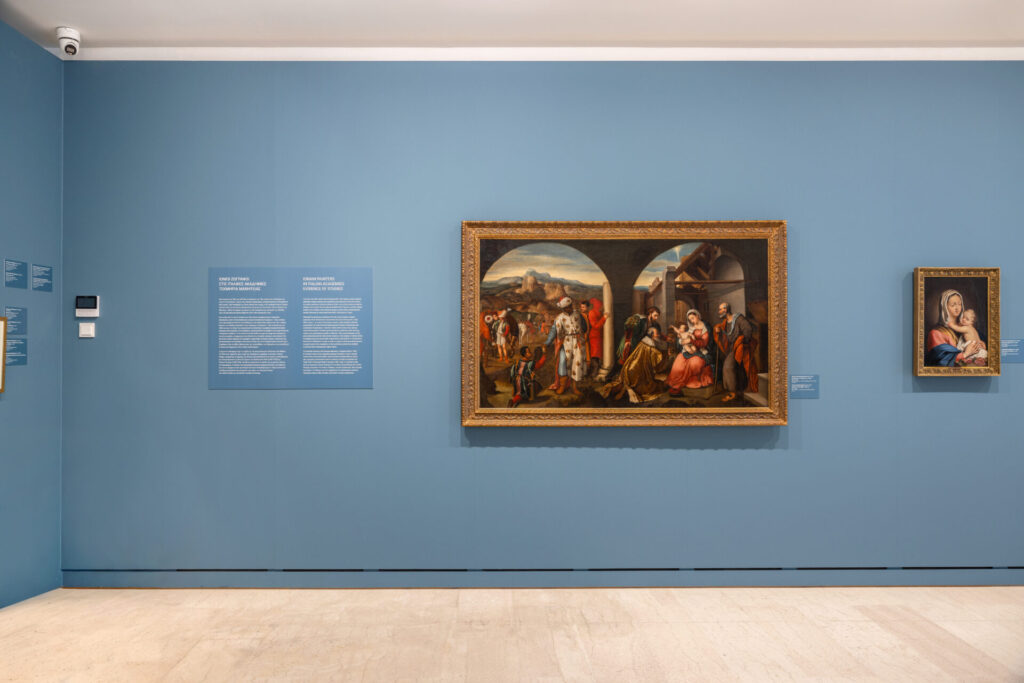
In this exhibition, something truly special also takes place: it features the very first work ever registered in the National Gallery’s collection, with the accession number “One.” The piece, “The Adoration of the Magi” by Petros Pavlidis-Minotos, was taken out of storage specifically for this occasion and presented at the Annex.
As the team shared, this exhibition was a true feat. A large number of collaborations with institutions made it possible, with works and archival material contributed either in physical or digital form. The majority of the works come from the National Gallery – Alexandros Soutzos Museum in Athens; however, many had been in storage and required conservation before being displayed. This meant that a substantial amount of groundwork was carried out on multiple levels, beyond the extensive research that the exhibition itself demanded. From the initial concept to the final realization, the process took approximately three years.
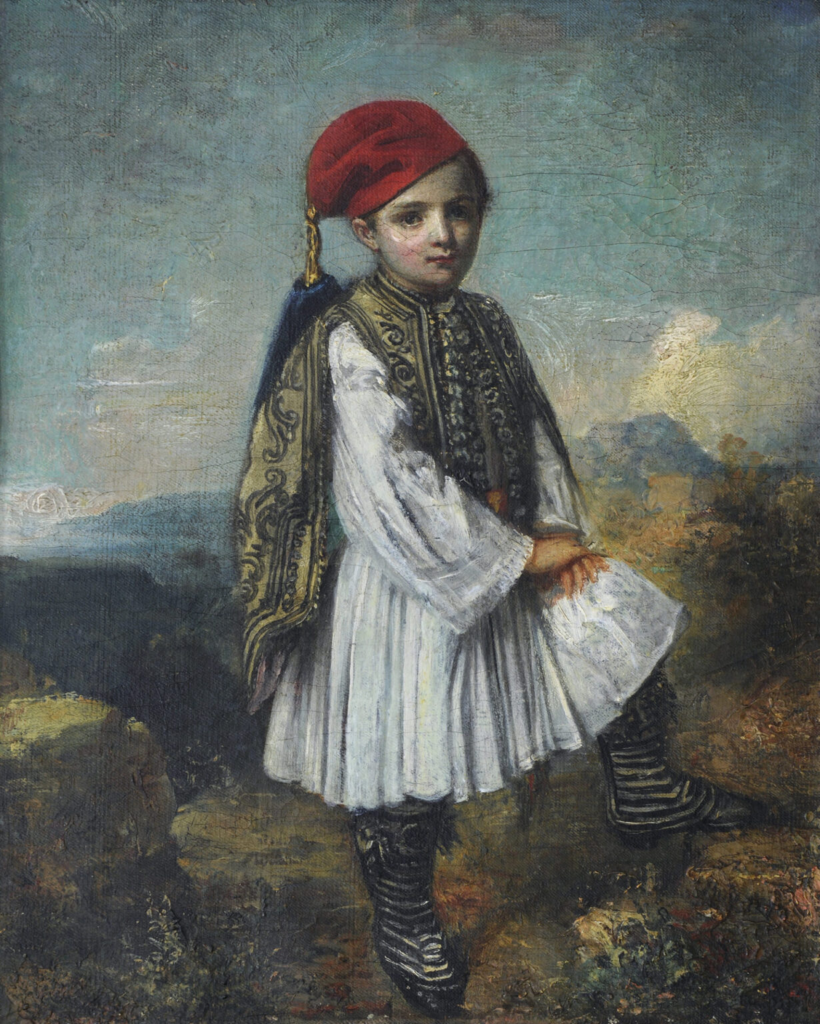
I find myself lingering on Gerasimos Pitzamanos’s “Virgin and Child” (1803), on the striking portrait of Dionysios Solomos as an infant by Nikolaos Koutouzis, and on the portrait of the Zakynthian writer Elisavet Moutzan-Martinegou by Nikolaos Kantounis–another figure whose life and work I feel compelled to explore further. It is an exhibition rich in powerful portraits, but also in landscapes, such as those by Georgios Samartzis and Vikentios Bokatsiambis.
Seeking to better understand the defining features of the Heptanese School, Marina Papasotiriou explains:
“It is the absolute relationship with Italy. We see a clear influence from Italian painters. For example, Nikolaos Kantounis’s ‘Deposition’ bears no resemblance to what we encounter in traditional Byzantine iconography. Here, we have moved into modeling of form, three-dimensionality, emotion, facial expression, and detailed rendering of garments–as in ‘The Prophet’ by an unknown artist, from the Museum of Zakynthos. This ‘Prophet’ lies on the edge of Mannerism: there is an intensity, proportions are not strictly observed, and we see exaggeration, as well as an expressive use of color and gesture.”
“At the same time, however, there is also resistance to these influences,” Panagiotis Ioannou notes, referring to the different sections of the exhibition and its archival material:
“There is another form of artistic production, that of Byzantine-influenced art, more traditional for the 18th century. Toward its end, we observe an alignment of artistic production with political priorities and ideological processes. Later, with the establishment of the Greek state and the parallel political developments in the Ionian Islands, we encounter another phase related to the formal education of artists in academies. Here we see systematic training, from Pitzamanos to Prosalentis–some of the first to pursue structured studies in Italian academies–leading up to Angelos Giallinas in the late 19th century. These artists move beyond experiential learning into formal academic education in the Italian peninsula, and upon returning, they transmit these assimilated models first in the Ionian Islands and later across other regions of Greece. Finally, there is another section that explores how these scattered elements–paintings, tempera works, drawings, and theoretical treatises–come together to form history, shaping a theoretical and ideological discourse. From the mid-19th century, with the first historiographical exhibitions by Moustoxydis, to the late 20th century–reaching 1993, 150 years later–with the establishment of the National Gallery Annex in Corfu.”

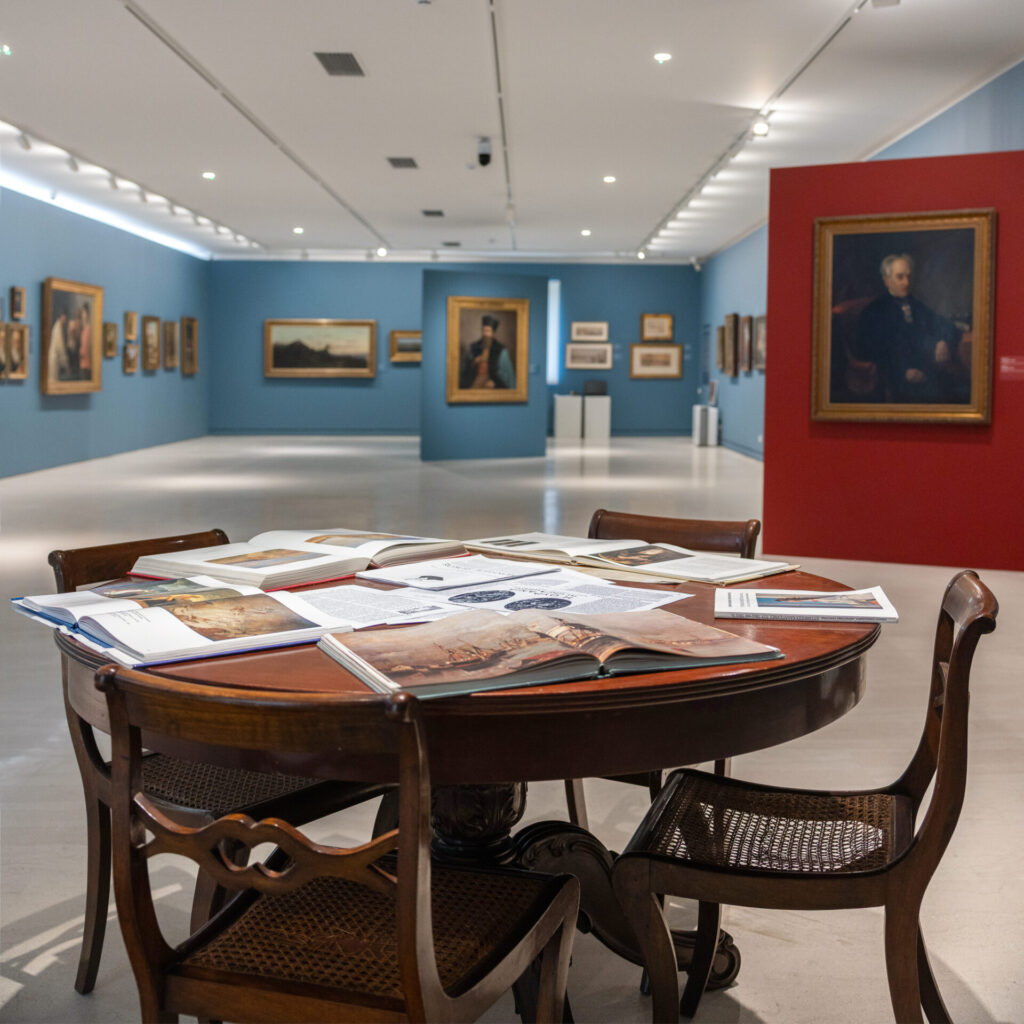
At the end of the exhibition, a table filled with relevant books and important texts completes the historical narrative and the period covered by “Painting in the Ionian Islands: 18th–19th Century,” spanning from the late Venetian rule in the Ionian region to the final decades of the 19th century. Beside it, the sofa of Georgios Rallis evokes the atmosphere of a literary salon.
Elena Chamalidi reflects on the exhibition and the changes made to the Annex’s exhibition spaces:
“Even for us as visitors–having come here for years with students for teaching—it is deeply moving. For us, this exhibition represents the renewal we needed, even on a psychological level.”
Marina Papasotiriou adds, with evident enthusiasm, how rewarding it is to see the Annex filled with visitors, essentially reopening with an exhibition rooted in the place itself:
“I am particularly happy because it seems that when you have something meaningful to offer, the public responds.”
Another important development is that the ground floor of the Annex has now been officially designated as a space for temporary exhibitions–a long-standing goal that has finally been realized. The consistent support of the Director of the National Gallery, Syrago Tsiara, has proven essential. Papasotiriou also revealed that the next exhibition will be dedicated to Alekos Fassianos, curated by Effie Agathonikou. In the more immediate future, the exhibition will be accompanied by a closing event in collaboration with the Ionian University: the musical performance Dionysios Solomos “To Mr. Georgios De Rossi” with Nikos Xydakis, on Wednesday, April 22, 2026, at 19:30.

“Where the Phaeacians of Homer still live, and the East meets the West in a kiss,” wrote Palamas of Corfu. During my journey for this exhibition, I saw the images within the artworks come alive in their own place. I encountered warm, generous people who care deeply about what they do, carrying out their work with dedication. And I discovered more about the Ionian artists through an exhibition that invites you to return to the sources and keep exploring.
Leaving the Annex of the National Gallery in Corfu, everything seems to align: place, people, and a distinctly Ionian blend–both familiar and foreign at once. Pure enchantment.
NIKOS XYDAKIS | DIONYSIOS SOLOMOS “TO MR. GEORGE DE ROSSI”
A musical-poetic composition by Nikos Xydakis, performed by the composer himself, accompanied by Alexandros Kapsokavadis (guitar, laouto, vocals), Effi Zaitidou (kanun), Despoina Spanou (cello, vocals), Fotis Mylonas (flute, vocals), and Giannis Koutagiar (double bass).

The performance will take place on Wednesday, April 22, 2026, at 19:30, at the exhibition space of the National Gallery Annex in Corfu, and marks the closing event of the public program organized in the framework of the exhibition “Painting in the Ionian Islands, 18th–19th Century,” in collaboration with the Ionian University.
Info
Painting in the Ionian Islands: 18th–19th Century | National Gallery – Alexandros Soutzos Museum, Corfu Annex | Castellino Building, Kato Korakiana
Opening hours:
Monday, Wednesday, Thursday, Saturday, Sunday: 08:30–15:30
Friday: 10:00–14:00 & 18:00–21:00
Tuesday: Closed
Access:
The Annex is located 14 km from Corfu town, in the area of Kato Korakiana, along the Palaiokastritsa national road, in the direction of Dassia.
Public bus (KTEL): No. 7, departure from Saroko Square – Katomeri stop.