 KATERINA PARRI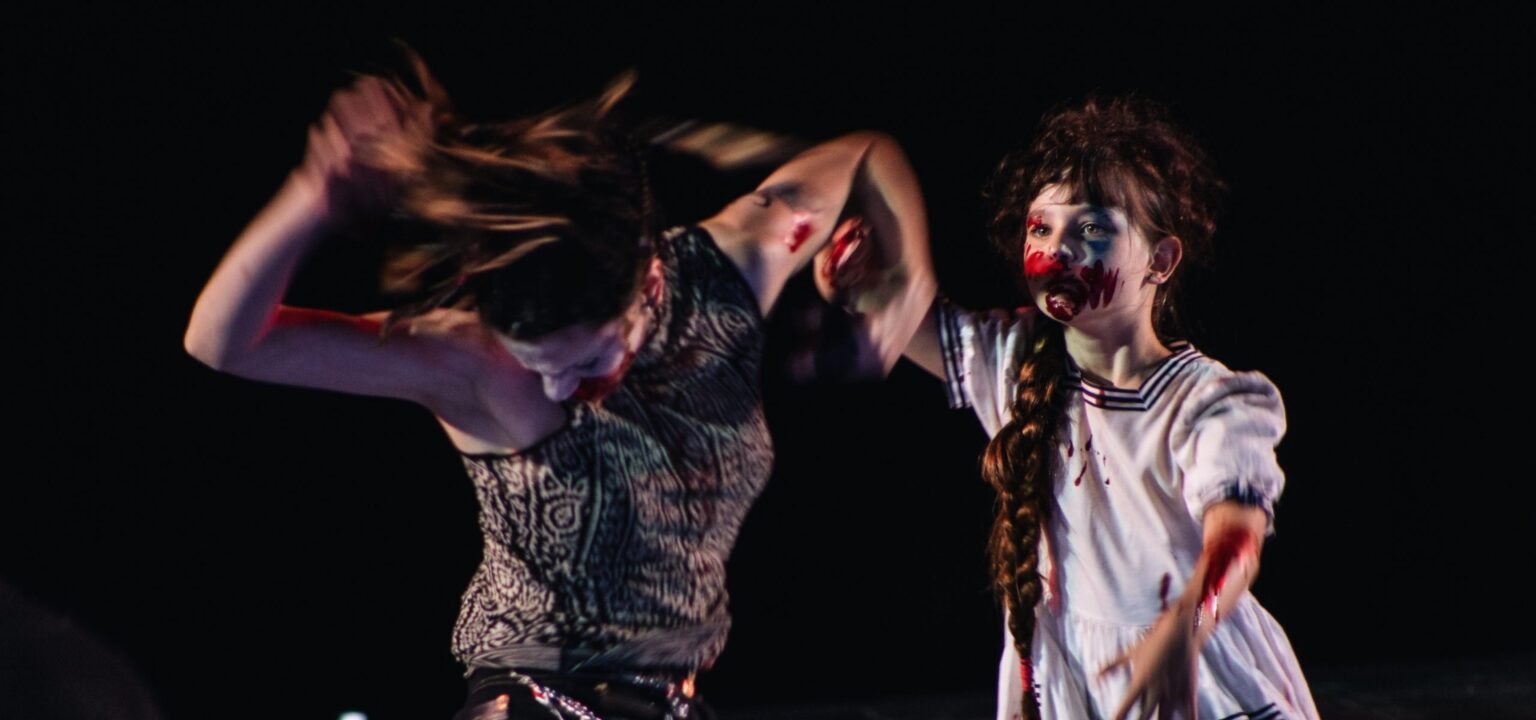
By Eleni Koutsilaiou
Despite the extremity of the subject, the rawness, and the brutality of the descriptions and events, the result of the reception is a cohesive emotion that overwhelms the audience
“The journey of return is always a journey but never a return. It is mourning, an inner mortuary where we enter to recognize the corpse of something we still thought was alive. This happens for those who believe they will one day find their mother again, and for the mother who believes she will find her daughters again. It is an ancient story that is constantly repeated from the depths of time.” – Wajdi Mouawad
As part of the Contemporary Ancients Cycle, Wajdi Mouawad’s latest creation, titled “The Oath of Europe”, had its world premiere at the Argolic Theatre, commissioned by the Athens and Epidaurus Festival.
Born in Lebanon in 1968, Mouawad was displaced during his childhood by the Lebanese Civil War and sought refuge with his family in France, where they spent five difficult years before moving to Quebec. There, the distinguished artist lived until 2000. A highly regarded playwright, director, actor, and artistic director of the Théâtre National de la Colline in Paris, Mouawad has been awarded numerous honors for his significant contribution to the arts, with notable recognition including being made a Knight of the National Order of Arts and Letters of France in 2002, of Canada in 2009, and of Quebec the following year. His work is marked by strong political themes, power, rawness, and a rare poetry in contemporary Western theatre. A central theme of his work is the attempt to free the individual from the collective trauma of an endless cycle of blood and violence.
Cultural identity, intergenerational trauma, collective memory, the violent displacement from one’s homeland, the traumatic conditions of refugee life, and the search for self under these circumstances are core themes in his artistic exploration. He questions how much of a person is defined by their cultural identity, their upbringing, and their origins, and whether, while preserving their culture, they can free themselves from its constraints, feeling part of a universal human community.
Direction – Dramaturgy
His theatrical approach responds to the deeper essence of the Contemporary Ancients Cycle. This is its first major virtue, as it does not merely reinterpret ancient drama thematically and ideologically but, driven by his admiration for Ancient Tragedy, attempts to revisit its genetic material -myth. He recalls the moral framework that pervades it: Hubris, Ate, Nemesis, Tisis, and Catharsis, using these concepts as the cornerstone for his modern narrative structure.
The perpetual cycle of violence and blood, the timeless moral laws, and the archetypal forms that are violently but futilely repelled by modern man, with the historical-political context as a mechanism for the crushing of the individual, will serve as the materials for the dramaturgical architecture of the performance. His theatrical contribution will be developed with sincerity, precision, and passion in the theatre where the modern revival of Ancient Drama, the only form of theatre born from direct Democracy, has been honored for 70 consecutive years since 1954.
The second great virtue of the project is that it places the concept of Reconciliation, a notion long devalued, as central to the healing of humanity’s collective wounds.
The powerful on-stage dynamics, the disarming precision of the performance, the exceptional acting, and the sincere artistic contribution neutralize dramaturgical simplifications and directorial shortcomings, and some unfortunate symbolism. Despite the extremity of the subject, the rawness, and the brutality of the descriptions and events, the result is a cohesive emotion that floods the audience.
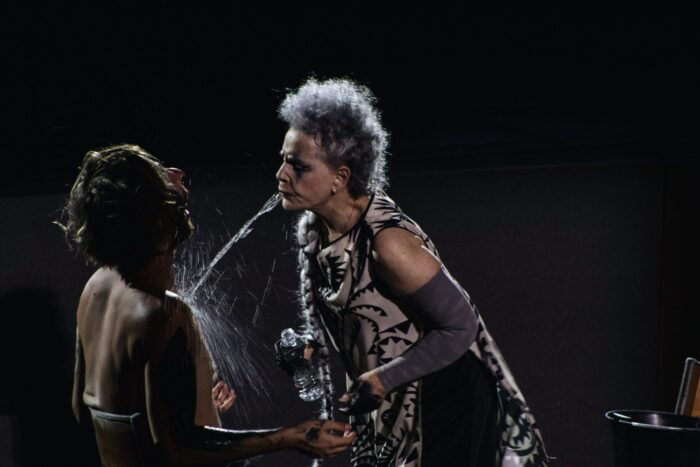
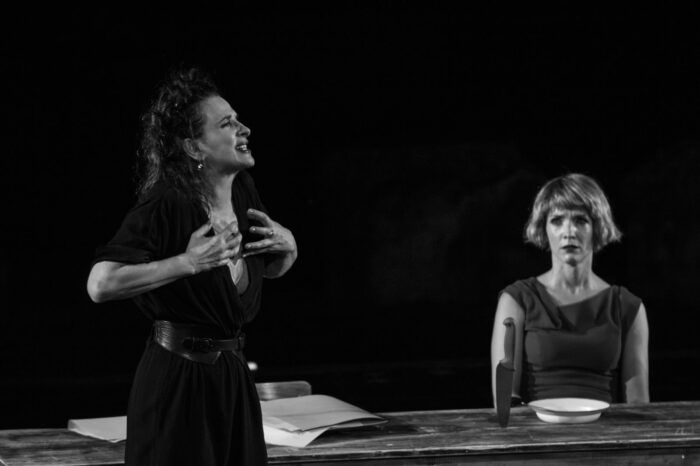
I must admit, the scene at the end, with the three daughters of Europe trying to balance on glittering Christian Louboutin heels, I could only accept as ironic. However, I don’t think this was the intention of the director and dramaturg. (Text – Direction: Wajdi Mouawad – Dramaturgy: Charlotte Farcet)
Work and Analysis
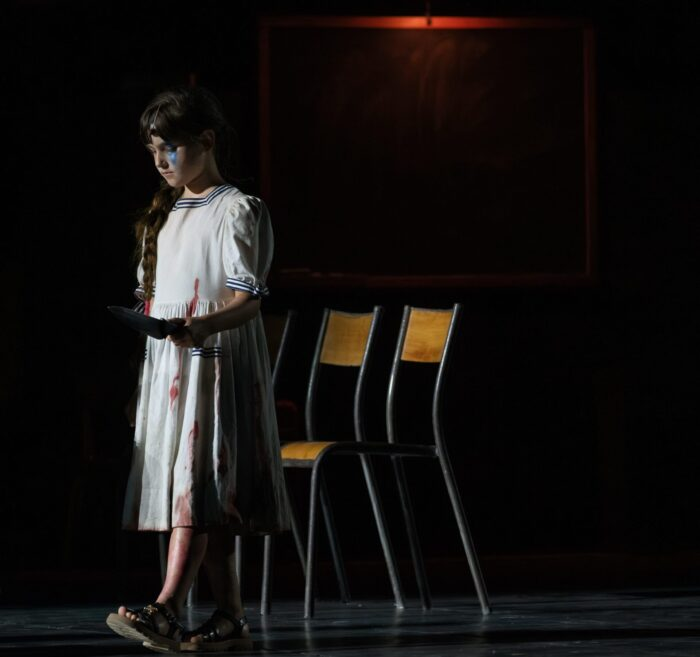
We follow a 75-year-old woman named “Europe” who converses in an internal, motionless space-time with her spectral childhood self. She admits that at the age of eight, during a bloody civil conflict in her community, when her own people were slaughtering mercilessly, the persecuted, in an attempt to ensure the continuity of their generation, hid eighteen children in the school to save them. At that moment, she fired a flare to alert her people to the children’s existence, and they, in turn, released wild dogs that devoured them.
Her abhorrent act is welcomed with enthusiasm and praise by her community, except by her older brother, who opposes the heinous acts of slaughter. He is tortured terribly by their father and uncle, dies, but remains morally unscathed, and as he is dying, he imposes an oath on his sister that she must atone for her unholy act: “You have a knife in your womb,” he tells her as he breathes his last.

The young Europe has committed a triple hubris: she has led defenseless children to a martyr’s death, violated the sanctuary of the school which, in any war context, must remain inviolate, and allowed the children to be devoured by dogs.
Thus, the performance begins with the commission of this triple hubris. Hubris in Ancient Greek literature is considered the violation of human boundaries, particularly violent, arrogant, disrespectful, and sacrilegious behavior against human laws but more so against the unwritten divine law. The consequences of hubris weigh not only on the one who commits it but also on subsequent generations descended from them.
As time passes, and while Europe remains mentally trapped in the still time of the massacre and the spectral space of the school, she falls into Ate—the blindness of the mind due to the hubris she has committed, leading her to even more abominable acts. Europe has decided to give birth to eighteen children, as many as the children who were slaughtered because of her, in her childhood, and to kill them by drowning them in the nearby river of her village. And this she has done to the first three newborns, all boys.
Mouawad uses the archetype of the “monstrous mother,” which, as D. Anastasiadou notes in her doctoral thesis “The Timeless Journey of Medea in Euripides”,
“Mothers are matrices of memory, who through laments kill because they lost those they loved. Mothers as matrices of memory and life, who guard the continuous passage to Hades, like initiation, birth, and journey, making tragedy an ode to death, a perpetual lament, a mournful song for god and man. Motherhood in Ancient Greece is a paradigm of mourning, murderous and excessive, as it is combative. Combative femininity is synonymous with combative motherhood; it draws a knife, making the case of ‘the grieving and abandoned woman’ a dangerous one. The knife is hidden in the female cloak, but it often rises publicly in ancient tragedy.”
Through the dissemination of the “monstrous maternal image,” the important creator achieves the prevalence of the Abhorrent and the emergence of the Tragic.
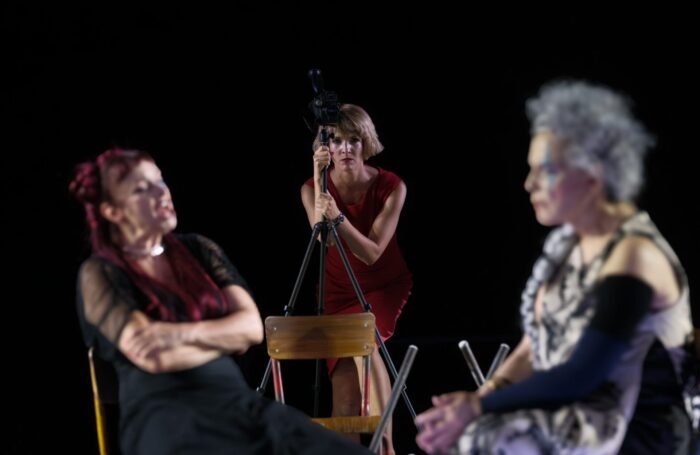
However, Europe cannot bear to complete her abominable act and saves the last three children she gives birth to, all girls, leaving them beside the river. The fate of these children remains unknown to the now elderly Europe, who—although tortured terribly by the memory of her act, refuses to confess it.
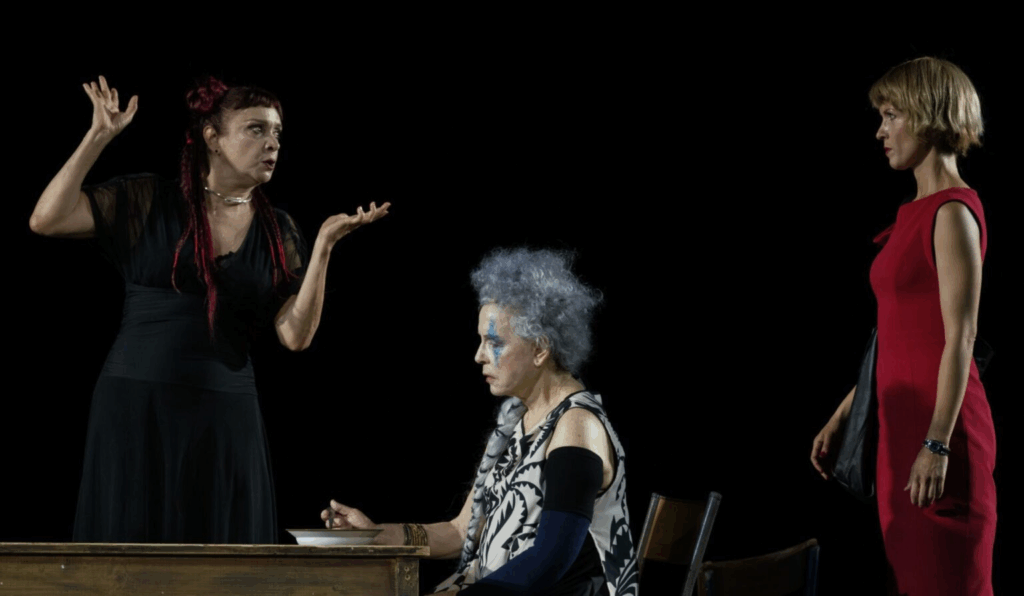
Nemesis (the wrath of the divine in Ancient Greek literature) in Mouawad’s performance is personified by Assia Fandiaghha, a United Nations diplomat who pressures the elderly Europe to confess her crimes, which she adamantly refuses until she agrees to speak when the diplomat brings her the three lost daughters who are unaware of who their mother is and of each other’s existence.
Assia Fandiaghha will keep her word. Three women -Megara, Wadiha, and Zovet- the three daughters of Europe, will face her. The Tisis (punishment) imposed by her Hubris will be enforced through the suffering of her children: Zovet suffers from phobias and has an inexplicable fear of dogs, remains unemployed, aimless, wandering, and stateless. Megara, despite repeated IVF treatments, cannot conceive, suffering miscarriages, and Wadiha -the embodiment of good- has a son who refuses to confess the heinous crime he committed: that he killed, abused, and ate the innards of his mistress who abandoned him, an abominable act and cannibalism, echoing the Thyestean feasts.

Hubris from Ancient Greek literature meets intergenerational trauma dramaturgically in the significant creator’s attempt to speak about the crushing of Man in the modern unholy historical-political context.
The eight-year-old girl inhabiting the seventy-five-year-old woman will confess the abominable act. She will reveal that she is the Mother of the three women. The Mother of the wounds of the modern world. The Old Continent that births civilization and kills it repeatedly. This confession will create explosions of anger and sorrow but will lead to the catharsis of the characters. They will try to stand again, devastated, looted but now relieved of the unholy acts that weighed them down, seeking reconciliation in all its forms.
The Contributors
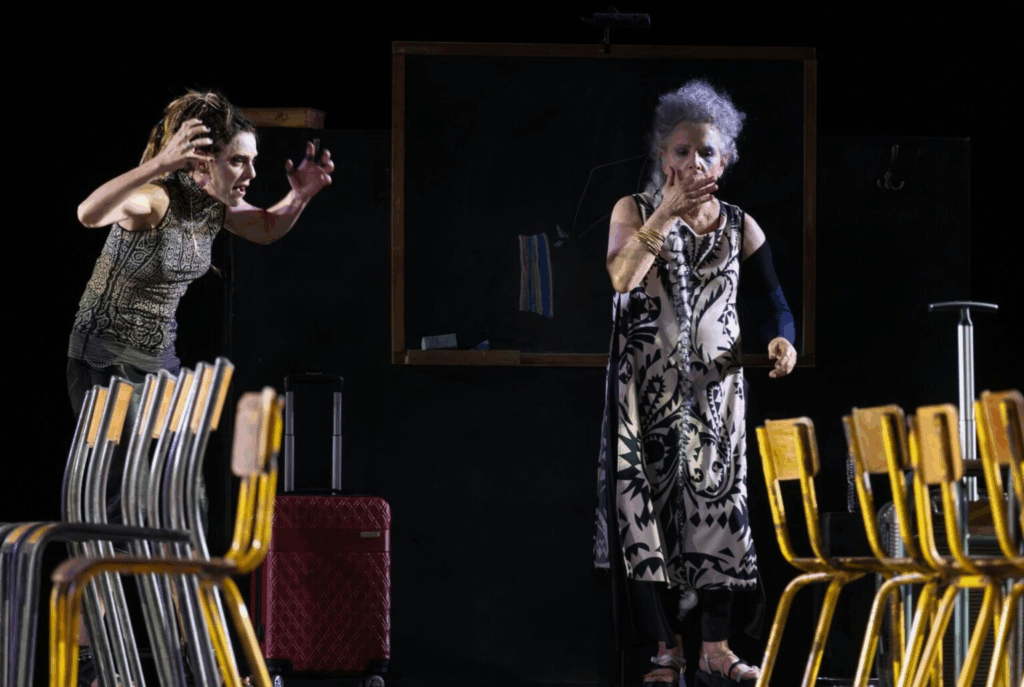
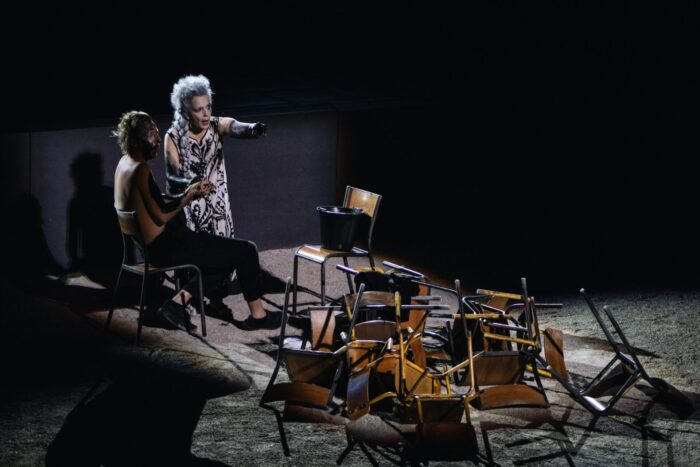
Both the sets (by the significant Emmanuel Clolus) and the costumes (by Isabelle Flosi) feel somewhat uninspired and impractical. In particular, the set design created an illusion of an indoor theater stage, neutralizing the power of the Orchestra of the Ancient Theatre of Epidaurus.
The lighting design by Laurent Schneegans was powerful and interesting.
The sound design by Annabelle Maillard and the musical composition by Alexandros Drakos Ktistakis harmoniously accompany the performance.
The Performances
Daria Pisareva accurately plays Assia Fandiaghha (the United Nations diplomat), whose class superiority is shattered when it is revealed that she belongs to the descendants of the slaughtered tribe and seeks truth and justice.

Violette Chauveau is adequate as Jovette.
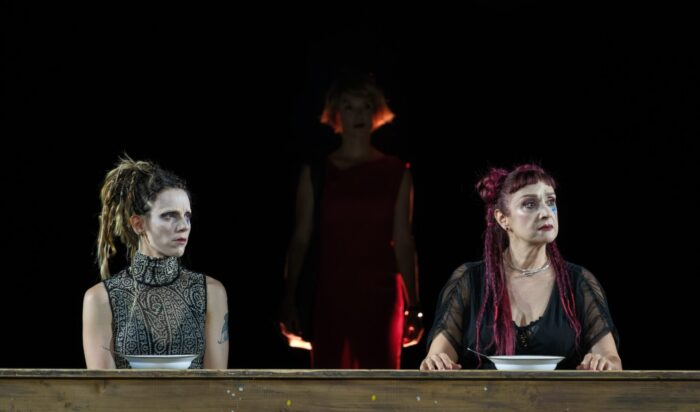
In her most complete performance to date, Danae Epithimiadi as Megara is outstanding. Her acting of the contrast between torment and vitriolic humor is spot on.

Emmanuel Schwartz as Zacharie (mainly in the confession of the heinous crime) gave us a shocking interpretive deposition: measure, simplicity, torment, depth, tenderness.
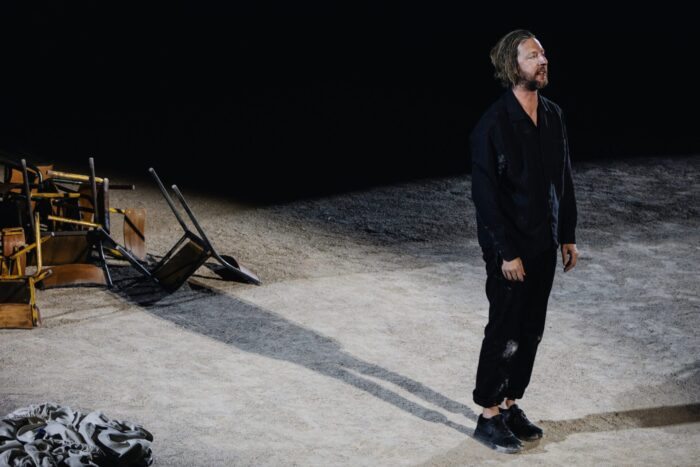
Juliette Binoche, as Wadiha, beyond her remarkable acting skill, has a rare moral quality with which she serves her art: modesty, craftsmanship, and light.
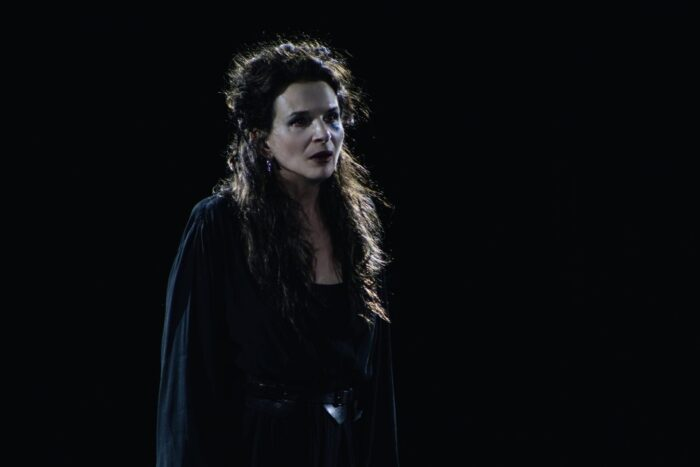
Leora Rivlin as Europe gave us a captivating interpretive deposition: devastated and monstrous. Helpless in the gloom she created and all-powerful through the heroic act of confession.
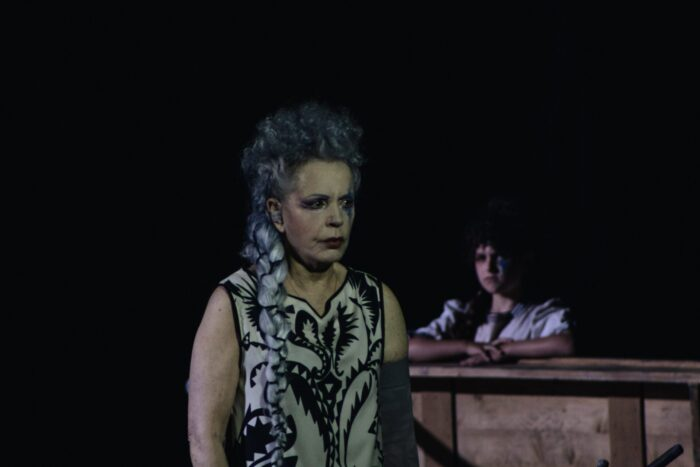
I confess, at first, I was worried about the presence of such a young child in such an extreme spectacle. However, little Adèle Réto-Lefort appeared to be incredibly happy during the bow, so emotionally protected that all my reservations vanished.
An interesting detail that I think is worth mentioning is that Mouawad has written children’s books: La petite pieuvre qui voulait jouer du piano (The Little Octopus Who Wanted to Play Piano) and Pacamambo for older children, which once again deal with his familiar themes in a gentler way.
…Summary
A performance full of torment and light. Poetry and gloom. Sincerity and moral quality. Its strength and depth neutralized any dramaturgical and directorial weaknesses.