 KATERINA PARRI
The earth is trembling. Systems of thought have been demolished, and there are no more straightpaths. There are endless floods,eruptions, earthquakes, fires. Today, the world is unpredictable and in such a world, utopia is necessary. But utopia needs trembling thinking: we cannot discuss utopiawith fixed ideas.– Édouard Glissant
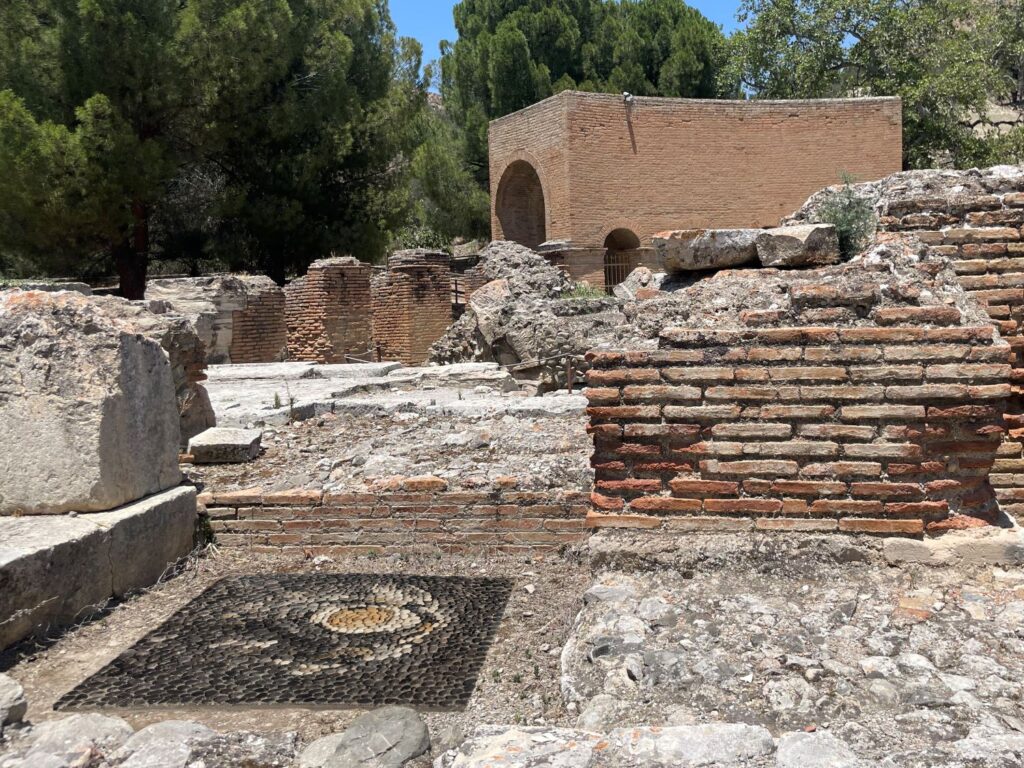
The writer, poet and painter Etel Adnan was “writing in a foreign language” about her experience of a life led between Arabic, French, English, Greek and Turkish and her travels in the Mediterranean. Those languages clashing with each other become a narrative vessel not only for the homonymous essay but for Adnan’s entire oeuvre,where friction and conflict are widely discussed.Whether it is language, gender, or the geopolitical dimension of this multilingual experience, friction and conflict presuppose the existence of a zone of contact or touch. Within this zone, tension manifests itself not only where there is contact, but also where there is movement. Starting from the notions of (up)rooting and transcendence that occurs once languages come into contact with each other, as well as the idea of being exiled from, and immigrating into, a certain language, the exhibition and performance programme Touching Faultlines will take place at the Roman Theatre in Ancient Gortys, Crete.
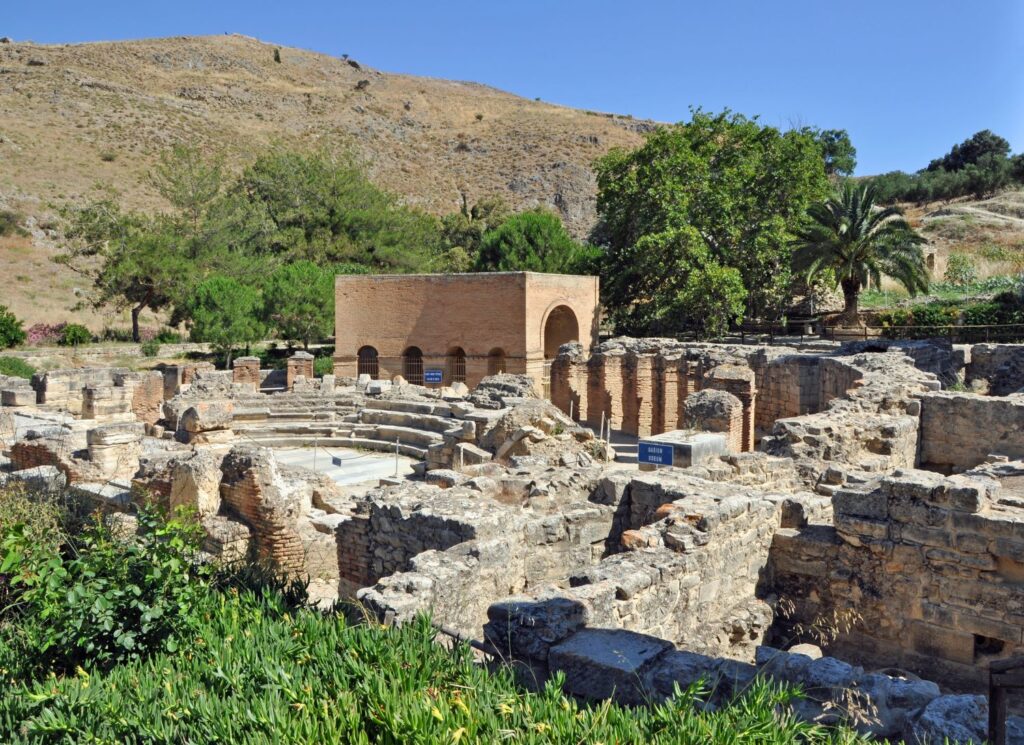
The site brings us into contact with a long history of an inevitably shifting art and culture that-inevitably-moves and is in dialogue with the faultines in relation to the Eurasian and African tectonic plates meeting just a few nautical miles away. At the same time, Crete, the carrier of multiple cultures that have travelled via its neighbouring ports throughout the centuries, is perhaps one of the quint essential melting pots of the Eastern Mediterranean region, as it is here where Southwest Asia (the Middle East) meets North Africa and Southeastern Europe.
The language used to describe geological phenomena and archaeological investigations is also used to propose a type of geopolitical framework that often slips into the realm of “science” and “evidence-based” knowledge. Artistic production appears here as a means of questioning epistemological foundations, reframing them through the embodied notion of trembling. Throughout the centuries, historical earthquakes and volcanic eruptions have repeatedly pierced through the mantle of the earth across the Mediterranean basin, turning the region into a zone of constant turbulence.

Contact zones. I use this term to refer to social spaces where cultures meet, clash, and grapple with each other, often in contexts of highly asymmetrical relations of power, such as colonialism, slavery, or their aftermaths as they are lived out in many parts of the world today (Pratt, Mary Louise. “Arts of the Contact Zone.”Profession, 1991, 33–40).
If one follows Mary Louise Pratt’s line of thought, to view points of collision as contact zones, what can we learn about such zones through the observation of geological bodies and their movements along the Mediterranean fault lines? The friction produced through geological movement is yet another testament of the type of interconnectedness that is so prominent in the Mediterranean heritage, and present but often overlooked in Western societies. Taking geoscientific entities and structures as its starting point, Touching Faultlines aims to challenge the friction of supposed dichotomies such as nature and culture, body and mind, surface and interior, science and mythology.
Through dance, sculpture, painting, installations, sound interventions, video and performances developed by artists from Greece, Cyprus, Albania, Lebanon, Tunisia and Italy, Touching Faultlines studies friction and negotiates historical narratives, cultural backgrounds and inherited traumas. Remaining in continuous conversation with the geological underpinnings and perpetual plate movements that have so often led to historical deflections, the works included in the exhibition propose new political and cultural readings on notions of tension, deflation, healing and reconstruction.
The contact zone referred to by Mary Louise Pratt and the archipelagic thinking of Édouard Glissant embody the margins of tectonic plates, looking at bodies in constant motion and understanding the friction between them as a step towards understanding difference and transformation.Touching Faultlines brings contemporary artistic production into dialogue with the archaeological context of presentation, creating multiple connections and readings. The materiality of the site is intertwined with personal narratives, notions of situatedness, symbiosis, overlap and the possibilities of paradigm shift and interchange. Mythology intersects with memory and speculative fiction towards a (geological) future that is not yet here.

About the location
Gortys (Greek: Γόρτυς, or Γόρτυνα, pronounced [ˈɣortina]) is amunicipality, and anarchaeological site, on the Mediterranean island of Crete 45 km away from the island’s capital, Heraklion. Gortys was the Roman capital of Creta et Cyrenaica. The area was first inhabited around 7000 BC.
It is located in the valley of Messara in the south of the Psiloritis mountain, in the current position of the villages of Metropolis and Agioi Deka,and near the Libyan Sea. The city covered a large area on the sides of the river Mitropolianos (or Litheos), surrounded by an ancient olive grove.
Classical Greek mythology has it that Gortys was the site of one of Zeus’ many affairs.This myth features the princess Europa, whose name has been applied to the continent,Europe. Disguised as a bull, Zeus abducted Europa from Lebanon and they had an affair under an evergreen plane tree, like the one seen today in Gortys.
Programme
23 August, Opening reception 17.30-21.00
Performances:
18:00 Anna Papathanasiou&Inga Galinytė,Empathetic Bodies: a fresh page
19:00 Ermira Goro presents her latest Choreographic work (with Spyros Dogas and Sofia Pouchtou)
Screening: 20:30 Huniti Goldox, The Dido Problem
24 August, 8.00-21.00
Performances: 19:00 Ermira Goro presents her latest Choreographic work (with Spyros Dogas and Sofia Pouchtou)
Screening: 20:30 Huniti Goldox,The Dido Problem
Participants:
Mounira Al Solh,Enrico Floriddia & Fredj Moussa, Huniti Goldox,Ermira Goro, Lito Kattou, Petros Moris, Eva Papamargariti,Anna Papathanasiou& IngaGalinytė, Panos Profitis, Eleni Tomadaki, Iria Vrettou
Credits Curation: Angeliki Tzortzakaki, Panos Giannikopoulos
Production: Foivos Petropoulos & WILD REEDS
Graphic Design and Visual Identity: Bend.gr
Touching Faultlines is part of the 2024 programme All of Greece, One Culturefunded by the Greek Ministry of Culture and managed by the Greek National Opera.
Info
Friday 23 August 2024 - Sunday 25 August 2024
Exhibition opening hours:
Friday 23 August: 08.00-21.00
Saturday 24 August: 08.00-21.00
Sunday 25 August: 08.00-20.00
Roman Odeon of Gortys, Crete