 elc team
The G. & A. Mamidakis Foundation presents, on Saturday 6 June 2026 in Agios Nikolaos, the large-scale sculptural installation “Chronotopia” by Canadian artists Caitlind r.c. Brown and Wayne Garrett, recipient of the 2026 Art Prize.
The large-scale site-specific sculptural installation stood out among more than 450 submissions from 65 countries, proposing new readings and ways of perceiving the landscape at a time when the need for collectivity, reflection, and reconnection with the natural and social environment becomes increasingly urgent. The work will remain on permanent open-air display and will join the collection of the G. & A. Mamidakis Foundation, which includes more than 70 works by important Greek and international artists.
The work
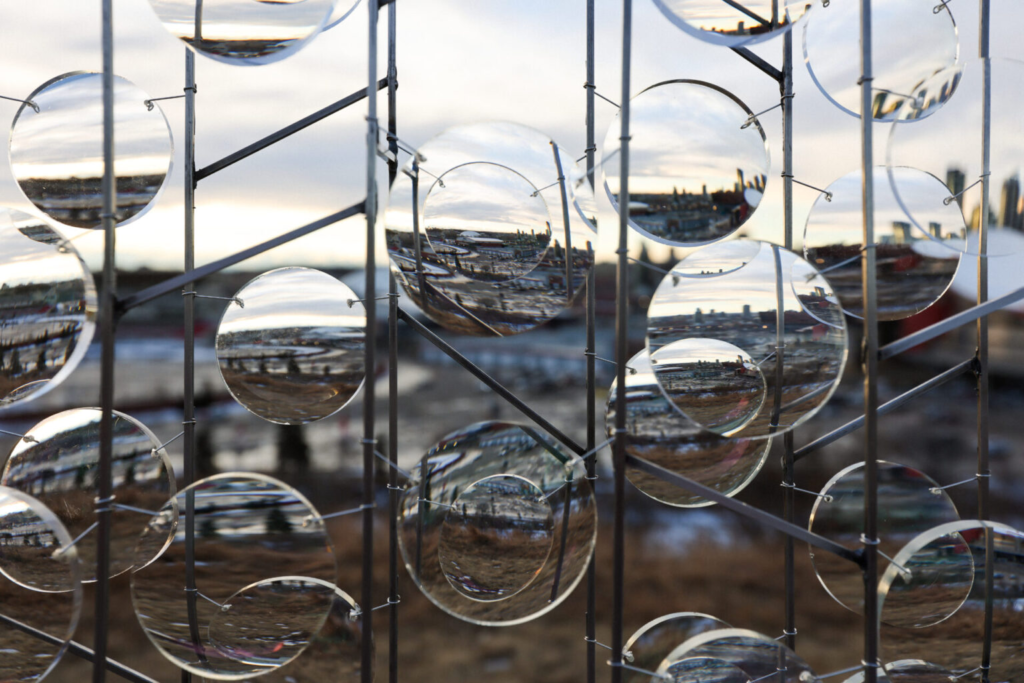
Chronotopia is inspired by the interactions between Crete, water, light, space, and time. The title refers to the concepts of time (Chrono) and place or space (Topia). These two Greek words merge into a neologism suggesting a condition in which time and place are intertwined and coexist, creating the familiar framework within which human beings live. The work consists of layers of thousands of optical myopic lenses forming two arched panels of light that embrace the visitor through a fixed metal structure resembling a lattice of branches. The installation invites viewers to move through the space it creates and observe the landscape through the lenses.
From inside the installation, the lenses capture and focus distant images into domed microcosms that shift according to changing conditions. They move with the wind, transform with the light, and constantly reassemble themselves without ever stabilising into a single image. Outside the installation, the body of each viewer appears as a mosaic-like abstraction, a ghostly figure becoming part of a different mode of seeing.
The blue line of the Mediterranean horizon, faintly visible through the scattered lenses and more clearly between them, becomes an image of linear time. Yet when the viewer enters Chronotopia, the lenses interrupt this linearity, fragmenting and transforming it, at times compressing it and at others expanding it according to their individual optical properties.
In this context, the experience of Chronotopia may also be understood as an exercise in perception: a reminder that what we consider to be the “image” of the world is never immediate, but always mediated. In this way, the work balances between a shared, universal experience of the world and the subjectivity through which each of us perceives it.
Particularly significant is the choice of the installation’s primary material, which highlights a form of sustainability and the artists’ sense of responsibility towards the materials they use. The vision lenses shaping the installation come from the Canadian Lions Eyeglass Recycling Centre in Calgary, an organisation that recycles used glasses and distributes them free of charge to people in more than 70 countries. In this case, the lenses had been deemed unsuitable for reuse and destined for recycling, before being creatively reintegrated into the artists’ process and transformed into artistic material. The installation is composed of thousands of such lenses, which have already undergone multiple uses and had previously been incorporated into pop-up works in Japan, including A Whisper in the Eye of the Storm (Northern Alps Art Festival, Japan, 2024) and Conversations with Time (Setouchi Triennale, Japan, 2025). Their transfer to Crete marks a new, and perhaps final, stage in their journey, underlining the cyclical nature of both matter and meaning within the work.
The artists
Caitlind Brown and Wayne Garrett are artists from Western Canada, specifically from Calgary, a city of nearly two million inhabitants in the province of Alberta. They were born and raised in a place defined by open horizons and framed by the Canadian Rockies. The power and beauty of nature therefore hold a central place in both their lives and artistic practice, as their relationship with the landscape has directly shaped the way they understand the world, people, and the relationships between them.
They have collaborated since 2010. Their earliest joint projects emerged within the broader practice of expanded cinema and gradually evolved into luminous sculptures, installations, and spatial interventions. Their collaborative artistic practice focuses primarily on non-traditional art spaces such as public parks, forests, abandoned buildings, and parking lots, always exploring the potential connections between people, places, and situations.
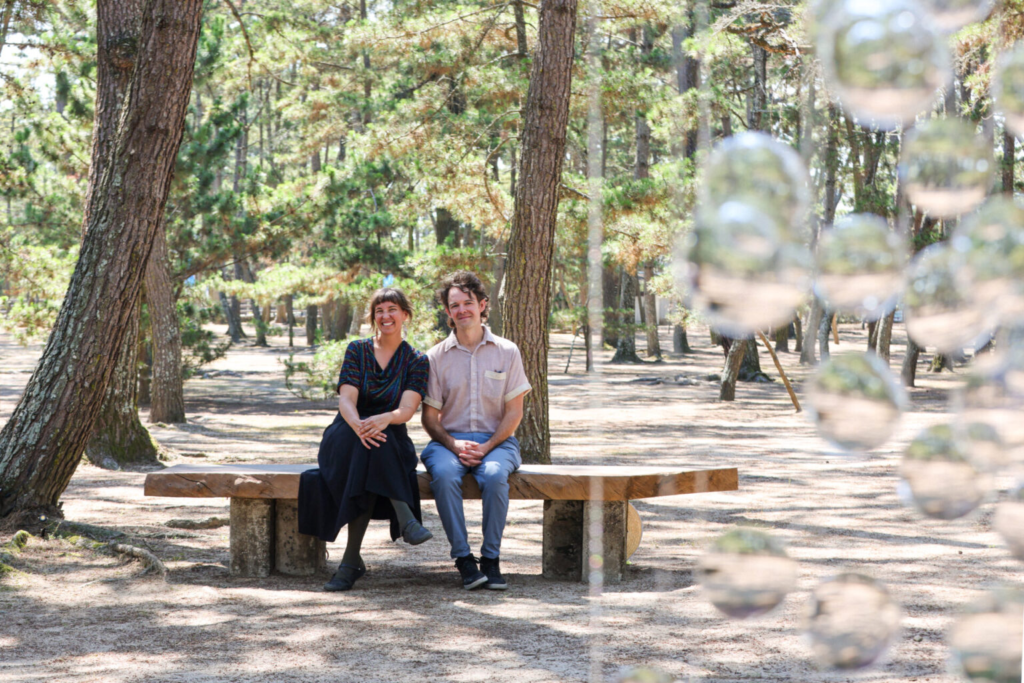
Human presence constantly serves as the measure through which they conceive and develop their work, not as passive observers but often as active participants within the work itself. Space also plays an equally central role: the environment within which the work is situated and activated.
Chronotopia organically belongs within this trajectory, condensing core questions that concern the artists: the subjectivity of experience, the fluidity of time, and the ongoing negotiation between the individual and the collective.
Caitlind r.c. Brown is an artist and cultural organiser whose work ranges from experimental public-space interventions to collaborative projects. She graduated from the Alberta University of the Arts in 2010 and received the Alumni of Merit Career Award in 2019. She has founded and coordinated numerous collective and collaborative initiatives, including THE WRECK CITY, The Wandering Island, and The Hibernation Project, focusing on immersive and participatory practices.
Wayne Patrick Garrett is an artist and musician whose multidisciplinary work includes site-specific installations, sculpture, sound, and performance. He trained as a Machinist Technician at the Southern Alberta Institute of Technology and studied jazz music at Mount Royal University. He entered the field of contemporary art through the experimental artistic collective Arbour Lake Sghool (sic) in Calgary, where he met Caitlind Brown, shaping the beginning of their shared artistic journey.
As the artists state:
“We work in the in-between spaces of things – nature and culture, privacy and community, light and darkness, sound and listening, Me and You. Our works respond to space, seeking to expand human experience through radical acts of seeing, listening, sensing, and being. We believe in the utopian power of art to create new perceptions of everyday life, reduce the distance between people, and build our human capacity for empathy and insight.”
The G. & A. Mamidakis Foundation Art Prize
The year 2026 marks the sixth edition of the Art Prize. Since 2019, the Prize has embodied the original vision and inspiration of Gina Mamidakis: the creation of a framework offering space and time to contemporary artists for free expression and artistic creation, a practice rooted in the first Art Symposia held in the late 1980s. Since then, the institution has evolved dynamically alongside shifts in the contemporary art scene while remaining firmly committed to supporting artistic innovation and connecting art with place through site-specific works designed for permanent exhibition in Agios Nikolaos, Crete.
Over the last three years, the Prize has acquired an international character, attracting hundreds of submissions from around the world each year. This year, more than 450 proposals from 65 countries demonstrated the dynamism and reach of the institution within a broad and diverse artistic community. As in previous years, this year’s open call focused on large-scale works designed for outdoor environments, organically integrated into the landscape and functioning as points of reference that transform the experience of the natural setting.
The Prize continues to evolve, aspiring to function as a point of reference for contemporary artistic creation and as a platform for meaningful support of the artistic community.
At the same time, it represents a rare example in Greece of support for the production of large-scale works, often designed for outdoor environments. The works become part of a private collection with a public character, open to all, creating multiple levels of experience and dialogue not only for art professionals and enthusiasts, but also for the local community and visitors to Agios Nikolaos.
Applications for the Art Prize open every autumn and are announced through a public open call.