 elc team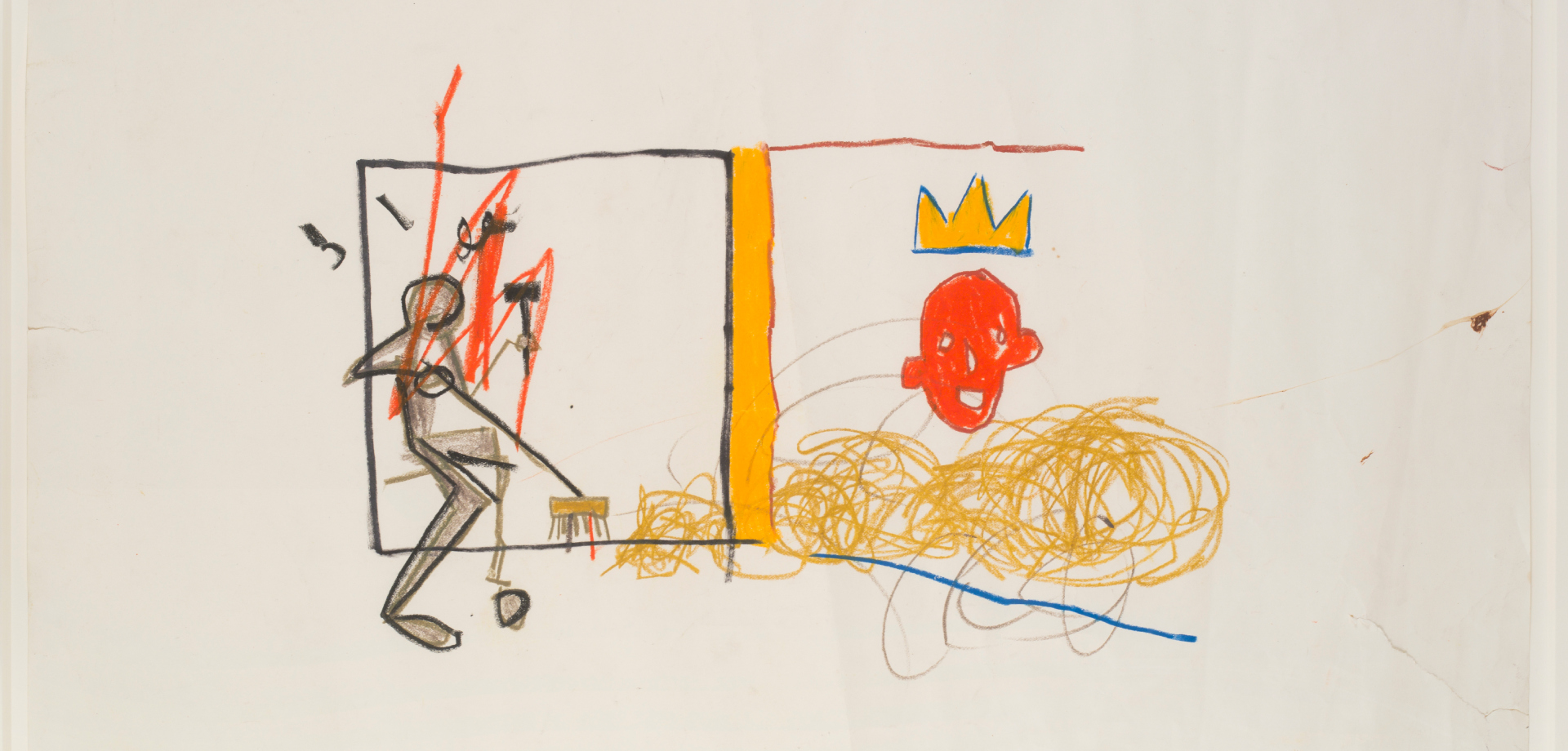
The exhibition is not merely a retrospective that attempts to “define” Jean-Michel Basquiat, but rather seeks to illuminate his many facets: always two steps ahead of his time, entirely free, and defiantly unconventional.
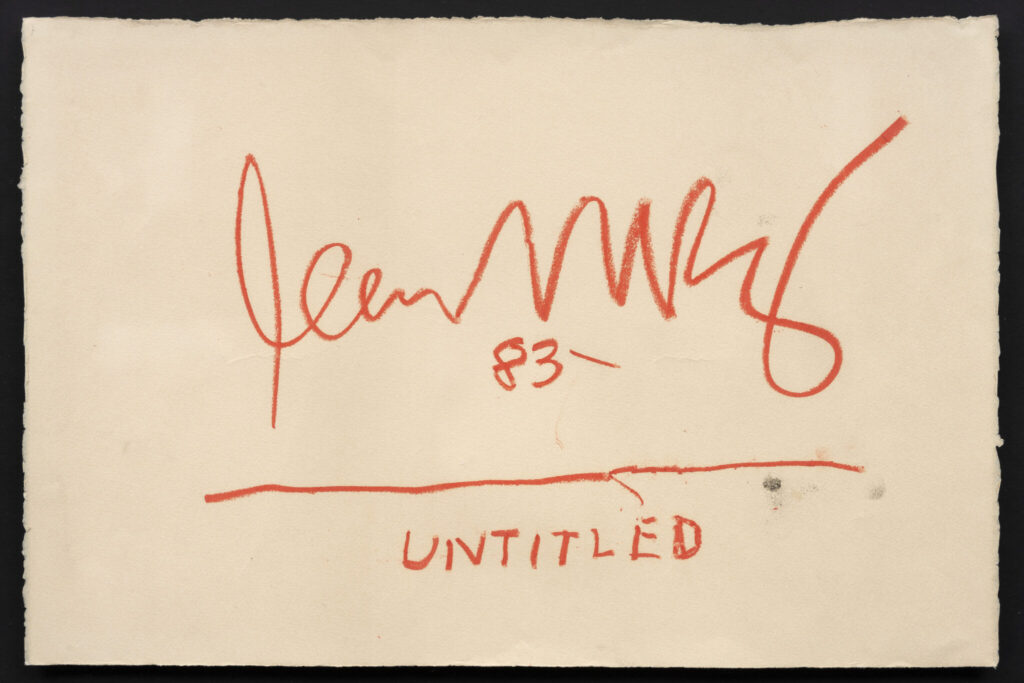
The Intermission gallery, in collaboration with Galerie Enrico Navarra, is pleased to present the first exhibition of works by Jean-Michel Basquiat in Greece, opening on May 22. Titled Untitled, the exhibition takes its name from a 1983 artwork bearing only the artist’s signature and the word “Untitled” – a gesture that directly recalls Duchamp’s thinking: a subtle yet powerful comment on the notion of authorship and, above all, a direct reference to Basquiat’s own stance – his resistance to being confined to categories. Untitled, then, is a title that refuses to be a title.
This exhibition is not merely a retrospective attempting to “define” Jean-Michel Basquiat. Rather, it seeks to shed light on his many facets: versatile, bold, playful, two steps ahead of his time, entirely free and unconventional, he both exorcises and provokes chaos, experimenting with different media and cleverly alternating between painting and drawing, between text and poetry, political commentary and pop culture, antiquity and the contemporary. The streets of New York electrify his imagination – as does Ancient Greece, the violent satire of Looney Tunes, the stock market, politics, history, the televised hysteria of the Reagan era. All of these, his creative obsessions, coexist in a singular, internally explosive universe.
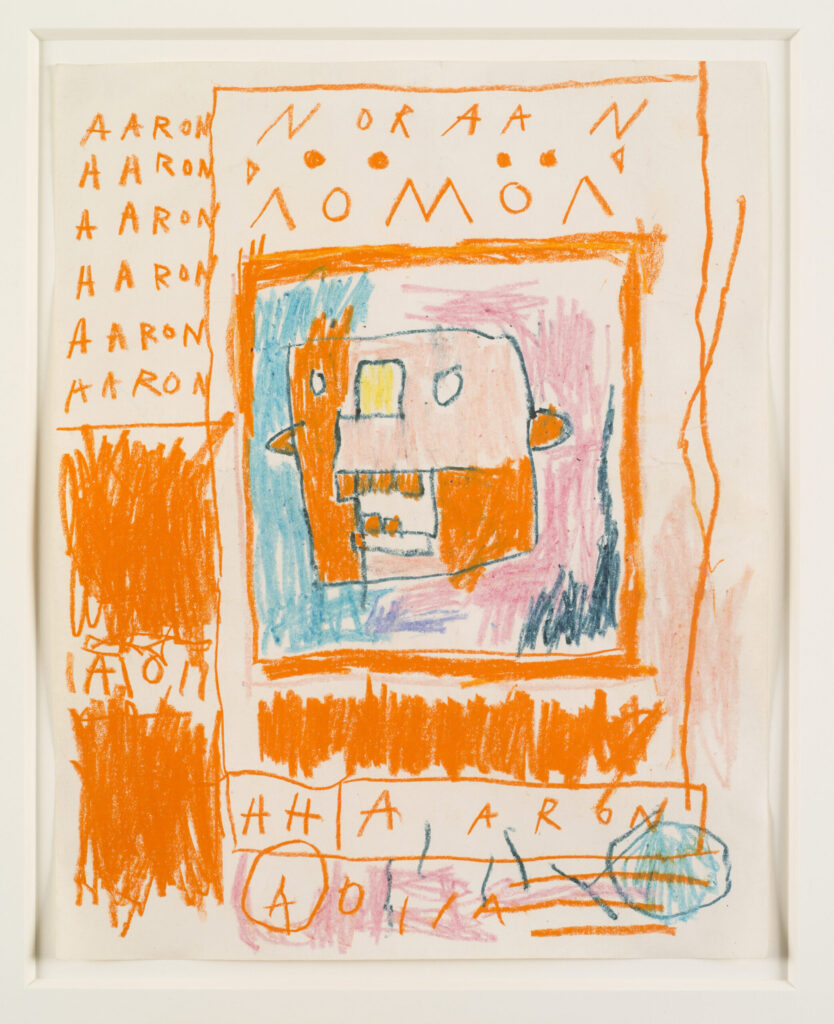
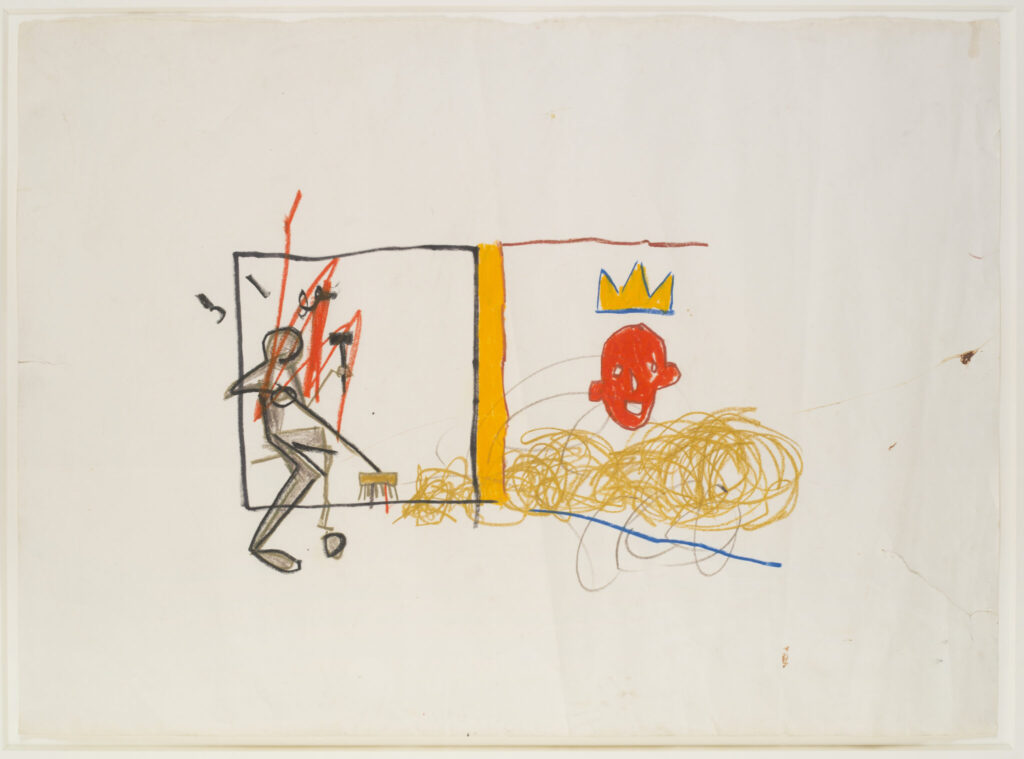
Basquiat didn’t so much paint as unfold his mind across canvas, paper—any surface. “No one else ever handled canvas like that,” writes artist and author Charlie Fox in the accompanying exhibition text. Untitled showcases a selection of works that are emblematic of Basquiat’s short yet powerful career, spanning from the late 1970s to 1987. Drawings on paper reveal the immediacy of his art, the raw, unfiltered energy of the “radiant child” of the New York art scene, who continues to represent urban youth culture across the globe, decades after his untimely death.
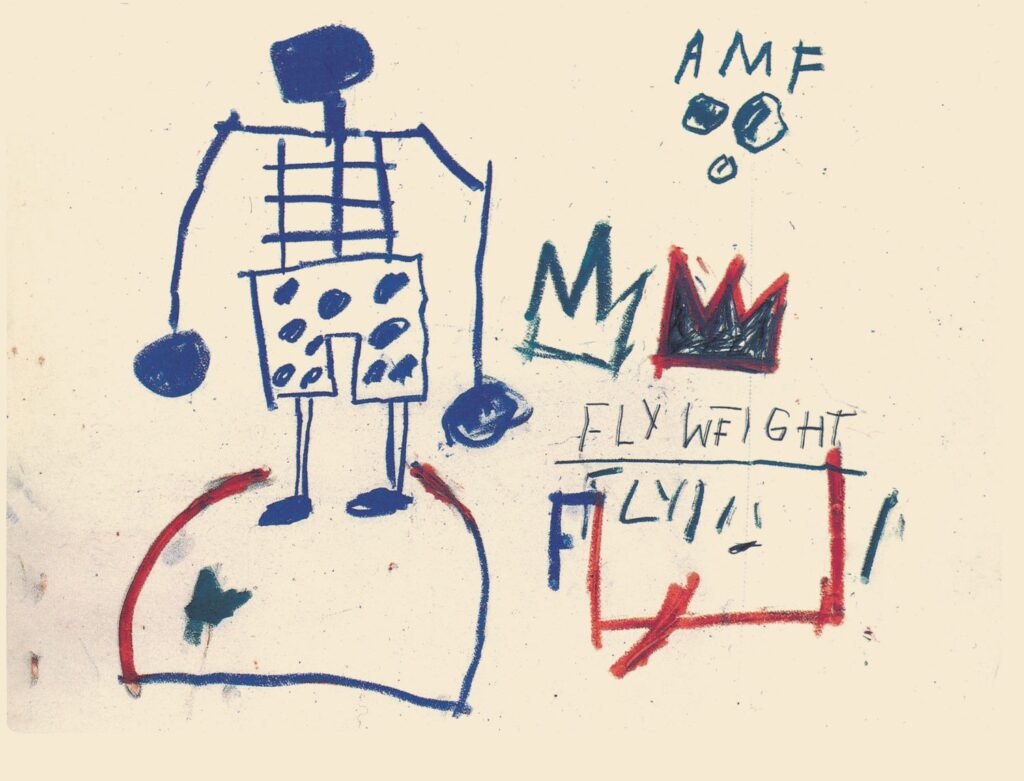
He uses bold brushstrokes, sketches, texts, symbols, hip hop rhymes, and his signature crown—employed obsessively—and connects them in unexpected ways within compositions that exude childlike spontaneity. He always sought to “paint like a child,” yet his aim was to deliver sharp social and political messages.
The exhibition invites visitors to encounter some of the early drawings of this self-taught Neo-Expressionist. Each work sketches out collective emotions and personal experiences—such as the car accident that led to surgery when he was just seven. Untitled (Portrait of Joe Louis) (1982) is a tribute to the legendary boxing champion (1937–1949), nicknamed “the Brown Bomber,” a recurring figure in Basquiat’s oeuvre, here rendered as a cartoonish totem. Champion, legend, and commodified icon—this is a reminder that glory and money are equally brutal games. Everything is a commodity: sports, the body, the painting itself. Jean-Michel Basquiat’s signature (drawn on a piece of paper also displayed here and which inspired the exhibition’s title) is a commodity too. The same critique is evident in Loans (1984), painted with watercolor and oil on cheap paper. After all, this is 1980s New York—Reagan’s America, Wall Street’s playground.
The work Untitled (Alice in Wonderland, 1983) is like a psychedelic reconstruction of Lewis Carroll’s entire classic tale on a single page, infused with Basquiat’s explosive visual language: the Cheshire Cat with kaleidoscope eyes, the Mad Hatter with a price tag on his hat, the caterpillar, the crocodile, the White Rabbit’s clock stuck just before midnight. If you decode Basquiat’s Wonderland, you’ll find New York pulsing underneath—in all its madness and magnificence.
The Western Kid (1981) is one of Basquiat’s shortest yet sharpest texts: “A kid raised on westerns sits in the lap of an Indian chief. ‘I’m not Jewish,’ the kid says. Flashback to the Crusades.” A commentary on American mythology, historical distortion, and the tragicomedy of the world. It’s a typical example of Basquiat’s intent to expose racism, portraying scenes of minority struggle in America—especially that of the African American community. A struggle that affected him personally, as his father was from Haiti and his mother from Puerto Rico.
The exhibition Untitled proposes an open-ended reading of Basquiat’s work—not as a static, museum-like representation, but as lived experience. A journey in which the rhythm of the works resonates with the jazz improvisations of his hero, Charlie Parker.
The exhibition space has been studied and designed by Kois Associated Architects, creating an environment that amplifies the power of Basquiat’s work and highlights the exhibition’s dialogue with the urban and industrial fabric of Piraeus.
BIOGRAPHICAL NOTE
Jean-Michel Basquiat was born in 1960 in Brooklyn, New York. At the age of 17, he left home to live on the streets of New York City, where he found refuge in art. He began painting graffiti on city walls under the pseudonym SAMO (same old shit), alongside Al Diaz—the other half of the artistic duo. The intensity and instantly recognizable style of his work quickly made him an integral part of the emerging New York art scene of the 1980s.
His participation in the group exhibition New York/New Wave at MoMA PS1 in 1981 marked a turning point in his career, opening the doors to the international art world. Within a few years, he participated in Documenta 7 in Kassel, Germany, becoming the youngest artist ever invited to the exhibition, graced the cover of The New York Times, and collaborated with his idol, Andy Warhol.
Basquiat’s work fused the personal with the political, the poetic with the spontaneous. He drew inspiration from jazz, Black history, pop culture, medical illustration, and the streets of New York. Though he had no formal academic training, his sharp instinct helped him construct a complex visual language that deeply influenced contemporary painting and inspired the next generation of artists. His work continues to be exhibited worldwide, reinterpreted, and in constant dialogue with the present—most notably through major institutional exhibitions such as the 2019 show at the Fondation Louis Vuitton.
Info
Jean-Michel Basquiat: Untitled | The Intermission Gallery
Exhibition Duration: May 22 – August 2, 2025
Opening Reception: Thursday, May 22, 6 – 9 p.m.
Location: 37A Polydeykous Street, 185 45 Piraeus
theintermission.art
Opening Hours: Wednesday – Saturday, 12 p.m. – 8 p.m.
The Intermission 37A Polydeykous Street Piraeus 18545