 elc team
The CAN Christina Androulidaki Gallery presents Nikos Markou’s exhibition titled “Gazi, 1982–1984.” The exhibition features 13 black-and-white photographs – rare vintage silver gelatin prints, printed analogically by the artist himself in the darkroom in 1985-alongside 12 color photographs from the same period.
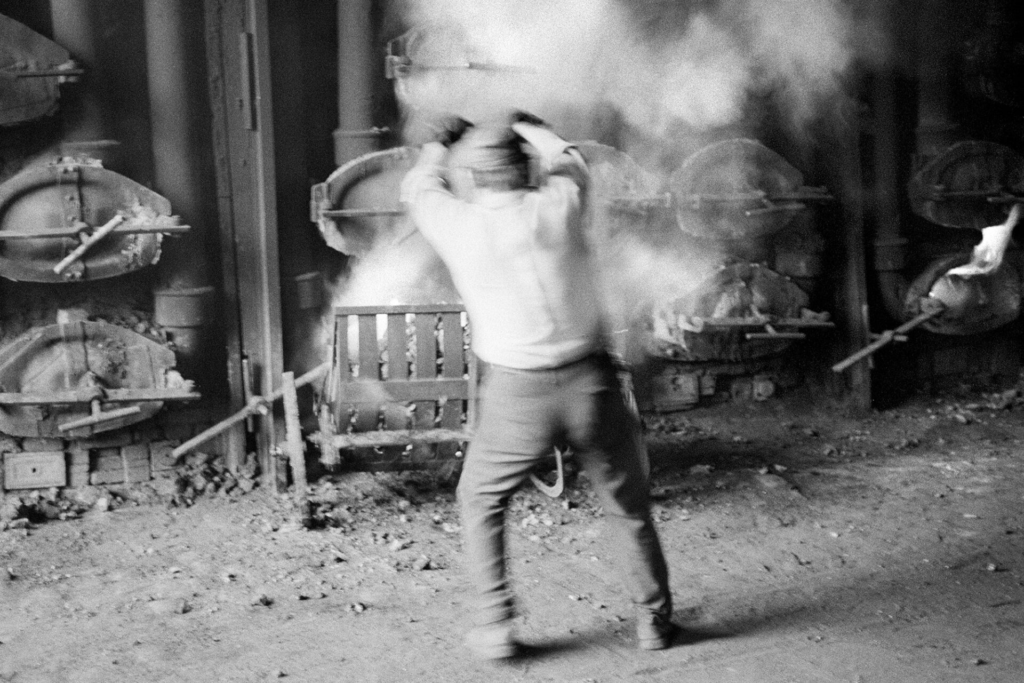
The photographs depict Gazi at a time of deep transition: just before the closure of the gasworks in 1984. Founded in 1857, the factory is not merely a significant industrial complex, but also a historic site, which the artist documents-together with its people-at a pivotal moment in modern Greek urban history, just before it fades and disappears entirely.
Nikos Markou first officially entered the site in 1982, after repeated-nitially unsuccessful-attempts to secure permission to photograph there. He continued to return for approximately two years, gradually completing the project. He chose to photograph mainly on winter, overcast days, so that the light would not “burn” the image by falling too harshly on surfaces. Through this choice, he begins to form the visual language that he would develop over the next four decades: a conscious use of light and shadow as structural elements of form. His chiaroscuro remains soft, allowing detail to emerge through smoke, tar, dust, heat, and the blackness of coal that covers everything, while the space seems to operate outside of time-a place where everything is, both photographically and in reality, black and white.
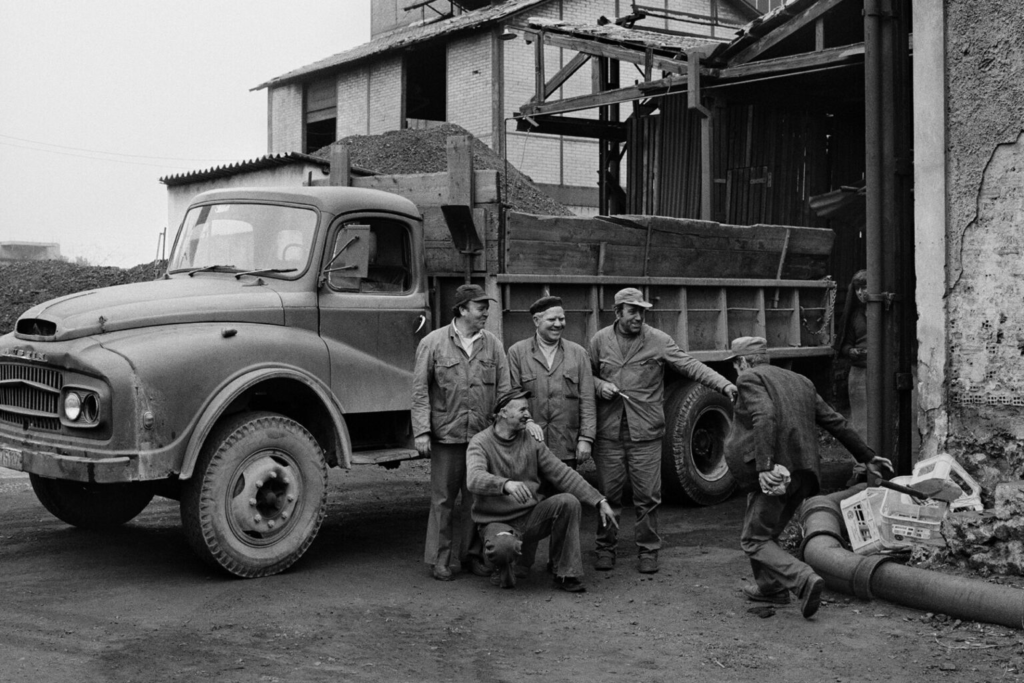
As he notes: “Passing through the factory’s main gate in 1982, I was transported to 1857. Working conditions had not changed for one hundred and twenty-five years.” It is telling that for every 15 minutes of work, workers had to take a 20-minute break-an indication of the extreme physical strain this labor required. At the center of his interest are the faces that make up this world-the constant alternation between labor and rest, this uninterrupted diptych and continuous passage from one state to another. In this spirit, the right wall of the gallery presents a strict sequence of 13 black-and-white images, reflecting this ongoing alternation: scenes of hard labor and their in-between pauses, where workers sit to rest, stand and smoke, or pose for the camera.
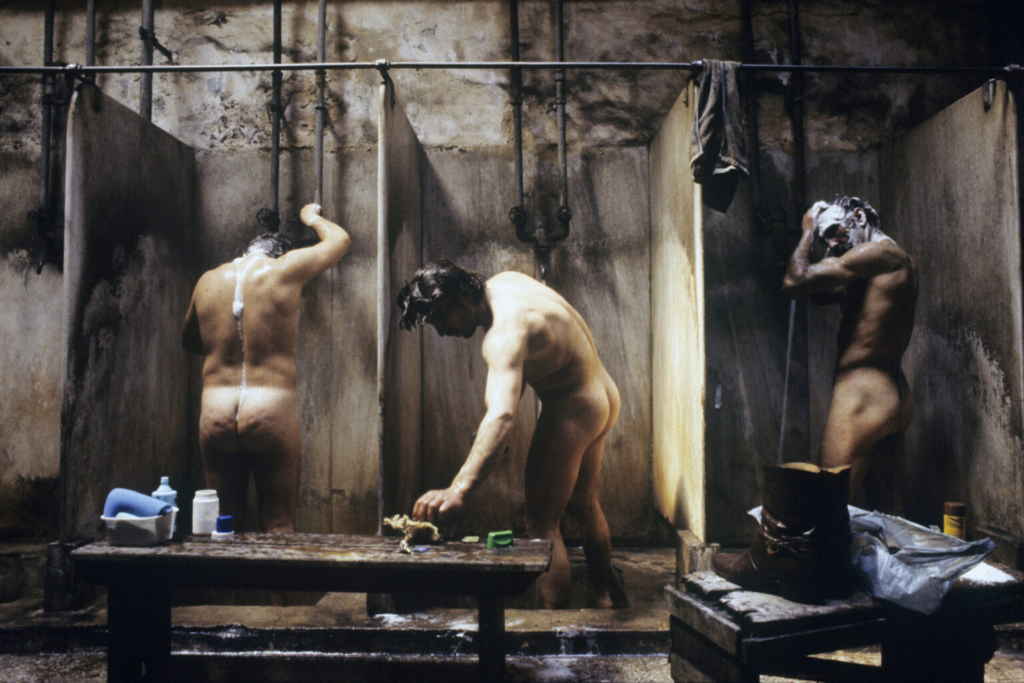
While the factory itself appears as an almost monochromatic field, erasing any chromatic variation, Markou reveals, in contrast, another universe within the baths. When he eventually slips into the showers, his presence provokes no reaction; the workers have grown accustomed to him moving among them with his camera. At each visit, he prints the photographs taken the previous day and shares them with them, and they receive them with joy-as images of their work, as a “gift” that was far from given. In this way, his presence becomes fully integrated into their daily life, allowing him to document a deeply private and previously unseen space, in moments that feel entirely natural and unstaged.
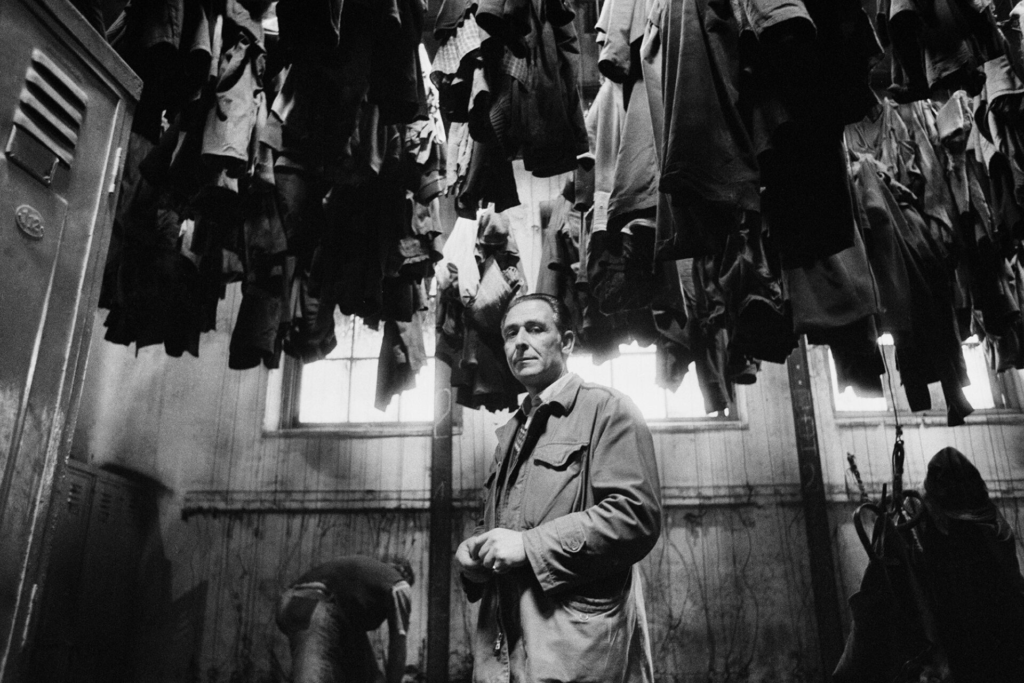
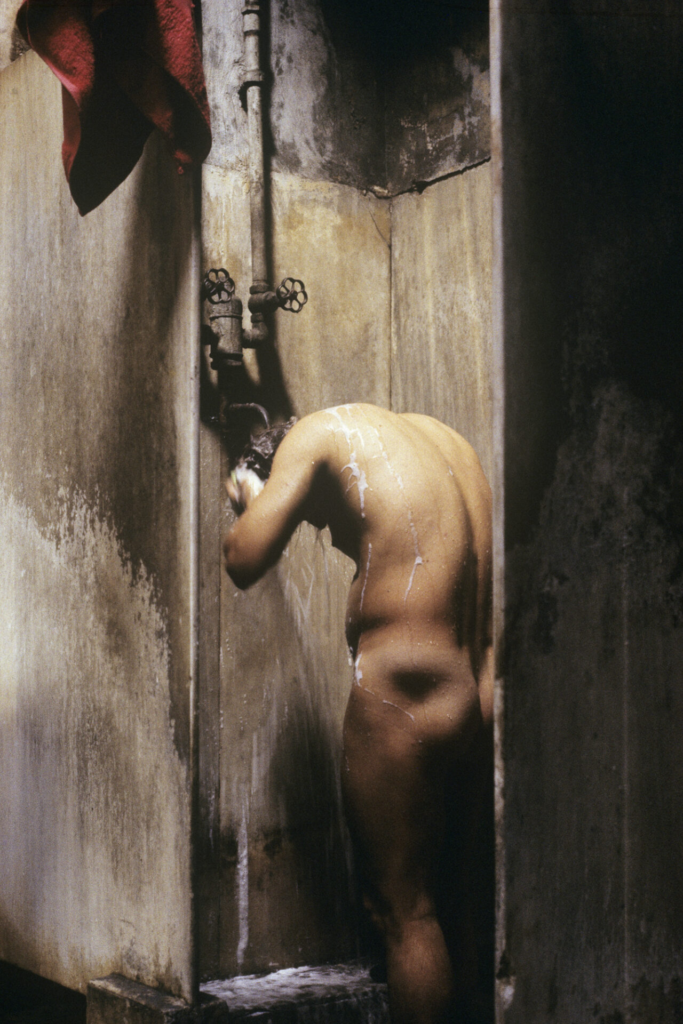
“This happened after six months,” he recalls. “There was a space where they left their civilian clothes when they changed into their work uniforms. They would hoist them up with wire cables, like in old dry cleaners. At some point I found myself there, noticed a wooden door, and asked where it led. They told me it was the baths. I asked if I could go in, and they said ‘go in.’ I entered-five or six men were showering, laughing, joking among themselves. They didn’t pay attention to me; after so long there, they knew me. I wouldn’t say they were only tired bodies; there were also young, hardened men among them. The partitions were marble, which, with humidity and rust from the pipes, had developed incredible patinas, and there was a skylight letting in light, since the electric lighting was dim. […] The baths were the only part of the space that had color; everything else was black and white. That’s where my interest in color began, which is why I photographed the baths in color.”
This transition concerns not only the medium, but also the very act of seeing: from documenting labor to observing materiality and surface. In the baths, Markou does not simply change subject; he changes the way he sees as an artist-what he considers worth capturing and how he captures it. Color functions as a tool for revealing matter.
The bath series captures both everyday life and a sense of timelessness. Naked male bodies, seen without idealization or embellishment, exist in a space where time seems to slow down and the body, freed from its function, returns to its materiality. Familiar yet quietly heroic bodies testify to a silent human intimacy born from coexistence and shared labor. Any sense of eroticism arises as a byproduct of the condition itself-an ambiguous quality that permeates the scene without defining it. The Gazi series was first presented in 1985 and has since remained one of the most cohesive photographic documents of modern Athenian history.
Today, 41 years later, it returns as an active field of interpretation: an archive that carries within it the human presence, the experience of labor, the materiality of space, and the transition from an industrial to a post-industrial city. The exhibition sheds light on an Athens that is no longer visible, yet persists through its traces and transformations.
Bio
Nikos Markou (b. Athens, 1959) is a graduate of the Mathematics Department of the University of Athens and has been working as a professional photographer since 1980. He has presented his work in sixteen solo exhibitions, including: Gazi 1982–1984 (CAN Christina Androulidaki Gallery, Athens, 2026), Topos (Citronne Gallery, Poros, 2020), Inner Space (Citronne Gallery, Athens, 2020), Cycladic Café Art Project (Museum of Cycladic Art, Athens, 2018), The Future Lies Behind Us (AD Gallery, Athens, 2014), Monumenta Naturalia (AD Gallery, Athens, 2012), Topos: Aspects of Space (Thessaloniki Museum of Photography, 2010 and PhotoEspaña, OpenPhoto Cuenca, Spain), Perama, Aspects of Greek Photography (Nice Biennale, Galerie Mossa, Nice, France, 1998), Gazi (Astrolavos Art Space, Athens, 1997 and Athens Photography Center, Athens, 1985), among others. He has participated in more than sixty group exhibitions, including: Why Look at Animals (EMST, Athens, 2025), Embrace Empathy (Vorres Museum, Athens, 2024), The Sea Around Us (Tavros, Athens, 2022), The Luleå Biennial: Tidal Ground (Luleå Konsthall, 2018), Geometries (Onassis Stegi / Agricultural University of Athens, 2018), Places of Memory (Athens Photo Festival, Benaki Museum, 2016), Faces. Portrait Photography in Europe since 1990 (PHotoEspaña, Madrid, 2016), Sense of Place: European Landscape Photography (BOZAR, Brussels, 2012), among others. He has published two monographs, Geometries (ADAM Editions) and COSMOS (tetarto Editions). He is represented by CAN Christina Androulidaki Gallery, Athens.
Info
Opening: Saturday, April 4, 2026, 12–4 PM
Duration: April 4 – May 9, 2026
Opening Hours:
Tue–Fri: 12–8 PM
Sat: 12–4 PM
Location: CAN Christina Androulidaki Gallery
Chalkokondili 19, Athina 104 32, Greece