 elc team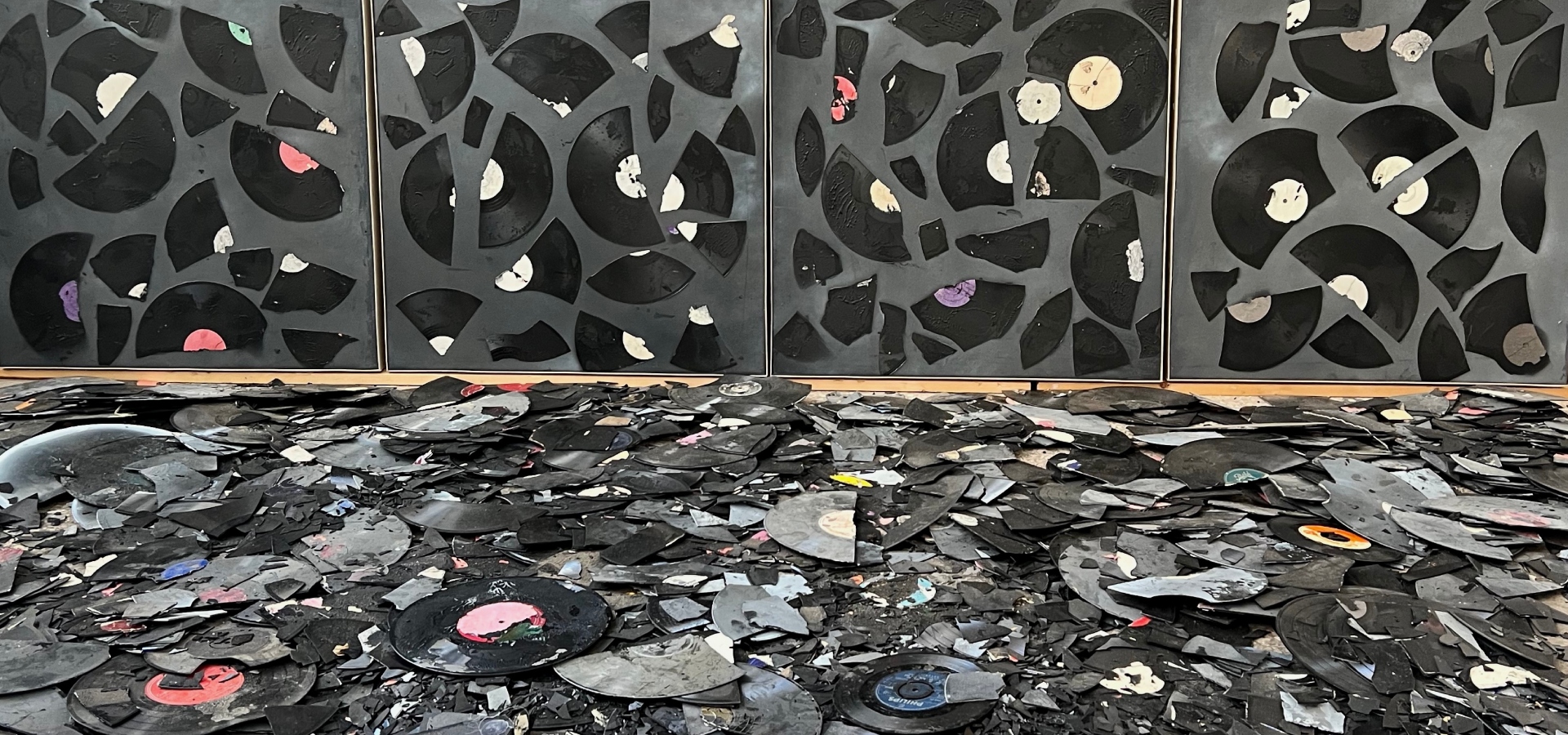
CITRONNE Gallery presents the solo exhibition of Panos Charalambous, “COLUMBIA – Die Ruinen von Athen.”
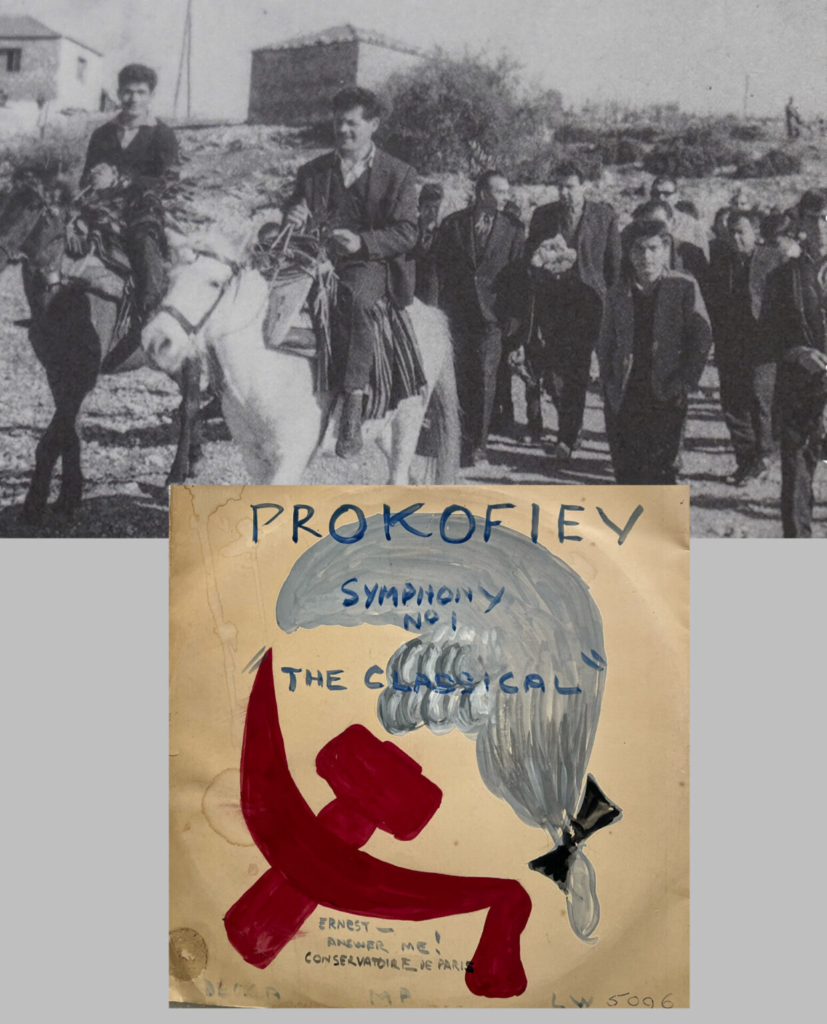
The exhibition “COLUMBIA” continues Charalambous’ earlier project, AMVRAKIA.MIA (CITRONNE Gallery, 2024). Its title draws from the historic Columbia factory in Rizoupoli, an emblematic site of the Greek recording industry. The artist expands his research around memory, sound, lived experience, and the material traces of experience.
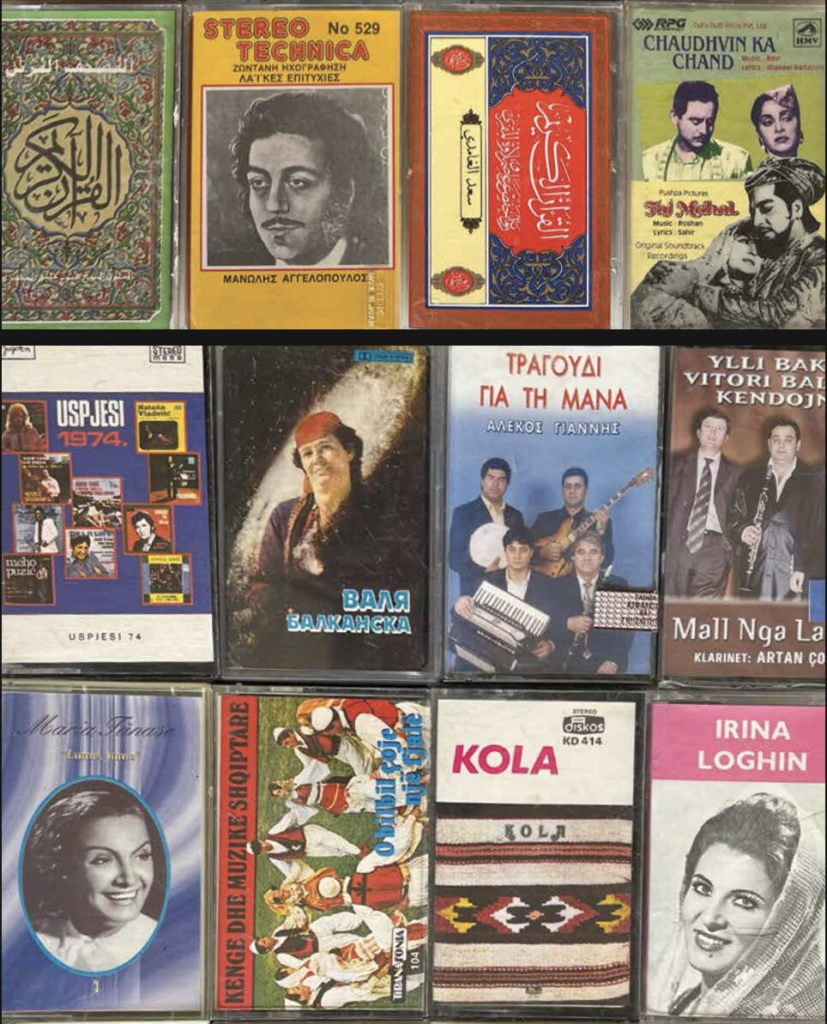
This exhibition refers to a broader acoustic culture, where voice, song, and music were once embedded in vinyl records. The demolition of the Columbia factory marks a pivotal moment: a historic site becomes a ruin and ultimately a residue. This residue–survival through loss–lies at the core of Charalambous’ work.
The artist activates the architectural elements of the gallery space to subtly reconstruct the Columbia gate–that is, the memory of the factory. Thus, the entrance to the exhibition becomes an entry point into memory. Within this spatial proposition unfolds the first part of the modular installation: the audio room. On an oversized table rest vinyl records, turntables, speakers, garlands of tobacco, shells, a taxidermied eagle, sharp leaves of agave plants, and The Magic Mountain by Thomas Mann–a contemporary “personal” still life. Sound, whether produced by nature or by vinyl, does not emerge from visible speakers, but travels through tobacco leaves and shells, which function as sound conduits.
Vinyl records, as structural elements, are approached as bodies marked by wear, use, movement, and time. The taxidermied eagle symbolically balances between life and afterlife, between strength and fragility–just as the entire installation oscillates between sound and echo, presence and absence. The sharp agave leaves and shells form a harsh, Mediterranean, almost liminal entity. The presence of Mann’s book introduces interiority, duration, and depth.
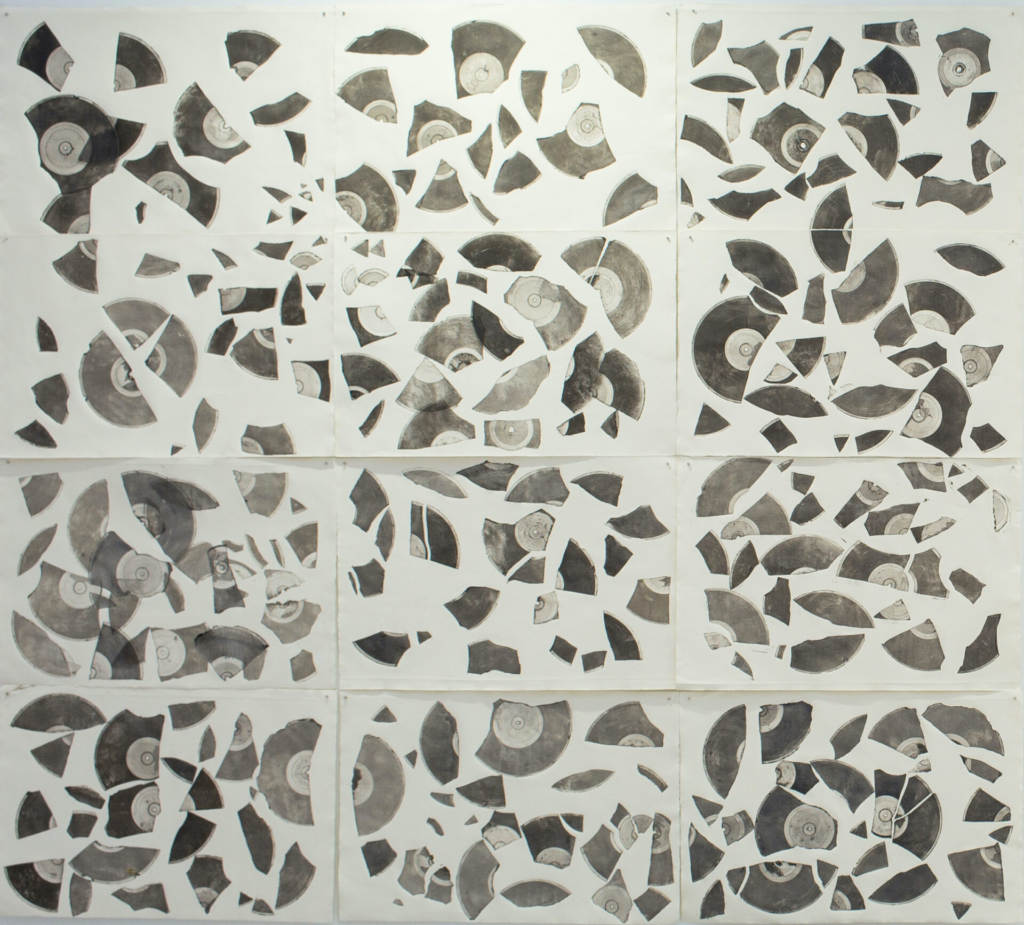
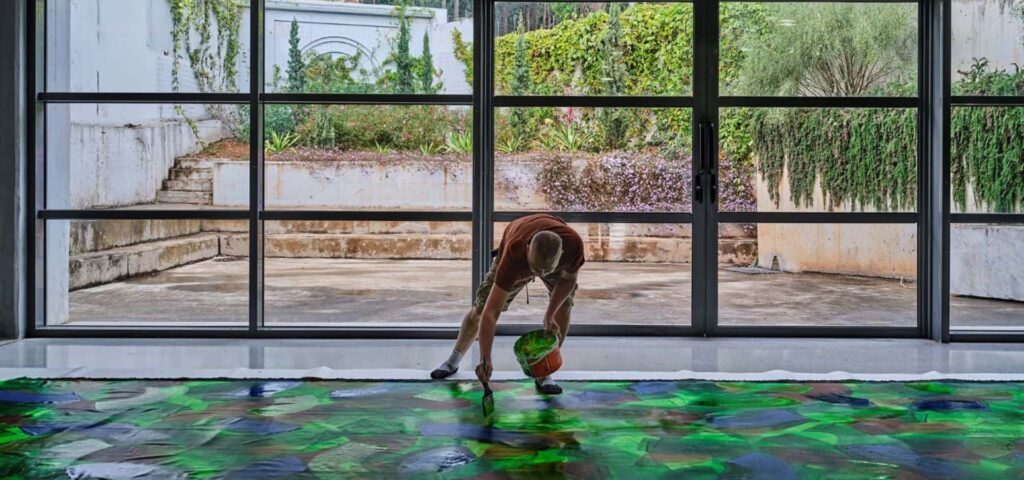
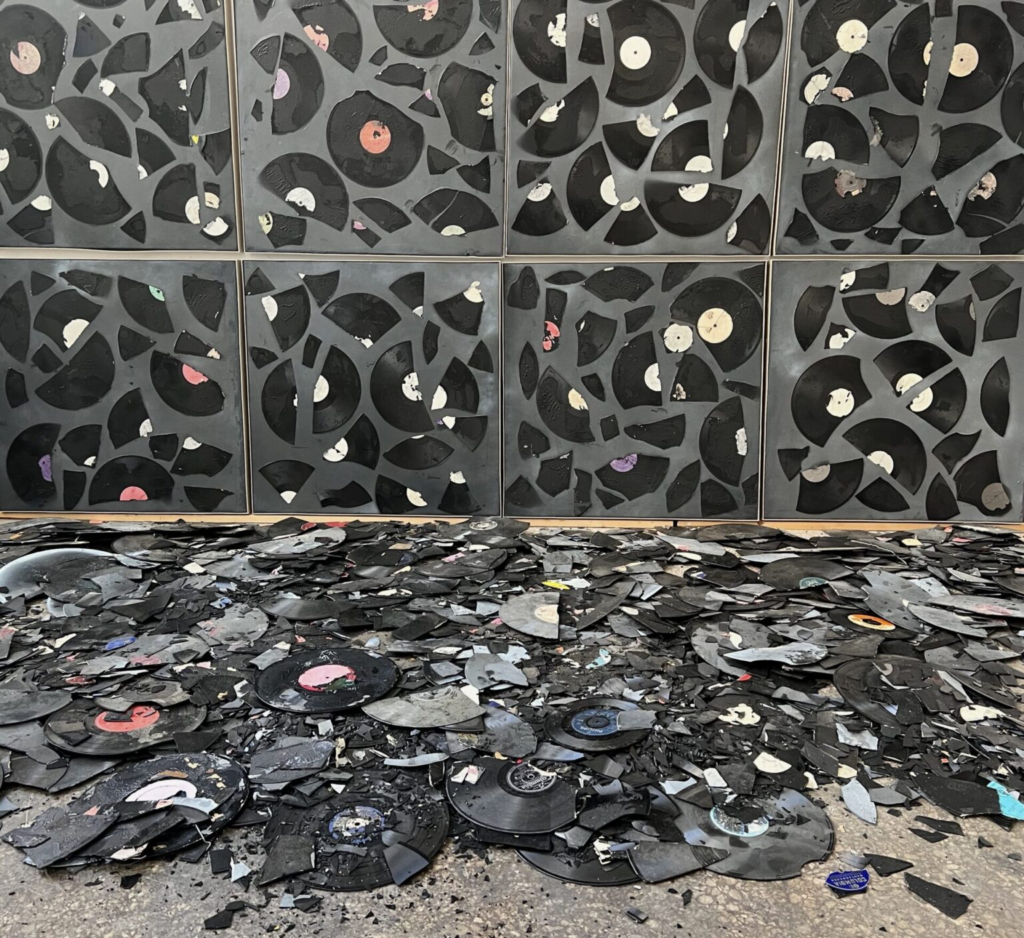
In the second installation, Charalambous returns to a key formal and conceptual element of his practice: the musical floor. In this exhibition, the musical floor becomes a field for rearticulating the fragmentation of memory. The artist uses broken vinyl records as matrices to imprint onto canvas, later intervening with paint. The vinyl itself leaves marks, engravings–the morphology of wear. Once a carrier of sound, memory, and inscription, vinyl is transformed into a tool of visual writing.
At the same time, a frieze composed of individual tile-like fragments extends across two walls in the back room of the gallery. It retains the memory of the floor, yet lifts it from the horizontal plane to the vertical. The musical floor–once a site of movement, action, and sonic activation–becomes wall, image, sequential surface, almost an archival strip. Still, it remains more than a painting: it functions as a fragmentary reconstruction of a sonic and functional past. Beneath the frieze, vinyl records accumulate like a mountain of fragments. This “mountain” acts as a sculptural equivalent of a ruin. A video of hail striking the vinyl introduces a random, violent intervention upon already worn material. The impact generates unpredictable, almost destructive sounds.
This installation serves as the concluding point of the exhibition–not because it “ends” the journey, but because it condenses it. The musical floor, the imprint, the painterly intervention, the frieze, the mountain of fragments, and the hail video form a unified site where sound becomes image; image becomes trace; and the fragment becomes a carrier of memory and reactivation. Charalambous does not simply arrange objects in space; he mediates between sound, matter, and memory.
Panos Charalambous is among the most significant and established artists of the contemporary Greek scene. His work has been presented, among others, at documenta 14 and at the 58th Venice Biennale in the Greek Pavilion. His long career combines artistic research, teaching, practice, and institutional presence, shaping a distinct and influential field within contemporary Greek art.
During the exhibition, audio happenings will take place, highlighting the sonic dimension of the work.
The exhibition is accompanied by the publication COLUMBIA, released by CITRONNE Gallery and Editions of the Twenty-First. This bilingual edition (Greek–English), featuring texts by Panos Panopoulos, Tatiana Spinari-Pollalis, Giorgos Tzirtzilakis, and Panos Charalambous, functions as a “printed exhibition,” where text and image together document the multifaceted nature of the artist’s work and research.
Curated by: Tatiana Spinari-Pollalis
Info
Opening: Wednesday, April 29 | 19:00–22:00
Duration: April 29 – June 29, 2026
Opening Hours:
Tue, Thu, Fri: 11:00–20:00
Wed, Sat: 11:00–16:00
Location: CITRONNE Gallery
Patriarchou Ioakim 19, Athina 106 75, Greece