 KATERINA PARRI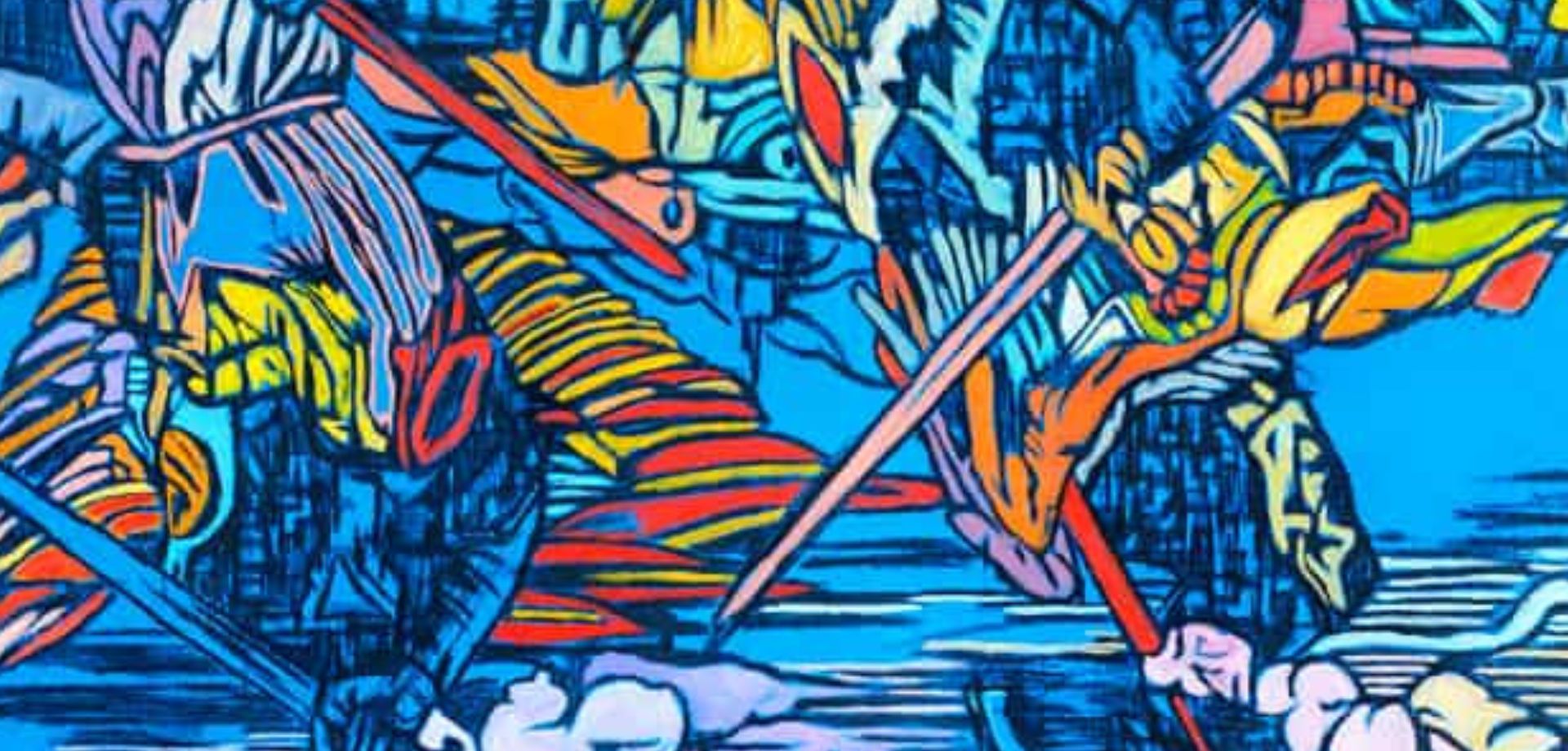
a.antonopoulou.art. gallery will be opening the new solo exhibition of Christos Athanasiadis entitled ‘Apocalypse’
In his in-depth study of Albrecht Dürer, the eminent art historian Erwin Panofsky notes that Dürer’s interpretation of the textual information of the Apocalypse was more vivid than that of his predecessors. He avoided repetition and condensed the episodes into fourteen dense woodcuts illustrating the chapters of the book, which he edited entirely himself. According to Panofsky, dramatisation was one of Dürer’s key principles in rendering the written text, but he did not rely entirely on it. Because of this dramatic intensity, when we look at the woodcuts of the Book of Revelation, we are not simply witnessing an episode; we are sharing in the visionary experience of the heroes – the Evangelist, for example – and in the metaphysical space in which the figures are placed.
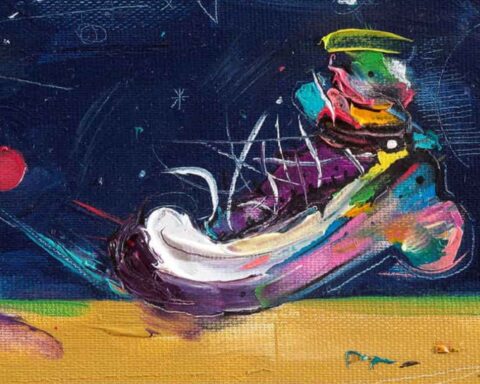
In his new solo exhibition entitled ‘Apocalypsis‘, Christos Athanasiadis attempts a bold and original transcription of Dürer’s iconographic world. Borrowing motifs from his woodcuts and deconstructing the Gothic decoration that characterises them, he searches for forms that create a new form. The key word here is “reconfiguration”: Athanasiadis does not repaint Dürer’s drawing, but builds on it – with colour. The work is not a filling in of colours and shapes, but the result of a complex and difficult process in which colour plays a leading role. Painted in charcoal and oil on canvas, the paintings in the exhibition are an elaborate reconfiguration of the figures of the Apocalypse.


In Athanasiadis’ work, drawing and painting coexist and interact. The drawing supports the painting by forming its basis, and the painting completes the drawing by composing the final image. Avoiding blending and mid-tones, the painter uses bold tile colours to evoke medieval stained glass. In this way he creates a sense of transparency and lightness. His forms do not (want to) be heavy. You get the impression that they are not standing anywhere, that everything is floating in a colourful sky, in a space without boundaries.
And while no two works are the same size or have the same ground colour, they are all organically connected, forming a single, unbroken whole. Dürer’s world exists – and does not exist – within these paintings. It appears inverted, detached from its original context: shooting stars are lifted into the sky, clouds become solid blocks of colour, narrative is abolished, the landscape is folded, forms and bodies merge into a chaotic mixture of elements and patterns. Here the human (the hands, for example) is intertwined with the meta-human, and revelation is translated – or reduced – into abstraction.
Even those who are familiar with Dürer’s Apocalypse will find it difficult to discover his incomparable style in these paintings. And yet, in a strange way, Panofsky’s pertinent observations also help us to understand Athanasiadis’s paintings. Significantly, the ‘dematerialised’ power of the lines of the creator of the Apocalypse woodcuts also pervades the Greek artist’s painting. If Dürer’s innovations imbue the viewer with a ‘sense of fantastic unreality’, the same could be said of Athanasiadis’s eccentric compositions, which disorientate the gaze and do not allow it to remain fixed in one place. The same can be said of the ‘abstract transparency’ of the drawing and the way in which the three-dimensional space is rendered, emphasised and at the same time negated. Like Dürer, Athanasiadis concentrates on the essentials, giving us a “complex network of forms whose message must be decoded rather than grasped at first glance”. But unlike the strict symmetry and graphic economy of the former’s compositions, the latter’s lines seem uncontrollable.
On the other hand, one suspects that in this case Dürer is only the occasion. Athanasiadis’ “Apocalypse” refers indirectly to the revelation of painting, to the revelation of its unknown and multiple mechanisms, to its ability to generate new images from forms that belong to its past and its history. To reconfigure an existing image, however masterly, is to revisit its basic components in order to discover and reveal the essence of painting and its deeper meaning. Athanasiadis is not one of those painters who follow the easy way out or the dominant trends. Having studied in the home of the Renaissance, Italy (where Dürer travelled in his youth), his gaze is firmly fixed on the great masters – painters and poets such as Dante – who have shaped our gaze and the way we see the world.

Athanasiadis’ “Apocalypse” expresses the need to communicate a “divine truth” that is more about the immortal art of painting and its heritage. In front of his paintings, which are reminiscent of stained glass windows, one imagines the light penetrating the paint and travelling through time. Ultimately, this is the deeper truth hidden in his brilliant works: revelation here means first and foremost a fascinating journey to the sources of art.
Christopher Marinos – Art historian and curator
Info
‘Apocalypse’ | Christos Athanasiadis| a.antonopoulou.art. gallery | 16 Jan. – 22 Feb. 2025
Inauguration: Thursday 16/01/2025, 7-10 p.m.
Friday, Thursday, 10:00 am – 10:00 pm – 10:00 pm – 10:00 pm
Opening hours: Wednesday, Thursday, Friday 14:00 – 20:00 & Saturday 12:00 – 16:00
a.antonopoulou.art. gallery, Aristofanous 20, Athina 105 54