 PEPI NIKOLOPOULOU
A Festival at the Crossroads: Yorgos Ziavras on Art, Risk, and the Prespes Landscape
In the heart of Prespes, where silence carries centuries of history and the landscape becomes a living stage, the TRIETHNÉS International Music Festival sets out to transform a borderland into a site of artistic convergence. Rooted in experimentation and a desire for meaningful dialogue between the old and the new, the local and the global, the festival seeks to give voice to a region that often remains silent.
The festival’s Artistic Director, Yorgos Ziavras, speaks with passion about the vision behind this bold initiative. About the need for the arts to connect rather than divide, about Prespes as an inexhaustible source of inspiration, and about the cultural identity of the Balkans as a fertile ground for creative expression. In a time when everything feels already said, Ziavras embraces risk as a leap of faith toward something genuinely new.
TRIETHNÉS is not just a festival, it’s a vision for Prespes as a new cultural hub in the Balkans. What was the initial spark that led you to this idea and why here, why now?
The first spark was ignited around six years ago. I was hiking in the area’s mountains and was dazzled by the beauty of the landscape, the unique stillness of the place (helped by the lake, which absorbs harmonics), and the rich, multilayered history. It was a somewhat associative first thought of “here.” The “now” came after the idea matured, the conditions aligned, and we had an excellent first artistic initiative last year in the region, as part of the program All of Greece One Culture.
Prespes’ tri-national geography carries significant historical and symbolic weight. How can this particular location become a place of artistic dialogue and connection, rather than division?
Honestly, I can’t give you a definitive answer. There are no ready-made solutions in these matters, international experience shows that. What I can say so far is that the permanent residents of the Tri-border area are overwhelmingly open to actions and efforts that aim to bring people together. And art, historically, has rarely tried to divide, it has connection and transcendence in its very DNA. That is definitely our aim.
One of the most compelling aspects of the program is the encounter between contemporary musical creation and local traditional music. Why is this combination important to you, and what does it reveal about Balkan cultural identity today?
Contemporary music is inherently experimental it seeks to express what hasn’t yet been said (at least in its successful manifestations), though of course, it always builds on something; immaculate conceptions exist only in the realm of the imaginary. Traditional music, by contrast, is characterized by the repetition of what time has rendered “tradition.” This doesn’t mean it doesn’t evolve – it does, but within narrower frames. So it’s like blending two seemingly foreign approaches, only to discover they’re not so foreign after all.
Furthermore, we’re deeply interested in working with the musical traditions of the area we’re activating, since these are the musics born of this land. We use them as material for experimentation – offering composers “toys to break,” so to speak. The Balkans are a huge cultural melting pot- even geographically, they sit on a threshold. What better place for these unconventional fusions? Not that the Balkans need us – we need them. They can and should be an endless source of inspiration, and we hope to help highlight that.
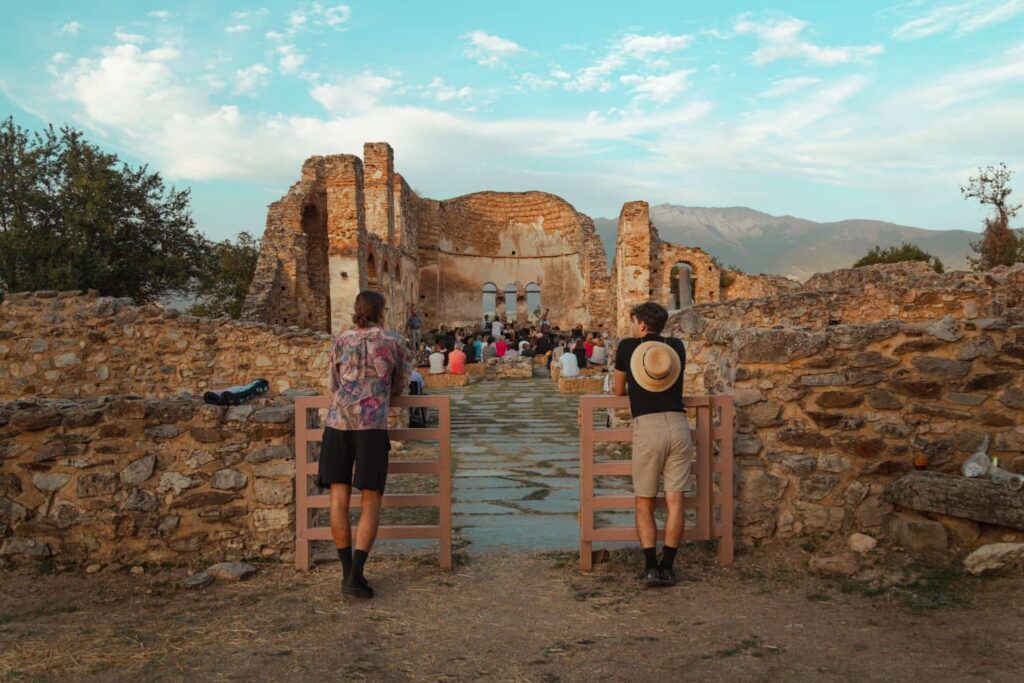
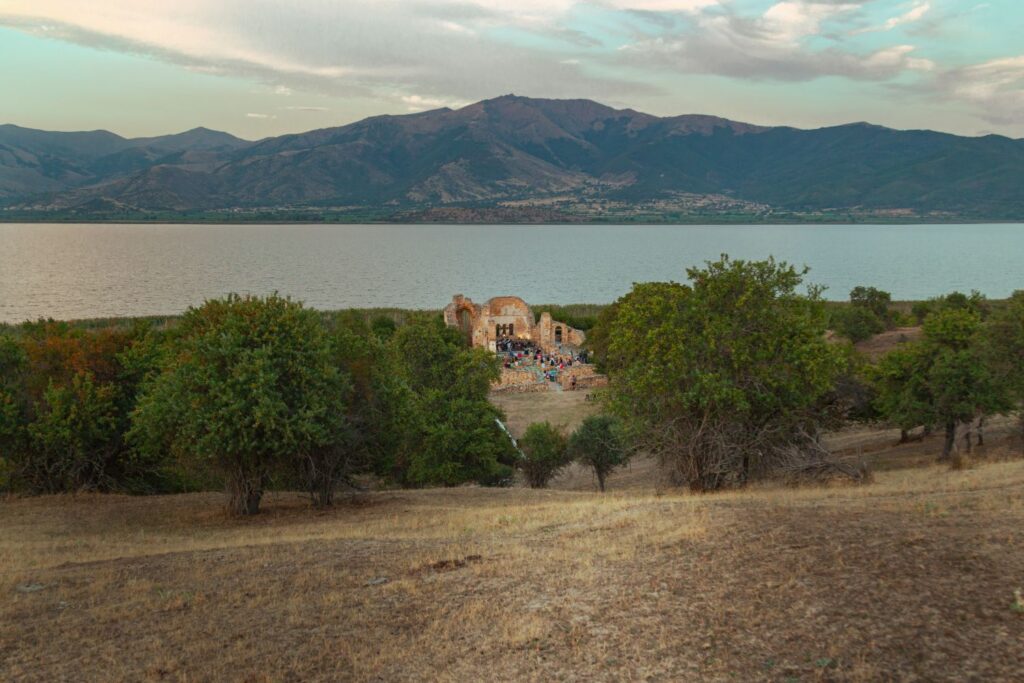
From placing a piano in a stone quarry to collaborating with polyphonic groups in unusual settings, the festival clearly embraces experimentation. What role does artistic risk play in your curatorial approach?
Look, there’s risk in everything in life. Even in psychoanalytic terms, the life drive pushes you relentlessly toward the unknown. Personally, I see no point in not taking risks – especially in a world that often feels like everything has already been said. So we take risks to explore the possibility (or, in my opinion, the certainty) that there is still something truly new to say.
That said, the experimentation in our programming is deliberate. These choices may initially seem experimental – both to local audiences and to visitors more familiar with contemporary music – but in essence, they serve as bridges between genres and publics. So yes, it’s a risk – but one with significant potential rewards.
Launching the first edition of a festival is always a bold step. What are your hopes and ambitions for TRIETHNÉS in terms of legacy—artistically, locally, and across the Balkans?
Our goal is that, in ten years’ time, TRIETHNÉS will be a major international point of reference for “new” music and the performing arts more broadly. But we want to get there by first winning over the local community, the permanent residents. They’re the ones we want to embrace and believe in us first.
We aim to speak to everyone and convince them that the music we present has value and a place in their lives. We want to position TRIETHNÉS on the international map as a fantastic place to explore, experiment, and transcend boundaries. And above all, we want to help this beloved region grow, gain support, and shine, as we know it can.
In what ways did the natural and historical landscape of Prespes influence the aesthetic choices of this first edition of the festival?
Prespes is the landscape and human presence upon it, with all its historical depth. Every curatorial decision we made stems from and refers back to Prespes, and that will remain true in the years to come. Quite literally, the reason TRIETHNÉS exists is because of the irresistible pull of Prespes itself. It’s like an homage to the place.
And the beauty is that this source of inspiration is incredibly rich, inexhaustible, and – most importantly-relevant beyond the local context. This is not material for internal recycling; it speaks to broader and even global audiences.
What is the core objective of this inaugural edition? What would constitute a “sign of success”- artistic resonance, public engagement, future collaborations? And how do you envision TRIETHNÉS evolving in the years to come?
Our team’s organizational goals are clear: assess our capacity, identify and resolve potential issues, improve accessibility and attendance, and so on.
Personally, my goal is for the audience to take it personally. I want them to feel compelled to give us feedback, to talk to us about what they experienced -what challenged them, moved them, for better or worse. I want them to have ideas they feel excited to share. I hope they’ll want to contribute, to offer help, to tell others about the festival. That would be a very good sign for the future.
That, in a way, is part of what I dream of for the years ahead: to meet people at my performances around Europe who speak about our festival with the same warmth as the villagers of Prespes, who, ideally, will one day refer to it as “our festival.”