“I am a sculpture… There are other sculptures like me. The main difference is that they cannot speak… I would like to see all the nuclear bombs on Earth turned into sculptures.” — Takis
The symbol of infinity pays tribute to the 100th anniversary of Takis’ birth, as the Basil & Elise Goulandris Foundation, in both Athens and Andros, is magnetized by his work through a major retrospective exhibition titled Takis 1∞, on view at its museums from June 22 to November 2, 2025.
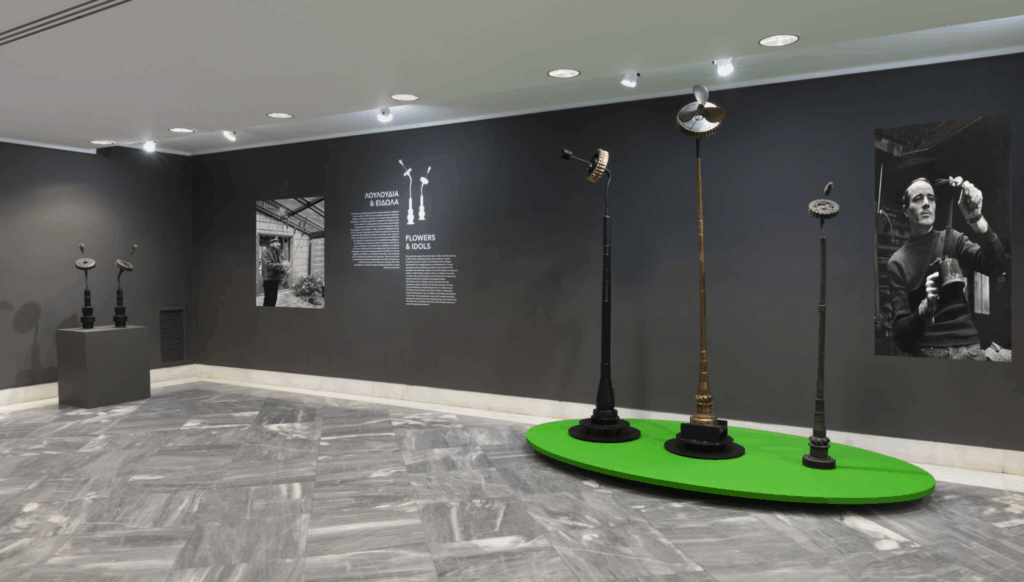
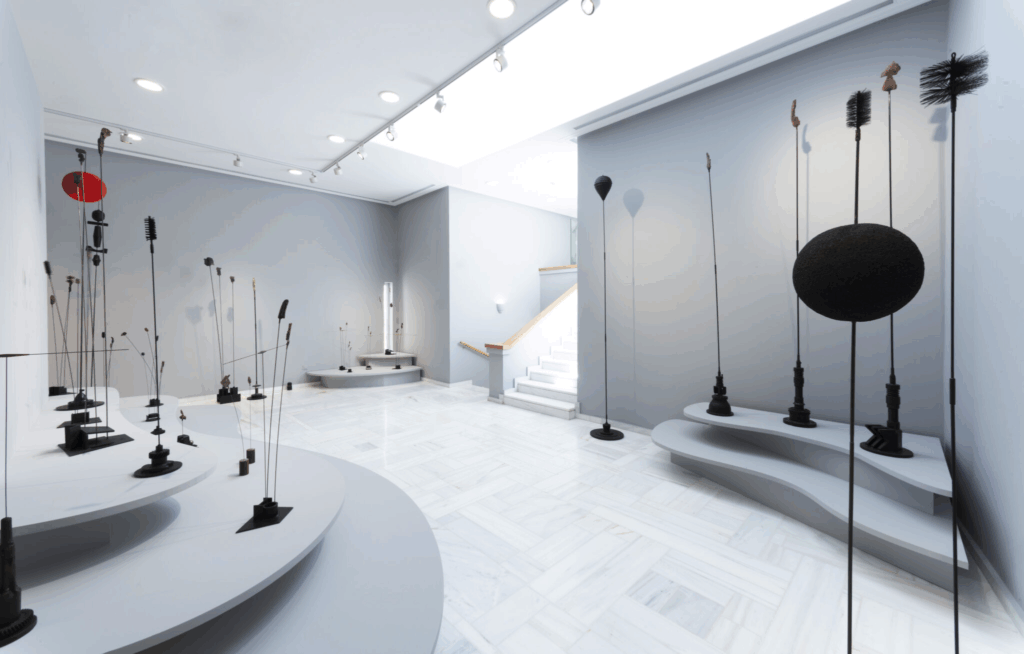
Among Takis’ works in Andros, over 30 Signals will be presented together, just as the artist had envisioned: like a forest.
For the first time in the Foundation’s history, all spaces usually dedicated to temporary exhibitions—across all three museums—will be entirely devoted to Takis. Over 150 works will be presented in a show that also marks the reopening of the renovated Old Wing of the Museum of Contemporary Art in Andros.
The exhibition is curated by Maria Koutsomalli-Moreau, Head of Collections at the B&E Goulandris Foundation, alongside Toby Kamps, head of the Modernist Collection at the Hamburger Kunsthalle and a specialist in Takis’ work. Koutsomalli-Moreau refers to this vast retrospective as a “puzzle” because of the artist’s prolific output—what proved most challenging was selecting the works and how to present them in a way that makes sense for the visitor. Kamps, who had worked directly with Takis in the past, curated the show with a constant awareness of what the artist himself would have ideally wanted.
Shared elements across the Athens and Andros presentations include the use of yellow, taken from Takis’ Magnetic Wall, which inspired the exhibition design, and the presence of sound works, as Takis always insisted that his exhibitions be infused with sound.
Maria Koutsomalli-Moreau shared the following with elc magazine regarding the Takis 1∞ centenary tribute: “I hope we achieve what Takis always wanted—to touch everyone. He believed that art isn’t something to be overanalyzed. He didn’t hold the art world’s professionals in particularly high regard. What mattered to him was the raw, first encounter with art—art that moves you and entertains you. The element of play in his works. Our next goal is for the visitor to see that, although self-taught, he was immensely talented from early on. This is especially evident in Andros, where we showcase his lesser-known early works. These pieces reveal a young man who, in the midst of Occupation, hunger, and even imprisonment, found an outlet through art—and through a tremendous natural gift.”
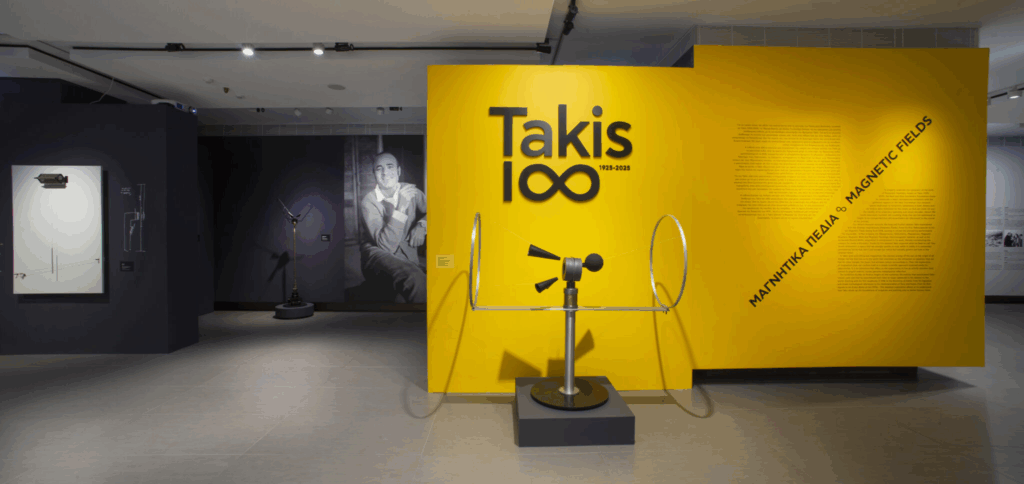
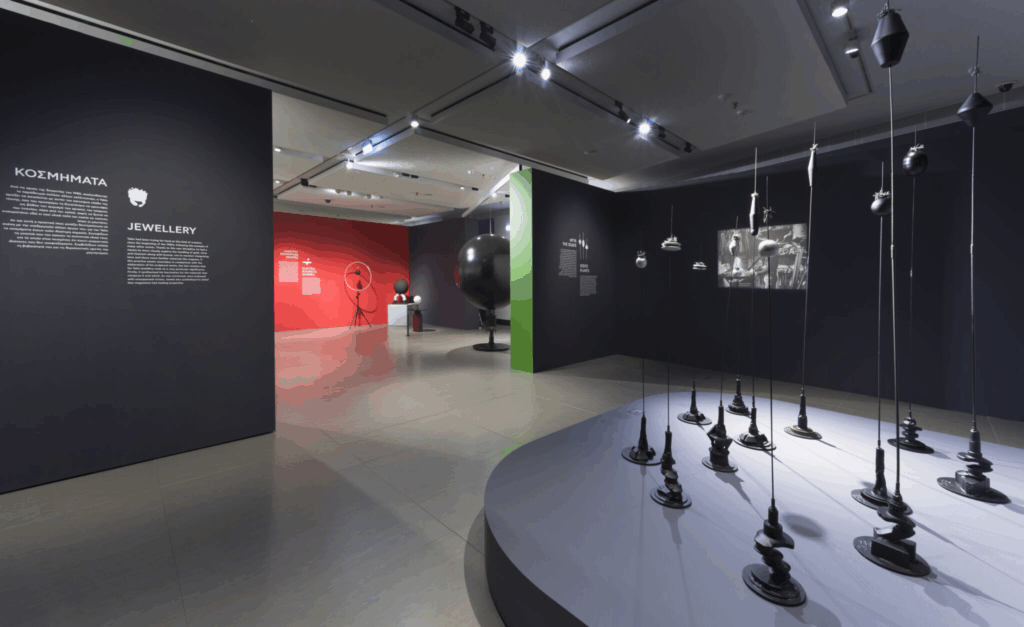
Mur magnétique jaune / Yellow Magnetic Wall, 1976 | Magnets, plastic thread and metal on canvas, 175 × 359 cmExhibition view of “Takis 1∞” at the B&E Goulandris Foundation’s Museum in Athens
“Magnetic Fields” in Athens and “Eureka” in Andros
The retrospective draws heavily from the Takis Foundation’s collection, alongside works from the B&E Goulandris Foundation, thanks to the deep friendship between Takis and its founders. Additional works are on loan from private collectors and institutions.
As Koutsomalli-Moreau notes: “The aim was to include the most emblematic works for each thematic section.” To differentiate the two locations, the Athens show focuses exclusively on Takis’ relationship with magnetism—hence the subtitle Magnetic Fields. As Takis discovered that magnetism could give form to the invisible in sculpture, he regarded it as a monumental breakthrough and continued exploring its potential until his death.
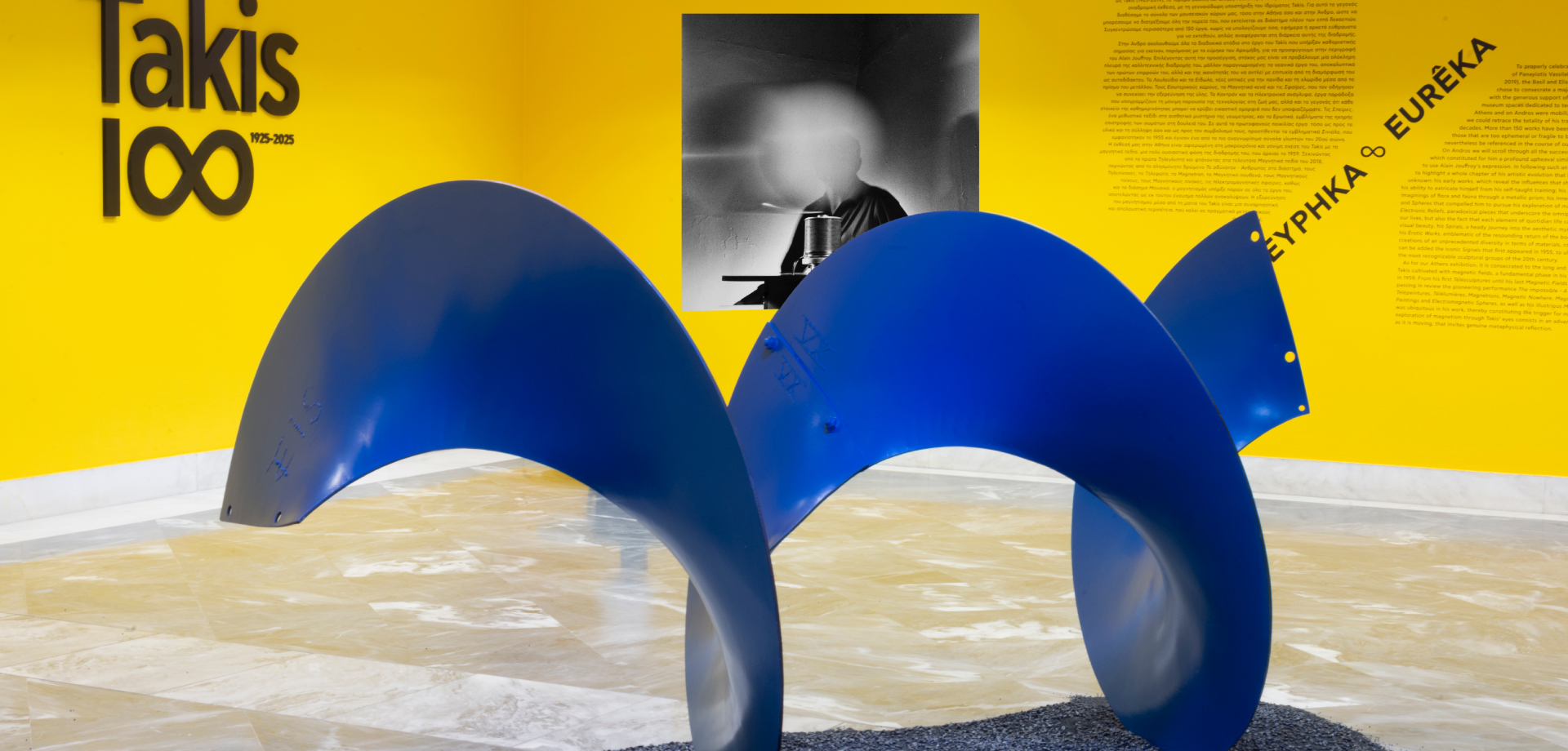
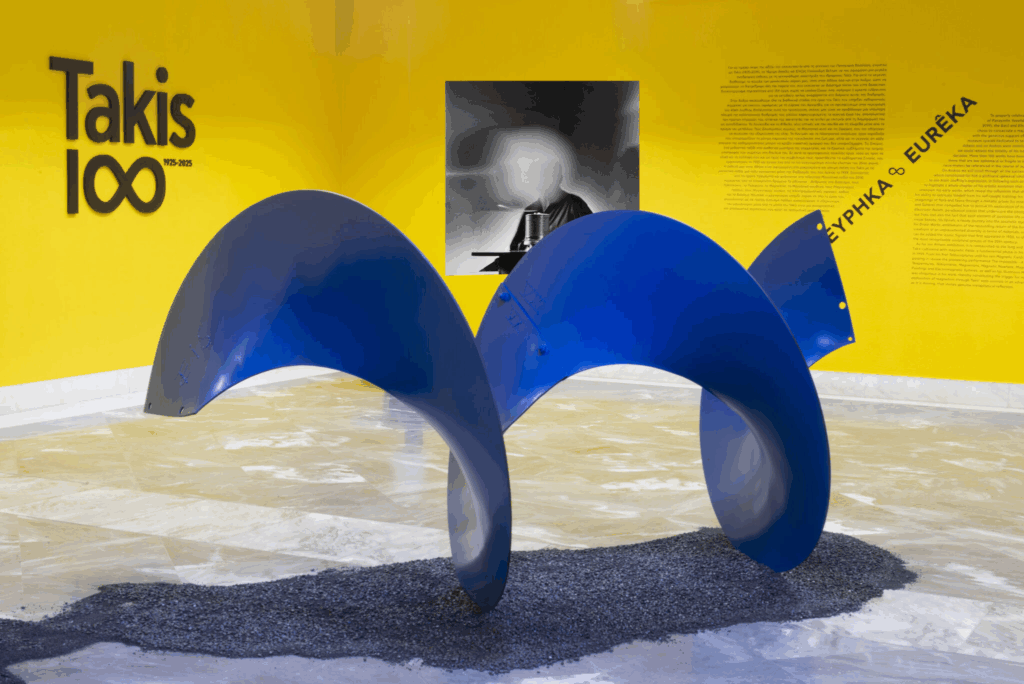
In Andros, the focus shifts to his spirit of discovery. Subtitled Eureka, the exhibition traces Takis’ major leaps in innovation—starting in 1948 when he began using iron as the base for his sculptures instead of plaster, producing works reminiscent of Giacometti. Later came the integration of sound and music, followed by color and light, with materials such as mercury and the creation of Tele-Lights, which became central to his later work.
The Old Wing Reopens in Andros
The Old Wing of the Museum of Contemporary Art in Andros had been closed for nearly five years for restoration and renovation. “Andros presents a particular challenge when it comes to building maintenance,” shares Maria Koutsomalli-Moreau. “We’re right by the sea, and that makes upkeep extremely difficult.” The Old Wing had originally opened in the late 1970s, and when it came time to reopen it, the team felt that including it in the Takis 1∞ retrospective would be ideal. “That’s why this year, it reopens with Takis’ Signals, his musical instruments, and a group of works he referred to as Interior Spaces,” says Koutsomalli-Moreau. “For reasons I can’t even fully explain, these works resonated so deeply with this part of the building… They have a really good energy.”
Exhibition view of “Takis 1∞” at the Museum of Contemporary Art in AndrosExhibition view of “Takis 1∞” at the Museum of Contemporary Art in Andros
A striking element of the Takis 1∞ exhibition is the strong presence of the artist’s ephemeral works, such as his performances. There are also several pieces that could not be physically transported due to their extreme fragility or the use of hazardous materials—like mercury.
One highlight is the documentation of his iconic 1960 performance “The Impossible – A Man in Space,” held at the Iris Clert Gallery in Paris, which is featured in the exhibition: “In 1959, Takis began to distance himself from the nouveau réalisme artists he had connected with in Paris, such as Yves Klein,” recounts Koutsomalli-Moreau. “He found himself among a group of Anglo-Saxon artists and writers—from America, South Africa, Canada—including William Burroughs, Allen Ginsberg, and others who would later form the Beat Generation. At the time, headlines were dominated by the space race between the U.S. and the Soviet Union. Jokingly, Takis declared, ‘I’ll do it. I’ll send the first man into space using magnetism.’ Everyone in the group got excited. One of them, Sinclair Beiles, said: ‘Send me. I’ll be the first man you launch into space. And as you lift me, I’ll deliver a manifesto.’ They worked for months to realize the performance, with other Beat writers contributing texts. Clert, the gallery owner, collected all of these. In late November, Takis presented the performance, and using magnetic force, managed to suspend Beiles in midair for several seconds.”
Soon after, Takis began developing more ephemeral works that could be shared freely with the public. The first were his Signal Fireworks, which he lit spontaneously in the streets of Paris without official permission—much to the joy of passersby.
“We have video footage of both the Signal Fireworks and the Man in Space performance,” says Koutsomalli-Moreau. “Clert was so clever and capable—she even managed to bring in journalists to film it, which was an incredibly rare and difficult feat at the time.”
Exhibition view of “Takis 1∞” at the Museum of Contemporary Art in Andros
Exhibition view of “Takis 1∞” at the Museum of Contemporary Art in Andros
Ephemeral works and the landmark performance “The Impossible – A Man in Space”
Takis 1∞ also highlights the artist’s ephemeral works and historic performances. Some works could not be moved due to their fragility or use of hazardous materials (like mercury).
One highlight is the performance The Impossible – A Man in Space (1960), held at Iris Clert Gallery in Paris:
In 1959, distancing himself from the nouveau réalisme circle of artists (like Yves Klein), Takis found himself among English-speaking expats—William Burroughs, Allen Ginsberg, and others—who would soon define the Beat Generation. Amid the Cold War space race, Takis joked, “I’ll be the one to send the first man into space—using magnetism.” Poet Sinclair Beiles volunteered: “Send me. And as you launch me, I’ll read a manifesto.”
After months of preparation, the performance was staged in late November. Through magnetic force, Beiles was suspended mid-air for a few seconds—an iconic moment in art history. Takis also began staging unsanctioned firework “Signal” events in the streets of Paris. Both the performance and these ephemeral firework Signals are documented in rare videos included in the exhibition—thanks to gallerist Iris Clert, who brought in journalists to film what was a technical feat for the time.
Curator’s Highlights
“In Athens, my favorite work is the Tele-Light, which we managed to secure. When it lights up, you feel it communicating with something unseen. Burroughs once said you could hear metal breathing in its presence,” says Koutsomalli-Moreau. “In Andros, what moved me deeply was seeing the forest of Signals we assembled—over 30 of them. It’s exactly how Takis wanted them to be seen. You feel energy, joy. We also loved that the exhibition design across both venues was inspired by the yellow of Takis’ Magnetic Walls. That yellow dominates in both Athens and Andros.”
Exhibition view of “Takis 1∞” at the Museum of Contemporary Art in Andros
“He remained authentic to the end” – Takis in the history of art
“Takis’ great contribution to art was that he gave form to the invisible,” says Koutsomalli-Moreau. “He turned energy into matter. And his works generate a tangible aura—magnetic, yes, but not only. He stayed true to himself, always emphasizing his autodidactic roots. With curiosity and the ability to engage with science—not as a scientist but as an artist—he gave something new to the world. His art goes beyond walls, beyond the material of sculpture. It touches everything and everyone.”
Exhibition view of “Takis 1∞” at the B&E Goulandris Foundation’s Museum in AthensExhibition view of “Takis 1∞” at the B&E Goulandris Foundation’s Museum in Athens
Info
Takis 1∞
June 22 – November 2, 2025
Basil & Elise Goulandris Foundation, Athens & Museum of Contemporary Art, Andros

 elc team