 elc team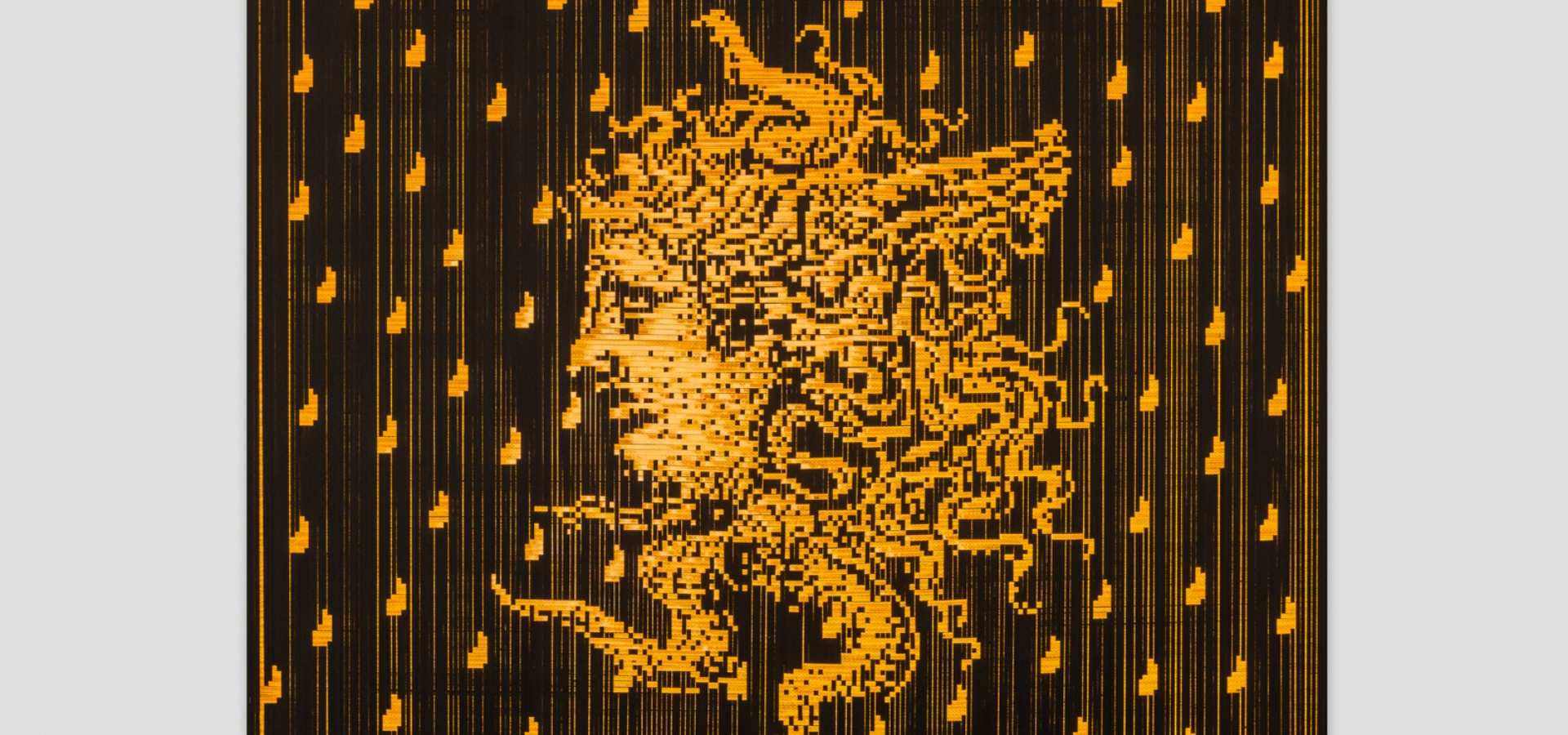
Efi Spyrou presents the exhibition “Luminous Strays: Crossing Light, Absence, and Multiplicity” at the Convento Chiaramontano dei Francescani Minori in Sicily, starting October 10.
In Book 15 of Ovid’s Metamorphoses, Pythagoras speaks of a universe in perpetual flux: “You see the nights’ traverses tend towards day, and brilliant light follow the dark of night. The sky has a different colour when all weary things are at rest, at midnight” (15.186–98). Within his imaginary, light and dark are imagined as intertwined states in motion rather than opposing forces locked in a cycle of conquest.
Luminous Strays, an immersive installation by Efi Spyrou, materializes this idea by exploring themes of visibility and concealment, identity and estrangement, the embodied and the ephemeral.
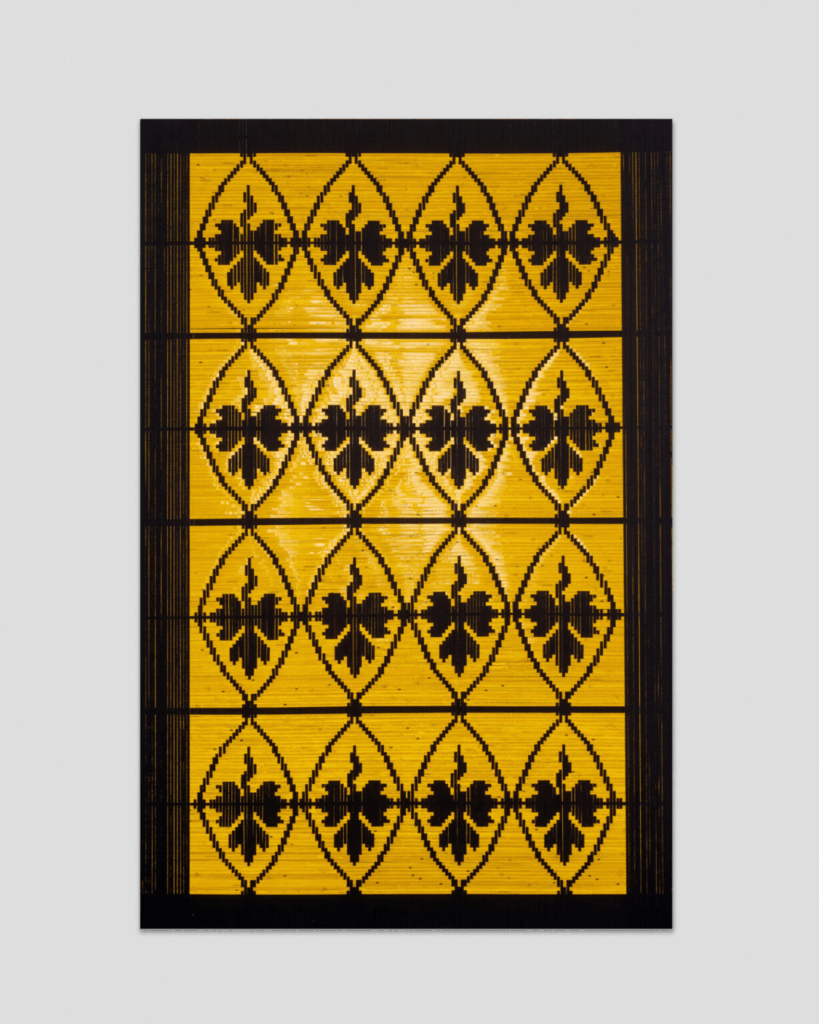
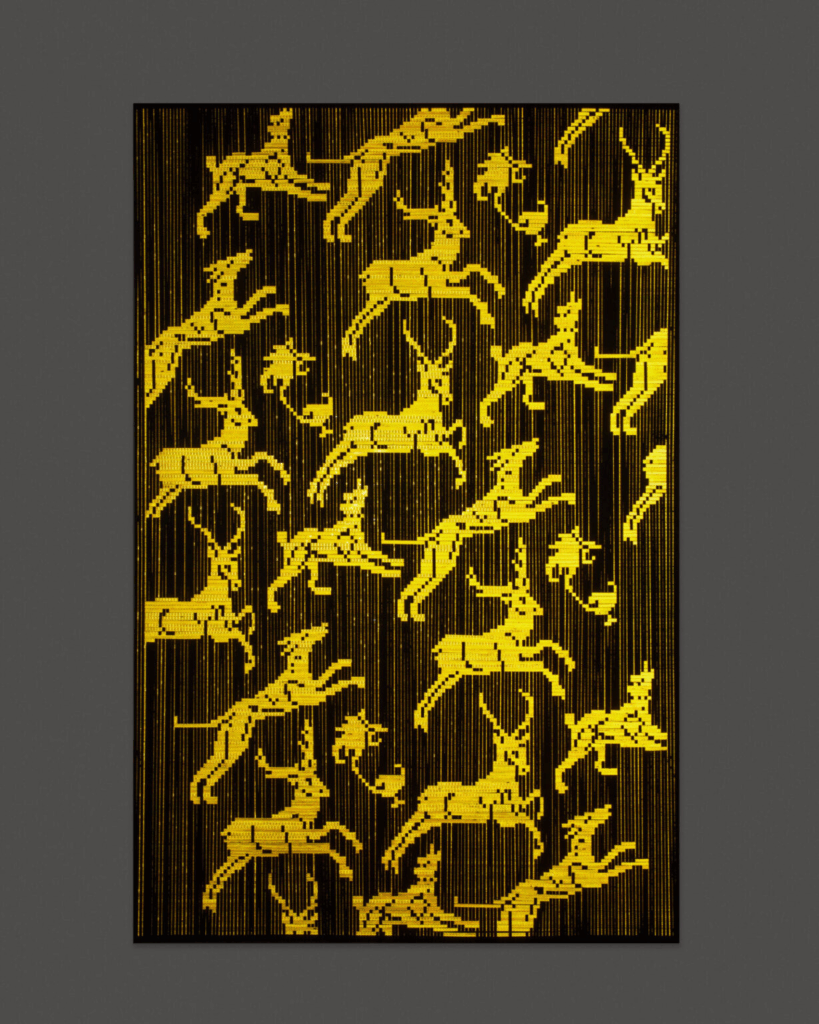
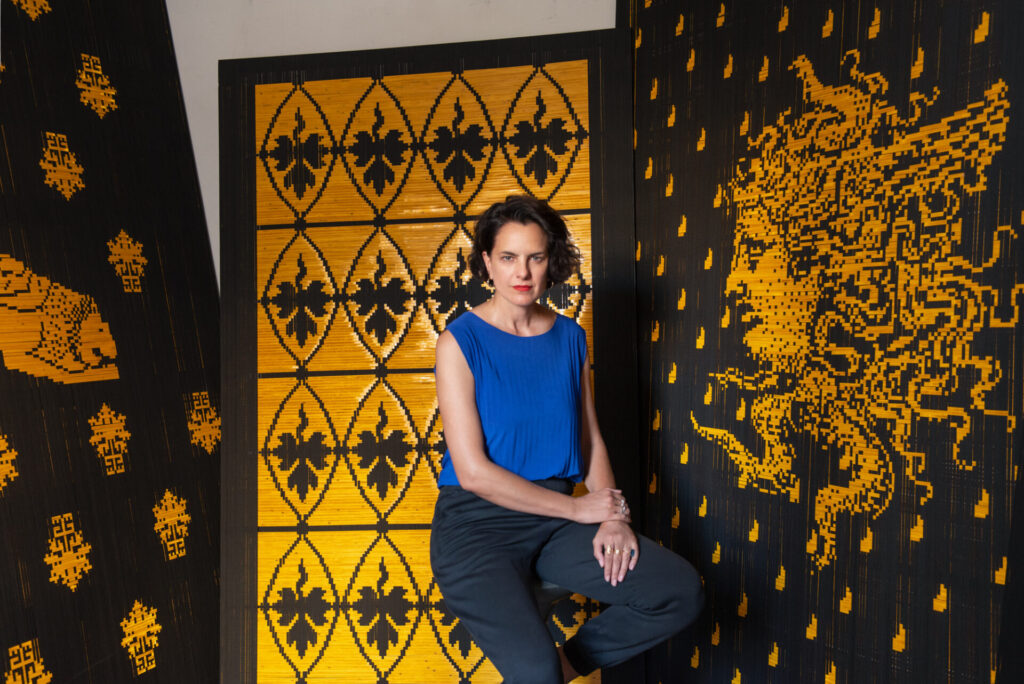
Comprising seven woven panels suspended at various heights within a dim, ecclesiastical space, the installation draws viewers into a transformative state activated through an interplay between darkness and light. Each of the panels is woven from black fabric and high-reflective tape, alluding both to traditional textile practices and to the digital structure of the image. They remain nearly imperceptible until illuminated by a flash, a camera lens, or a directed beam of light. Through brightness, different creatures, emblems, and forms emerge-not as fixed shapes but as fleeting presences hovering on the edge of recognition, quietly asking us to consider what we see, how we see it, and why.

At the heart of Spyrou’s installation lies her personal engagement with Agrigento’s archaeological heritage and the wider Sicilian folklore-a landscape shaped by the intermingling of ancient myths, natural symbolism, and ritual memory. In the months leading up to the panels’ production, her research revealed Agrigento as a place where numerous groups historically converged and exchanged goods, ideas, and practices. Founded as the Greek city of Akragas in the 6th century BCE, it later came under Roman, Byzantine, Arab, and Norman rule, each leaving lasting traces on its history. Aligned with recent historiography, this perspective moves beyond binary frameworks-such as Greek versus non-Greek, West versus East, or local versus foreign-and towards a more nuanced understanding of identity, one that embraces multiple, hybrid and often hidden, realities.
In this light, the deer and dogs caught in endless play, the tearful Medusa, the two-headed eagle with a cat’s face and spiral spine, the inverted queen symbol, the kneeling lion entwined in vine leaves, and the griffin blooming from foliage-do not emerge from the mainstream visual archive of local archaeology, but from its corners-the faint carvings, peripheral motifs, and dispersed fragments.
Informed by both traditional practices of weaving and contemporary digital methods of image construction, Spyrou’s depiction intensifies her subjects’ estrangement while at the same time setting in motion their familiarisation. As viewers move around these hybrid mosaics, their appearances fluctuate: certain elements come into sharp focus, while others dissolve into abstraction, discernible only from particular perspectives. In seeking the angle that brings them to the fore, viewers participate in what is perceived and sustained, constituting the very presence of the subjects in question. Thus, they enact a rhythm through fragments, where meaning is not fixed but slowly constructed through movement, attention, and relation. The experience of the installation unfolds not as a linear interpretation, but as a circumambulation.
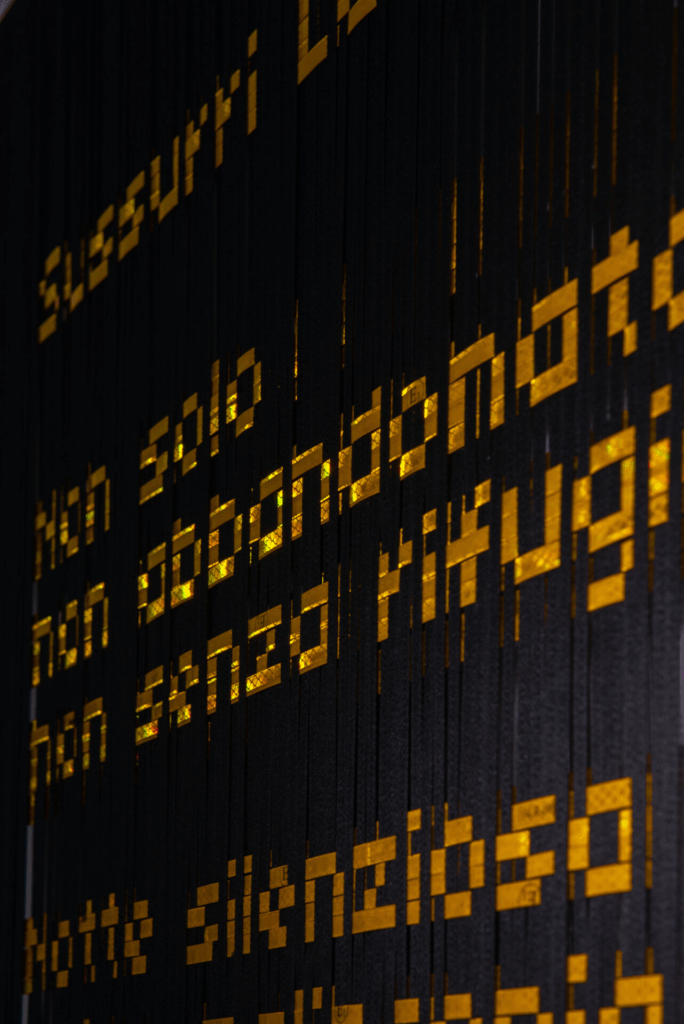
Alongside the figurative elements, one of the installation’s panels features lines from Sussuri Luna, a poem from Italian poet Salvatore Indelicato’s Gocce d’amore, a work exploring themes of love, longing, and fleeting moments of connection. The specific panel consists entirely of words that Spyrou selected from the poem without translation. Here, the words move beyond text, functioning as visual elements in their own right-as image. They become both the medium and the message. Unlike the other panels, Sussuri Luna unfolds linearly-horizontally and vertically-generating its own rhythm and introducing a more structured, almost geometric sense within the space. When one resists focusing on the meaning of the words and instead attends to their visual presence, the words appear as forms floating in the void. Here, individuality and cultural background are briefly suspended, the lines between xenos and oikios dissolve.
Spyrou invites us to remain open to the unknown: the viewer’s movement in Luminous Strays becomes a slow and quiet resistance to our impulse to pre-assign and impose meanings and identities-whether onto entities beyond our own form or onto words beyond our own tongue. One might recall thinkers like Olga Tokarczuk, who envisions the Transfugium-a heterotopic space where humans relinquish their domination over nature. To enter this reserve, a human must undergo a metamorphosis—an interspecies shift that transforms their species identity and subverts the anthropocentric order. Within the Transfugium, the human exists only as part of a larger whole. “Remember Ovid?” Tokarczuk writes, “Metamorphoses have never been based on mechanical differences. It’s the same with transfugation: it emphasizes similarities… The world is one.” Tokarczuk’s writing responds to the pressing need for a new language of storytelling-one that presents human beings and the world around them as part of a continuum, where relationships and interconnections replace divisions.

In the spirit of Ovidian metamorphosis, Luminous Strays suggests that the human condition is a becoming, a continuous unfolding of self in relation to others and the world, never a loss of self, but an opening into multiplicity. Within the multicultural reality of Agrigento and beyond, Spyrou proposes that illuminating the ‘Other’ is not an act of contrast, but one of recognition and introspection—a shifting space where the nights’ traverses tend towards day, brilliant light follows the dark of night, and the sky has a different colour.
Artist: Efi Spyrou
Organized by: RUNONART A.M.K.E
Sound Composition/Design: Dimitris Tsoukas
Visual Identity: Typical Organisation
Photography: Maria Siorba
With the financial support and under the auspices of the Fondazione Agrigento 2025
Production Team:
Artemis Panagiotidou, Athina Alkini , Iris Ilia Papaioannou Deko, Margianna Marougka
Acknowledgements:
3M G. Astypaliotis & Sia EE, Afes Oustabasidou, Agata Darlasi, Alekos Roupas, Andreas Christoforou, Carmello Roccaro, Christos Tsiopanis, Damonas Kalamitsis, Dimitris Costas , Dimitris Negas, Doris Lamprinopoulou, Eliza Soroga, Elvira Mangione, Eri Dimitriadi, Eva Rapti & Paolo Marzano, Kostas Manousis, Loukas Hapsis, Maria Maneta
Nikoleta Demopoulou, Pantelis Chandris, Roberto Bruccoleri, Spyridoula Spyrou, Thodoris Chiotis, Virginie Berre
Art Packaging: Artlock
Art Transportation: John Transport
Special Thanks:
Marghe Orlando, Laura Vento, Andrea Saieva, Simonetta Trovato
Meno Foundation, Roberto Albergoni, Carla D’Amico
MUDIA Museo Diocesano Agrigento
Honoring Thanks:
Poet Salvatore Indelicato
Text by: Danae Parlamas Pertejo

Info
EFI SPYROU
Luminous Strays: Traversing Light, Absence, and Multiplicity
Opening: 10 October 2025, 18:00
Venue: ex Convento Chiaramontano dei Francescani Minori, Agrigento