 PEPI NIKOLOPOULOU
The works of Yannis Pappas are not merely sculptures; they are imprints of life, moments frozen in time to speak to us—to the present and the future
“Looking back on my youth and the way I worked then, I am now in a position to judge and evaluate what were the ideas, the beliefs that guided and inspired me: That sculpture – art – requires courage, the determination to commit oneself. That it requires incessant work, study, and therefore the life of an artist must be the life of a worker, a day labourer. To work or not to work is a struggle. Time is short, but so is patience. Sensitivity and talent are not enough. Sculpture requires order, method, discipline. It does not tolerate spasmodic efforts”, said the great Yannis Pappas.
Yannis Pappas left his mark not only with his works, but also with his attitude to life as an artist. His understanding of sculpture as a constant struggle requiring dedication, method and patience is reflected in both his creative process and his teaching. In his words, he reminded us that art is not just an expression of sensitivity and talent, but a daily exercise in discipline and hard work.
To create a work of art is an arduous task. It is a process that requires years of dedication, persistent effort and constant exploration. From the first sketches to the finished work, each stage is a step on a path of experimentation and exploration. Visual ideas evolve and interact through the physical and intellectual work of the artist, who transforms matter into form and gives life to inanimate material.
Concepts and thoughts condensed in the title of the exhibition “Borrowed Time. The artist’s toil through the work of Yannis Pappas”, which was inaugurated at the Benaki Museum and will run from 20 February 2025 to 27 July 2025, curated by the director of the Yannis Pappas workshop, Thodoris Bargiotas.
“An honest artist is first and foremost a craftsman. A truth that lies at the heart of the essence of Yannis Pappas’ work and life,” says Thodoris Bargiotas with sincerity and emotion.
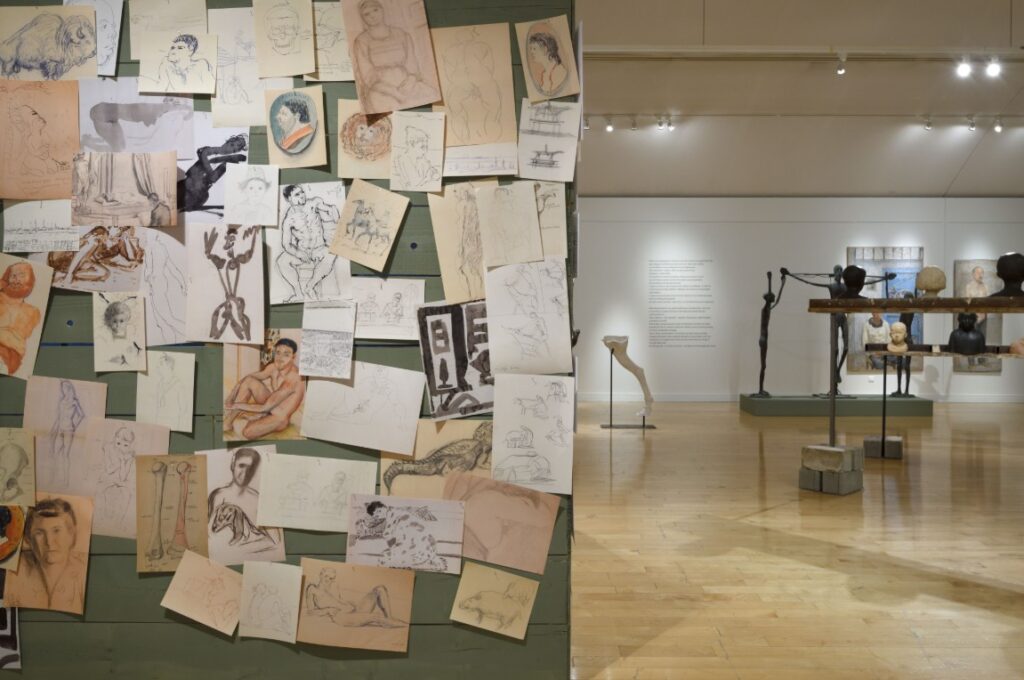
A successful sculpture is but the crystallisation of all that has gone before – a synthesis of experiences, trials and failures – and at the same time the springboard for what will follow. The time it takes to achieve this harmony does not really belong to the creator; it is a borrowed resource that the artist hopes to “pay back” through his works, leaving his mark on the art world.
Yannis Pappas’ tireless and multidimensional vision reflects a particular perception of time: not as an obstacle, but as a precious loan that nourishes and shapes the artwork. The exhibition reveals this unseen side of the sculptural process, focusing on the preparatory stages: the two- and three-dimensional sketch, the armature, the mould and the template.
Yannis Pappas’ creative career is not limited to the large, iconic works that have made his name, such as the statue of Eleftherios Venizelos (Eleftherias Park, 1969), the statue of General Makrygiannis (Dionysiou Areopagitou & Byronos, 1996), the statue of Odysseus Elytis (Dexamenis Square, 1997), the statue of Charilaos Trikoupis (Courtyard of the Greek Parliament, 1998).
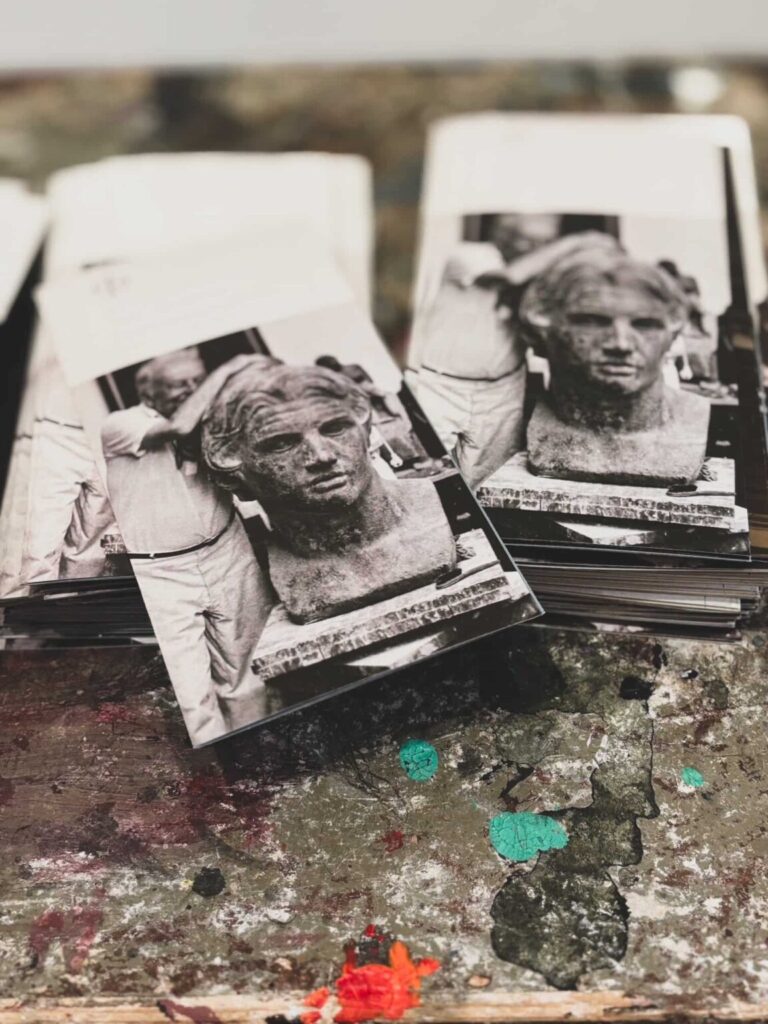
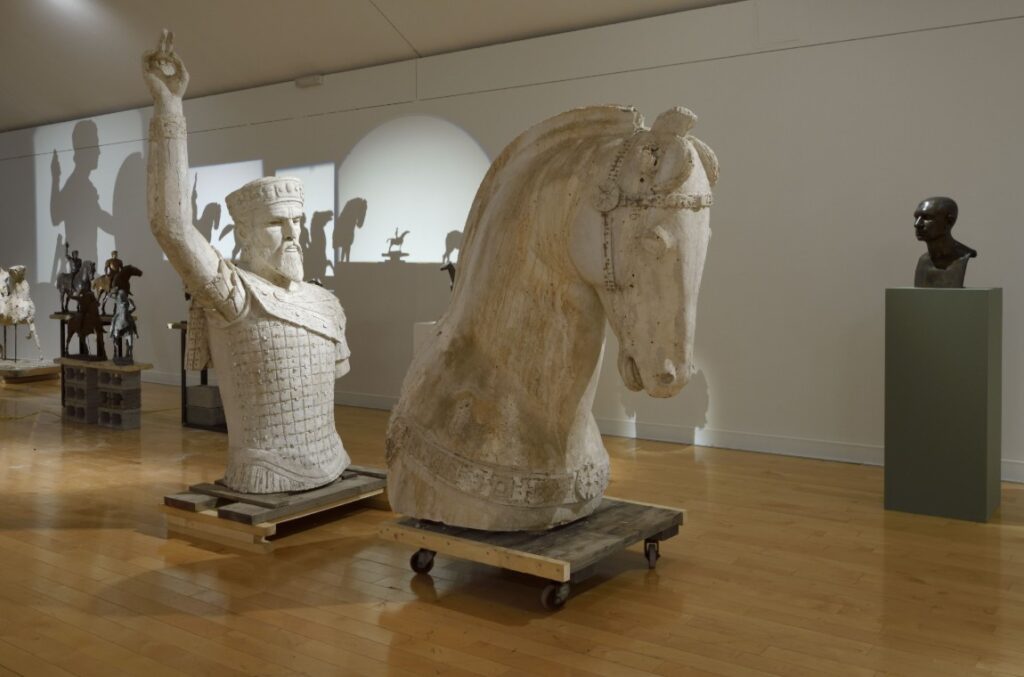
“For me personally, the essence and meaning of Yannis Pappas’ work is not to be found in his last great sculptures, such as the equestrian Alexander the Great. The essence is to be found in every small part of the process, starting with the drawings themselves,” says Thodoris Bargiotas.
It is worth noting that Yannis Pappas’ interest in these sculptures is not in the historical figure and its meaning, but in something deeper.
“Pappas is interested in the relationship between the horse and the animal and, in a more visual language, the relationship between the horizontal and the vertical,” adds Thodoris Bargiotas.
“This exhibition is a challenge to the creative process, to the way he constantly observes, reflects and works on the reality that surrounds him and the stimuli that surround him. Of course, the most raw means of responding to stimuli is drawing,” says the museum’s scientific director, George Manginis Manginis, about the exhibition.
Before I begin my tour of the exhibition, I am impressed by the video prepared by Thodoris Bargiotas’ students. Through their images, I follow the transport of the equestrian statue of Alexander the Great to its next stop: the atrium of the Benaki Museum, where it will be displayed as part of the exhibition. A journey to heaven and back to earth – and then back to heaven again, as if it were carrying the eternal passage between myth and reality.
“In this video we can reflect on the efforts and difficulties involved in the journey of a work of art, while at the same time this journey itself can produce a piece of performance art, a performance,” notes George Manginis.
In the atrium of the Benaki Museum / Pireos 138, the bronze equestrian statue of Alexander the Great, transferred from the Yannis Pappas Laboratory and one of the two casts of this particular model, will be on display during the exhibition.

A Glimpse into the Unseen: Exploring the Exhibition of Yannis Pappas
As you enter the room, your gaze is immediately drawn to the murals on the left—portraits of models from the Athens School of Fine Arts (A.S.K.T.), where Yannis Pappas taught for many years. Mata, Efi, Romans, Elias, Sami. These figures—men and women, their faces now familiar to generations of students—have long served as subjects for the study of form, movement, and expression. Through them, one learns the proportions, structure, and physicality of the human body. Nearby, large and meticulously detailed terracotta sculptures stand as striking testaments to this pursuit of artistic precision.
“The key anatomical points of the body: the jugular notch, the ‘goat’ (possibly referring to a specific anatomical landmark), the seventh cervical vertebra, the pubis, the arches of the feet, the pelvis, the knees, and the ankles. These points are defined by their frontal and temporal weight distribution, each positioned at right angles. The result of this weighting is the projection of each point onto the horizontal surface, where it is marked. From this projection, the height is measured—the vertical distance of the anatomical point from the horizontal plane. This operation requires care, patience and precision. These measurements are difficult because a person is never standing still. I am recording only one aspect of the long and time-consuming process. It is not a process, it is a struggle,” says Yannis Pappas himself.

A struggle that continued until his final breath in January 2005, when, on his deathbed at the Annunciation Hospital, he sketched his self-portrait with trembling hands. ‘My child, last night I asked the nurse for a mirror. And I drew myself. As I am. Look how well I did,’ his son, Alekos Pappas, recalls him saying. In just a few jagged lines, he captured his ailing, battered face—oxygen tubes attached—a stark testament to his unwavering pursuit of artistic truth. A lifetime of effort, toil, and struggle distilled into a single moment of visual poetry, wonder, and beauty.

Creation does not happen in a single moment. Each sketch, each small sculpture bears the mark of his artistic eye and reflects his deep understanding of form and expression. The seemingly humble sketches and original models reflect the same dedication and creative pulse that can be seen in his most monumental works. Each line and etching is a link in an unbroken creative chain in which the search for the essence of the human body and life is captured in a way that transcends the material and touches the timeless.
Small and fragile works, drawings and sculptures alongside the large and impressive. “Sculpture is my wife and painting is my mistress,” as the artist himself used to say. And here in the exhibition, in each of the ‘invisible’ sections, the artist’s anxiety and longing to capture the essence of form is captured, as well as his constant struggle with the time required to perfect his work.
In his studio in the Zografou area, which was the home of the great Greek artist’s family until the 1960s, there are more than 11,500 drawings, sketches and notes in which one can trace traces of previous works, imprints of foreign thoughts and starting points. In the exhibition, around 360 of these works can be admired, from his paintings, drawings and sculptures to the “kitchen” of his art.
“Our intention is to highlight the physical labour that sculpture requires, a truth that few people know. Looking at the unseen side of Pappas’ art, we have chosen to show the sketches, the armatures, the moulds, in order to highlight the desire, the perseverance and the effort that this creative process requires,” explains Thodoris Bargiotas during the tour.
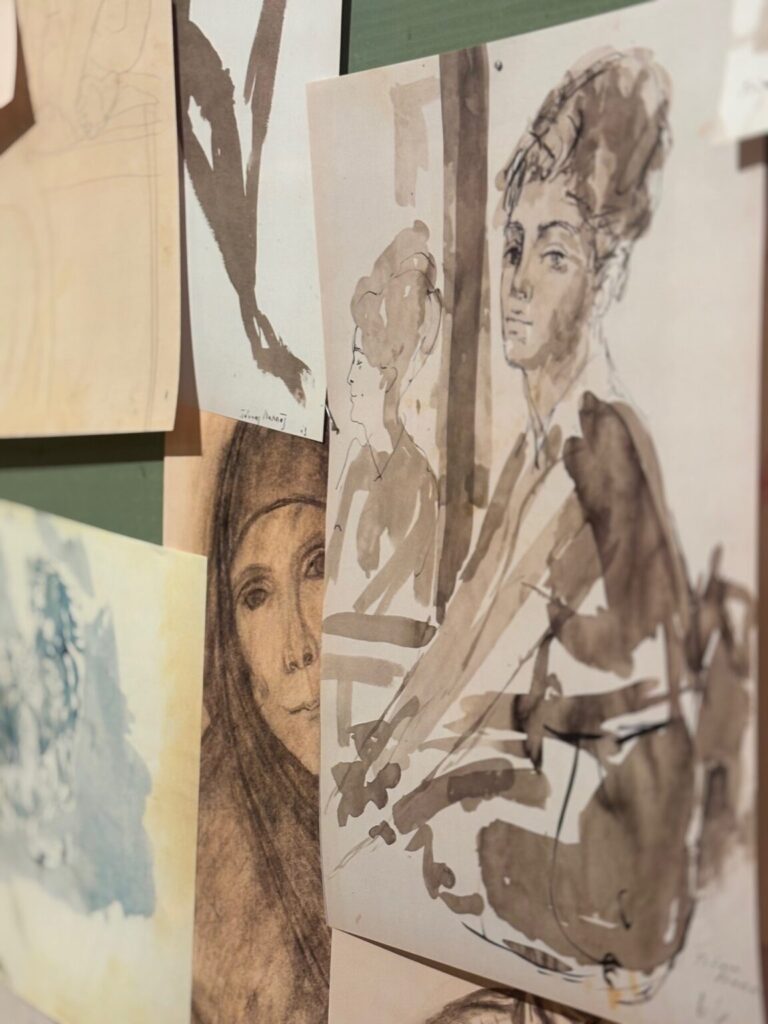


At the heart of the exhibition, in the center of the hall, stands a wooden installation housing the drawings of Yannis Pappas. Sketches from Athens, Alexandria, and every place he passed through—impressions of fleeting and momentous instances of his life. Unfinished lines, brushstrokes that touch upon life and love, animals, summers and winters. Among them, rhymed verses dedicated to friends and hasty notes for the days ahead.
Look a little closer, and the wooden structure reveals hidden surprises—just like life itself. Along its edges, discreetly suspended, are funeral masks of familiar faces, silent reminders of another dimension. In this way, the wooden box becomes more than a container of memory; it transforms into a profound symbol of existence, where life and death intertwine, just as they do in the artist’s work.
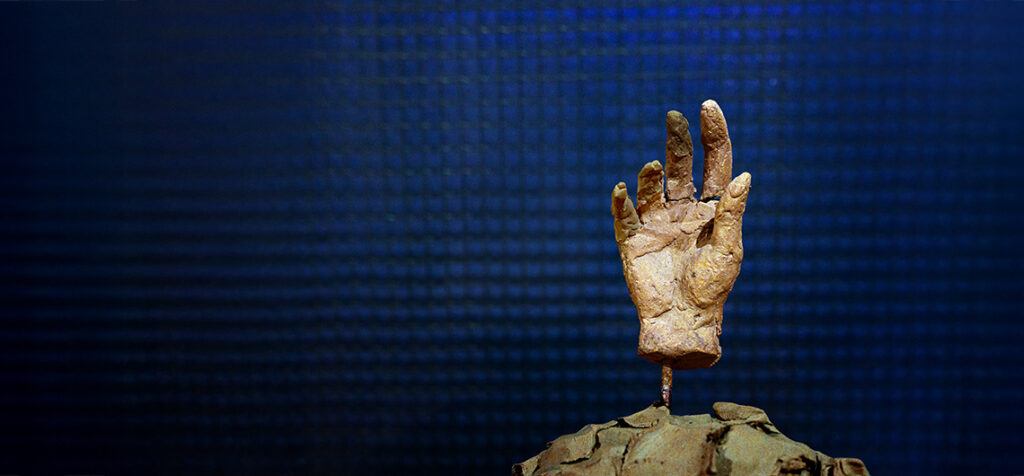
Around the wooden structure, Yannis Pappas’s sculptures are spread out in his characteristically human mood. Forms sometimes striding forward, sometimes with closed hands, others more liberated, such as the Blind Homer with his hands raised towards the ether, in a movement that seems to seek the immaterial. Among them, the model of Doxa, the seated Diotima and the Children of the Occupation stand out, sculpted with tenderness and affection.
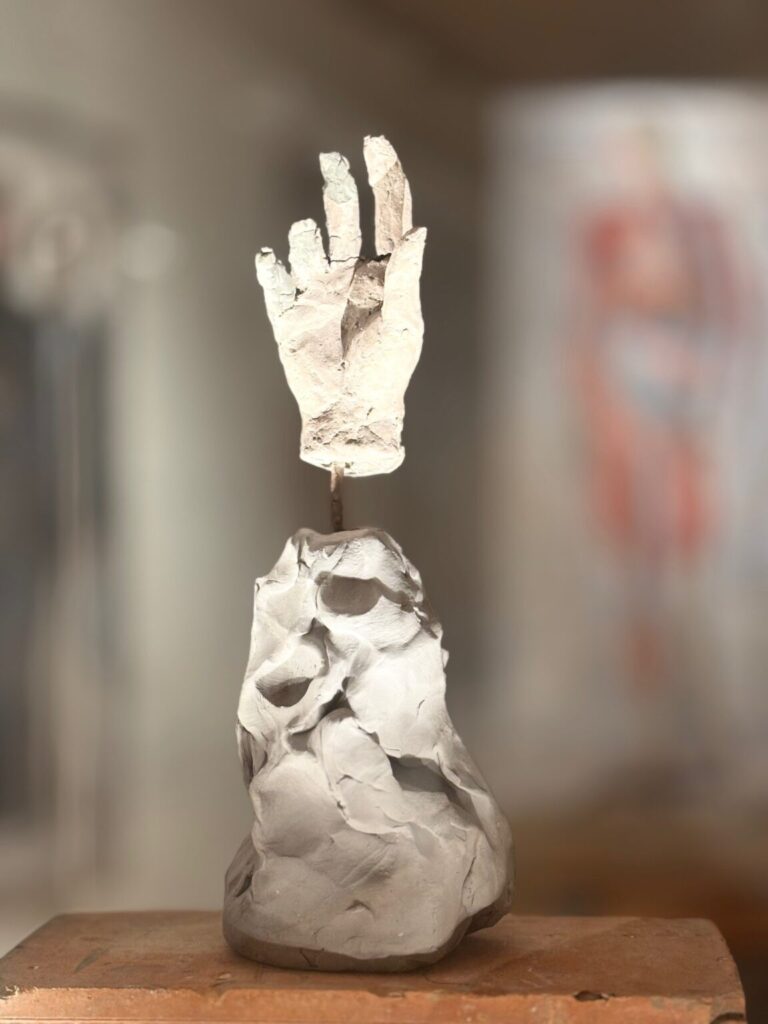
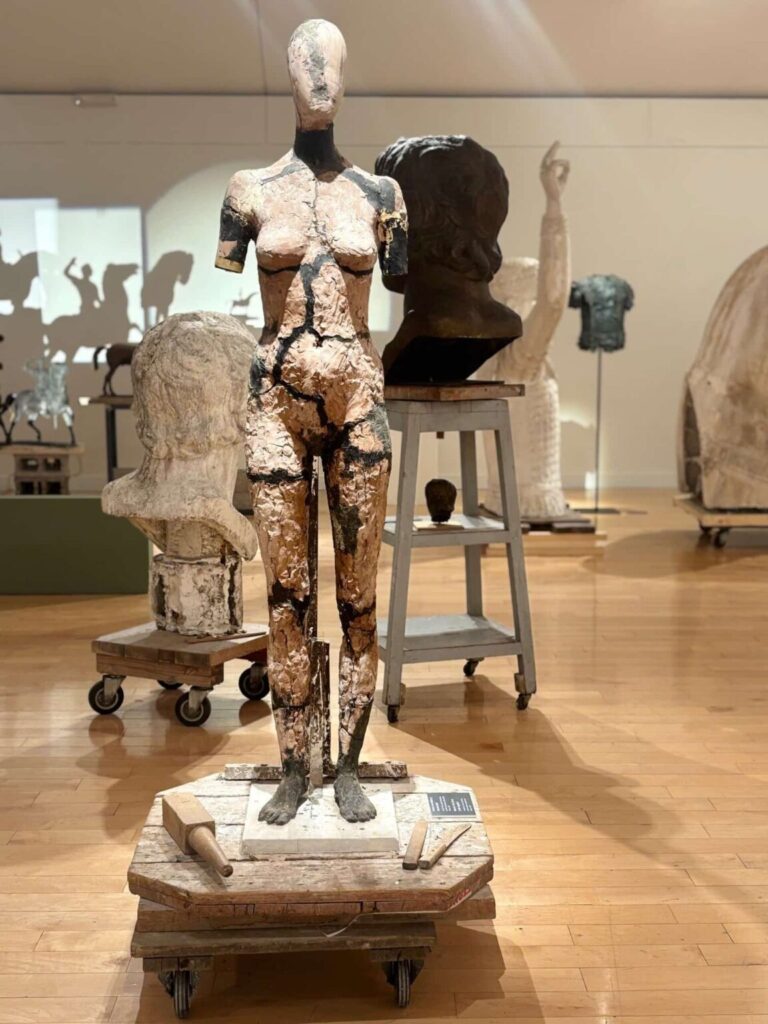

A film recording the process of casting the equestrian statue of Alexander the Great for the Municipality of Athens has survived and is a valuable source of knowledge about the lost-wax method – an ancient casting technique lost in the mists of time. Yannis Pappas, with respect for tradition and an eye for contemporary art, revived this method in the 1950s when he decided to create the first foundry at the Athens School of Fine Arts. The only one in Greece.
This initiative opened up new horizons in sculptural creation, making Pappas not only a great artist but also a pioneering teacher. The works of Yannis Pappas are not just sculptures, they are imprints of life, moments frozen in time that speak to us, today and tomorrow.
Info
Borrowed Time: The Toil of the Artist through the work of Yannis Pappas | Benaki Museum
Duration: 20/02/2025 – 27/07/2025
Please check museum opening times for the day you intend to visit the exhibition.
TICKETS: € 9, € 7
Tickets may be bought in advance at tickets.benaki.org or by attending the Museum on the day of the visit.
Benaki Museum, Pireos 138