 KATERINA PARRI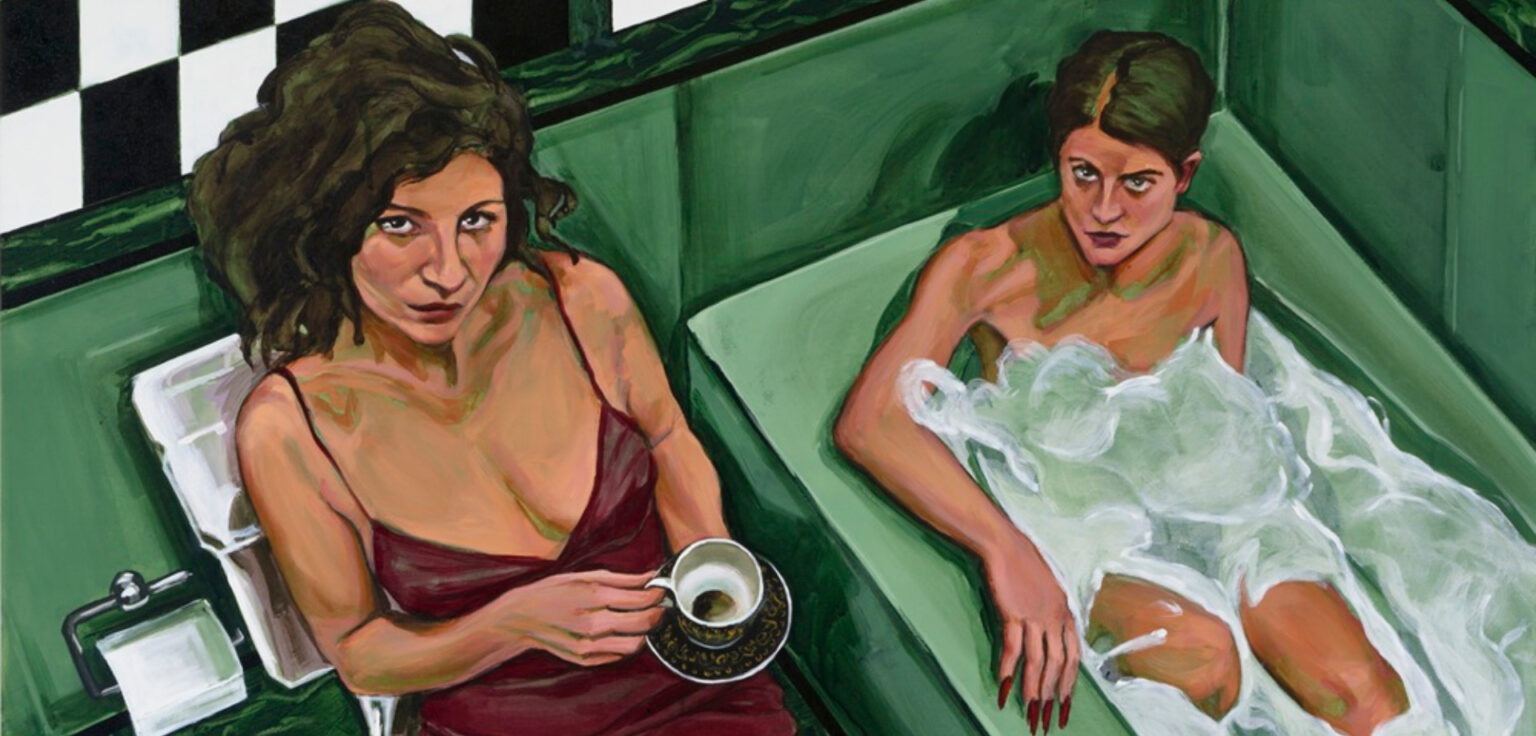
A Conversation on Green, Beauty, and the Power of Ambiguity
In this captivating artist talk, renowned painter Stella Kapezanou sits down with art critic Dionisis Christofilogiannis to explore the evocative world of her Emerald Paintings. Together, they delve into the seductive yet unsettling nature of her work, where beauty and discomfort intertwine, creating an experience that both captivates and challenges the viewer.
Kapezanou reflects on her journey with color, particularly the powerful emerald green that dominates her recent works, symbolizing everything from envy to healing, from luxury to poison. Throughout the conversation, she discusses her use of visual language as both an invitation and a disruption, drawing connections to art history, contemporary culture, and the age of Instagram.
The talk also touches on the tension between control and defiance in Kapezanou’s women, the emotional complexity embedded in each piece, and the deep intertextuality that defines her art. As the two converse, the audience is invited to consider the role of beauty in the modern world and how the artist’s work resists easy explanations, instead leaving room for personal interpretation and emotional resonance.
Join them as they explore the alchemy of color, the ambiguity of desire.
Dionisis Christofilogiannis: So, Stella… Emerald Paintings. You’ve gone full green this time—lush, venomous, seductive. What’s the obsession?
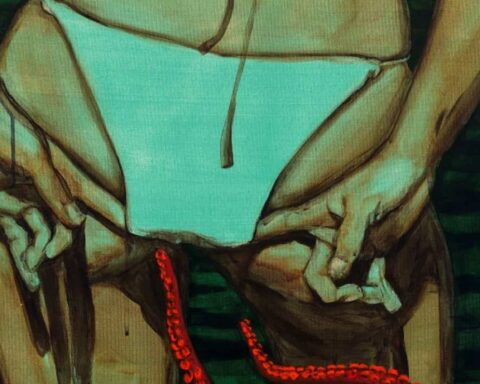
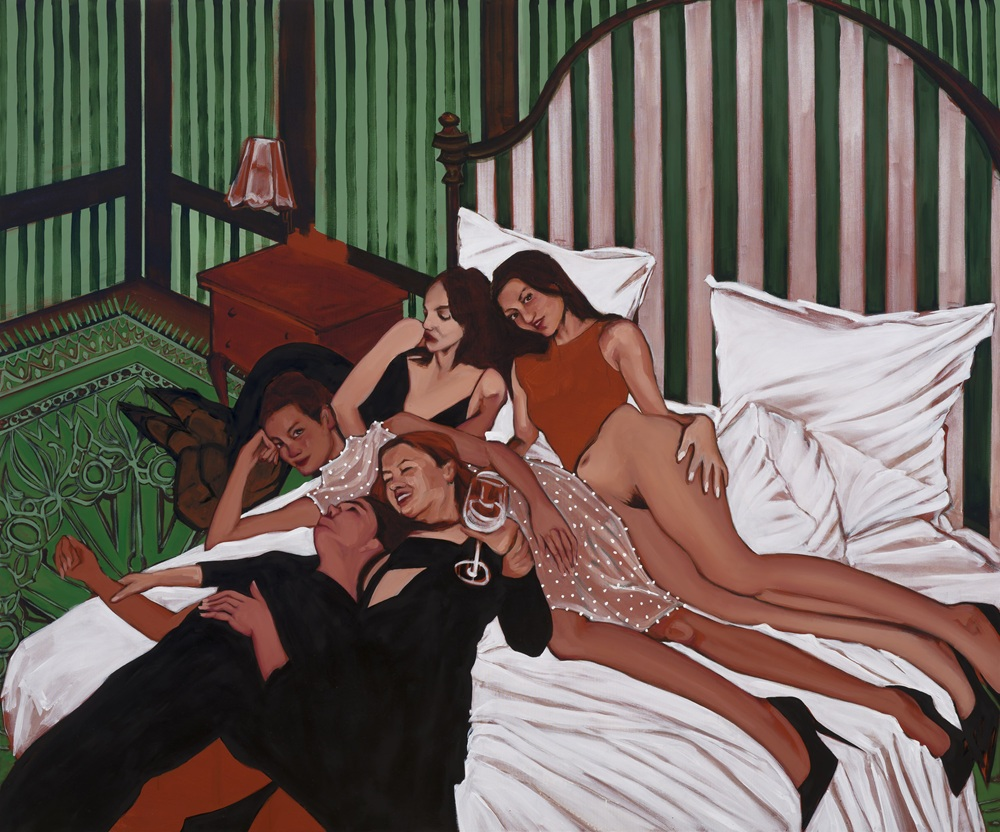
Stella Kapezanou: It’s not an obsession; it’s a possession. Green took over. It began as a whisper in the palette, and suddenly everything had to be green. But not soft green. Emerald—precise, controlled, dangerous. It’s the color of envy, money, healing, and poison all at once. It doesn’t behave. It glows and rots. That contradiction—that’s what I’m chasing.
Dionisis: It’s seductive. But also suspicious. That tension runs through all the works.
Stella: Exactly. I use beauty as bait. I want the painting to seduce you—color, composition, surface—but then keep you uneasy. There’s always a glitch. Something resists the pleasure. I love that moment when a viewer doesn’t know if they should trust what they’re feeling. The works are glossy and lush, but something’s always slightly off. I don’t want resolution. I want desire mixed with discomfort.
Stella: Let me throw it back—do you think our generation is even allowed to create beauty anymore? Or has Instagram burned that out?
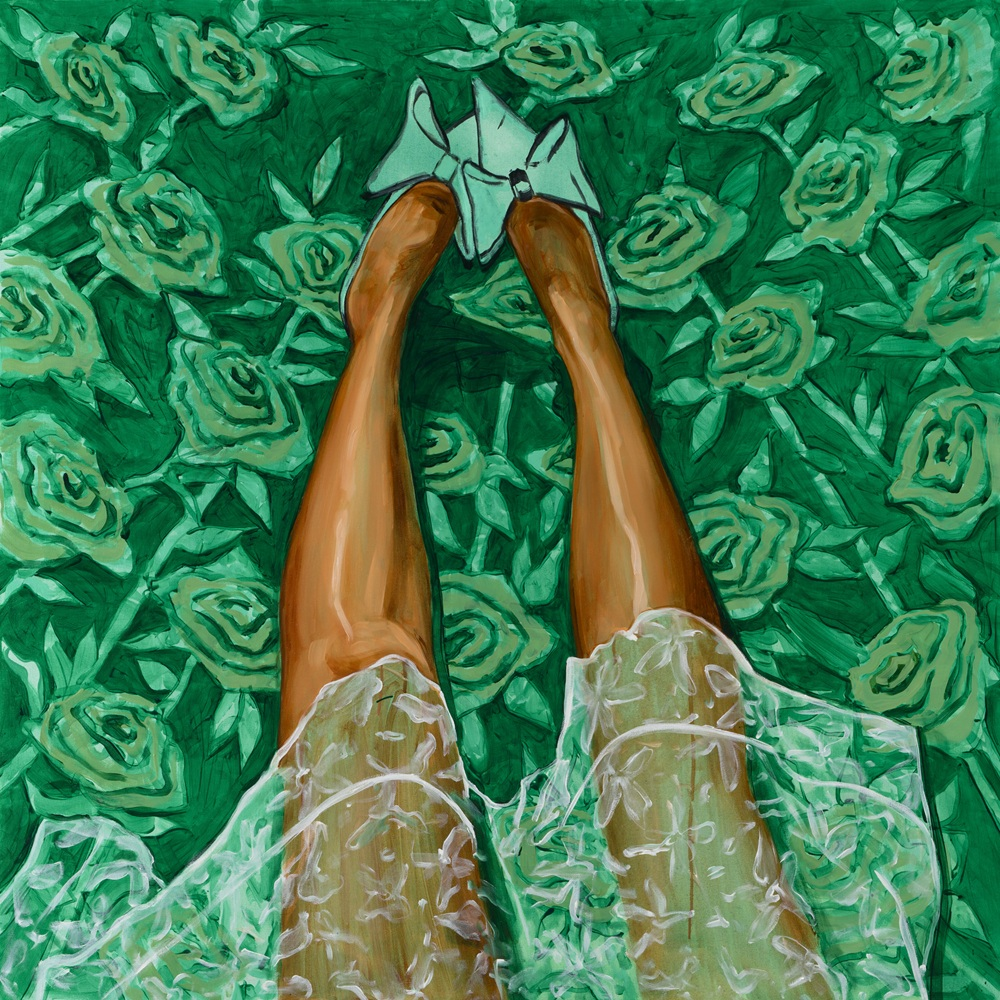
Dionisis: Depends on how you approach it. I think we’ve reclaimed it—but you’re right, there’s trauma there. We’ve been so conditioned to aestheticize everything for the feed that it’s hard to separate beauty from performance. But your paintings go somewhere else. They reference that aesthetic economy, but then sabotage it.
Stella: Totally. I’m interested in aesthetic manipulation—what happens when the painting flirts with you the way a filtered photo does. But instead of validation, it gives you ambiguity. I sometimes think of my women as if they’re posing for an invisible camera, but the moment captured is private, charged, maybe dangerous. It’s like scrolling and stumbling into something that shouldn’t be public—but is.
Dionisis: There’s definitely a kind of erotic dissonance. It reminds me of Manet—especially his women. They’re composed, frontal, direct—but always withholding something. There’s a refusal in their gaze.
Stella: Manet is huge for me. That cold intimacy. Those staged moments that feel at once theatrical and brutally real. His Olympia doesn’t seduce the viewer—she confronts them. My women do that too. They’re hyper-aware of being watched, but they’re not interested in performing obedience. It’s a performance of control. There’s humor, there’s defiance, but always a fracture underneath. Like a beautiful mask that’s about to crack. And his black—don’t even get me started. I’m melting at how he uses black. It’s not just shadow or negative space—it’s presence. His blacks carry weight, elegance, violence. They anchor the composition and destabilize it at the same time. That’s alchemy.
Dionisis: That’s what makes the work endure. The longer you look, the more it unravels. The visual language is crisp, but the emotional reading is complex—shifting, layered, psychological.
Stella: I want each painting to feel like a dream you almost remember. Like a party you left too early or a secret you’re not sure you were meant to hear. There’s a loneliness beneath the glamour. A kind of exquisite isolation.
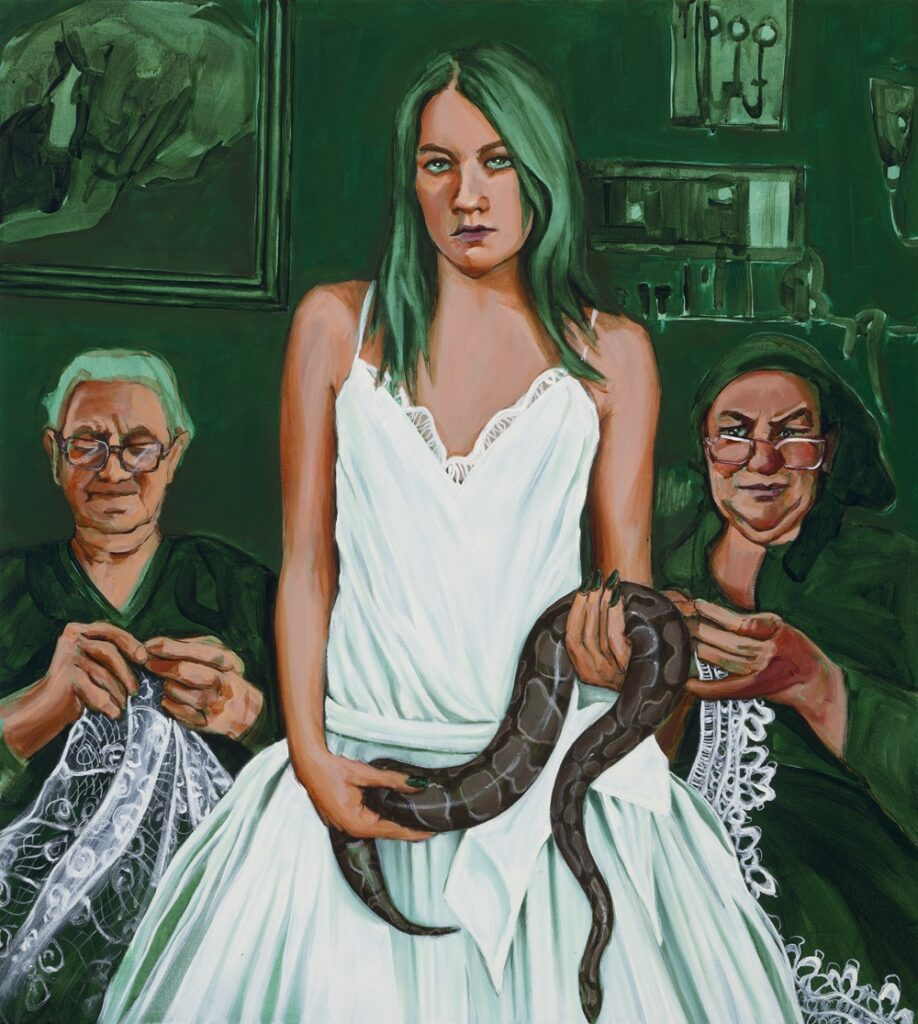
Courtesy of the artist and Skoufa Gallery ©Christos Simatos

Courtesy of the artist and Skoufa Gallery ©Christos Simatos
Dionisis: The work feels super intertextual—fashion, cinema, mythology, Instagram, art history… How do you even begin a painting?
Stella: It usually starts with a fragment—an image I’ve hoarded, a pose that unsettles me, a mood I can’t shake off. I build from there, almost like staging a myth that’s been half-forgotten. I’m drawn to symbols that carry emotional static—mirrors, velvet sofas, tilted glasses, clawed hands, strange animals. They’re never just props—they’re codes. But I don’t tie things up neatly. I want the painting to stay open—simmering, seductive, a little unreadable. Something you can’t quite explain, but also can’t forget.
Dionisis: You once said that nothing exists outside of context anymore. Do you still believe that?
Stella: More than ever. Every image is already coded before it reaches you. Especially now—with algorithms, hashtags, AI filters. We’ve lost the idea of the “neutral” image. That’s why painting is powerful. It slows things down. It resists context by holding tension within itself. It doesn’t offer a caption. It invites projection.
Stella: Let me ask you—do you feel haunted by the pressure to explain your work? Or do you enjoy the misreadings?
Dionisis: I used to resist them, but now I think misreadings are the most honest part of the encounter. The viewer brings their baggage, their algorithms, their projections. I just build the world. What they do inside it isn’t mine to control.
Stella: Exactly. That’s the intimacy of painting. It doesn’t demand to be “understood.” It wants to be felt, misread, remembered wrong.
Dionisis: Alright, last one—what’s next?
Stella: Dragons. I’m working on a solo show at the Municipal Gallery of Athens. Finally, a space that can handle my scale, physically and emotionally. It’s going to be wild. Dragons, ravens, black cats, snakes, tigers… and my women, of course. This one’s about raw power. Myth, instinct, sovereignty, desire. It’s a show about burning things down and rebuilding from ash. There’s humor, but it bites. Think spellbook meets fever dream. It’s not a quiet show—it growls.
Stella: And Dionisis—don’t think you’re getting out of it. I expect you there when the dragons land. And I expect your most brutally honest take.
Dionisis: I’ll be there. Front row, notebook closed. Just watching the dragons burn it all down.

Info
Stella Kapezanou – Emerald Paintings
Solo Exhibition at Skoufa Gallery, Athens | May 8–31, 2025
4 Skoufa Str.,
Kolonaki, 106 73
Athens, Greece
+30 210 3643025