 STELIOS PARRIS
By Stelios Parris
The sculpture by Praxiteles Tzanoulinos is not a monument but an experience, and that is precisely its essence. A sculpture that does not rise, does not impose itself, does not demand distance or silence.
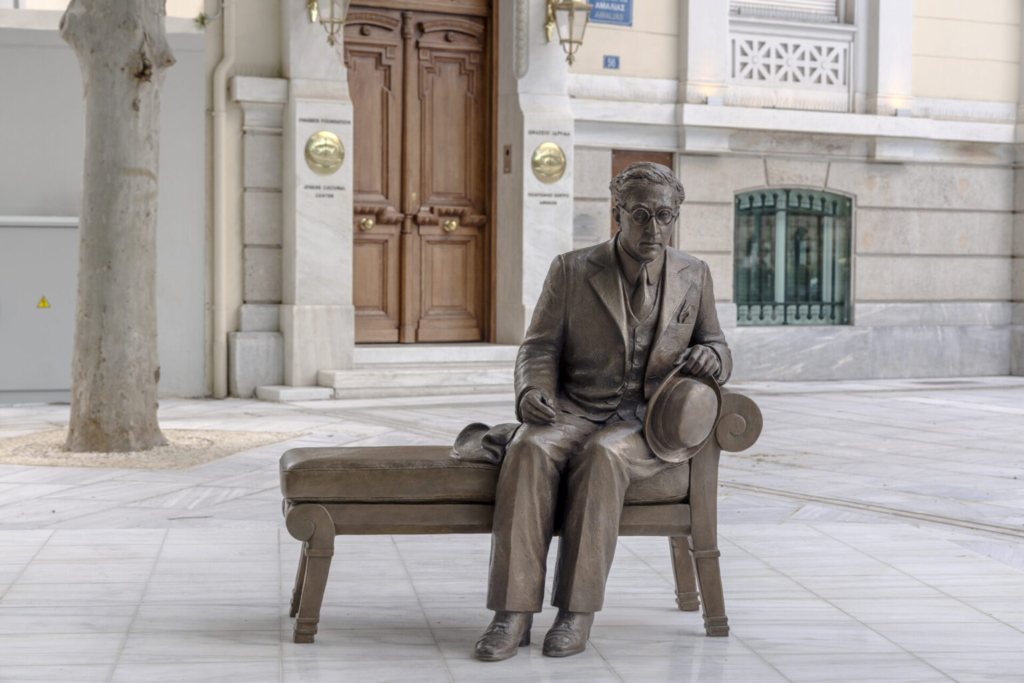
On April 29, the anniversary of both the birth and death of Constantine P. Cavafy, the Onassis Foundation, in collaboration with the Municipality of Athens, chose to unveil the sculptural work by Praxiteles Tzanoulinos depicting Cavafy. The Alexandrian poet has symbolically “returned” to Athens. At the beginning of Dionysiou Areopagitou Street, opposite Arch of Hadrian, within the very flow of everyday city life, the poet sits on a bronze bench, at life size, waiting for passersby to sit beside him.
The sculpture by Praxiteles Tzanoulinos is a donation from the Onassis Foundation to the Municipality of Athens and forms part of a broader strategy of interventions that approach public space as a field of culture. This is not a statue, but a proposal of proximity, a shift in how we relate to monuments, to poetry, and to the city itself. As was said during the handover ceremony, “The viewer does not stand opposite the work, but beside it.” To me, this phrase encapsulates the entire philosophy of the intervention.
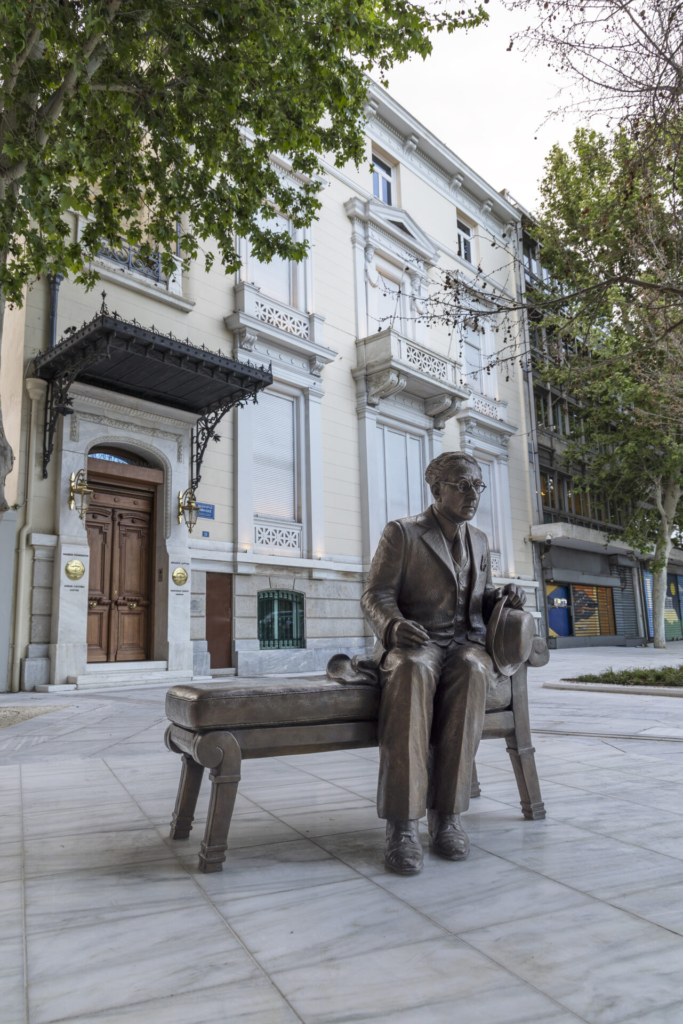
The President of the Onassis Foundation, Antonis Papadimitriou, chose not to deliver a conventional speech, but instead to map the neighborhood hosting the sculpture. “I believe that Constantine Cavafy would have appreciated the neighborhood where his statue has found its place. The statue we deliver today to the city of Athens as a new landmark stands beneath the Acropolis, opposite the Temple of Olympian Zeus and the Arch of Hadrian. It is also at the end of Dionysiou Areopagitou Street, named after Saint Dionysius the Areopagite, the philosopher who embraced Christianity around 51 AD and became the patron saint of Athens.
It lies below Philopappos Hill, where the funerary monument of Gaius Julius Antiochus Philopappos stands, a nobleman from Commagene who became consul of Athens. I should note that Cavafy wrote two poems about Commagene. It is also very close to the Odeon of Herodes Atticus, built by Tiberius Claudius Herodes Atticus, a political orator, sophist, and benefactor of the 2nd century AD, often described as the Onassis of his time.

Cavafy and his statue are thus placed in an area dense with associations, combining elements of his poetry and philosophy: Hellenistic Athens, the Greek East, and the blending of pagan and Christian worlds. The Onassis Foundation has embraced Cavafy not out of commercial familiarity, but because his work is truly unique. He is the most widely known Greek poet abroad after the classics. Here, at the beginning of the route to the Acropolis and its museum, many visitors will recognize him. This national poet will converse with the nations of tourists who follow the classical walk. It will be a gentle reminder that Greece is not only the ancient world, and Athens not only that of Pericles.”

The sculpture by Praxiteles Tzanoulinos is not a monument but an experience, and this is its essence. A sculpture that does not rise, does not impose, does not demand distance or silence. Cavafy sits, in human scale, inviting you to sit beside him. This choice was emphasized both by the President of the Onassis Foundation and by the Minister of Culture, Lina Mendoni, as a radical shift in how we perceive monumentality. As she noted:
“…This particular sculpture, the work of Praxiteles Tzanoulinos, reflects the quality of his craft, capturing the poet’s form in a way that is neither obvious nor easy. Cavafy is not presented as a bust. That would have been simpler, more conventional. Instead, he is seated on a bench, allowing someone to sit beside him, to read, to think, to reflect or reconsider. It recalls the case of Fernando Pessoa at his café table in Lisbon, where one can sit next to him, or Virginia Woolf on her bench in Richmond.
The fact that an ordinary citizen can sit beside the poet creates a different kind of intimacy, allowing for a deeply personal interpretation of a work already widely recognized. This is yet another success in creating a distinct landmark, not merely a statue or bust. In fact, this is the third landmark created by the Onassis Foundation dedicated to Cavafy: the Archive nearby, the restored house in Alexandria, and now Cavafy on the bench. The poet himself invites us to take his book, sit beside him, and let him tell us his stories.”

Praxiteles Tzanoulinos spoke about his sculpture through a video: “It was a fortunate commission by the Onassis Foundation, but one that required me to overcome many boundaries. In portraiture, especially when dealing with the figure of Constantine Cavafy, the challenge is not only to capture resemblance but to convey an inner world. The sculptor, when creating a portrait, is like a biographer. I studied photographic material, sketches, and descriptions. For instance, E. M. Forster, who visited him in Alexandria in 1916, wrote: ‘I saw this Greek gentleman with a hat, standing slightly at an angle to the universe.’ This description, along with visual references, guided my work. It is a piece that will be seen by us, by our children, and by future generations. It belongs to eternity.”
Here it is worth pausing on the technique he used, the “lost-wax casting” method, employed since antiquity for its ability to capture fine detail. The Charioteer of Delphi was created this way. The sculptor first models the work in clay, creates a mold, and then produces a wax replica. Details are added to the wax, which is then coated in refractory material and heated. The wax melts away, and molten metal takes its place. From absence comes form. Once the metal solidifies, the mold is broken, and the sculpture is revealed, refined, and polished.
Cavafy was a cosmopolitan poet, and Dionysiou Areopagitou is the street most traversed by visitors from around the world. Now they will encounter him without a ticket, without a schedule, at any hour of the day. They will sit beside him and remember that “the city will follow you.”
When the evening ended, I returned to see the work again, more distanced. The lighting by Eleftheria Deko enhances it, while the platform ensures accessibility for wheelchair users. From afar, I observed the posture of Cavafy’s body, echoing familiar photographs. I, too, sat beside him. I did not feel the need to reach out and embrace him, as others had done. His posture, slightly turned, inclined toward the universe, seemed to allow only one form of physical contact: our knees touching.
I remained there, thinking that this is how it might have been if I had traveled back in time to meet him, in an era when two men could not openly kiss or embrace on a bench. Perhaps only our knees would touch, our eyes would meet, and the rest would remain unspoken.
«The city will follow you. You will wander
the same streets. And in the same neighborhoods you will grow old,
and in these same houses you will turn gray.»