 elc team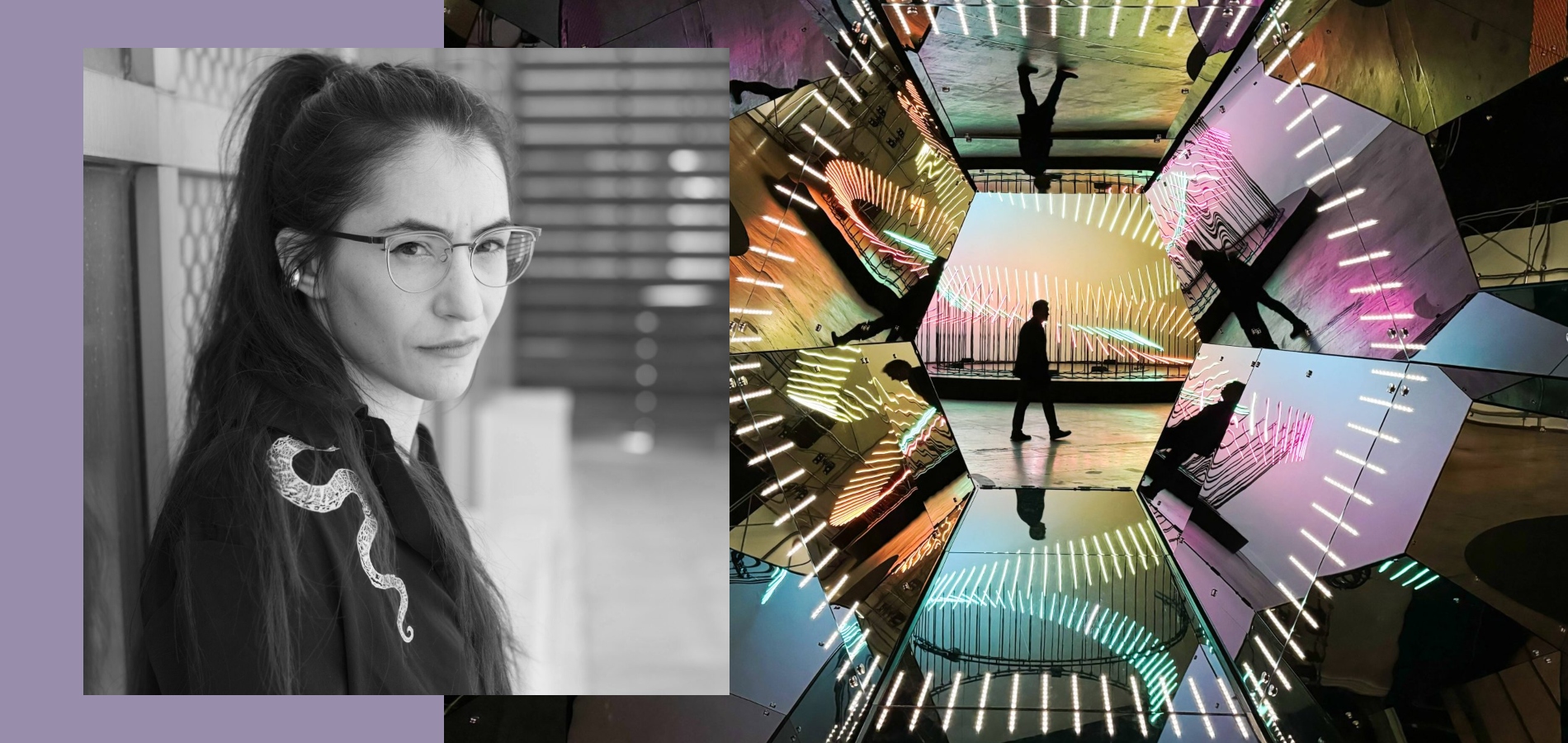
By Katerina Parri
“What gives me particular satisfaction this year as well is that the works are not explicitly anthropocentric, yet they still speak powerfully and profoundly about the human element.”
In 2007, the International Digital Arts Festival of Greece, the Athens Digital Arts Festival, took place for the first time at Technopolis. Back then, it was called the Athens Video Art Festival, and the badge with its logo still remains pinned on the denim jacket I was wearing when I first “encountered” this very distinctive and forward-thinking festival. Since its inception in 2005, the Athens Digital Arts Festival has been the largest and longest-running festival dedicated to digital arts. Over the years, it has evolved and changed locations, but in its 22nd edition this year, it returns for four days to Technopolis of the City of Athens.
This year, the leading theme is META–MORPHOSIS, conceived as a journey into a world of change and transformation, with works that blur the boundaries between art, technology, and science, inviting us to discover and experience them.
ADAF 2026 will feature Installations, Video Art, Animation, AR/VR/XR, Performances, Music, Workshops, Talks, Web Art, Digital Image, Games, and ADAF Kids. Through the lens of “META–MORPHOSIS,” its main goal is to highlight how everything around us evolves, and how these changes are integrated into or influence our daily lives. Elli-Anna Peristeraki has been the curator of the Athens Digital Arts Festival for the past ten years, and as she shared with elculture, ADAF has now become a significant part of her identity. I spoke with her about this “journey” of curating, the challenges it entails, the changes she has observed in audiences in relation to their familiarity with technology, and of course, the highlights of this year’s program:
This year, the key word for the 22nd Athens Digital Arts Festival is “META–MORPHOSIS.” Tell us how you arrived at this theme and how it will unfold in this year’s program.
This theme emerged from our need to open a meaningful dialogue around the environmental issues of our time. As early as last year, we began raising questions about our relationship with the natural environment–both with our audience and with the artists we collaborate with–wondering what role art can play in this context. Reflecting on the profound changes taking place both in the natural landscape and in our daily lives–under the pressure of the climate crisis and the increasingly intense presence of technology–we arrived at the theme of transformation. A theme that asks precisely what is changing and what a “post-” world might look like after undergoing all these shifts.
We are living in the era of the AI boom, and it is important to pause and consider this. A simple question to an AI system—something we do without a second thought, often out of everyday curiosity–can consume up to 1.75 Wh of electricity, roughly equivalent to charging a mobile phone for 30 seconds. The cooling of data centers for that same query can correspond to the consumption of up to 30 ml of water. These are not merely technical details; they are issues that concern all of us, yet we rarely consider them in our daily lives. Digital art has the unique ability to address and comment on these realities in both creative and self-reflective ways. There are voices within the artistic community that engage with these issues in deep and meaningful ways. The theme META–MORPHOSIS, therefore, aims to create space and narrative for these works, bringing them into dialogue with the audience and prompting these questions.
What criteria and key axes guided your selection of this year’s program?
The selection of the program is always based on a set of criteria that operate simultaneously: the aesthetic value of the works, their relationship to the theme, the so-called “wow factor,” as well as a balanced representation of both established artists and emerging creators. It is also extremely important for us to give a platform to the Greek scene to showcase its work, so we aim for the best possible representation of both Greek and international artists.
Another key criterion is the use of a wide range of cutting-edge technologies. It is a multifaceted and by no means easy process-the majority of works submitted through the open call are of high quality and value, yet the exhibition space and time are limited. We always begin with an initial review of all submissions and then move into collective discussion: what similarities and differences we identify in the artists’ concerns, and how these intersect-or diverge-from our own regarding the theme.
Through this process, the narrative of the exhibition gradually takes shape, in an effort to approach the theme as comprehensively as possible. It is a process that moves between what we believe should be presented and what is currently preoccupying the artistic community. This year’s works have been selected specifically to serve our narrative around transformation, with a particular focus on environmental issues.
As the festival once again takes place at Technopolis, the buildings we activate are autonomous and host one or more categories, so each building unit has a slightly different focus-while always maintaining transformation as a common axis.
The central installation exhibition in the Machine Works unfolds as a narrative: from human transformation to the transformation of nature-of trees, of water-placing at its center a work about migratory flows of both humans and aquatic beings, while also addressing the transformation of space as something more transcendental.
Our screenings function as a contemplative space on transition-not only as a change of form, but as an ongoing process of reshaping perception, memory, and existence within an environment that is constantly transforming, both ecologically and technologically. Meanwhile, VR/AR/XR works encourage viewers to experience transformation as a dynamic condition of coexistence between humans, technology, and environment, where perception, memory, and the very experience of “being” are continuously redefined.
There is, of course, also space for students and academic institutions from Greece and abroad, who bring their own unique perspective to the theme, exploring how the new generation of artists experiences this condition. All other categories follow with the same coherence.

You have been part of the Athens Digital Arts Festival for many years. What are the challenges of curating this largest and longest-running festival for digital arts?
This year marks ten years for me with the festival, and it is a great honor to be where I am–having had the opportunity to collaborate with people and artists through this platform for so many years. The challenges are many, because such an undertaking has a wide reach and is demanding on multiple levels. The greatest responsibility of curating is that it is, by its very nature, a political act. The decision to highlight one work over another, and the way these works are combined into a narrative, constitutes a form of public discourse.
Therefore, the choice of theme, works, and narrative line carries significant weight–and the greater the reach of a festival, the greater the responsibility. This is a personal challenge for me, as well as for all members of the curatorial team. We work very closely together, operating collectively at all levels, following extensive and meaningful discussion. The truth is that everyone who has been, and continues to be, part of our team shares a common passion, common concerns, and consequently a shared vision–almost organically, without this necessarily being the intention–each person contributing something essential to the whole, shaped by their own individuality.
The second major challenge for us is the space. What kind of space can host and serve our vision? The works are often deeply spatial, so where you construct an experience is of tremendous importance. Santa Rosa had one kind of philosophy–a unified building with a more fluid transition from one theme to another–whereas Technopolis offers a different one, with its distinct buildings and courtyard, allowing you the space to “wash off” one experience before entering the next. Over the years, we have moved through many buildings across Athens, activating different parts of the city each time–because we embrace change, we enjoy discovering, and we are drawn to the transformation of a space into something entirely different. This year, we chose to return to Technopolis, which has proven to be ideally suited to what we want to achieve.
Another significant challenge is the practical one. How do you secure the resources needed to turn a vision into reality? Cutting-edge technologies are a rather costly medium, and in order to bring to life what we imagine, we require resources. As a result, we–and often the artists we aim to support–are sometimes forced to make small compromises. It may sound reasonable or even cliché, but when you consider that the artistic and creative process is inherently driven by passion, compromise–though we always manage to keep it minimal through great personal effort–becomes a challenge. It ceases to be merely practical and becomes deeply emotional as well.
Have you noticed any changes in the audience’s response in terms of their familiarity with technology?
Clearly, yes. To put it briefly: when I first started working for the festival, it was quite a different era. It was just after the smartphone boom, at the early stages of our relationship with apps, and people encountering, for example, VR would perceive it as something exotic and unprecedented. Today, the audience is much more familiar on all levels-from teenagers who have grown up within these technological advancements and with unlimited, immediate access to the internet, to someone’s “mother” or “grandmother” of my generation, who now use e-banking, e-prescriptions, and have Facebook accounts.
The technological fetishism that once functioned as a self-standing attraction has changed radically. We have moved into an era where, to impress the audience, much more is required than an impressive new medium. In my view, it now requires much more of what we call immersion–that is, placing the viewer in a state that envelops them entirely–or it must rely primarily on the meaning of the work itself, rather than on the magic of technology as such (for example, interactivity, which used to be a primary way of impressing audiences in the past, or the exoticization of a medium such as robots). When we manage to bring all these elements together, we have achieved the goal of a truly successful experience.
What makes this year’s Athens Digital Arts Festival stand out compared to previous editions, and what gives you and your team a sense of satisfaction?
ADAF is something so deeply our own that it is difficult for us to be the most objective judges of it. Each edition is “our child”–and as with any child, it is hard to compare one to another or to say which stands out more, because you love them all equally. Personally, I feel joy with every project we finalize, and I look forward to each one with undiminished excitement.
What gives me particular satisfaction this year is that the works are not explicitly anthropocentric, yet they still speak powerfully and profoundly about the human element. There is a subtle but essential difference between placing the human at the center of the narrative and allowing the narrative to deeply concern the human–without positioning them at the center in a way that excludes everything else.
However, the most distinctive aspect of this year’s edition, for me, is the way the entire exhibition has been curatorially woven together. The narrative touches on all dimensions–the human, the natural, but also the transcendental, identity, space, the environment, the self–always speaking about the same theme with coherence and internal logic. The visitor’s journey does not encounter contradictions or abrupt turns; it unfolds through transitions where one space gently prepares you for the next. The viewer is transported from one state to another, almost as if moving through chapters, deepening within the same journey.
For me, this is also the most difficult thing to achieve in an exhibition that brings together such diverse media, technologies, and artistic languages–and precisely for this reason, I feel a particular sense of pride this year for the work we accomplished as a team.
Could you share some of your personal highlights that you are most looking forward to at the Athens Digital Arts Festival?
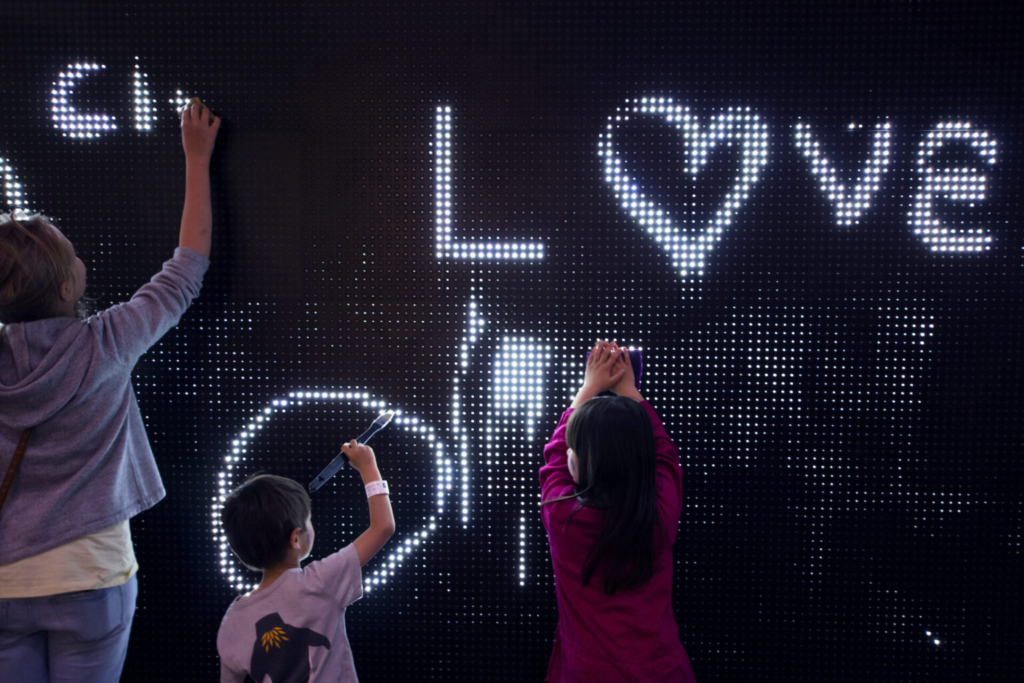
As our little beloved friend from the rainbow says, “I don’t know what to choose first.” And this year, honestly, that feeling is stronger than ever. I’ll start with Waterlight Graffiti by French artist Antonin Fourneau, a work we’ve wanted to bring for many years. It’s a massive surface made up of thousands of LEDs that light up when touched by water–anything liquid becomes a tool of expression: a brush, your fingers, a spray. Inspired by the Chinese art of dishu, calligraphy with water on the ground, the piece is extremely playful, accessible to all ages, and has a rare ability: it makes people smile spontaneously. That immediacy and generosity of the work is something I deeply love.
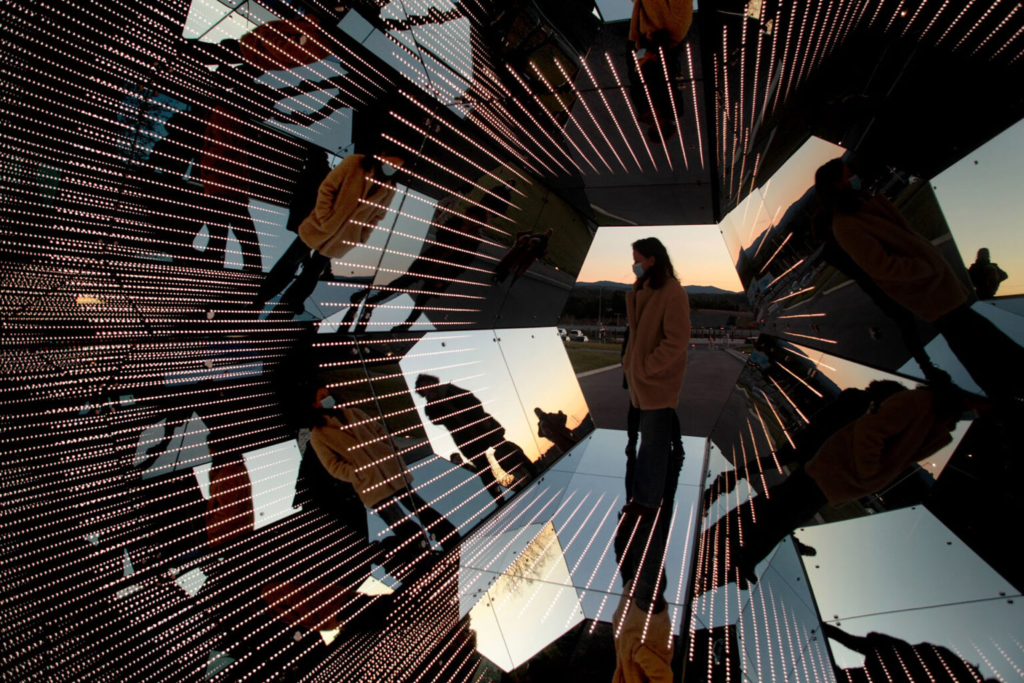
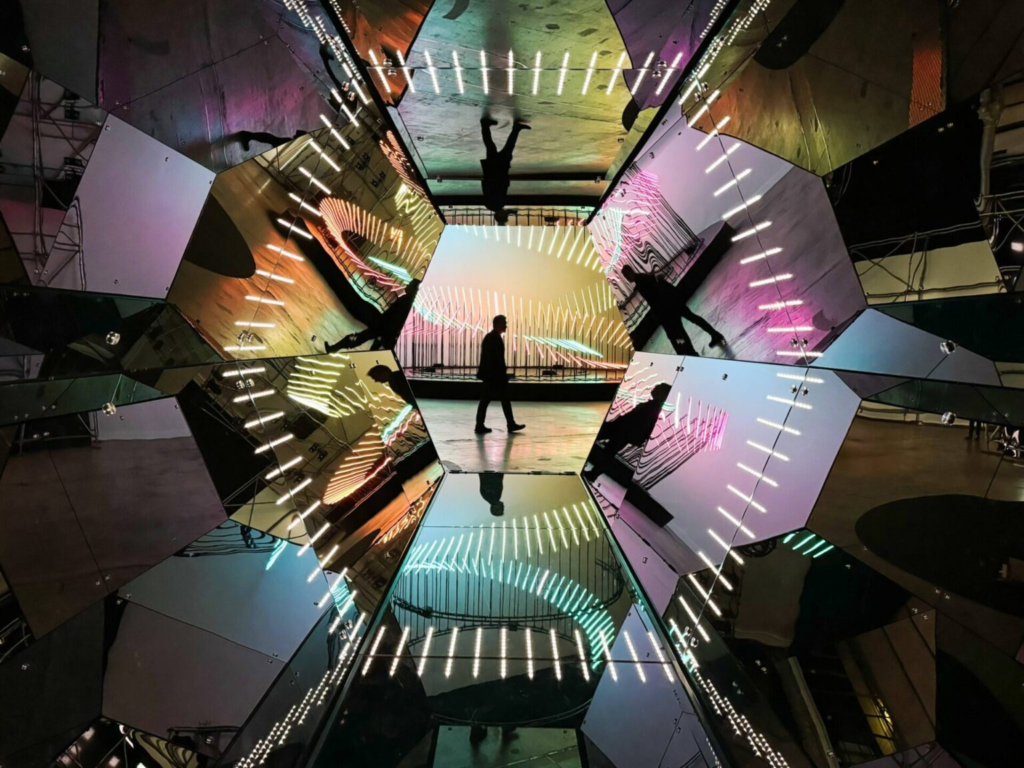
Equally significant, though with a completely different energy, is Passengers by Guillaume Marmin. A monumental capsule-like installation that has traveled widely–and one we had been hoping to bring for quite some time. Visitors are invited to pass through a structure that reveals a vast kaleidoscopic world of mirrors and light, where their reflection multiplies infinitely within a constantly shifting pixel landscape, accompanied by a hypnotic sound environment. It speaks directly to what concerns us: transformation, time, and our relationship with the body and identity in a rapidly changing world.
A project that fills me with particular pride this year is NEOn NERO, an in situ multimedia installation we created together with an exceptional team of Greek artists, in the unique setting of Hadrian’s Aqueduct at Dexameni Square, in collaboration with EYDAP. Its curation and dramaturgy are my own. Having personally selected the artists based on their previous work, I formed an interdisciplinary team spanning sound, image, light, interactivity, scenography, and choreography. The aqueduct is approached not as a static monument but as a living organism–a heart beating beneath the city. The installation draws on real-time water quality data, incorporates 3D scans of the space, and unfolds through four states: the darkness before flow, the emergence of water, the convergence of underground and above-ground worlds, and finally memory as a continuous stream. It’s a unique opportunity–for us as an organization, for me personally as a curator, and for the artists involved—and one that we have all truly enjoyed, resulting in something magical.
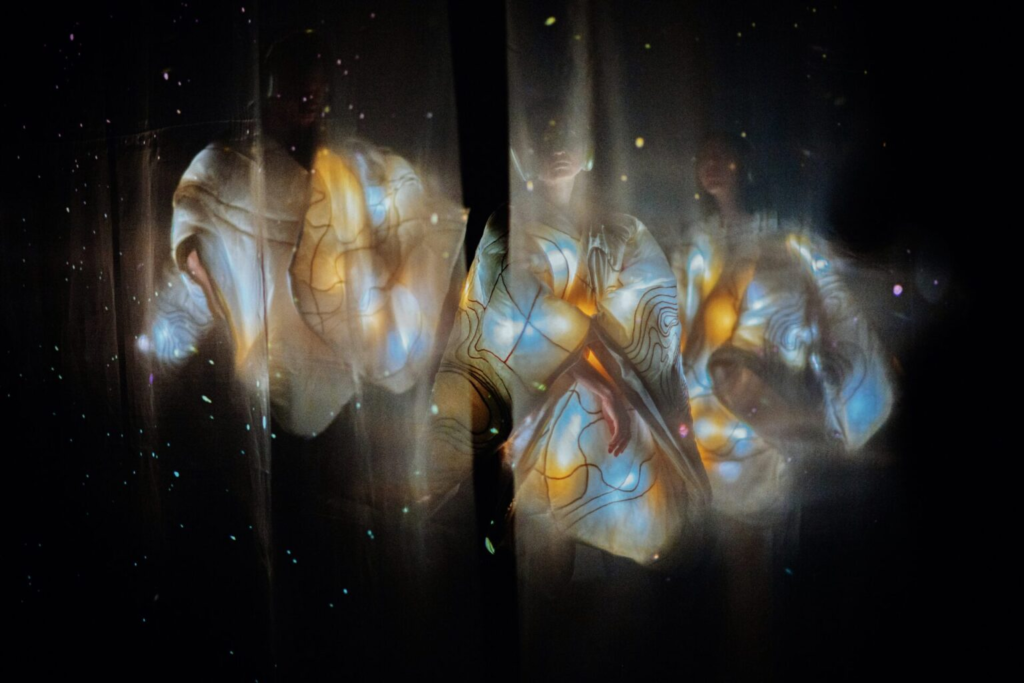
From the immersive experiences in the AR/VR/XR category, I would highlight Ceci est mon cœur by the duo Nicolas Blies and Stéphane Hueber-Blies. A work that premiered globally in Venice in 2024 and was awarded at the Breakthroughs in Storytelling Awards of Columbia University. Viewers wear a connected garment with illuminated embroidery and collectively experience a poetic, sensory story about reconciliation with our bodies–a theme that deeply resonates with this year’s concept.
I’m also very much looking forward to Hippolytus in the Hands of Aphrodite by Yolanda Markopoulou, a work first presented at the Athens Epidaurus Festival. Using innovative AR technologies, it brings to life a performance rooted in something classical, transforming it into something timeless and contemporary. It may not be immediately apparent to someone unfamiliar with the field, but these are highly demanding productions that require deep expertise and a sophisticated merging of classical theatre and new media–something we don’t often see, especially from Greek artists and producers.
From the live performances, I’m particularly happy that we are giving space to the highly significant Greek experimental scene–Tasos Stamou, Phoivos Angelos Kollias, Anna vs June–while also placing them in dialogue with less avant-garde sounds, such as Ody Icons and Papazo. ADAF has always believed that these two cultures complement one another.
This year, we’ve also prepared a musical surprise for the closing–which I won’t reveal just yet–but I know it will be something people will truly enjoy…
What is the overall approach you follow at the Athens Digital Arts Festival regarding the experience of art in combination with technology? How is this “bridge” between the present and the future constructed?
Art and technology may, at first glance, seem like two worlds with little to say to one another. In digital arts, however, one serves the other in a way that is rarely encountered elsewhere. Technology on its own has the ability to create wonders–and when artistic inspiration is added to it, the result is almost always magical. Yet when meaning is also introduced into this mix, that is when true impact begins. Because then you no longer have just an image that impresses–you have an experience being created, and experience conveys meaning in a way no static image can replace.
This is why this form of art collaborates so closely with science–and in doing so, science finds a way to reach a broader audience without needing to be simplified. This relationship also makes digital art an extremely referential tool. It becomes very easy–and natural–to speak through it about issues of technology, about how we envision the future, about what it means to live in a world where technology increasingly defines us. Since technology is what carries us toward the future, art that uses it becomes, by default, a point of contact–a bridge that connects not only the present to the future, but sometimes even to the past.
This bridge is not only aesthetic. It is also critical. We do not simply present what technology can do–we ask what it does to us, to our world, to our natural environment. And I believe this is the role digital art can play: to give us the language to speak about what is coming–before it arrives.
What is the Athens Digital Arts Festival to you personally?
My sweet burden. It has become a significant part of my identity–a platform that has allowed me to express myself creatively in the field I love, and I consider that a great gift. My relationship with digital arts has deep roots. I grew up with a sense of admiration and awe toward science–my grandfather was one of the most prominent Greek physicists of his time, and that left its mark on me.
My need to reconcile that sense of wonder with my artistic nature led me to digital art–and the connection was immediate and profound. The festival came into my life at a moment when I had already begun working in this field with artistic groups. It gave me space, it gave me stimuli, it taught me a great deal–and somehow, it became deeply embedded within me. It comes with great challenges and difficulties, requiring personal effort and resilience in the face of uncertainty. But each time, the outcome rewards you–even when you feel you have reached the very last drop of your energy.
Beyond what it means to me personally, ADAF is something important for the Greek artistic community–a space for growth, inspiration, and visibility. And for its audience, it offers a rare opportunity to encounter works that are remarkable, unique, and rich in meaning. It was the first event to give such a voice in our country, and it is also the one that has endured and persisted over time without losing its pulse, despite the difficulties–and that is of great significance. I believe I will never stop feeling excited about it, as if each time were the first.
A few words about Athens Digital Arts Festival
The International Digital Arts Festival of Greece, the Athens Digital Arts Festival, returns for its 22nd edition as the country’s largest and longest-running festival dedicated to digital arts. For four days, it transforms Technopolis City of Athens into a vibrant digital canvas, bringing together artists from around the world with works that blur the boundaries between art, technology, and science – inviting audiences to explore, experience, and engage.
This year’s central theme, META–MORPHOSIS, unfolds as a journey through change and transformation. The festival reflects on how everything around us evolves, how change is absorbed into–or reshapes–our everyday lives, and creates a meeting point for artists, scientists, technologists, researchers, thinkers, AI entities, and anyone encountering this world for the first time.
From installations, video art, animation, and AR/VR/XR experiences to performances, music, workshops, talks, web art, digital image, games, and ADAF Kids, the programme offers something for everyone–no prior knowledge required.
More than a festival, ADAF is a space of exchange and discovery: a bridge between the present and the future, where technology becomes familiar, ideas circulate freely, and art opens new ways of understanding the shifting relationship between the artificial and the natural world.
No, you don’t need to be a digital expert–the experts will already be there.
ADAF is for everyone: an open invitation not just to observe, but to participate, interact, and experience transformation firsthand.
Info
22nd Athens Digital Arts Festival
META–MORPHOSIS
📅 April 23–26
📍 Technopolis City of Athens