 KATERINA PARRI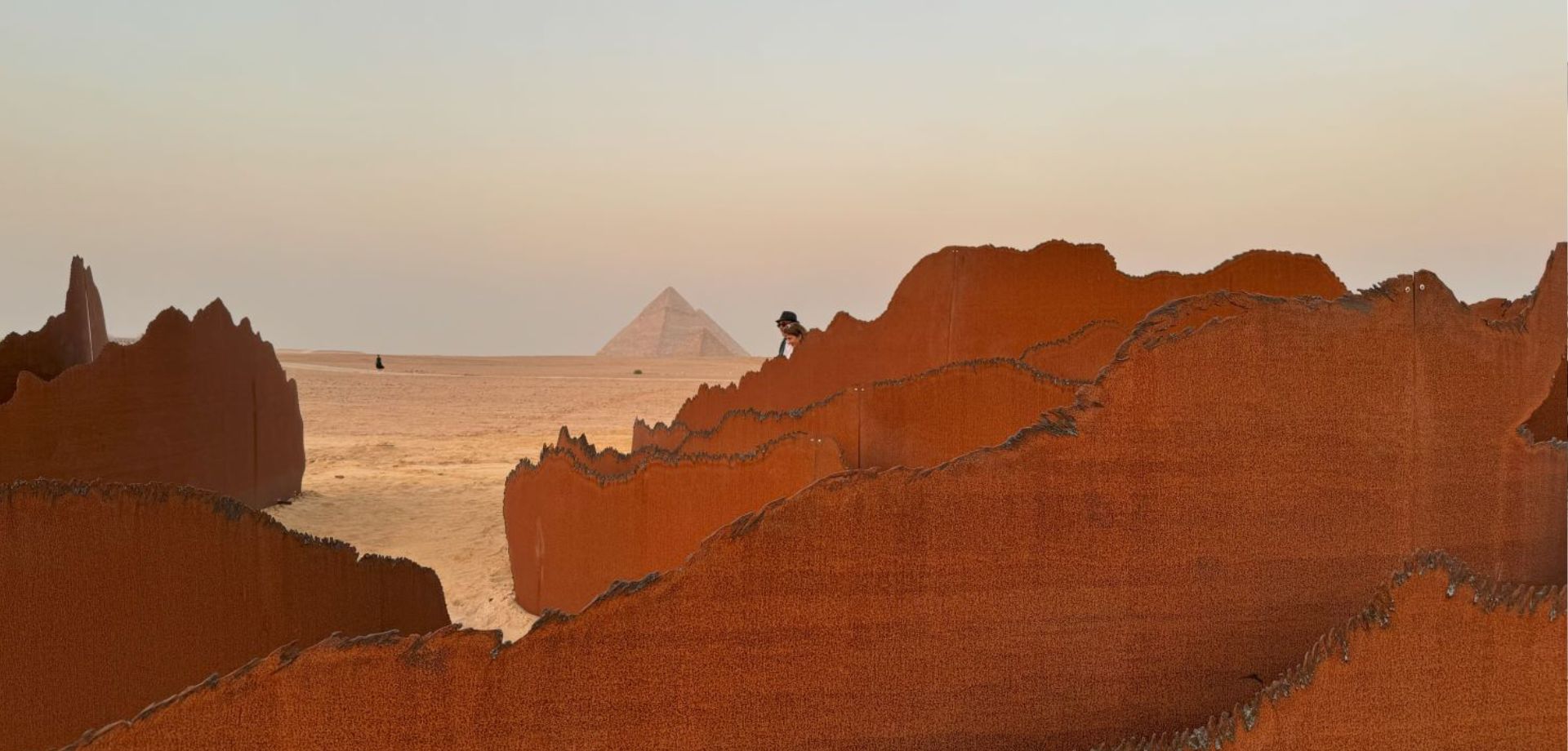
An exhibition that encourages artists and audiences alike to explore universal themes such as continuity, memory, and humanity’s search for meaning.
The “Forever is Now” exhibition in Egypt at the Giza Pyramids offers a unique opportunity to reflect on the complex relationship between contemporary art and the historical significance of archaeological sites. This event, which takes place on the plateau of the 4,500-year-old Giza pyramids, invites artists from across the world to engage with the legacy of ancient Egypt through in-situ, temporary installations that overlay the site with new interpretative layers. As a UNESCO World Heritage Site, Giza’s historical and cultural context deeply influences the reception and significance of each work, bringing up critical questions about the role of contemporary art in such charged, ancient spaces.
The exhibition, set beside the Great Pyramid of Giza—the oldest of the Seven Wonders of the Ancient World and the tomb of Pharaoh Khufu—encourages artists and audiences alike to explore universal themes such as continuity, memory, and humanity’s search for meaning. Artists contributing to “Forever is Now” navigate the rich narratives embedded within the pyramids, using installations that are both ephemeral and reflective, inviting viewers to consider the connections between past achievements and present artistic practices. This interaction between old and new raises questions about the ethical and cultural implications of situating modern art within such historically resonant sites.

In the broader context of archaeological and heritage spaces, similar inquiries arise around the concept of site specificity: How does contemporary art change or influence our understanding of heritage sites? What responsibilities do artists and curators have when engaging with such sites? The critical reflections stemming from “Forever is Now” prompt us to ask, “Who is this art for?” and “What does it mean to bring a contemporary layer into a timeless space?” These inquiries encourage a deeper understanding of site-specific art and its role in bridging the ancient with the modern, fostering a dialogue across millennia that both honors and reinterprets cultural heritage.
Managing the logistics of this event would have required a delicate balance between artistic vision and respect for the archaeological site’s integrity. The team successfully achieved this without disrupting the historical essence of the pyramids, an impressive feat given the complexities of working within a UNESCO-protected area.
Congratulations are indeed fitting for both the organizers and artists involved in the “Forever is Now” exhibition. Creating an art installation at a site as iconic and historically significant as the Giza Pyramids is a monumental challenge—one that requires not only creativity and vision but also sensitivity to the cultural and historical weight of the location. Each artwork in this exhibition bridges vast expanses of time, encouraging viewers to see ancient monuments as spaces that continue to inspire new interpretations and dialogue rather than as relics frozen in time.
The exhibition organizers have undertaken the ambitious task of fostering a dialogue between ancient history and contemporary perspectives, which is no small feat, especially within a UNESCO World Heritage Site. Balancing the artistic freedom of contemporary creators with the need to respect the sanctity and integrity of one of the world’s most revered archaeological sites is an impressive achievement. Artists, too, should be applauded for their adaptability and respect, as they work to create installations that add layers of meaning without overshadowing or detracting from the historical significance of the Pyramids.

This combination of history and contemporary art challenges us to think about how we interact with and interpret heritage sites.
Ik-Joong Kang (South Korea): His work “Four Temples” fuses ancient and modern symbols, representing universal themes of peace and connectivity, using symbols such as the Korean folk song “Arirang” written in multiple languages, underscoring the importance of language and cultural exchange.
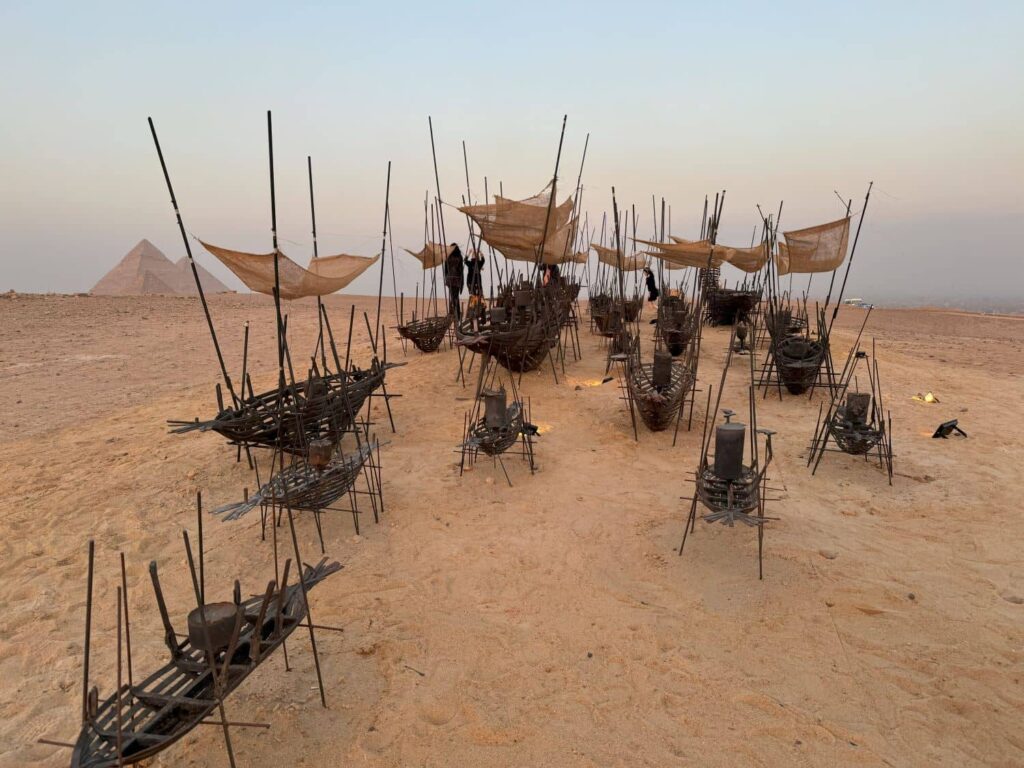
Xavier Mascaró (Spain/Latin America): His piece “Exodus” captures the timeless theme of migration, symbolizing the movement of people and ideas across time through sculptures inspired by Egyptian funerary boats.
Chris Levine (United Kingdom): Known for his light-based works, Levine’s “QUADRIVIUM” combines sacred geometry and cosmic elements inspired by the Great Pyramid of Khufu. This interactive sculpture explores ancient knowledge through the lens of contemporary art and invites viewers to ponder the spiritual energy of Giza.
Federica Di Carlo (Italy): Her installation “I See, I See” draws on Egyptian mythology to explore connections between the viewer, nature, and the sun. Using optical lenses, her work transforms light into a ritualistic experience, embodying themes of cosmic harmony and human perception.
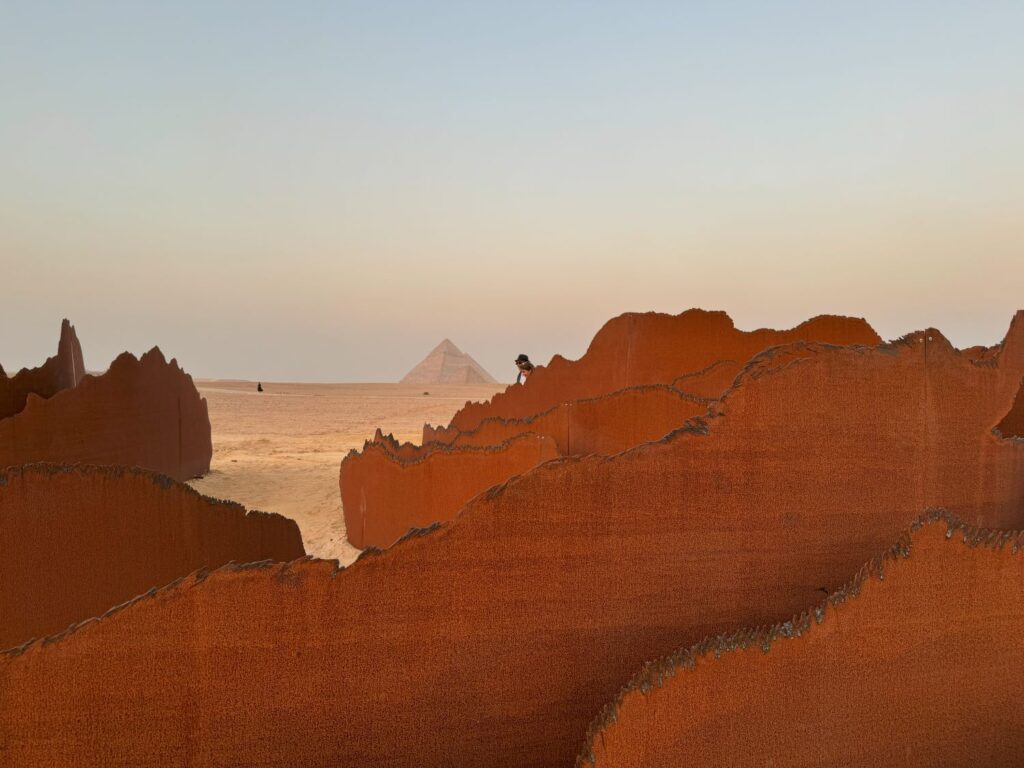
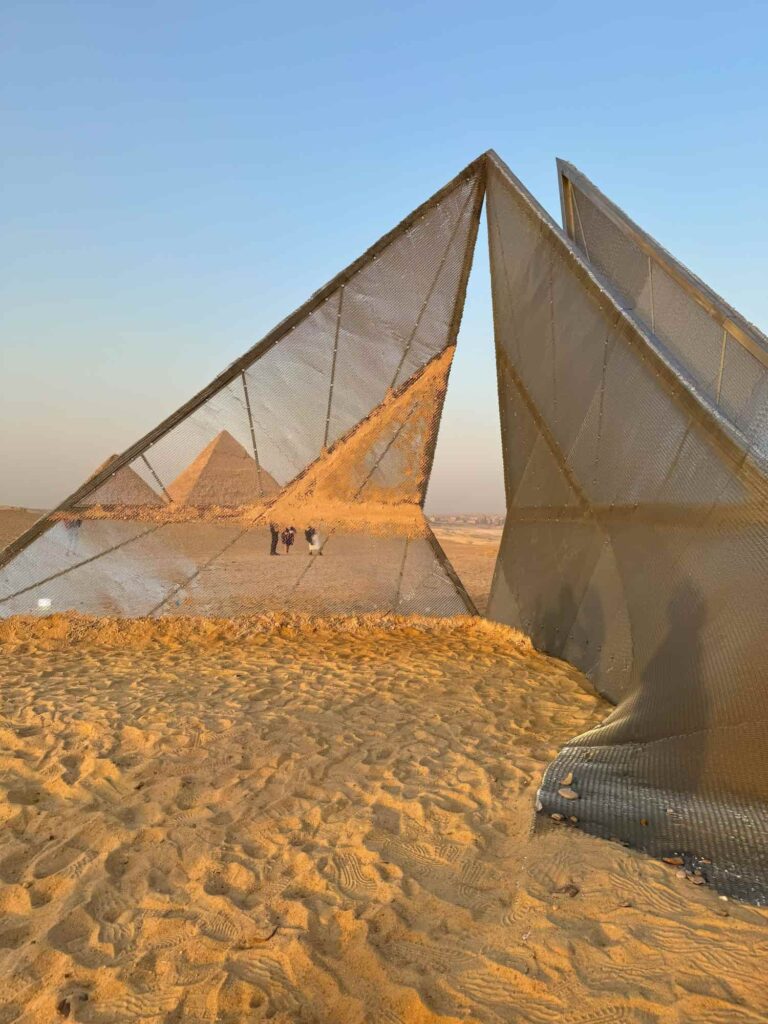
Jean Boghossian (Belgium/Lebanon): In “Desert Waves,” Boghossian uses steel sheets scorched to create a structure reminiscent of the pyramids. This work, inspired by the ancient landscape, invites viewers to experience the intersection of destruction and renewal
Jean-Marie Appriou (France) creates fantastical, large-scale sculptures using materials like bronze and glass. His work, showcased at major venues like the Louvre and the Fondation Louis Vuitton, often explores themes of transformation and temporality, as seen in his clay boat piece, Vessel of Time, inspired by Egyptian solar barques and the passage across life stages.
Khaled Zaki (Egypt) draws from ancient Egyptian and Italian Renaissance influences. His sculpture The Race, featuring chariot wheels and racing horses, represents human innovation and resilience. Zaki’s work is known for its symbolic commentary on historical narratives and modern societal structures.
Luca Boffi (Italy), an artist and farmer, incorporates his environmental philosophy into public space art. Through installations such as Monochrome RGB, he investigates grids and landscapes, connecting the architectural and organic, emphasizing shared memory, and engaging community narratives.
Marie Khouri (Lebanon/Canada) combines modernist design with emotional depth, inspired by her Egyptian heritage. Her installation I Love, first shown at the Vancouver Art Gallery, communicates messages of peace and unity through Arabic calligraphy and flowing forms that bridge cultural traditions.
Nassia Inglessis (Greece) uses kinetic sculptures to challenge the static nature of modern architecture. Her installation Liquid Solid draws from Egyptian architectural wisdom, exploring themes of impermanence and adaptability, and creating a bridge between ancient techniques and future technologies.
Shilo Shiv Suleman (India) uses art as a means of social justice, often engaging with marginal communities. Her interactive installation Padma, inspired by the Egyptian and Indian lotus, uses biofeedback to visualize viewers’ heartbeats, symbolizing rebirth and unity across cultures.
Jake Michael Singer (South Africa) explores myth through large-scale installations. His piece We Will Meet Again in the Sky reflects Egyptian beliefs about birds as symbols of transcendence. It pays homage to Bennu, an Egyptian deity linked to rebirth, and celebrates the unity and autonomy in nature’s rhythms.
These artists merge cultural heritage with contemporary narratives, reflecting on humanity’s timeless connection to nature, spirituality, and technology. Their art is not only a tribute to ancient practices but also a profound statement on modern resilience and communal identity.
“Forever is Now” strategically seeks to bridge cultures and connect artists with local communities, making contemporary art accessible to diverse audiences, including students and artisans. Through its themes of unity, history, and the transformative power of storytelling, this edition of “Forever is Now” pays homage to Egypt’s heritage and reinforces the global continuity of art as a medium for understanding and evolution.
Info
Forever is Now.04 | Venue Great Pyramids of Giza
From 24 October, 2024 – 16 November, 2024